


Adaptive Reuse in Riverside: Turning Old Buildings into Modern Offices
Adaptive reuse is transforming the way cities like Riverside approach commercial real estate. Instead of tearing down older buildings, adaptive reuse repurposes them into modern, functional office spaces that meet today’s business needs. This approach preserves architectural character, reduces construction waste, and often accelerates project timelines compared to building from scratch.
For property owners and investors, adaptive reuse offers a unique opportunity to revitalize underutilized properties while creating offices that attract tenants seeking contemporary amenities and efficient layouts. By combining historic charm with modern systems, these projects deliver both aesthetic appeal and long-term financial value, making adaptive reuse an increasingly popular strategy in Riverside’s evolving commercial market.
Quick Answer:
- What it is: Converting underused or historic buildings (like old citrus packing houses or warehouses) into functional modern offices
- Why it matters: Saves 16% on costs, takes 17% less time than new construction, and preserves Riverside's character
- Key benefits: Lower vacancy rates, unique character that attracts tenants, sustainability advantages, and federal tax credits up to 20%
- Best candidates: Buildings with high ceilings, open floor plates, and solid "bones"—especially former industrial and commercial structures near downtown or the Metrolink station
The trend is real. By early 2024, nearly 70 million square feet of office space across the U.S. was being repurposed, with conversions more than doubling compared to the previous year. In the Inland Empire, where commercial real estate continues to thrive, adaptive reuse offers a practical solution to rising vacancy rates while celebrating the region's rich history.
Riverside is uniquely positioned for this movement. The city's downtown core features New Formalist architecture, historic citrus packing houses, and brick warehouses that once defined the region's agricultural economy. These structures—many sitting underused—represent untapped potential for businesses seeking office space with character, modern amenities, and a story to tell.
Why adaptive reuse beats new construction:
- Reduces embodied carbon by approximately 75%
- Leverages existing infrastructure and prime locations
- Creates distinctive spaces that generic new builds can't match
- Often qualifies for historic tax credits and sustainability incentives
For business owners, this means competitive lease rates with unique architectural features—exposed brick, soaring ceilings, natural light from oversized windows—that help attract and retain talent. For investors, it means repositioning underperforming assets into high-demand Class A or B office space with shorter development timelines.
The New Wave of Commercial Real Estate: Why Adaptive Reuse is Gaining Momentum
The commercial real estate landscape is dynamic, and nowhere is this more evident than in the rising trend of adaptive reuse. Nationwide, office vacancy rates have sharply increased, with forecasts indicating a significant share of office spaces could remain empty. However, instead of viewing this as a crisis, we see an opportunity. By early 2024, nearly 70 million square feet of office space was already undergoing conversion projects across urban areas in the United States, with completions projected to more than double compared to the previous year. This surge is a direct response to changing work patterns and a desire for more sustainable, character-rich spaces.
Here in the Inland Empire, we’ve observed that commercial real estate remains strong. Yet, even in a robust market, repurposing underused assets is a smart strategy. Adaptive reuse offers compelling advantages that make it an attractive option for both property owners and businesses looking for modern office space.
Beyond environmental stewardship, adaptive reuse often translates into significant cost and time savings. Research consistently shows that conversion projects, on average, cost 16% less and take 17% less time than equivalent new construction. This faster turnaround means businesses can occupy their new spaces sooner, generating revenue and reducing the overall project timeline.
Finally, adaptive reuse plays a crucial role in preserving the unique character of our cities. Old buildings often boast architectural details, robust construction, and a sense of history that new builds simply cannot replicate. By repurposing these structures, we maintain the aesthetic and cultural fabric of our communities, creating memorable spaces that bland, new construction often lacks. This blend of heritage and modern functionality is a powerful draw for businesses seeking a distinctive brand identity and for investors looking to reposition assets into high-demand properties.
Architectural and Design Strategies for Adaptive Reuse in Riverside: Turning Old Buildings into Modern Offices
Transforming older buildings into modern office spaces requires thoughtful architectural and design strategies that respect the existing structure while meeting contemporary needs. In Riverside, many historic buildings feature unique brickwork, timber framing, or decorative facades that add character and visual appeal. Preserving these elements not only honors the city’s architectural heritage but also creates distinctive office environments that stand out in a competitive market.
A key strategy in adaptive reuse is reconfiguring interior layouts to maximize flexibility and functionality. Older buildings often have compartmentalized floor plans that aren’t ideal for modern office workflows. Architects and designers focus on creating open, collaborative spaces, integrating natural light, and improving circulation while maintaining structural integrity. In Riverside, where daylight and energy efficiency are highly valued, optimizing window placement, skylights, and interior glass walls can dramatically enhance occupant comfort and productivity.
Sustainability is another critical consideration in adaptive reuse projects. Reusing an existing building reduces construction waste and the environmental impact associated with new development. In Riverside’s climate, incorporating energy-efficient HVAC systems, high-performance insulation, and upgraded windows helps maintain comfortable indoor temperatures while lowering operating costs. Green design elements such as rooftop gardens or solar-ready roofs can further improve the building’s environmental footprint, appealing to tenants and investors alike.
Finally, integrating modern building systems without compromising historic character is essential. Electrical, plumbing, and IT infrastructure often need significant upgrades to meet today’s business demands. Thoughtful design ensures these systems are seamlessly incorporated, supporting modern office technology, safety codes, and accessibility requirements. When executed effectively, adaptive reuse in Riverside results in office spaces that blend historic charm with modern functionality, delivering long-term value and attracting tenants seeking unique, high-quality work environments.
Navigating Riverside's Regulatory Landscape
One of the most critical aspects of any adaptive reuse project in Riverside is successfully navigating the legal and regulatory problems. This isn't always a straightforward path, but with local expertise, it's entirely manageable.
Here are the key regulatory steps we typically encounter:
- Zoning and General Plan Amendments: Many older buildings are in areas with outdated zoning. Converting an industrial building to an office might require a General Plan Amendment and a Zone Change. This process has been successfully navigated in past projects, setting a precedent for flexibility in urban planning within the city.
- Historic Preservation Guidelines: Riverside's rich history means many potential adaptive reuse sites are designated historic landmarks or fall within Cultural Resources Overlay Zones. Projects involving these buildings often require oversight from the Cultural Heritage Board (CHB) and adherence to specific preservation standards, such as the Secretary of the Interior's Standards for Rehabilitation. This means working with experts who understand how to maintain historical and architectural significance—like original window casings, masonry, or structural elements—while making necessary modern updates. Early consultation with the CHB is essential to align the project vision with preservation requirements.
- Building Codes and ADA Compliance: Older buildings rarely meet today's stringent building codes, especially concerning accessibility (ADA compliance). This requires creative design solutions and careful planning to integrate modern safety and access standards without compromising historic features. We often recommend allowing 30-50% more time for permitting compared to new construction due to the complexities of aligning old structures with new codes.
- Permitting Process (Change-of-Use): A change in a building's function, from warehouse to office, for example, necessitates a change-of-use permit. This process involves multiple reviews and approvals, and early engagement with building officials is crucial to finding compliance pathways that save both historical elements and budget.
- Environmental Review (CEQA): Like many development projects in California, adaptive reuse projects may trigger environmental review under the California Environmental Quality Act (CEQA). This process assesses potential impacts on historical resources, traffic, noise, and air quality. While reusing a building is inherently more sustainable, the change of use can trigger the need for studies and mitigation measures. A thorough initial study can determine the level of review required, and proactive planning can streamline this often-complex process.
The City of Riverside is generally supportive of development that revitalizes its urban core, and they offer resources for small businesses. However, understanding and proactively addressing these regulatory challenges is vital for a smooth project timeline. Variances, especially for elements like parking requirements, are not uncommon and can be successfully negotiated with a well-prepared plan.
The Ripple Effect: Economic, Community, and Environmental Benefits
Investments in commercial and residential development don’t just affect the buildings themselves—they create a ripple effect that impacts the broader economy, communities, and the environment. Thoughtful projects can stimulate local businesses, create jobs, and enhance property values, while also fostering stronger, more connected neighborhoods. Understanding these benefits helps property owners and developers make decisions that deliver long-term value beyond immediate financial returns.
On the environmental side, sustainable design, energy-efficient systems, and smart land use reduce resource consumption, minimize waste, and help communities adapt to climate challenges. When combined with economic and social impacts, these benefits demonstrate how a single development—or even a well-planned renovation—can generate positive outcomes that extend far beyond the property line.
Fueling Economic Growth and Urban Revitalization
Adaptive reuse is a proven engine for economic growth and urban revitalization. By changing vacant or underused commercial properties, we attract new businesses and talent to Riverside, fostering a dynamic business environment. This influx of activity naturally increases property values in surrounding areas and creates both short-term construction jobs and long-term positions within the newly established offices.
The boost in local tax revenue from these revitalized properties and successful businesses helps fund public services and infrastructure. Furthermore, these projects stimulate nearby retail and service sectors, as new employees and visitors frequent local shops, restaurants, and other amenities. We've seen how the presence of thriving commercial spaces, often filled by graduates from Inland Empire colleges and universities, contributes to a vibrant downtown and supports the overall economic health of the region. For investors, these projects represent sound commercial real estate investment strategies, turning obsolete assets into profitable ventures that strengthen the local economy.
The Power of Partnerships and Sustainability in Adaptive Reuse in Riverside: Turning Old Buildings into Modern Offices
The success of adaptive reuse projects often hinges on strong public-private partnerships and meaningful community engagement. The Cheech Marin Center, for example, was a testament to how collaboration between public entities and private individuals can achieve ambitious revitalization goals. Such partnerships can leverage diverse resources, expertise, and funding to overcome complex challenges.
Beyond economic and social benefits, adaptive reuse is a cornerstone of achieving sustainability goals. By reusing existing structures, we significantly reduce construction waste and lower the embodied carbon associated with new building materials and processes. Projects that prioritize sustainability can also earn valuable certifications, such as LEED, further enhancing their appeal and demonstrating a commitment to environmental responsibility. This focus on sustainability demand is not just a trend; it's a fundamental shift in how we approach urban development, ensuring that our growth is both prosperous and planet-friendly. Our team at Stance Commercial Real Estate understands the importance of these elements and how they contribute to the long-term success of adaptive reuse projects, offering resources for small businesses looking to integrate sustainable practices.
Frequently Asked Questions about Adaptive Reuse in Riverside
We often get questions about the practicalities and benefits of adaptive reuse buildings. Here are some of the most common inquiries we address:
What are the primary financial incentives for adaptive reuse projects?
There are several compelling financial incentives that make adaptive reuse particularly attractive:
- Federal Historic Tax Credits: For certified historic structures, developers can receive a substantial 20% federal tax credit for rehabilitation expenses. This can significantly offset project costs.
- Section 179D Deduction: This incentive offers up to $1.88 per square foot for energy-efficient renovations, encouraging sustainable upgrades.
- PACE Financing Programs: Property Assessed Clean Energy (PACE) programs provide long-term funding for energy and water efficiency improvements, often secured by a property assessment rather than traditional loans.
- Local Incentives: Many cities, including Riverside, may offer local incentives such as property tax abatements, density bonuses, or expedited permitting processes to encourage adaptive reuse and historic preservation.
- Grants for Historic Preservation: Various grants are available from state and national organizations to help fund the preservation of historic properties.
These incentives, combined with the inherent cost savings compared to new construction, make adaptive reuse a financially savvy choice for many investors and businesses. Our team can help small businesses steer these opportunities and access available help.
What types of old buildings in Riverside are best suited for conversion into modern offices?
The best candidates for adaptive reuse typically share certain characteristics:
- Former Industrial Buildings: Old citrus packing houses, brick warehouses, and light manufacturing facilities are often ideal. They usually feature robust construction, high ceilings, large, open floor plates, and plenty of natural light—all highly desirable traits for modern, flexible office layouts.
- Underused Retail Buildings: Larger, older retail spaces, especially those with good street frontage and architectural character, can be reimagined as dynamic office environments.
- Older Class B and C Office Buildings: Many aging office buildings, while perhaps no longer suitable for their original purpose or attracting tenants at competitive rates, have solid "bones" and prime locations. With strategic renovations, these can be transformed into vibrant, modern Class A or B office spaces.
The key is to look for structural integrity, generous ceiling heights, and opportunities for abundant natural light and ventilation. These elements provide a flexible canvas for contemporary office design.
What are the biggest challenges associated with adaptive reuse projects?
While highly rewarding, adaptive reuse projects present unique challenges that require careful planning and expertise. The most common hurdles include:
- Unforeseen Structural Issues: Old buildings can hide surprises. What appears structurally sound on the surface may reveal deteriorated foundations, hidden water damage, or outdated structural systems once demolition begins. Comprehensive due diligence, including structural engineering assessments and materials testing, is crucial to budget for these potential 'unknowns.'
- Hazardous Materials Abatement: Buildings from certain eras often contain hazardous materials like asbestos, lead-based paint, or PCBs. Identifying and safely removing these materials is a regulatory requirement that can add significant time and cost to a project.
- Code Compliance and Modernization: Bringing an old structure up to modern building codes for seismic safety, fire suppression (sprinklers), energy efficiency, and ADA accessibility is one of the biggest tasks. It often requires creative engineering and architectural solutions to integrate new systems without compromising the building's historic character.
- Navigating the Permitting Labyrinth: As mentioned, the regulatory path for adaptive reuse is more complex than for new construction. It involves multiple agencies, potential historic reviews, and change-of-use permits, leading to longer permitting timelines.
Successfully overcoming these challenges hinges on assembling an experienced team—including architects, engineers, and contractors with a proven track record in adaptive reuse—and building a realistic budget and timeline that accounts for potential contingencies.
How does adaptive reuse impact the local commercial real estate market?
Adaptive reuse has a profoundly positive impact on the local commercial real estate market in Riverside:
- Reduces Vacancy Rates: By repurposing obsolete or underperforming inventory, adaptive reuse directly helps stabilize or lower office vacancy rates, making the overall market healthier.
- Creates Unique, High-Demand Spaces: These projects convert generic or outdated spaces into distinctive, character-rich offices that often command premium rental rates. They fill a niche that new, cookie-cutter construction cannot, creating high-demand Class A or B office spaces.
- Attracts Diverse Tenants: Businesses, especially those in creative, tech, or design fields, are often drawn to the unique aesthetic and collaborative potential of adaptive reuse spaces. They offer a strong brand identity that helps attract and retain talent.
- Improves Urban Fabric: Successful adaptive reuse projects contribute to the revitalization of neighborhoods, making downtown Riverside and other commercial districts more vibrant and attractive places to work and visit.
How Stance CRE Can Help You
Adaptive reuse strengthens Riverside's commercial real estate guide by diversifying its office offerings, improving market efficiency, and fostering a more dynamic urban environment.
The movement of turning old buildings into modern offices is more than just a trend; it's a strategic imperative for our city's commercial future. We've explored how this approach brings significant economic benefits, revitalizing urban areas, attracting new businesses, and creating jobs. Environmentally, it's a champion of sustainability, drastically reducing waste and carbon emissions compared to new construction. Culturally, it preserves the unique architectural heritage that tells Riverside's story, giving our city character and soul.
For investors and business owners alike, the opportunity is clear. Adaptive reuse offers a pathway to acquiring unique, high-value commercial properties with shorter development timelines and access to valuable financial incentives. It's about seeing potential where others see obsolescence and changing it into a thriving asset. For those looking to acquire like a pro: your guide to commercial property ownership in this evolving landscape, the advantages of adaptive reuse should be front and center.
As the Inland Empire continues to grow, adaptive reuse will play a pivotal role in shaping the future of work, creating vibrant, inspiring, and sustainable office environments that meet the demands of a modern workforce. As local experts in the Riverside market, the team at Stance Commercial Real Estate is uniquely positioned to help you identify and steer these unique opportunities. Whether you're looking to invest in a transformative project or find the perfect character-rich office space for your business, we are here to guide you.
Ready to explore the possibilities of adaptive reuse for your business or investment portfolio in Riverside? Leasing office space in Riverside starts with a clear strategy and a partner who understands the local market and regulatory landscape. Contact Stance Commercial Real Estate today to discuss how we can help you find or create your next exceptional commercial space.

How E-Commerce Growth Is Shaping Industrial Real Estate
Why E-Commerce Is Changing the Industrial Real Estate Landscape
E-commerce has become one of the most powerful forces driving the evolution of industrial real estate. As online shopping becomes deeply woven into everyday consumer behavior, its influence on physical infrastructure continues to expand. Today, e-commerce accounts for nearly 19% of core retail sales—a share that continues to rise—and requires about three times more warehouse space per dollar of sales than traditional brick-and-mortar retail.
This fundamental shift is redefining logistics and development strategies across the industry. Developers and investors are prioritizing larger, taller, and more technologically advanced facilities designed for automation, robotics, and rapid fulfillment. At the same time, proximity to consumers has become a key competitive advantage, fueling demand for last-mile distribution centers in and around dense urban markets. Together, these trends are reshaping the landscape of industrial real estate and setting the pace for the next decade of growth and innovation.
The core impacts of e-commerce on industrial real estate are multifaceted and profound:
- Massive Space Demand: The scale is immense. Every $1 billion in new e-commerce sales generates an estimated demand for 1.25 million square feet of new distribution space. As online sales grow by hundreds of billions annually, the need for logistics real estate expands exponentially.
- Warehouse Evolution: The modern warehouse bears little resemblance to its predecessors. New facilities are significantly larger and taller, with clear heights often exceeding 40 feet to maximize cubic storage capacity. This verticality is essential for accommodating complex racking and automated systems.
- Strategic Location Shift: The consumer expectation of same-day or next-day delivery has made proximity to the end customer paramount. This is pushing warehouse development from remote, rural areas to infill locations closer to major population centers.
- Rise of Specialized Facilities: The e-commerce ecosystem has spurred demand for a variety of specialized asset types, including micro-fulfillment centers (MFCs) for rapid urban delivery, temperature-controlled cold storage for online groceries, and vast reverse logistics hubs to process a high volume of returns.
- Pervasive Technology Integration: Demand is soaring for facilities built to support automation. This includes robust power infrastructure, super-flat floors for robotics, and high-speed data connectivity for AI-driven inventory management systems.
To meet this surge, the market has responded with a historic construction cycle. Between 2022 and 2023 alone, over 1.1 billion square feet of new industrial space was delivered in the U.S. Despite this significant influx of new supply, national industrial vacancy remains structurally low at 6.7%, a testament to the powerful underlying demand. This tight market has fueled strong rental growth, with average rents rising 7.2% year-over-year. In prime logistics markets like Southern California's Inland Empire, the effects are even more pronounced, with rent growth reaching an incredible 12.1% year-over-year, highlighting the irreplaceable role of coastal logistics hubs in the global supply chain.
The Surge in Demand: Why E-Commerce Needs More (and Different) Space
The explosive growth of online retail is the single most powerful force changing the industrial real estate sector. It’s no longer just about needing more warehouses; it’s about needing smarter, faster, and more strategically located facilities designed for an entirely different supply chain model. With e-commerce requiring, on average, three times more logistics space than traditional retail to generate the same amount of sales, the pressure is on for investors, developers, and businesses to adapt to this new reality.
The 3x Space Multiplier
Unlike traditional retail, where goods ship on pallets in bulk to a few dozen store locations, e-commerce involves picking, packing, and shipping millions of individual orders directly to customers' doorsteps. This direct-to-consumer (D2C) model requires a vastly larger physical footprint for several critical reasons:
- Individual Order Fulfillment: The process for a single online order is far more complex than a bulk shipment. Each item must be individually picked from a shelf, scanned, transported to a packing station, boxed with dunnage, labeled, and sorted for shipment. This granular process requires extensive networks of conveyors, numerous packing stations, and large staging areas for outbound parcels, all of which consume significant square footage.
- Wider Product Variety: Online stores offer a seemingly endless aisle, leading to a massive proliferation of unique products, or Stock Keeping Units (SKUs). A large physical retail store might carry 50,000 SKUs, but a major e-commerce fulfillment center can easily house over a million. Storing this incredible variety requires more space and sophisticated inventory management systems to ensure items can be located and picked efficiently.
- Returns Processing (Reverse Logistics): Handling the high volume of online returns—often called the "shadow supply chain"—is a massive, space-intensive operation. E-commerce return rates can be as high as 30%, compared to under 10% for brick-and-mortar. Each returned item must be received, inspected, graded, and then either restocked, refurbished, or liquidated. This entire process requires dedicated space equivalent to a second, parallel warehouse operation.
This isn't just a theoretical multiplier. The market data is clear: an increase of $1 billion in e-commerce sales translates to a tangible need for approximately 1.25 million square feet of new distribution space.
Bigger, Taller, Faster: The New Warehouse Standard
To accommodate the complexity and velocity of e-commerce, the very design of industrial facilities is undergoing a dramatic transformation. Warehouses are evolving in their physical characteristics to maximize efficiency and throughput.
- Increased Clear Heights: Vertical space is just as important as floor space. To maximize storage density, new warehouses feature soaring clear heights, with 40 feet becoming the new standard, a significant increase from the 28-32 feet common just a decade ago. This allows for taller racking systems and multi-level automated mezzanines. The average new warehouse has increased by 3.7 feet in height compared to facilities built between 2002 and 2007.
- Larger Building Footprints: The average new warehouse has also grown by over 108,000 square feet in size compared to the same period, with facilities now regularly exceeding 1 million square feet. These massive buildings, especially prevalent in logistics hubs like Southern California's Inland Empire, are needed to house extensive inventory and complex sorting systems under one roof.
- Efficient Goods Flow: Modern facilities are designed as finely tuned engines for moving goods. This includes a higher ratio of dock doors to facilitate rapid loading and unloading, expansive truck courts for maneuvering, and dedicated trailer parking (yard space), which is critical for staging inbound and outbound freight. The interior is designed for the rapid movement of goods, often incorporating advanced conveyor systems, robotics, and super-flat floors required for specialized machinery.
This evolution is a testament to why Industrial Real Estate: Why Warehouses Are Outperforming Other Sectors. The relentless demand for industrial space that can handle high volumes at high speeds is paramount in the age of e-commerce.
How E-Commerce Growth Is Shaping Industrial Real Estate Locations and Design
Consumer demand for near-instant delivery has forced a radical rethinking of the entire supply chain. Proximity to the customer is now the paramount concern, driving a wave of innovation in where industrial facilities are located and how they are designed to function.
The "Urbanization of Warehousing": The Race for the Last Mile
Gone are the days when warehouses could be located exclusively in distant, rural areas. The promise of same-day or one-hour delivery has shifted the strategic focus to sites much closer to dense population centers—a trend known as the "urbanization of warehousing." The primary driver is last-mile delivery, the final and most expensive leg of a product's journey from the warehouse to the customer's doorstep. To shorten this leg and reduce transportation costs, companies must position inventory as close to consumers as possible.
This has fueled the rise of micro-fulfillment centers (MFCs). These are smaller (10,000 to 50,000 square feet), highly automated facilities strategically placed within or on the edge of urban areas, enabling rapid order processing and dispatch. To create these urban logistics hubs, developers are pursuing creative urban infill projects. This often involves navigating significant challenges, such as high land costs, complex zoning regulations, and community opposition (NIMBYism), but the payoff in delivery speed and efficiency is substantial. A key trend is the repurposing of obsolete commercial properties, such as vacant big-box retail stores. These locations are ideal as they are already situated in prime commercial corridors near population centers and have existing infrastructure like parking and loading areas, a convergence that ties into The Future of Mixed-Use Developments: Live-Work-Play Spaces in Demand.
The Rise of Specialized Facilities and Reverse Logistics
Beyond general warehousing, e-commerce has created explosive demand for highly specialized facilities. A major driver is the management of product returns. Online purchases have a staggeringly high return rate of nearly 30%, compared to less than 10% for in-store purchases. This has created an entire sub-industry and asset class dedicated to reverse logistics—the complex process of moving goods from customers back to the seller or a third-party processor.
These reverse logistics centers handle the labor-intensive tasks of inspection, sorting, grading, and repackaging. Because of the operational complexity and unpredictable inflow of goods, these facilities require 15-20% more space than traditional outbound operations. This hidden operational cost of e-commerce translates directly into millions of square feet of additional industrial real estate demand.
Another specialized facility seeing explosive growth is cold storage. The boom in online grocery sales and meal-kit delivery services requires a sophisticated, unbroken cold chain with precise temperature-controlled environments. These cold storage facilities are significantly more expensive to build and operate than standard warehouses due to the need for insulated metal panels, advanced refrigeration systems, and higher energy consumption. However, they command premium rents and attract long-term leases from high-credit tenants.
In land-constrained urban markets, multi-story warehouses are also emerging as an innovative solution. Pioneered in dense Asian and European cities, these facilities are now appearing in the U.S. They maximize vertical space by building up, often featuring truck ramps to allow full-sized tractor-trailers to access loading docks on the second or even third floor. These developments represent key Industrial Development Trends that are reshaping the sector in response to e-commerce pressures.
Adapting to New E-Commerce Models
New retail models that blend the online and offline worlds require highly flexible industrial solutions. Omnichannel retailing, which seeks to create a seamless customer experience across online, mobile, and physical stores, means that logistics facilities must support both direct-to-consumer parcel shipments and bulk replenishment for retail stores from the same inventory pool.
Direct-to-Consumer (D2C) brands are also a growing source of demand. As these brands scale, they are increasingly building their own logistics infrastructure, driving demand for flexible industrial spaces that can accommodate their growth. Many are using hybrid facilities that combine warehouse, office, and sometimes even showroom or content creation space. Even traditional retailers are adapting their supply chains with models like buy-online-pickup-in-store (BOPIS), which requires efficient inventory staging areas within their stores or at nearby micro-fulfillment sites, further evolving Retail Commercial Real Estate strategies.
The Tech Revolution: Automation and AI in the Modern Warehouse
To keep pace with the relentless speed and staggering volume of e-commerce, technology is no longer a luxury but an absolute necessity. Automation, artificial intelligence, and data analytics are the engines driving the efficiency of the modern warehouse. This technological revolution is not only transforming how facilities operate but is also fundamentally influencing their physical design and infrastructure requirements.
How E-Commerce Growth Is Shaping Industrial Real Estate through Automation
The growing pursuit of speed in e-commerce fulfillment has made automation not just beneficial but essential. A single large fulfillment center may now handle hundreds of thousands of individual orders each day—a volume that human labor alone cannot efficiently or accurately manage. This accelerating reliance on advanced technology is fundamentally transforming the industrial real estate landscape, influencing everything from facility design and layout to location strategy and infrastructure investment.
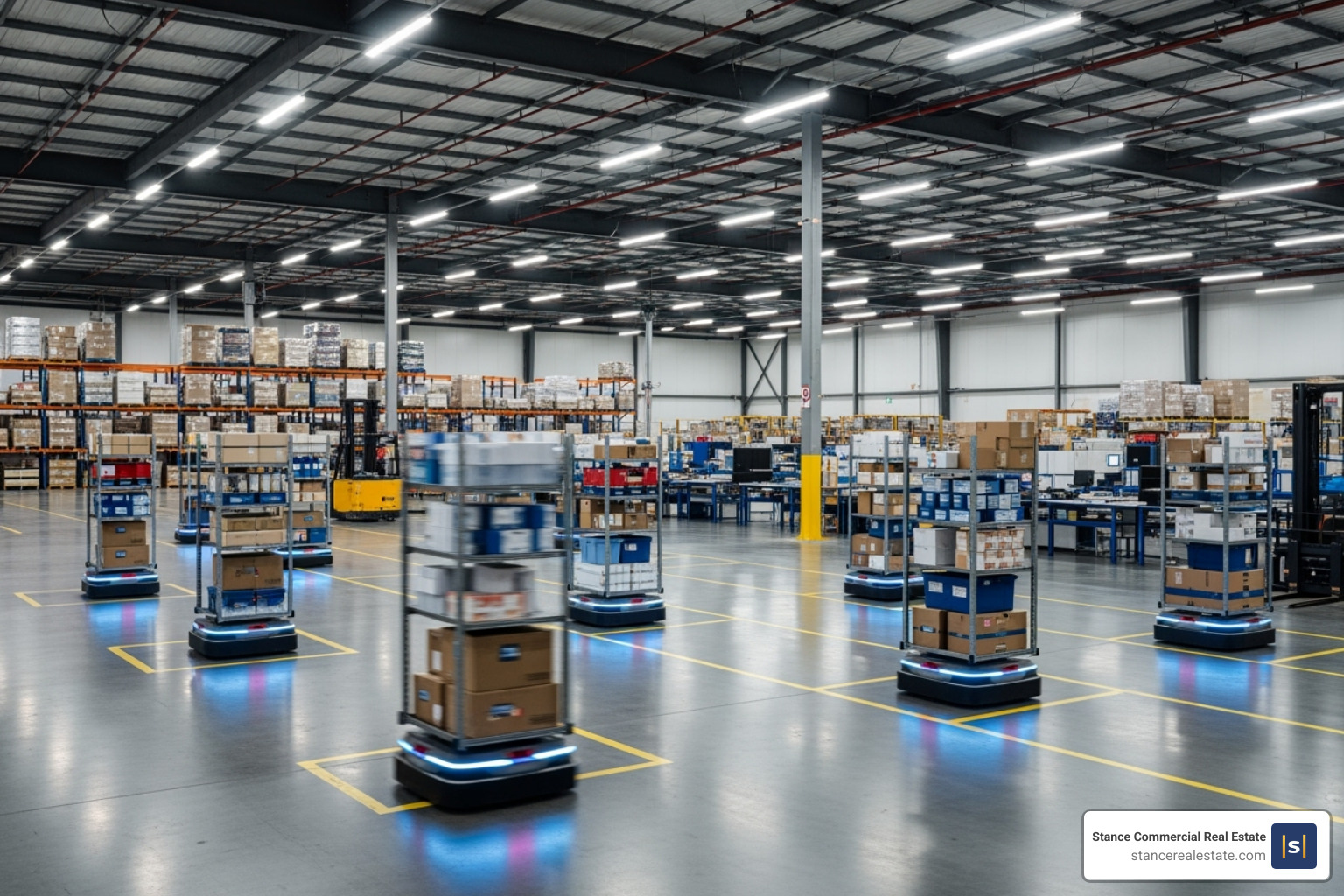
- Robotics and Automated Guided Vehicles (AGVs): Machines are now performing a wide range of repetitive and physically demanding tasks. This includes Autonomous Mobile Robots (AMRs) that bring shelves of goods to stationary human pickers (a "goods-to-person" system), robotic arms that can pick and place individual items, and AGVs that transport pallets and carts throughout the facility. This technology dramatically boosts productivity, reduces human error, improves workplace safety, and helps mitigate the challenges of labor shortages.
- AI-Powered Inventory and Warehouse Management: Sophisticated Warehouse Management Systems (WMS) and Warehouse Execution Systems (WES) are the brains of the operation. Artificial intelligence analyzes vast amounts of sales data to predict demand, optimizing product placement (slotting) within the warehouse to ensure popular items are located for the fastest possible retrieval. AI algorithms also orchestrate the movement of robots and direct human workers on the most efficient picking paths in real-time.
- Automated Sorting Systems: At the outbound stage, high-speed conveyor belts and automated sorting machines are essential. These systems can rapidly scan and direct thousands of packages per hour to the correct loading bay for shipment, making high-volume, direct-to-consumer shipping possible.
This deep integration of automation delivers tangible benefits beyond speed. It leads to significantly reduced long-term labor costs, a critical factor in a tight labor market, and vastly improved order accuracy, which enhances customer satisfaction and reduces the costly process of handling incorrect shipments. Consequently, modern industrial facilities must be designed from the ground up to accommodate these complex systems, requiring sufficient power capacity, robust fiber-optic networks, and perfectly flat floors with high load-bearing capacity.
Smart Buildings, IoT, and Sustainability
Beyond operational automation, e-commerce is pushing the industrial sector toward smarter, more sustainable buildings. These features not only reduce operating costs but also future-proof the investment and appeal to environmentally conscious corporate tenants.
Internet of Things (IoT) sensors are turning warehouses into intelligent, data-rich environments. These sensors can monitor everything from ambient temperature and humidity to the vibration patterns of conveyor motors. This data enables predictive maintenance, allowing facility managers to anticipate equipment failures before they occur, preventing costly downtime and operational disruptions.
Energy efficiency has become a major priority for both developers and tenants. Modern warehouses are increasingly adopting high-efficiency LED lighting with motion sensors, smart HVAC systems, and advanced insulation materials to lower substantial operational costs. Many developers are pursuing green building initiatives and LEED (Leadership in Energy and Environmental Design) certification to attract premium tenants and increase the long-term value and marketability of their properties.
The vast, flat roofs of modern warehouses are ideal for the installation of rooftop solar panels. These solar arrays can generate a significant portion of a facility's energy needs, reducing reliance on the grid and hedging against rising electricity costs. As delivery fleets rapidly electrify, EV charging stations for both employee vehicles and commercial delivery vans are also becoming essential infrastructure. These forward-looking advancements align with the growing Sustainability Demand from corporate occupiers and contribute to the broader Green Real Estate Trends reshaping the entire real estate sector.
Navigating the Market: Challenges and Opportunities for Investors
The e-commerce-driven industrial boom presents a landscape of both robust, sustained demand and significant challenges. For investors and developers, successfully navigating rising costs, land scarcity, and shifting market dynamics is crucial for capitalizing on the sector's immense long-term potential.
Key Challenges in the Industrial Sector
Understanding and mitigating these headwinds is essential for making informed and profitable investment decisions in the current environment.
- Extreme Land Scarcity: Finding well-located, entitled parcels of land near major population centers for last-mile facilities is increasingly difficult and prohibitively expensive. The entitlement process itself—securing zoning changes and permits—can take years and faces growing opposition from local communities concerned about traffic and noise.
- Rising Construction and Material Costs: Global supply chain issues and inflation have led to significant increases in the cost of key building materials like steel, concrete, and roofing components. Tariffs and transportation costs further squeeze development margins, making it harder for new projects to pencil out financially.
- Persistent Labor Shortages: The industrial sector faces a dual labor challenge: finding skilled construction workers to build new facilities and finding operational staff to run the warehouses. This competition for labor is a primary driver behind the push for greater automation within facilities.
- Supply Chain Disruptions: Delays in receiving critical building components, such as electrical switchgear or pre-cast concrete panels, can push project completion dates back by months, increasing carrying costs and delaying rental income.
- Normalizing Vacancy Rates: After years of historically low vacancy, the national industrial vacancy rate climbed to 6.7% in August 2024. This is not a sign of collapsing demand but rather a temporary imbalance caused by a massive construction pipeline delivering new supply faster than it can be absorbed in some submarkets.
- Financial Headwinds: A fluctuating interest rate environment directly impacts the cost of capital for acquisitions and development. Higher Commercial Real Estate Interest Rates can affect project viability, investor returns, and overall market liquidity.
How E-Commerce Growth Is Shaping Industrial Real Estate Investment Opportunities
Despite the challenges, the e-commerce revolution continues to create a wealth of compelling opportunities for savvy investors who know where to look.
- Value-Add Investments: One of the most attractive strategies is acquiring older, functionally obsolete industrial properties and upgrading them for modern tenants. For example, an investor could purchase a 1980s-era warehouse with 24-foot clear heights and invest in raising the roof to 36 feet, adding modern ESFR fire suppression systems, and expanding the truck court. Such upgrades can make the facility viable for e-commerce users and potentially double its rental income.
- Creative Repurposing of Obsolete Properties: Converting former big-box retail stores, defunct shopping centers, or even multi-level parking garages into last-mile delivery hubs is a highly profitable strategy. It leverages prime locations with existing infrastructure while meeting the intense demand for urban logistics space.
- Speculative Development in Core Markets: In markets with proven strong fundamentals, low vacancy, and a diverse tenant base, building new industrial facilities on a speculative basis (without a pre-committed tenant) can be highly rewarding. While it carries higher risk, it allows developers to capture peak market rents upon completion.
- Focus on High-Growth Markets: While the Inland Empire remains a top-tier market with the nation's highest rent growth at 12.1% year-over-year, other markets are also booming. Key logistics hubs to target include Dallas-Fort Worth (a critical central U.S. hub), Phoenix (serving the rapidly growing Southwest), Atlanta (the logistics capital of the Southeast), and the I-81/I-78 corridor in Pennsylvania and New Jersey (serving the entire Northeast megalopolis).
- Specialized Asset Investment: Investing in niche property types can lead to outsized returns due to less competition and specialized tenant needs. This includes developing or acquiring cold storage facilities, which command premium rents; advanced manufacturing centers for reshoring initiatives; or dedicated reverse logistics hubs, which are becoming critical infrastructure for major retailers.
Frequently Asked Questions about E-Commerce and Industrial Real Estate
Below are answers to some of the most frequently asked questions from investors, developers, and business owners about the impact of e-commerce growth on industrial real estate.
How much more space does e-commerce really need compared to traditional retail?
E-commerce operations require, on average, three times more logistics space than traditional retail for the same dollar amount of sales. This "3x multiplier" is a rule of thumb in the industry. The reason is that e-commerce warehouses must perform tasks that don't exist in a traditional retail supply chain. They must store a much wider variety of individual products (SKUs), handle the labor-intensive process of picking and packing every single customer order, and manage a high volume of customer returns, which requires its own dedicated space and workflow. To put it in perspective, every $1 billion in new e-commerce sales creates demand for approximately 1.25 million square feet of distribution space.
What is "reverse logistics" and why is it so important for industrial real estate?
Reverse logistics is the entire process of managing product returns from customers back to the seller or a third-party processor. It's a critical and costly part of e-commerce because online shoppers return items at a much higher rate—nearly 30% for some product categories—compared to less than 10% for in-store purchases. This constant flow of returned goods requires dedicated facilities and highly specific processes for receiving, inspection, sorting, repackaging, and restocking. These operations are less efficient and more chaotic than outbound fulfillment, meaning they can require 15-20% more warehouse space than standard outbound operations. This creates a significant, and often overlooked, source of additional demand for industrial real estate.
What is the difference between a fulfillment center and a distribution center?
While the terms are often used interchangeably, they traditionally describe facilities with different functions. A classic distribution center (DC) operates on a business-to-business (B2B) model. It receives goods in bulk (e.g., by the pallet or truckload) from manufacturers and ships them in bulk to a relatively small number of retail stores. In contrast, a fulfillment center (FC) is designed for e-commerce and operates on a direct-to-consumer (D2C) model. It stores individual items and is optimized for picking, packing, and shipping a very high volume of small, unique orders to thousands of individual addresses. FCs require more complex technology, more labor or automation, and more space for returns. As omnichannel retail grows, the lines are blurring, with many modern facilities designed as hybrid models that can handle both B2B and D2C operations.
Is the industrial real estate market at risk of being overbuilt?
This is a nuanced question. A recent construction boom added over 1.1 billion square feet of industrial space between 2022 and 2023, which did push the national vacancy rate up to 6.7% from historic, unsustainable lows below 4%. However, this normalization does not necessarily signal a downturn.
Several powerful, long-term factors suggest a strong outlook. The continued double-digit growth of e-commerce, the strategic reshoring of manufacturing to North America, and the need for companies to hold more "safety stock" inventory all create sustained, powerful demand. Furthermore, a significant portion of the older warehouse stock in the U.S. is functionally obsolete and cannot meet modern e-commerce needs for high ceilings, robust power, and automation. While some secondary markets may experience temporary oversupply, prime logistics hubs like the Inland Empire continue to see robust demand and rent growth. For savvy investors, analyzing the current market is key to identifying opportunities, as even a temporary rise in vacancy can create attractive entry points for long-term holds.
How Stance CRE Can Help You
The connection between e-commerce and industrial real estate is more than influential—it is transformative. We are seeing a fundamental and lasting shift in how goods move through the economy, and the impact of e-commerce growth will continue to be the primary driver of industrial real estate market dynamics for the foreseeable future.
The landscape has shifted dramatically and irrevocably. What was once a niche delivery option, same-day delivery is now a consumer expectation. Warehouses, once relegated to remote locations, have moved to the edges of our cities to enable last-mile logistics. And the facilities themselves, once simple storage sheds, are now sophisticated hubs of technology powered by robotics and artificial intelligence. The average warehouse is larger, taller, and smarter—a complete reimagining of an asset class, all driven by the relentless growth of online shopping.
For investors, developers, and businesses, success in this new era requires vision, adaptability, and deep expertise. The challenges—including intense land scarcity, rising construction costs, and the need to carefully balance new supply with market absorption—are significant. However, the opportunities they create are even greater. Value-add repositioning of older assets, creative repurposing of obsolete properties, strategic development in core markets, and investment in specialized assets like cold storage or reverse logistics hubs offer immense potential for growth and return.
This is especially true in core logistics markets like the Inland Empire, where strategic location, irreplaceable infrastructure, and a deep labor pool create exceptional and durable opportunities. Capitalizing on this potential requires more than just capital; it demands deep local knowledge and a data-driven approach to navigate the complexities of the market.
At Stance Commercial Real Estate, we have a decade of experience on the ground in the Inland Empire market. We provide the critical insights and expert guidance our clients need to make confident, informed decisions in this rapidly evolving landscape. The future of industrial real estate is digital, automated, and closer to the customer than ever before. The question is whether you are positioned to capitalize on the change. To learn how we can help you optimize your industrial real estate strategy, explore our expert commercial real estate services.

The Future of Mixed-Use Developments: Live-Work-Play Spaces in Demand
Modern mixed-use development in Southern California featuring integrated office, retail, and commercial spaces with contemporary glass architecture and pedestrian-friendly design
The Rise of Mixed-Use Developments: Redefining Commercial Real Estate
The Future of Mixed-Use Developments: Live-Work-Play Spaces in Demand signifies a paradigm shift in urban planning and commercial real estate investment. This evolution moves beyond constructing isolated buildings to creating dynamic, integrated ecosystems. It's not merely an architectural trend but a strategic response to changing workforce behaviors, consumer preferences, and investment priorities. By weaving together various commercial property types, these developments foster vibrant, self-sustaining environments that generate value far exceeding the sum of their parts.
Several key drivers are accelerating this transformation:
- Post-Pandemic Shift in Work Culture: The widespread adoption of remote and hybrid work models has fundamentally altered the role of the physical office. Employees no longer need to be in a traditional office five days a week, but they crave collaborative, amenity-rich environments when they are. Mixed-use developments provide the perfect solution, offering flexible workspaces surrounded by conveniences that make the commute worthwhile.
- Robust Investment Appeal: For commercial investors in Riverside, diversification is a cornerstone of risk management. The city’s growing economy and revitalized downtown make mixed-use properties especially attractive, as they naturally balance risk by drawing income from office tenants, retail businesses, and hospitality ventures. With Riverside’s mix of university-driven demand, a strong logistics sector, and a steadily expanding local population, this multi-pronged revenue model provides a powerful buffer against sector-specific downturns—helping investors secure more stable and predictable cash flow in one of Southern California’s most dynamic markets.
- Evolving Business and Employee Needs: In Riverside’s competitive labor market—shaped in part by the presence of UC Riverside and a steady stream of young talent—companies are increasingly leveraging their physical location as a tool for recruitment and retention. A workplace within one of the city’s dynamic mixed-use hubs, surrounded by high-quality dining, fitness centers, and entertainment venues, offers more than convenience. It creates an environment that appeals to graduates, professionals, and families alike, enhancing employee satisfaction while promoting a healthy work-life balance in a true college-town setting.
Mixed-use developments masterfully combine office, retail, hospitality, and entertainment spaces within a single, pedestrian-friendly location. This integration gives rise to what urban planners term "18-hour neighborhoods." Unlike sterile, single-use office parks that become ghost towns after 5 p.m., these districts remain animated from early morning coffee runs to late-night entertainment, creating a continuous cycle of commercial activity. This sustained vibrancy makes the area safer, more appealing, and economically potent.
The concept directly addresses modern business demands through convenience, community, and economic synergy. Instead of disparate properties scattered across a city, these developments create a symbiotic environment where each commercial component amplifies the success of the others. For investors, this translates to multiple, reinforcing revenue streams from a single asset. Office tenants benefit from immediate access to dining, shopping, and client entertainment venues. In turn, retail and hospitality businesses thrive on the consistent foot traffic generated by office workers, hotel guests, and event attendees. This powerful feedback loop results in higher occupancy rates, premium rental potential, and enhanced long-term asset value.
This transformative trend is reshaping markets across the country, including the Inland Empire, where underutilized retail centers and vacant land are being reimagined as bustling commercial destinations. As an expert in the Inland Empire commercial real estate market, I have witnessed firsthand how these ambitious projects unlock new avenues for growth and profitability for forward-thinking investors. A deep understanding of these evolving property types is paramount for success, as explored in our comprehensive guide to Understanding the Riverside Commercial Real Estate Market.
What Are the Core Components of a "Work-Play" Space?
A successful mixed-use development is far more than a simple collection of buildings; it is a meticulously curated ecosystem of complementary commercial uses. The synergy between these components is what drives its economic engine. The core elements typically include:
- Commercial Office Space: This forms the economic anchor of the daytime economy. Modern developments offer a spectrum of office solutions, from prestigious corporate headquarters and build-to-suit campuses to flexible co-working hubs and satellite offices for companies embracing a hub-and-spoke model. The proximity to a rich tapestry of amenities makes these office spaces exceptionally attractive, helping companies foster a vibrant corporate culture and win the war for talent.
- Retail and Dining: This is the commercial lifeblood of the development, providing essential services and creating a sense of place. A carefully curated tenant mix is crucial. It should include a variety of options, such as fast-casual eateries for office workers, high-end restaurants for client dinners, boutique shops, and essential services like banks or fitness centers. This diverse offering ensures the development caters to a wide audience and captures spending throughout the day and evening.
- Entertainment and Hospitality: These components extend the development's commercial vibrancy beyond standard business hours. Cinemas, live music venues, art galleries, and boutique hotels act as powerful magnets, drawing visitors from across the region, especially during evenings and weekends. This influx of external traffic provides a significant revenue boost for on-site retail and dining establishments.
- Public Green Spaces and Plazas: Well-designed public realms are the connective tissue of a mixed-use development. Landscaped parks, inviting plazas with seating, and interactive water features serve as communal gathering points. They enhance the aesthetic appeal, promote well-being, and provide versatile venues for programmed events like farmers' markets, outdoor concerts, and seasonal festivals, which further drive foot traffic and community engagement.
The seamless integration of these elements creates a powerful, self-reinforcing economic loop. The daytime population from the office spaces provides a captive audience for retailers and restaurants. In the evening, the entertainment and hospitality venues draw a new wave of visitors, sustaining commercial activity. This symbiotic relationship is the defining characteristic that makes mixed-use developments such a compelling and resilient asset class for commercial real estate investors.
The Investment Advantage: Why Mixed-Use Properties Are a Smart Portfolio Addition
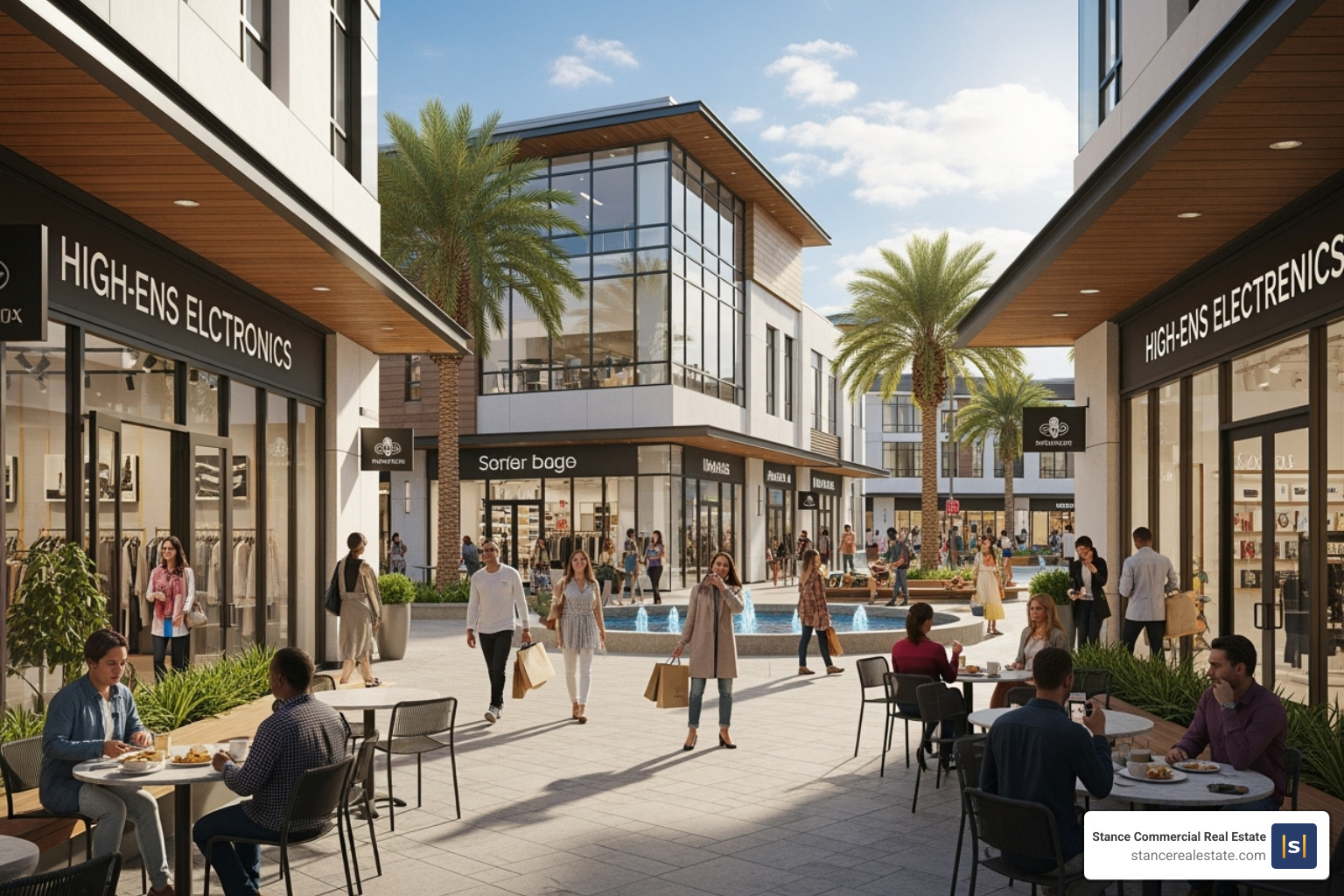
For forward-thinking investors, the rise of mixed-use developments—true live-work-play environments—translates into measurable financial advantages and long-term portfolio stability. Unlike traditional single-use assets, these projects combine office, retail, and hospitality into one integrated destination, creating built-in diversification and synergy. The result is a more secure and growth-oriented investment model that reduces reliance on any single tenant or sector. By spreading risk across multiple revenue streams within a cohesive property, mixed-use developments offer both resilience in shifting markets and the potential for outsized returns in today’s evolving commercial landscape.
This built-in diversification creates a powerful economic moat. If the office market faces headwinds, robust consumer spending can keep the retail and hospitality components thriving, thus maintaining a steady overall cash flow. The key financial benefits for investors are compelling:
- Diversified and Resilient Income Streams: Revenue is generated from multiple, often counter-cyclical, sources. Office tenants provide stable, long-term lease income, while retail tenants can offer percentage-rent agreements tied to sales performance. Hospitality and entertainment components capture discretionary spending. This blend provides a formidable hedge against market volatility in any single commercial sector.
- Premium Rental Rates and Higher Yields: The inherent value proposition of a mixed-use environment allows property owners to command premium rents. Tenants are willing to pay more for the unparalleled convenience, built-in amenities, and constant foot traffic that these developments provide. This leads to higher net operating income (NOI) and, consequently, more attractive capitalization rates for investors.
- Lower Vacancy Rates and Reduced Turnover: The integrated ecosystem creates natural, sustained demand. Office workers form a captive market for on-site retailers and restaurants. Conversely, the vibrant array of amenities serves as a powerful magnet for attracting and retaining high-quality office tenants. This symbiotic relationship leads to longer lease terms, lower vacancy rates, and reduced marketing and re-leasing costs over the life of the investment.
Throughout my years of experience guiding clients through Investing in Riverside Commercial Properties, I have consistently observed that well-executed mixed-use projects outperform their single-use counterparts in both occupancy levels and long-term value appreciation. They are not just buildings; they are destinations that foster a loyal customer base.
How Mixed-Use Developments Contribute to Local Economic Growth
Beyond the impressive returns for individual investors, these developments serve as powerful economic engines for entire communities. A thoughtfully planned mixed-use project can catalyze the transformation of a neighborhood, fostering sustainable prosperity and creating a legacy of growth. Their contributions include:
- Attracting and Retaining Businesses: The dynamic environment and ready-made customer base make these developments highly attractive to a wide range of businesses, from innovative startups seeking a collaborative atmosphere to established corporations looking for a prestigious address.
- Creating Diverse and Stable Job Opportunities: These large-scale projects generate a multitude of jobs across various sectors, including high-skilled positions in construction and engineering, professional services, property management, retail, and hospitality.
- Boosting Municipal Tax Revenue: As property values appreciate and commercial activity flourishes, local governments see a significant increase in their tax base. This includes higher property tax collections, as well as new revenue from sales taxes and business license fees, which can be reinvested into public services.
- Revitalizing Underutilized Areas: Mixed-use projects are an ideal solution for urban infill and revitalization. They can transform blighted industrial sites, aging strip malls, or vacant lots into thriving, walkable commercial hubs, thereby maximizing land use, curbing urban sprawl, and breathing new economic life into communities.
The inherent complexity and scale of these projects have spurred growth within the Commercial Real Estate Services Industry, demanding specialized expertise in finance, law, design, and management to unlock their substantial rewards.
For companies exploring options for Leasing Office Space in Riverside, properties that have been developed with these core principles in mind consistently attract the best tenants and maintain the highest occupancy rates over the long term.
Frequently Asked Questions about Mixed-Use Developments
As experts in The Future of Mixed-Use Developments: Live-Work-Play Spaces in Demand, we frequently engage with investors, developers, and business owners to demystify this complex but rewarding asset class. Here are detailed answers to some of the most common inquiries we receive.
Why is mixed-use development considered more sustainable?
Sustainability in mixed-use projects is a multi-faceted concept that encompasses economic, social, and environmental efficiencies. They are inherently more sustainable than conventional, single-use developments for several key reasons:
- Reduced Car Dependency and Emissions: By co-locating office, retail, and entertainment spaces, these developments create walkable environments where employees and visitors can accomplish multiple tasks in one trip, often without using a car. This significantly reduces vehicle miles traveled (VMT), which in turn lowers traffic congestion and carbon emissions.
- Efficient Land Use and Smart Growth: Mixed-use projects promote density and vertical development, which is a far more efficient use of valuable land than low-density, sprawling development patterns. This helps to preserve open space, protect natural habitats, and curb the high infrastructure costs associated with urban sprawl.
- Shared Infrastructure and Resources: The model allows for the highly efficient sharing of critical infrastructure. For example, a single parking structure can serve office workers during weekday business hours and then accommodate patrons of restaurants and entertainment venues in the evenings and on weekends. This shared-use model reduces the need for redundant facilities, lowers construction and operating costs, and minimizes the development's overall environmental footprint.
What are the biggest challenges for mixed-use development projects?
While the rewards are substantial, mixed-use projects are inherently complex and present unique challenges that require specialized expertise to overcome. The primary hurdles include:
- Complex Zoning and Entitlement Processes: Many municipalities still operate with outdated zoning codes that rigidly separate commercial uses. Navigating these regulations and securing the necessary entitlements for an integrated project can be a time-consuming, expensive, and uncertain process.
- Higher Upfront Costs and Complex Financing: Integrating diverse commercial property types with varied structural and infrastructure needs (e.g., ventilation for restaurants, loading docks for retail, high-tech connectivity for offices) leads to higher design and construction costs. Securing financing can also be more complex, often requiring multiple types of loans and a diverse capital stack.
- Intensive Market Analysis: Accurately forecasting long-term demand across multiple, distinct commercial sectors—office, retail, and hospitality—is a significant challenge. A successful project requires exhaustive market analysis to ensure the proposed mix and scale of uses aligns with the economic realities of the local market.
- Operational and Management Complexity: Managing a mixed-use property is far more demanding than overseeing a single-use building. It requires a sophisticated management team with expertise across various commercial property types. The management must also excel at community management, tenant relations, and event programming to maintain the vibrancy of the development.
How do mixed-use developments impact commercial property values?
Mixed-use developments typically have a powerful, positive impact on the value of both the property itself and the surrounding commercial real estate. The vibrant, synergistic environment they create drives value in several ways:
- Increased Demand and Premium Rents: The unparalleled convenience and dynamic atmosphere create intense demand for both office and retail space. For retail tenants, the built-in customer base of thousands of office workers and visitors is an invaluable asset that drives sales and justifies premium lease rates. For office tenants, the rich on-site amenities are a critical tool for attracting and retaining top talent, allowing owners to command higher rents than comparable single-use office buildings.
- Enhanced Financial Stability and Investor Appeal: The diversified revenue streams generated by the different commercial components create a more stable and predictable financial performance. This resilience is highly attractive to institutional investors and lenders, which can lead to a lower cost of capital and, consequently, higher property valuations.
- Long-Term Appreciation Potential: By creating a true 'destination,' a successful mixed-use project can elevate the profile and desirability of an entire neighborhood. This 'placemaking' effect often leads to an overall appreciation potential that significantly exceeds what standalone commercial properties can achieve, creating substantial long-term wealth for investors.
How is a mixed-use development financed differently from a single-use property?
Financing a mixed-use project is a more intricate process than financing a standard commercial building due to the multiple property types involved. Lenders view each component—office, retail, hospitality—as having its own distinct risk profile and revenue model. Consequently, the financing structure is often a hybrid. A developer might need to secure a traditional commercial mortgage for the office component, a separate construction loan for the retail portion that may be contingent on pre-leasing thresholds, and potentially specialized financing for a hotel. This often requires dealing with multiple lenders or finding a specialized lender with a dedicated mixed-use financing program. The complexity of the capital stack is higher, and investors must demonstrate a sophisticated understanding of each component's market to secure favorable terms.
What are the key metrics for measuring the success of a mixed-use development?
While traditional metrics like occupancy rates and rental income are crucial, they don't tell the whole story for a mixed-use project. Success is measured by the health of the entire ecosystem. Key performance indicators (KPIs) include:
- Foot Traffic and Dwell Time: Using sensors and mobile data to measure how many people visit the development and how long they stay provides insight into its drawing power.
- Cross-Property Patronage: Analyzing data to see what percentage of office workers patronize the on-site retail and dining establishments. High cross-patronage is a sign of strong synergy.
- Retail Tenant Sales Performance: Tracking tenant sales per square foot is a direct measure of the retail component's health and the value of the built-in customer base.
- Community Engagement Metrics: Measuring attendance at programmed events and engagement on social media platforms can quantify the project's success as a community hub.
How Stance CRE Can Help You
At Stance Commercial Real Estate, our deep local expertise in the Inland Empire is built on identifying and executing these creative opportunities. We were founded on the principle that service and local knowledge make all the difference in helping our clients achieve their goals.
The future of commercial real estate is integrated, experiential, and community-focused. For investors looking to build a resilient and profitable portfolio in Riverside and the broader Inland Empire, understanding these powerful trends is essential for identifying the high-growth opportunities that will define the next decade of commercial real estate. The time to adapt your investment strategy and embrace this new paradigm is now.
Explore investment opportunities in Riverside's Opportunity Zones

Retail Commercial Real Estate Remains a Strong Investment Choice in Riverside, California
Retail commercial real estate refers to properties specifically designed for businesses that sell goods or services directly to consumers. This broad category includes neighborhood strip centers, grocery-anchored shopping plazas, lifestyle centers, outlet malls, and standalone retail buildings such as restaurants, banks, or big-box stores. These properties are typically located in high-traffic areas to attract customers and often serve as hubs of daily activity within a community. Successful retail real estate balances visibility, accessibility, and tenant mix to drive consistent foot traffic and long-term value.
Key Facts About Retail Commercial Real Estate:
- Higher Returns: Average gross rental returns of 9-12% vs. 3-5% for residential properties
- Longer Leases: Commercial tenants typically sign 3-10 year leases vs. 6-12 months residential
- Tenant-Paid Expenses: Commercial tenants often cover property taxes, insurance, and maintenance
- Market Strength: U.S. retail availability rate expected to hit record-low 4.6% in 2024
- Supply Constraints: Only 14 million sq. ft. of new retail space scheduled for delivery in 2024
Despite e-commerce growth, physical retail sales reached $724.6 billion in November 2024, showing 3.8% year-over-year growth. The "halo effect" proves that when retailers open physical stores, their online sales jump by approximately 30%.
The current market shows remarkable strength. Limited new construction over recent years has created a supply shortage, driving down vacancy rates and supporting rent growth. In markets like Toronto's GTA, average commercial/retail lease rates jumped from $28.01 to $47.21 per square foot in just one year.
I'm Joe Stance, and over my eighteen-year career in commercial real estate, I've leased and sold millions of square feet of property in the Inland Empire, with experience in retail commercial real estate transactions. Through my company Stance Commercial Real Estate, I've guided hundreds of companies through the complex process of finding, leasing, and purchasing retail properties that align with their specific business needs.
Understanding Retail Commercial Real Estate
When you walk into your neighborhood grocery store or grab coffee at that corner café, you're experiencing retail commercial real estate in action. These properties are specifically designed to house businesses that sell goods or services directly to you and me – the everyday consumers.
Retail commercial real estate generates income through rent payments from retail tenants, creating opportunities for investors to earn steady returns while supporting local businesses. The beauty of this market lies in its diversity, ranging from small storefront spaces where your local barber operates to massive shopping complexes that anchor entire communities.
The market splits into single-tenant and multi-tenant properties, each with distinct advantages. Single-tenant buildings house one retailer – think of a standalone Starbucks or bank branch. These properties often come with longer lease terms and stable income streams, making them attractive to investors who prefer predictability.
Multi-tenant properties combine multiple retailers under one roof or development, creating powerful synergies. When a strong anchor tenant like a grocery store draws steady foot traffic, smaller specialty stores benefit from that constant flow of potential customers.
Grocery-anchored centers have become the golden child of retail real estate. People need groceries regardless of economic conditions or online shopping trends. These properties typically feature a supermarket as the star attraction, surrounded by complementary businesses like pharmacies, dry cleaners, and restaurants.
Medical retail, or "medtail," represents one of the fastest-growing sectors. These properties house healthcare services like urgent care centers, dental offices, and specialty clinics. Medical tenants typically sign longer leases and face virtually no competition from e-commerce.
Retail Real Estate Market Research provides the local insights needed to make informed decisions in this dynamic market.
Types of Retail Commercial Real Estate Properties
Strip centers are the workhorses of retail commercial real estate – linear developments typically housing 5-15 tenants sharing a common parking area, creating convenient one-stop destinations for everyday needs.
Most strip centers are anchored by necessity-based retailers like grocery stores, pharmacies, or hardware stores that drive consistent traffic. The smaller tenants benefit from this steady flow of customers who might grab lunch while running errands.
Shopping malls face unique challenges but many are successfully adapting by incorporating experiential elements like entertainment venues, food halls, and interactive spaces that give people reasons to visit beyond just shopping.
Outlet centers serve value-conscious shoppers seeking discounted merchandise from brand-name retailers. These properties often locate outside urban cores where land costs are lower.
How Lease Structures Differ in Retail Commercial Real Estate
Triple net (NNN) leases dominate retail commercial real estate because they create alignment between landlords and tenants. Tenants pay base rent plus their proportionate share of property taxes, building insurance, and common area maintenance.
Percentage rent adds an interesting twist by tying some rent to tenant performance. Once a tenant's sales exceed a predetermined breakpoint, they pay additional rent as a percentage of gross sales.
CAM charges cover shared expenses like parking lot maintenance, landscaping, and common area utilities. These charges are typically split based on each tenant's proportionate share of the total leasable area.
Typical Returns & Risk Profile for Retail Commercial Real Estate
Retail commercial real estate typically delivers higher returns than other property types, with gross rental returns averaging 9-12% compared to 3-5% for residential properties.
Cap rates for retail properties vary dramatically based on location, tenant quality, and property type. A grocery-anchored center in a strong market might trade at 5-7% cap rates, while single-tenant properties with credit tenants could command even lower rates.
E-commerce risk remains a key concern, but the reality is more nuanced than many people assume. Physical and digital retail channels often complement rather than compete with each other.
2024-2025 Market Trends & Outlook for Retail Commercial Real Estate in Riverside, California
The retail commercial real estate market in Riverside, California is entering a rare and highly competitive phase—a genuine supply shortage that is creating significant opportunities for investors, developers, and tenants who are ready to move quickly.
Across the nation, retail availability is tightening, but Riverside stands out as a market where the imbalance between supply and demand is especially pronounced. With the U.S. retail availability rate hitting a record-low 4.6% in 2024, and only 14 million square feet of new multi-tenant retail space set for delivery nationwide, the squeeze is being felt locally. In Riverside, retail vacancy rates have dipped well below the regional average, and absorption remains strong, driven by sustained population growth and increasing consumer demand.
This supply crunch is no accident. After the 2008 financial crisis, retail development all but stalled in many parts of the country, and Riverside was no exception. For more than a decade, developers avoided large-scale retail projects, waiting for more favorable economic signals. That wait has turned into a bottleneck. As we move through 2024 and into 2025, the market dynamic has shifted rapidly—from tenant-favorable to landlord-favorable—almost overnight.
Rising construction costs have added another layer of complexity. In Southern California, we are seeing costs ranging from $300 to $500 per square foot, depending on the building type. This pricing, combined with higher interest rates and labor shortages, has made it difficult to justify speculative development unless rent growth is strong and sustained. Fortunately, Riverside's retail rents are beginning to catch up, with asking rents projected to grow by over 2% in Q4 2024, and that momentum is expected to continue into 2025.
Meanwhile, consumer spending in Riverside remains resilient. Bolstered by steady job growth, demographic expansion, and rising wages, local retail sales are performing better than many experts anticipated. The Inland Empire region—Riverside in particular—benefits from its strategic location, diverse population, and increasing foot traffic in both neighborhood centers and lifestyle destinations.
In short, Riverside is facing the same supply shortage seen nationwide, but with the added pressure of a fast-growing consumer base and limited new construction in the pipeline. Whether you are an investor seeking long-term upside, a developer evaluating build-to-suit opportunities, or a tenant searching for prime space, 2024–2025 is shaping up to be a critical window for making strategic retail real estate moves in Riverside.
Demand & Supply Drivers in 2024-2025
Population growth across the Sun Belt is unlocking retail goldmines—and Riverside, California is right in the mix. As more young professionals and families relocate to the Inland Empire, Riverside is seeing a surge in demand for high-quality retail experiences. This is not just about more people—it is about the right demographic: upwardly mobile, tech-savvy consumers with disposable income who are looking for places to shop, dine, and be entertained close to home.
The suburban migration trend that took off during the pandemic has solidified into a long-term behavioral shift. Riverside, with its balance of affordability, quality of life, and accessibility to major job markets, is a natural beneficiary. As a result, open-air community centers and convenience-oriented retail formats are thriving, while traditional enclosed malls continue to struggle with relevance. Consumers want ease, outdoor space, and a neighborhood feel—attributes Riverside’s retail corridors are increasingly built around.
While interest rates are finally stabilizing in 2024, providing more predictability for planning and underwriting, the cost of capital remains elevated. In Riverside, as elsewhere, this means speculative retail development remains limited. Investors and developers are focusing on core assets and tenant-driven projects, but that does not solve the underlying supply-demand imbalance.
Even when a project pencils out financially, construction challenges persist. The Inland Empire continues to face labor shortages and inflated material costs, making it difficult to build at scale. These bottlenecks are keeping new supply constrained, even as tenant demand accelerates.
Meanwhile, younger consumers are redefining retail expectations throughout the region. In Riverside, we are seeing growing interest in experiential retail—a mix of shopping, dining, wellness, and entertainment in dynamic, walkable environments. From local breweries and boutique fitness studios to food halls and immersive brand experiences, the next wave of retail in Riverside is about more than transactions—it is about creating places people want to spend time.
For those watching the market closely, the message is clear: Riverside’s retail landscape in 2024–2025 is full of opportunity, but the window to act is narrowing. Developers and investors who understand the demographic shifts and are ready to respond to changing consumer behavior stand to benefit most.
Impact of E-Commerce & Omnichannel on Retail Commercial Real Estate
Here's something that might surprise you: e-commerce and physical retail aren't enemies anymore—they're partners. The online share of total U.S. retail sales is expected to exceed 30% by 2030, up from 23% in 2024. But instead of killing physical stores, this growth is actually making them more valuable.
The halo effect is real and it's powerful. When retailers open physical store locations, their online sales jump by approximately 30%. Physical stores have become marketing tools, customer acquisition channels, and fulfillment centers all rolled into one.
Click-to-brick expansion is happening everywhere. Digitally native brands that started online are rushing to open physical locations. They're starting smart—with smaller format stores or pop-up locations to test markets before committing to larger spaces.
Last-mile logistics have completely changed what retailers need from their spaces. Many stores now double as mini-distribution centers, which means different layouts, better loading capabilities, and more flexibility. This is especially true in grocery and general merchandise.
Curbside pickup and buy-online-pickup-in-store services aren't nice-to-have features anymore—they're essential. Properties that can accommodate these services are commanding premium rents because tenants know their customers expect these options.
Physical stores have also become the solution to e-commerce's biggest headache: returns. Stores serve as convenient return locations for online purchases, which drives foot traffic and creates opportunities for additional sales.
Investing in Retail CRE: Pros, Cons, Returns & Lease Mechanics
When I sit down with investors considering retail commercial real estate, the first thing they notice is how different the numbers look compared to residential properties. The returns are higher, the leases are longer, and the tenant relationships work completely differently.
| Comparison Factor | Residential Real Estate | Retail Commercial Real Estate |
|---|---|---|
| Average Returns | 3-5% | 9-12% |
| Lease Terms | 6-12 months | 3-10 years |
| Tenant Responsibilities | Limited | Extensive (taxes, insurance, maintenance) |
| Management Intensity | High | Moderate |
| Entry Capital | Lower | Higher |
| Market Liquidity | High | Moderate |
Those higher returns in retail commercial real estate aren't just luck. They reflect the additional value that smart investors create through strategic tenant selection, careful lease structuring, and well-timed property improvements.
Pros & Cons of Investing in Retail Commercial Real Estate
The high yields are what initially attract most investors to retail properties. When you can generate 9-12% gross rental returns instead of the 3-5% typical in residential, it fundamentally changes your investment math.
Longer lease terms create stability that residential investors dream about. Instead of worrying about annual lease renewals, retail tenants typically commit to 3-10 year terms with predictable income.
Professional relationships make a huge difference in day-to-day management. Commercial tenants understand their lease obligations and handle issues through established business processes.
But retail investment isn't without challenges. Vacancy risk can be brutal when anchor tenants depart. Economic sensitivity affects retail properties more than necessity-based real estate like apartments or medical buildings.
Lease Structures, CAM & Percentage Rent Explained
Triple net (NNN) leases dominate retail commercial real estate because they create alignment between landlords and tenants. Tenants pay base rent plus their proportionate share of property taxes, building insurance, and common area maintenance.
Percentage rent clauses add excitement to retail leases by tying additional rent to tenant sales performance. Once tenant sales exceed a predetermined breakpoint, they pay extra rent as a percentage of gross sales.
Common Area Maintenance (CAM) charges cover shared property expenses like parking lot maintenance, landscaping, snow removal, security, and common area utilities.
Key Risks & Mitigation Strategies
Anchor tenant turnover represents the biggest risk in multi-tenant retail properties. When major tenants depart, it can trigger co-tenancy clauses allowing other tenants to reduce rent or terminate leases.
E-commerce disruption continues affecting certain retail categories, but successful retailers are adapting through omnichannel strategies that integrate online and offline operations.
Portfolio diversification across property types, geographic markets, and tenant categories reduces concentration risk.
Site Selection, Analytics & The Future of Experiential Retail
Finding the perfect location for retail commercial real estate has evolved far beyond driving around town and trusting your gut. Today's successful retailers and investors rely on sophisticated data analysis.
Demographics still matter, but we're talking about much more than counting heads. Smart retailers dig deep into household income patterns, age groups, education levels, and family structures.
Traffic counts have gotten incredibly sophisticated. Instead of someone sitting with a clipboard counting cars, we now use mobile phone data and video analytics to track pedestrian flow throughout the day, week, and year.
Parking ratios might sound boring, but they're crucial for success. Most thriving retail centers provide 4-6 parking spaces per 1,000 square feet of retail space.
Medical retail growth represents one of the hottest trends in retail real estate. As our population ages and healthcare needs increase, properties housing medical services enjoy steady patient flow, longer lease terms, and virtually no competition from online shopping.
The Retail Foot Traffic Battle explores how today's retailers compete for customer attention in an increasingly crowded marketplace.
Frequently Asked Questions about Retail Commercial Real Estate
These are the three questions I hear most often from investors considering retail commercial real estate. Let me give you the straight answers based on what I've seen in the market over the past decade.
What returns can I expect from retail commercial real estate investments?
Retail commercial real estate delivers significantly stronger returns than residential properties, but the numbers vary quite a bit depending on what you're buying and where.
Gross rental returns typically fall between 9-12%, which looks pretty attractive compared to the 3-5% you'd see from residential properties. But here's what really matters: your net returns after all expenses usually land in the 6-9% range for well-managed properties.
The beauty of triple net lease structures is that your tenants cover most operating expenses - property taxes, insurance, and maintenance. This helps maximize your net returns, though you'll still need to budget for vacancy periods, tenant improvements, and the occasional major repair.
Cap rates tell another part of the story. Grocery-anchored centers with solid anchor tenants might trade at 5-7% cap rates because they're so stable. Single-tenant properties with strong credit tenants can command even lower cap rates due to their predictability.
Don't forget about appreciation potential. In growing markets like ours here in the Inland Empire, properties often appreciate 3-5% annually while generating strong cash flow. When you combine that with your rental returns, you're looking at some compelling total return profiles.
How is limited new supply affecting rents and vacancy?
The supply shortage in retail commercial real estate is unlike anything I've seen in my career. We're dealing with only 14 million square feet of new multi-tenant retail space scheduled for delivery in 2024 - that's literally half of what the market needs.
Vacancy rates are hitting record lows. The U.S. retail availability rate is expected to drop to 4.6% in 2024, and in hot markets like Charlotte and Phoenix, we're seeing availability rates below 3.5%. That creates intense competition for quality space.
Rent growth is finally accelerating after years of modest increases. We're projecting rent growth to exceed 2% in the fourth quarter and keep climbing into 2025. Some markets are seeing even more dramatic jumps - Toronto's GTA saw commercial retail lease rates jump from $28.01 to $47.21 per square foot in just one year.
The challenge is that construction costs now range from $300-500 per square foot, which means only markets with really strong rent growth can justify new development. It's a cycle that feeds itself: supply stays tight, rents keep rising, but construction costs make it tough to add new supply.
What makes grocery-anchored and open-air centers so resilient?
Grocery-anchored centers have something most retail properties don't: necessity-based traffic. About 65% of consumer spending focuses on essential goods, which means people need to visit these centers regardless of economic conditions or online shopping trends.
Think about your own shopping habits. You probably hit the grocery store once or twice a week, and while you're there, you might grab dry cleaning, pick up a prescription, or grab lunch. That convenience factor creates incredible tenant synergies - the grocery store provides steady traffic while specialty tenants offer one-stop shopping for customers.
Open-air formats have become even more popular since the pandemic. Customers prefer outdoor shopping environments with easy parking, better visibility, and a more pleasant experience than cramped indoor malls. These centers just feel more comfortable and convenient.
The real advantage is adaptability. Open-air centers can easily reconfigure spaces, add drive-through services, or incorporate curbside pickup areas without major construction disruptions. Try doing that in an enclosed mall - it's nearly impossible.
From an investment standpoint, these properties combine stability with growth potential. The grocery anchor provides steady income while the surrounding tenants benefit from consistent foot traffic. It's a model that works in good times and bad.
How Stance CRE Can Help You
At Stance Commercial Real Estate, our deep local expertise in the Inland Empire is built on identifying and executing these creative opportunities. We were founded on the principle that service and local knowledge make all the difference in helping our clients achieve their goals.
The Southern California market is constantly evolving. Lease option investing gives you the adaptability to capitalize on market movements while protecting your capital.
Ready to explore what retail commercial real estate can do for your investment goals? Check out our insights on Investing in Riverside Commercial Properties or reach out to Stance Commercial Real Estate directly. With our local expertise and decade of retail transaction experience, we'll help you find opportunities that match your investment strategy and risk tolerance.
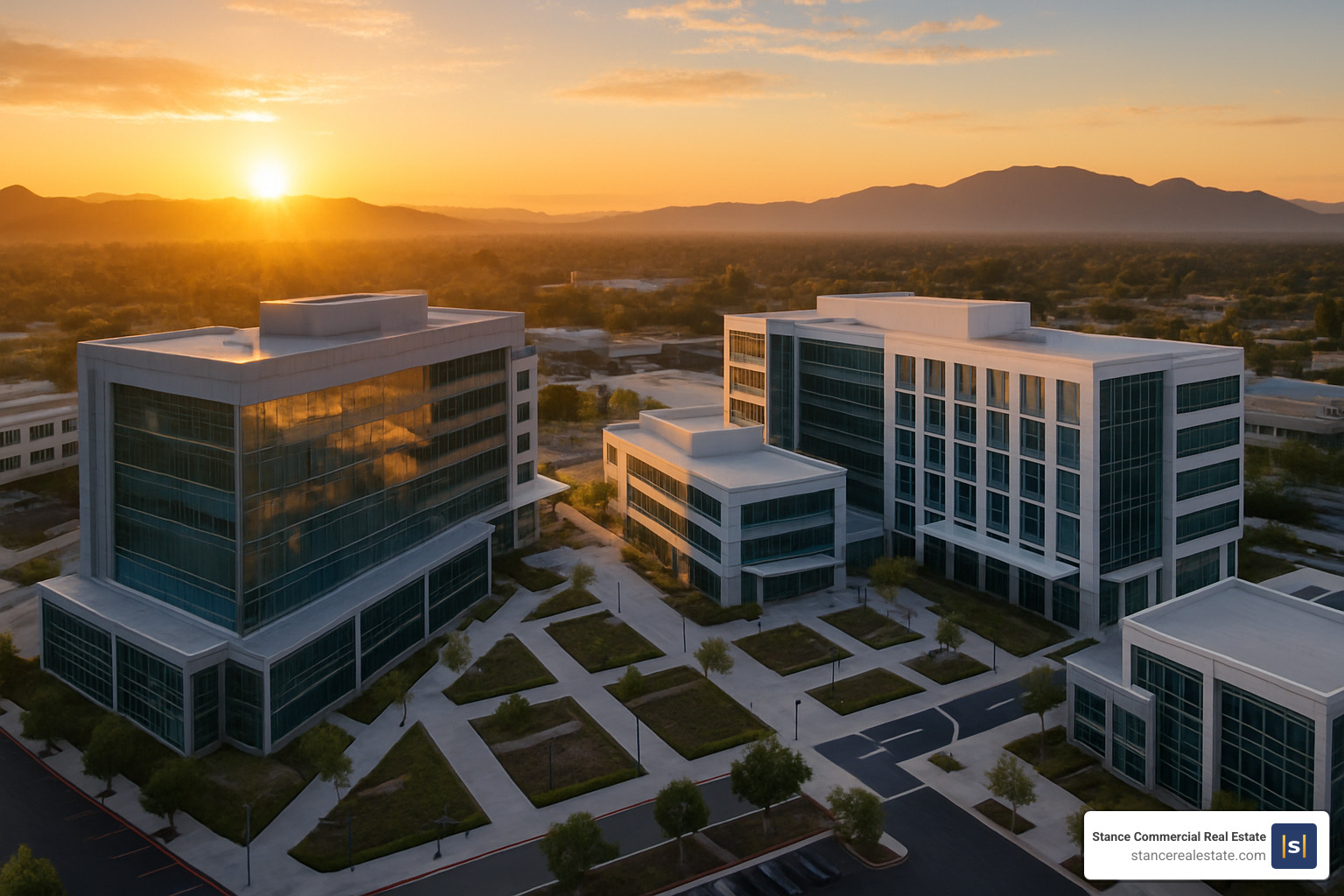
Why Riverside's Healthcare Real Estate Market is Booming
Healthcare-related commercial real estate in Riverside, California, has become one of the Inland Empire’s most competitive sectors. With medical office space in high demand and limited supply—typically only around nine suites available for lease at any given time—vacancy rates remain low, hovering between 5–7%. This tight market signals more than just scarcity; it highlights strong, sustained demand and a resilient healthcare economy. For investors and medical providers alike, this creates a dynamic environment where the right property can offer long-term stability and strong returns.
Key Market Snapshot:
- Vacancy Rate: 5–7% (well below general office space)
- Purchase Prices: $250–$350 per square foot
- Cap Rates: 5.5–7%
- Annual Appreciation: 3–5% in prime corridors
- Parking Requirement: 4.44 spaces per 1,000 SF
- Average Property Size: 30,103 SF
Several forces are powering this boom: an aging population, UC Riverside’s expanding research footprint, and steady migration from coastal counties to the more affordable Inland Empire. Major developments such as the $580 million Wellness Village campus in nearby Mead Valley underscore investor confidence.
Most facilities range from 1,000 SF boutique suites to 10,000 SF multi-specialty centers. Demand is especially strong for urgent care, imaging, and behavioral health practices located near hospital clusters along the 91, 60, and 215 freeways.
I’m Joe Stance, founder of Stance Commercial Real Estate. Over the last eighteen years, I have helped hundreds of providers lease and purchase millions of square feet throughout Riverside. The insights that follow will help you steer this high-demand niche.
Why Riverside’s Healthcare Property Market Matters
Healthcare properties outperform most other commercial asset classes during economic swings thanks to long lease terms and essential-service tenants. Pair that resilience with 3–5% annual value growth and Riverside becomes a compelling location for both providers and investors.
Market Overview of Commercial Real Estate Healthcare Facilities in Riverside, California
The healthcare facilities commercial real estate market in Riverside tells a story of scarcity and opportunity. Picture this: on any given day, only about 9 medical office spaces sit available for lease across the entire Riverside area. That's like having nine parking spots for a hundred cars – it creates some serious competition.
This tight market reflects what we're seeing throughout the Inland Empire. Healthcare providers often find themselves in bidding wars, and the smart ones know they need to move fast when the right property hits the market.
The numbers paint an interesting picture. While Riverside's overall commercial real estate market averages $567 per square foot, medical office purchases typically range from $250 to $350 per square foot. This pricing difference reflects the specialized market with specific location and infrastructure needs.
Most healthcare facilities in our market range from small 1,000 square foot practices to larger 10,000 square foot multi-specialty centers. The average commercial property size in Riverside is 30,103 square feet, but medical facilities tend to be more intimate and patient-focused in their scale.
Investors love medical office properties for good reason. Capitalization rates range from 5.5% to 7%, with the highest quality properties commanding the lowest cap rates. Medical tenants typically sign long-term leases and have excellent payment histories.
Supply & Demand for Healthcare Facilities in Riverside, California
Here's the reality of Riverside's healthcare real estate market: we're dealing with a classic supply shortage. Those 5-7% vacancy rates signal a market where demand consistently outpaces what's available.
Unlike other commercial sectors, we're not seeing much new ground-up construction of medical facilities. Most new supply comes from adaptive reuse projects – taking older office buildings and converting them into medical spaces. Converting an existing building is often faster and more cost-effective than starting from scratch.
Limited new construction reflects the reality of developing medical facilities. The approval process takes longer, development costs run higher, and many developers in the Inland Empire prefer industrial projects right now. This supply constraint supports both rental rates and property values.
Key Growth Drivers
Several powerful forces are driving growth in Riverside's healthcare market. The population boom in the Inland Empire is the big story here. We're talking about 2.41 million residents within a 20-mile radius of nearby Moreno Valley – that's a lot of people who need medical care.
UC Riverside's research growth adds another layer to this story. With over 53,000 students enrolled at local universities, we're seeing demand for both student health services and attracting medical professionals to the area.
The Inland Empire migration pattern is fascinating to watch. Families and healthcare professionals are relocating from higher-cost coastal areas, bringing both patient needs and medical expertise.
The $580 million Wellness Village campus in nearby Mead Valley represents the scale of investment flowing into regional healthcare infrastructure. This 450,000-square-foot integrated behavioral and medical health campus shows that major institutions have serious confidence in our market's long-term growth prospects.
Facility Types Most in Demand
The Riverside market shows clear preferences for specific types of healthcare facilities. Urgent care centers lead the pack, driven by changing patient preferences for convenient, immediate care. These facilities typically need 2,500 to 5,000 square feet with excellent visibility and abundant parking.
Imaging centers represent another high-demand category, though they come with specialized requirements like lead-lined walls for X-ray equipment and reinforced floors for heavy machinery.
Ambulatory surgery centers (ASCs) are increasingly popular as more procedures move from expensive hospital settings to outpatient facilities. These require 5,000 to 10,000 square feet with specialized HVAC systems and medical gas connections.
Behavioral health facilities have seen explosive growth, partly driven by increased awareness and the integration of mental health services into primary care.
Location, Design & Compliance Essentials
Finding the right location for commercial real estate isn't just about square footage and rent - it's about navigating a complex web of regulations, patient needs, and operational requirements that can make or break your practice.
The regulatory landscape starts with zoning verification. Not every commercial zone allows medical offices, and some require conditional use permits for specialized services. OSHPD (Office of Statewide Health Planning and Development) regulations kick in for certain facility types, while ADA compliance goes far beyond basic accessibility.
HIPAA compliance shapes your entire floor plan. Patient consultation areas need proper sound barriers, and records storage requires secure, restricted access zones. These aren't afterthoughts - they're fundamental design elements that affect everything from your initial build-out to daily operations.
Medical Office Space for Lease Riverside listings highlight compliance features as selling points because savvy healthcare providers know these details determine operational success.
Proximity & Accessibility Factors
Hospital clusters create natural medical corridors where everyone benefits. Referral relationships flow more easily when specialists are located near primary care providers and hospital services. Riverside's medical facilities naturally gravitate toward these clusters, creating synergies that help practices thrive.
The 91, 60, and 215 freeway corridors provide regional patient access, but the sweet spot is being within 5-10 minutes of major interchanges while maintaining visibility from arterial roads. Patients want convenience, and staff need reasonable commutes to reduce turnover.
Public transit access matters more than many providers realize. Practices serving diverse patient populations often find that bus route proximity affects patient retention and no-show rates.
Typical Sizes & Specialized Build-Out Features
Healthcare facility sizing in Riverside follows predictable patterns based on practice type and provider count. Small practices typically need 1,000 to 2,500 square feet, while medium practices require 2,500 to 5,000 square feet. Large single-specialty practices often occupy 5,000 to 10,000 square feet.
The 2-3 exam rooms per provider ratio serves as your baseline for space planning, but you'll also need consultation rooms, patient waiting areas, and administrative space.
Specialized build-out features separate medical facilities from standard office space. Improved plumbing systems support multiple sinks and specialized equipment. Dedicated electrical circuits handle medical equipment loads that would overwhelm standard office electrical systems.
HVAC systems with high air exchange rates aren't just comfort features - they're infection control necessities. Sound insulation between exam rooms protects patient privacy and creates the professional environment patients expect.
Regulatory, Zoning & Compliance Checklist
Medical-use zoning verification comes first because everything else depends on it. Some areas require conditional use permits for controlled substances or specialized procedures.
Medical waste disposal requirements exceed standard commercial waste management. You'll need specialized disposal contracts and appropriate storage areas within your facility. Fire codes for medical facilities include improved egress requirements and emergency lighting.
Environmental compliance varies by service type but may include X-ray equipment licensing, hazardous material storage protocols, and air quality monitoring.
Leasing vs. Buying: Process, Best Practices & Financial Analysis
Choosing between leasing and purchasing commercial real estate isn't just about monthly payments - it's about your practice's future and how you want to build wealth over time.
Most new practices start by leasing to keep their cash available for medical equipment, hiring staff, and building patient volume. Established practices often shift toward purchasing once they've proven their location works and want the tax benefits and equity building that comes with ownership.
Lease timelines for medical facilities typically take 6-12 months from your first property tour to seeing your first patient. That includes 3-4 months just for build-out, since medical spaces need specialized plumbing, electrical, and HVAC work. Purchase transactions move faster at 4-6 months, but require more upfront capital.
The Letter of Intent (LOI) stage sets everything in motion. This is where we negotiate your base rent, tenant improvement allowances, lease term, and renewal options. Medical tenants often get higher TI allowances because landlords know you're installing expensive specialized systems they'll benefit from long-term.
SBA loans can be game-changers for healthcare facility purchases. They often require just 10-15% down for owner-occupied medical facilities, compared to 25-30% for conventional commercial loans.
Understanding Commercial Real Estate Lease Agreement terms becomes crucial since medical leases include provisions most other businesses never see.
Step-by-Step Leasing Roadmap
Start with an honest needs assessment at least 6-12 months before you want to move in. I sit down with providers to map out not just their current needs, but where they'll be in five years.
Property tours require a different eye than most commercial spaces. The location and square footage matter, but can you actually deliver quality patient care there? We look at natural light quality, HVAC performance, sound insulation between rooms, and whether the layout supports efficient patient flow.
Negotiation goes way beyond the base rent number. Your total occupancy cost includes common area maintenance, utilities, insurance, and property taxes. Medical practices often have higher utility costs due to specialized equipment running extended hours.
Build-out coordination makes or breaks your timeline. I recommend assembling your full project team - architect, contractor, equipment suppliers, and IT specialists - before you even sign the lease.
Purchase & Investment Workflow
Due diligence for healthcare facilities digs deeper than typical commercial purchases. We verify zoning compliance for your specific medical use, conduct environmental assessments, and review any existing tenant leases if you're buying an investment property.
Financing options vary significantly based on your situation. Conventional commercial mortgages typically require 20-30% down. SBA 504 loans for owner-occupied facilities often provide better terms with lower down payments.
Escrow and closing processes involve additional inspections related to medical equipment, environmental compliance, and regulatory approvals.
Advantages & Disadvantages of Leasing vs. Buying in Riverside
Leasing works best when you need to preserve capital for medical equipment and operations, want flexibility to relocate as your practice grows, or prefer focusing on patient care rather than property management.
Buying makes sense when you want long-term cost control, tax benefits through depreciation and mortgage interest deductions, and the ability to build equity over time. Ownership gives you complete control over facility modifications.
The leasing downside includes ongoing rent payments with no equity building, potential rent increases at renewal, and restrictions on facility modifications.
Buying disadvantages include significant upfront capital requirements, responsibility for all maintenance and repairs, and reduced flexibility to relocate.
How Brokers Add Value
Site selection goes far beyond finding available space. We analyze demographics to ensure sufficient patient volume, map competitors to avoid oversaturated areas, and evaluate traffic patterns for patient accessibility.
Negotiation expertise becomes crucial in Riverside's tight market where multiple offers are common. We structure offers that stand out while protecting your interests.
Compliance guidance helps steer the maze of zoning, ADA, HIPAA, and other regulatory requirements affecting healthcare facilities.
Our Commercial Real Estate Services Industry expertise includes understanding healthcare-specific lease terms and long-term strategic planning for practice growth.
Rental & Investment Metrics
Base rents typically range from $2.50 to $4.00 per square foot annually, with premium locations near major hospitals commanding higher rates.
Net-net-net (NNN) costs add another $1.50 to $3.00 per square foot annually for taxes, insurance, and common area maintenance.
Return on investment scenarios for healthcare facility purchases typically show break-even points of 7-10 years compared to leasing, assuming 3-5% annual appreciation and available tax benefits.
Technology, Incentives & Future Outlook
Technology and public-sector funding are rapidly reshaping commercial real estate.
Emerging Investment Opportunities
- Behavioral health campuses – fastest-growing segment, often backed by long-term government contracts.
- Mixed-use medical developments – pharmacies, healthy food options, and fitness amenities within a single project.
- Value-add conversions – outdated offices turned into compliant medical space at below-market acquisition costs.
- Telehealth-ready suites – smaller, tech-heavy exam rooms paired with robust data infrastructure.
Taken together, these trends point to a Riverside market that will stay tight—and innovative—for years to come.
Frequently Asked Questions about Riverside Healthcare Real Estate
How close should my clinic be to a hospital?
The sweet spot for hospital proximity really depends on what type of practice you're running. If you're in a hospital-dependent specialty like emergency medicine or surgery, you'll want to stay within a 5-minute drive for those urgent patient transfers and emergency consultations that can't wait.
For referral-based specialists, that 10-15 minute range often works beautifully. You're close enough to maintain those crucial referral relationships with hospital physicians, but far enough out to potentially snag better property values. I've worked with imaging centers that found this distance perfect - they could still rush over for emergency reads when needed, but their rent was significantly lower than the properties right next to the hospital.
Primary care practices have more flexibility with location. Your patients care more about convenient parking and easy access from their neighborhoods than whether you're next door to the hospital. That said, you still want reasonable access for those times when you need to refer patients or handle emergencies.
The key is thinking about your daily workflow. How often do you actually need to be at the hospital? How critical is response time for your specialty? These practical considerations should drive your location decision more than any arbitrary distance rule.
What parking ratio is required for an urgent-care facility?
Urgent care facilities need more parking than your typical medical office, and there's a good reason for that. While standard medical offices require 4.44 spaces per 1,000 square feet, urgent care facilities typically need 5-6 spaces per 1,000 square feet due to their walk-in nature and higher patient turnover.
Think about it - regular medical offices work on appointments, so patient flow is somewhat predictable. Urgent care is the opposite. You might have two patients at 2 PM and twelve patients at 6 PM when everyone gets off work with their sick kids.
Peak hour analysis becomes crucial for urgent care parking planning. These facilities see their biggest rushes during evenings and weekends when primary care offices are closed. That's exactly when people realize they can't wait until Monday for that cough or sprained ankle.
One smart solution I've seen work well is shared parking arrangements with complementary businesses. If you're in a mixed-use development, you might share spaces with a business that's busy during your slow hours. Just make sure the arrangement is formal and legally documented.
The bottom line? Don't skimp on parking for urgent care. Nothing frustrates sick patients more than driving around looking for a parking spot when they already feel terrible.
How Stance CRE Can Help You
For healthcare providers entering this market, my advice remains consistent: start early, plan thoroughly, and work with experienced professionals. The tight inventory means good properties move quickly, but the right preparation positions you to act decisively when opportunities arise.
Investors should take note of the unique characteristics that make healthcare real estate so attractive. Long-term leases, stable tenants, and recession-resistant demand create an investment profile that's hard to match in other commercial sectors.
At Stance Commercial Real Estate, we've built our reputation on putting your success first. Our faith-driven approach means we prioritize your long-term success over short-term commissions. When you're ready to explore the opportunities in commercial real estate in Riverside, we're here to guide you through every step of the process with the local expertise and personal attention you deserve.
The healthcare real estate market in Riverside isn't just growing—it's thriving. Whether you're healing patients or building investment portfolios, this market offers the stability, growth potential, and community impact that makes commercial real estate so rewarding.

How Interest Rates Shape Commercial Real Estate
As of May 2025, commercial real estate interest rates range from approximately 5.75% to 15.25%, with conventional loan rates typically falling between 6.10% and 10.75%. These rates can vary widely depending on a variety of factors, including loan type, property class, creditworthiness of the borrower, loan-to-value ratio, asset location, and current market conditions influenced by Federal Reserve policy and inflation trends.
Few factors impact commercial real estate investment success more than interest rates. They directly affect everything from monthly cash flow to property valuations, making them a critical consideration for any investor or business owner.
When interest rates rise, borrowing costs increase, potentially reducing your net operating income. Conversely, when rates fall, refinancing opportunities emerge that can significantly improve your returns. Understanding this relationship is essential for making informed commercial property decisions.
I'm Joe Stance, and over my 30-year career in Riverside's commercial real estate market, I've guided hundreds of clients through financing decisions involving commercial real estate interest rates, helping them steer changing market conditions to secure optimal terms for their investments.
Understanding Commercial Real Estate Interest Rates
When you're looking to invest in commercial property, understanding how commercial real estate interest rates work is essential. Unlike your home mortgage, commercial loans have their own unique characteristics that directly impact your investment's profitability.
Think of commercial real estate interest rates as the cost of renting money for your property purchase or refinance. What makes these loans different is their focus—while your home loan primarily depends on your personal credit score and income, commercial lenders are most interested in whether the property itself can generate enough income to cover the payments.
Commercial loans typically come with shorter terms (usually 5-10 years) but are amortized over longer periods (25-30 years). This creates what we call "balloon payments" when the loan matures, requiring you to refinance. It's a structure that reflects the higher risk and complexity of commercial properties.
| Feature | Commercial Mortgages | Residential Mortgages |
|---|---|---|
| Focus | Property performance | Borrower creditworthiness |
| Loan Size | $250,000+ | $50,000+ |
| Terms | 5-10 years with 25-30 year amortization | 15-30 years fully amortized |
| Rates | 0.5-1% higher than residential | Lower, government-backed options |
| Down Payment | 20-30% (10-15% for SBA) | 3-20% |
| Prepayment | Often includes penalties | Typically no penalties |
| Recourse | Full or limited recourse common | Non-recourse standard |
Most commercial loans have interest rates that sit about 3% above the federal funds rate, though this can vary widely depending on your property type, location, and financial situation.
How commercial real estate interest rates are calculated
The math behind commercial real estate interest rates is actually pretty straightforward. Your rate equals a benchmark index plus a spread (or margin) that reflects how risky the lender thinks your loan is:
Interest Rate = Index + Spread
The benchmark indices you'll commonly encounter include:
The 10-Year Treasury Yield (currently at 4.221% as of June 2024) serves as the main reference point for fixed-rate commercial mortgages. When Treasury yields go up or down, your mortgage rate typically follows suit.
SOFR (Secured Overnight Financing Rate) has replaced LIBOR as the standard for variable-rate commercial loans. The 30-day SOFR currently sits at 5.330%.
The Prime Rate (currently 8.500%) is often used for construction loans, SBA loans, and some variable-rate mortgages.
The spread added to these indices typically ranges from 1.5% to 4%, depending on several factors. For example, a well-maintained apartment building in a prime location with a strong borrower might get a much lower spread than a struggling retail center with high vacancy.
To put this in real terms, if you're buying a multifamily property, your loan might be priced at "10-year Treasury + 2.25%." With the current 10-year Treasury at 4.221%, your interest rate would be approximately 6.471%.
Fixed vs. variable commercial real estate interest rates
One of the biggest decisions you'll face when financing a commercial property is whether to go with a fixed or variable rate.
Fixed-rate commercial mortgages give you peace of mind with consistent, predictable payments throughout your loan term. They typically price about 0.25-0.75% higher than initial variable rates, but they protect you if interest rates rise in the future. These loans commonly come in 5, 7, and 10-year terms and often include prepayment penalties if you decide to pay off the loan early.
Variable-rate commercial mortgages start with lower initial rates but carry some uncertainty about future payments. These rates adjust based on changes in the underlying index (SOFR or Prime). Many variable-rate loans include caps that limit how high your rate can go. They're often a better choice if you're planning a shorter-term hold or if you expect rates to decline. They also typically have lower or no prepayment penalties.
Rate locks are crucial when securing fixed-rate financing. Most commercial lenders won't allow you to lock your rate at the initial term sheet stage. Instead, you'll typically have the opportunity to lock once you've engaged the lender and paid a deposit for third-party reports. In today's volatile rate environment, understanding your lender's lock procedures can save you from unwelcome surprises before closing.
As I often tell my clients at Stance Commercial Real Estate, "Fixed rates provide stability over the loan term, while variable rates offer initial savings at the cost of future uncertainty." Your choice should align with your investment timeline, risk tolerance, and outlook on where interest rates are heading.
Market Snapshot: Current Rates & Benchmarks (2024–2025)
The current commercial real estate interest rate environment remains influenced by the Federal Reserve's monetary policy and broader economic factors. As of June 2024, the federal funds target range sits at 4.25%–4.50%, with projections for potential rate cuts later in the year.
The 10-year U.S. Treasury yield, a key benchmark for commercial mortgage rates, stands at 4.221% as of June 15, 2024. This represents a slight decrease from late 2023 highs but remains liftd compared to historical averages.
Commercial mortgage rates have shown some stabilization in 2024 after the volatility of 2022-2023, though many investors hoping for significant rate drops have been disappointed. The rapid pace of Fed rate hikes in 2022-2023—40% more tightening in half the time compared to prior cycles—created unusual market dynamics that continue to impact financing costs.
As we move through 2024 and into 2025, the commercial lending landscape appears to be stabilizing, with many industry experts suggesting that "the worst is behind us in the commercial real estate cycle." However, the $210 billion in CMBS loans maturing in 2024-2025 presents refinancing challenges for many property owners.
Rate ranges by property type
Commercial real estate interest rates vary significantly by property type, reflecting the different risk profiles and income stability associated with each asset class:
Multifamily (Apartment) Properties:
- Conventional: 5.45% - 7.00%
- Fannie Mae/Freddie Mac: 5.30% - 6.25%
- FHA/HUD: 3.50% - 4.50% (with terms up to 40 years)
- Bridge loans: 6.50% - 9.00%
Office Properties:
- Conventional: 6.67% - 8.50%
- CMBS: 6.25% - 7.49%
- Bridge loans: 7.50% - 12.00%
Retail Properties:
- Conventional: 6.67% - 8.50%
- CMBS: 6.25% - 7.49%
- NNN (Triple Net): 5.75% - 7.25%
Industrial Properties:
- Conventional: 6.67% - 8.00%
- CMBS: 6.00% - 7.25%
Hospitality Properties:
- Conventional: 7.50% - 9.00%
- SBA: 7.00% - 9.25%
- Bridge: 8.00% - 14.50%
Special Purpose Properties (Self-Storage, Healthcare, etc.):
- Conventional: 6.75% - 9.00%
- SBA: 6.75% - 9.25%
These ranges reflect typical rates for stabilized properties with strong fundamentals. Properties with challenges such as vacancy issues, deferred maintenance, or those located in secondary/tertiary markets may see rates 0.50% to 2.00% higher.
In the Riverside and Inland Empire markets, we've observed rates trending toward the lower end of these ranges for quality properties, particularly for industrial and multifamily assets, which continue to demonstrate strong fundamentals in our region.
Five Factors That Move Rates—And What You Can Control
Understanding what drives commercial real estate interest rates is like knowing which levers to pull for your investment success. While some factors remain beyond your control, others offer opportunities to secure better financing terms.
The rate you'll pay is shaped by a complex dance between big-picture economic forces and the specifics of your deal. Think of it as a seesaw – when the economy heats up, rates typically rise, and when it cools, they often fall.
Economic backdrop: Fed & Treasury yields
The Federal Reserve's decisions create the foundation for all commercial real estate interest rates. Think of the Fed as the conductor of an economic orchestra – when they wave their baton, the entire financial market responds.
After aggressive rate hikes in 2022-2023 to combat inflation, the Fed has maintained the federal funds rate at 4.25%-4.50% in early 2024. The market is now watching closely for potential rate cuts later this year, though Fed Chair Powell has emphasized they're "not on any preset course." This means all decisions remain data-dependent, creating both uncertainty and opportunity for commercial investors.
Deal-specific levers: LTV, DSCR, credit score
While you can't control the Fed, you absolutely can influence how lenders view your specific deal. This is where your opportunity to secure better commercial real estate interest rates really shines.
Your loan-to-value ratio (LTV) directly impacts your rate. Think of it as skin in the game – the more equity you bring, the better your rate. A property financed at 50-60% LTV might secure rates 0.25-0.50% lower than standard 65-75% LTV deals. Push beyond 75-80% LTV, and you'll likely pay 0.25-0.50% more (if such high-leverage financing is even available). For perspective, reducing your LTV from 75% to 65% on a multifamily property could potentially save you thousands in annual interest costs.
The debt service coverage ratio (DSCR) tells lenders how comfortably your property's income can handle the loan payments. Properties in Riverside with strong DSCRs above 1.40x have recently secured rates 0.20-0.35% lower than properties just meeting minimum qualifying ratios. Below 1.20x DSCR, conventional financing becomes challenging to obtain at any rate.
Frequently Asked Questions about Commercial Real Estate Interest Rates
Why are commercial real estate interest rates usually higher than residential?
When clients ask me why they're paying more for their office building loan than their home mortgage, I explain that commercial real estate interest rates typically run 0.5% to 1.0% higher for good reasons.
Commercial properties simply carry more risk for lenders. Think about it – your home is where you live, and you'll prioritize that payment above almost anything. But commercial properties depend on tenants, market conditions, and business performance, creating more unpredictable income streams.
The structure differs too. Your home loan might be a straightforward 30-year fixed mortgage, while commercial loans typically feature shorter 5-10 year terms with balloon payments. This creates refinancing challenges that lenders build into their pricing.
The underwriting process for commercial loans is also much more complex. Lenders scrutinize everything from tenant quality to market vacancy rates to property management – all factors that require specialized expertise and add to the cost.
Perhaps most significantly, residential mortgages often benefit from government backing through Fannie Mae, Freddie Mac, and FHA programs. This government support reduces lender risk and translates to lower rates. Most commercial loans don't have this safety net (except for SBA loans for owner-occupied properties).
That said, the gap isn't always huge. As one of my lending partners recently told a client, "Commercial loans are priced based on property performance rather than only borrower credit; strong deals may be lower than home loans while weaker ones are higher." I've seen well-qualified investors with prime Riverside properties occasionally secure rates quite competitive with residential mortgages.
How does property location affect my rate quote?
Location matters tremendously when it comes to commercial real estate interest rates – often creating differences of 0.25% to 0.75% for otherwise identical properties.
Primary markets like Los Angeles, New York, and San Francisco typically secure the lowest rates because lenders perceive less risk in these established, liquid markets. The Inland Empire, including our Riverside home base, falls into the secondary market category – but our proximity to Los Angeles gives us some advantages that more isolated secondary markets don't enjoy.
Economic diversity plays a huge role too. When I'm helping clients secure financing in Riverside, I emphasize our region's increasingly diverse economy. Gone are the days when we relied primarily on agriculture and warehousing. Today's Inland Empire features growing healthcare, education, and technology sectors, which makes lenders more comfortable with long-term prospects.
I've noticed that even within Riverside, location can significantly impact rates. Properties along established corridors like Magnolia Avenue or University Avenue typically secure rates 0.15-0.30% lower than those in developing areas on the city's outskirts.
Population trends matter tremendously to lenders. The Inland Empire's continued growth (we've added over 400,000 residents in the past decade) positively influences lender perceptions and helps keep our rates competitive.
Local knowledge makes all the difference here. After 30 years in this market, I can guide clients toward locations that not only meet their business needs but also optimize their financing options. Currently, industrial properties near transportation corridors and multifamily properties in our revitalized downtown secure the most favorable rates in our market.
How Stance CRE Can Help
Here at Stance Commercial Real Estate, we firmly believe that knowing our local market inside and out makes all the difference when navigating these complex financing waters. Our team's deep roots in Riverside's commercial neighborhoods, paired with our strong lender relationships, allow us to guide you toward financing solutions that truly match your unique investment goals—not just generic advice from a textbook.
Founded by Joe and Heidi Stance, our approach has always put service before profit. We bring decades of hands-on experience in the Inland Empire to every client conversation, helping you make thoughtful, strategic decisions about your commercial investments.
Whether you're taking your first steps into commercial property ownership, looking to refinance something in your existing portfolio, or breaking ground on an exciting new development, we're here to help you make sense of commercial real estate interest rates and find the financing structure that best supports your vision.
Ready to talk about your commercial real estate needs in Riverside or elsewhere in the Inland Empire? Visit our services page or reach out today. We'd love to show you how our local expertise can make a real difference for your investment success.

The Importance of Community Involvement in Commercial Real Estate
In today’s evolving real estate landscape, success is no longer measured solely by square footage or ROI. Instead, forward-thinking developers and investors are discovering the powerful, long-term value of engaging with the communities they serve. Community involvement in commercial real estate not only builds trust and strengthens local support, but also drives more sustainable, resilient developments. By unlocking the benefits of genuine collaboration, stakeholders can create spaces that are not just profitable—but truly impactful.
I'm Joe Stance, and with 18 years in Riverside and a decade leasing millions of square feet in commercial properties, I've personally experienced how community involvement helps both businesses and communities thrive. In this guide, I'll show you why and how to build these essential, rewarding relationships in your own real estate practice.
Opening the Benefits of Community Involvement in Commercial Real Estate
Commercial real estate is about far more than simply buying, selling, or leasing property. At its heart, it's about creating thriving communities where local businesses succeed, people connect, and neighborhoods flourish. Here at Stance Commercial Real Estate, we've seen how community involvement can lift both the neighborhoods we serve and the businesses we run.
Did you know real estate professionals who actively participate in community events and sponsorships typically experience a 20% increase in brand recognition and client referrals? Yep—this isn't just about goodwill; it actually boosts your bottom line. Engaging locally means becoming a trusted partner in the eyes of your neighbors. And nothing builds credibility faster than genuine, heartfelt involvement in your community.
In Riverside, California—a city known for its rich history, diverse population, and strong civic pride—community involvement is becoming a cornerstone of successful commercial real estate development. As the city continues to grow and revitalize areas like Downtown, the Eastside, and the University corridor, developers who actively engage with local residents, businesses, and organizations are finding increased support, smoother project approvals, and greater long-term success. By aligning new developments with the needs and values of the Riverside community, real estate professionals can create vibrant, inclusive spaces that contribute to the city’s economic vitality while preserving its unique character.
Building Trust and Reducing Resistance
In commercial real estate, trust is everything—and community involvement builds trust like nothing else. When you make a sincere effort to engage stakeholders early (such as residents, local businesses, and community groups), you're showing that you care about more than just profits. You're showing genuine concern for the community's wellbeing.
This authentic outreach fosters a sense of trust and transparency. As a result, local residents are more likely to support your projects rather than oppose them. This proactive approach reduces the headaches of resistance, opposition, or even legal delays that can sometimes stall developments.
Here in Riverside, we've experienced situations where early community engagement transformed skepticism into active enthusiasm. For instance, by hosting open forums and addressing questions and concerns proactively, we've created positive outcomes for everyone involved.
Enhancing Brand Awareness and Reputation
Being active in your community also gives your commercial real estate firm visibility beyond traditional advertising. When your business sponsors events, supports local charities, and participates in community initiatives, people notice—in a good way. These actions create positive brand associations that resonate deeply with community members, often resulting in valuable word-of-mouth referrals.
Industry research confirms this too: sponsoring local events and charities can increase positive brand perception and community goodwill by as much as 30%. And as your reputation grows, so does your business.
We agree wholeheartedly with James Lawrence, Head of Digital Marketing in APAC, who said, "A good real estate agent is a lot more than just a salesman." When your community sees you as a caring partner invested in their success, they're naturally more inclined to trust you with their business—and recommend you to friends and colleagues.
Ready to dive deeper into community involvement strategies that really work? Check out our guide on Get Your Small Business Involved in the Riverside Community for practical, actionable steps.
Strategies for Effective Community Engagement
Now that we've explored why community involvement matters, let's dive into practical, actionable ways you can strengthen your connection with the local community. At Stance Commercial Real Estate, we've seen how meaningful engagement creates lasting relationships and opens up new business opportunities across Riverside and the Inland Empire.
Commercial real estate professionals who actively get involved in community events and programs experience around a 25% boost in networking opportunities and new leads. If you've been looking for ways to grow your business, building authentic community relationships is a great place to start!
Participating in Community Events
One of the easiest and most enjoyable ways to engage with your community is by joining local events. Riverside offers plenty of fantastic opportunities year-round—there truly is something for everyone!
Events like the Riverside Festival of Lights, Lunar Festival, and various seasonal celebrations let you connect with locals in a relaxed, friendly setting. Cultural events such as the Riverside Art Walk or concerts at the park showcase the diverse and vibrant spirit of our neighborhoods. And let's not forget about our popular fairs, like the Riverside County Fair and National Date Festival, that bring the community together each year.
Being present at these events doesn't just show people you care—it also puts your face and brand in front of thousands of potential clients. You can set up an informational booth, sponsor an activity, or simply attend and mingle. Each interaction helps build genuine relationships.
Supporting Local Charities and Initiatives
Giving back to local charities and community programs is another powerful way to demonstrate your commitment. You can offer sponsorships to support local teams or charities, organize volunteering days where your team pitches in for food drives, habitat restoration, or neighborhood cleanups, or even provide in-kind donations—such as offering event space or donating your expertise.
Did you know that 92% of employees feel that volunteering together boosts team spirit and strengthens relationships? So not only will you help the community, you'll foster a stronger, more united team in your own office.
At Stance Commercial Real Estate, our own team regularly participates in the Riverside Relay for Life and local Habitat for Humanity builds. These activities are incredibly rewarding—giving us a sense of purpose, building camaraderie, and ultimately reinforcing our deep commitment to Riverside and its residents.
Hosting Educational Workshops and Seminars
Another meaningful strategy is to share your expertise directly through educational workshops and seminars. By offering valuable insights for free, you position yourself as a knowledgeable authority in commercial real estate and build trust with community members.
Host events on topics that genuinely help local businesses and residents, such as commercial real estate basics for small businesses, tips for first-time commercial tenants navigating lease agreements, or understanding sustainable building practices and their cost-saving benefits. You could even discuss local market trends and forecasts, giving attendees valuable knowledge to help them plan for the future.
At Stance Commercial Real Estate, we've partnered with the Riverside Chamber of Commerce to host quarterly workshops aimed at helping local entrepreneurs expand their businesses. Not only does this initiative strengthen our local economy, it connects us directly with growing businesses whose commercial real estate needs often align perfectly with our services.
How Community Involvement Improves Economic Growth and Sustainability
When commercial real estate professionals roll up their sleeves and get involved in their communities, something magical happens. Beyond just boosting your business profile, you're actually helping to build stronger, more prosperous neighborhoods where everyone benefits.
I've seen it here in Riverside – when we invest our time and resources into community initiatives, we create ripple effects that improve quality of life, foster sustainable development, and contribute to the economic health of our entire region.
The numbers back this up too. Properties in areas with strong community engagement typically see a 15% increase in value compared to similar properties in less engaged neighborhoods. That's not just good for your bottom line – it's good for everyone who calls that community home.
Increasing Property Values through Community Development
Think about the neighborhoods where you love to spend time. Chances are, they have inviting public spaces, useful amenities, and a sense of community pride. These elements don't happen by accident – they're often the result of dedicated community involvement from businesses and residents alike.
As commercial real estate professionals, we have unique opportunities to contribute to community development in ways that boost property values:
When we help create beautiful public spaces like parks and plazas, we're not just being nice – we're making neighborhoods more desirable. A commercial property near a well-designed public space typically commands higher rents and attracts quality tenants who want to be where people naturally gather.
Supporting community amenities makes a huge difference too. I remember when a developer friend incorporated a small community library space into their retail project based on neighborhood feedback. Not only did their property lease up faster than expected, but surrounding property values increased as the area became known as more family-friendly.
And let's talk about infrastructure improvements. When commercial real estate professionals advocate for better roads, sidewalks, or public transportation near their properties, everyone benefits. One office park in our area partnered with the city to improve pedestrian access, and within two years, occupancy rates increased by 22% while nearby residential values climbed too.
These improvements create a virtuous cycle. Better communities attract more investment, which funds more improvements, which attracts more residents and businesses... and on it goes.
Sustainable Practices in Real Estate Projects
Sustainability isn't just a buzzword – it's becoming essential in commercial real estate. And the good news? What's good for the planet is also good for property values and community wellbeing.
Green building practices might cost a bit more upfront, but they typically result in lower operating costs, healthier indoor environments, and higher property values over time. When we designed our most recent office renovation, we incorporated natural lighting, efficient HVAC systems, and sustainable materials. Not only did we reduce our energy bills by 30%, but our tenants report higher employee satisfaction and productivity.
Renewable energy adoption is another area where commercial real estate can make a huge impact. Solar panels on a commercial roof or parking canopies do more than just reduce electricity bills – they demonstrate a visible commitment to sustainability that resonates with environmentally conscious tenants and customers.
One exciting trend we're seeing in Riverside is the growth of community solar projects on commercial properties. These innovative arrangements allow property owners to lease rooftops or unused land to solar developers, creating a win-win situation. The property owner gains a new revenue stream, while the community gets access to clean, affordable energy.
According to industry research, community solar capacity in the U.S. has tripled since 2020, with an additional 7.3 GW expected by 2029. That's a powerful opportunity for commercial real estate owners to contribute to sustainability while also boosting their bottom line.
Environmental stewardship extends beyond individual buildings too. When we sponsor community clean-ups, participate in tree planting initiatives, or support watershed protection efforts, we're investing in the long-term health and appeal of our communities. These actions build goodwill while also creating more beautiful, resilient neighborhoods where people want to live, work, and shop.
At Stance Commercial Real Estate, we've found that community involvement means looking beyond short-term profits to consider how our actions today will shape the communities of tomorrow. When we invest in sustainable practices and community development, we're not just building better properties – we're building a better future for Riverside and the entire Inland Empire.
Building Social Capital and Networks
One of the most rewarding aspects of community involvement is the meaningful relationships and connections you develop along the way. In commercial real estate, these relationships—often called "social capital"—can be just as valuable as financial capital. They provide the foundation for successful, long-term business growth and a thriving community presence.
When you invest in genuine community involvement, you're not just shaking hands and smiling at events (though that's always nice!). You're building authentic relationships that open doors, generate referrals, and create lasting friendships. At Stance Commercial Real Estate, we've experienced how these connections lead directly to business success and personal fulfillment.
Leveraging Local Partnerships
One of the most powerful ways to build social capital is through thoughtfully chosen local partnerships. Collaborating with other businesses and organizations in Riverside can create win-win situations that benefit everyone involved.
Sometimes these partnerships take the form of joint ventures. By joining forces with local contractors, architects, and designers, we've managed community-oriented projects that not only improve neighborhoods but also strengthen relationships within our professional network.
Cross-promotion is another effective approach. When local businesses support each other, everyone wins—customers get better services, and businesses get increased visibility. For instance, we've partnered with a local business incubator to help graduating startups find their first commercial spaces. This approach filled vacancies in our buildings and fueled local business growth, creating a healthy cycle of success for everyone involved.
Community Involvement and Client Trust
Community involvement isn't just good PR—it's one of the most genuine ways to build trust among potential and current clients. When people see you regularly involved in local events, volunteering, or supporting causes they care about, they naturally start viewing your business as trustworthy and credible.
In fact, clients who first meet you outside a business context often become your most enthusiastic advocates. They're the ones who will share testimonials, recommend you to friends, and eagerly refer new business your way. It's like having your own grassroots marketing team—no billboards required!
These strong community bonds also lead to repeat business. Clients who view you as an integral part of their community are more likely to come back for future deals, expansions, or advice. According to a recent survey, a remarkable 91% of entrepreneurs who actively engage with their communities report significant growth in their businesses as a direct result.
When you approach community involvement with sincerity and genuine enthusiasm, you're creating bonds that fuel both your personal fulfillment and your business success. At Stance Commercial Real Estate, we're proud to build our reputation on real relationships, strong partnerships, and community trust.
Measuring the Impact of Community Involvement Efforts
Community involvement can feel intangible at times—after all, how do you measure goodwill or positive vibes? But tracking the impact of your efforts is crucial. It helps you know exactly what's working, what's not, and how to fine-tune your strategies for even better results.
Key Performance Indicators for Community Engagement
To evaluate your efforts effectively, focus on these key performance indicators (KPIs):
- Brand Awareness: Track how often people mention your name in conversations, local media, or online. Simple tools like community surveys, website analytics, and social media mentions give you valuable insights into whether your community efforts are putting your brand top-of-mind.
- Engagement Levels: Review attendance at your events or workshops, measure volunteer hours contributed by your team, and pay attention to social media interactions. When more people show up and get involved (either virtually or face-to-face), you know you're striking a chord with the community.
- Business Growth: Keep an eye on new leads and sales that directly result from your community involvement. Ask new clients how they heard about you—when they mention your community activities, that's proof your efforts are paying off.
- Property Value Impact: Compare market analyses and appraisal data for properties in neighborhoods where you're actively involved. If you see increased property values compared to similar neighborhoods without your involvement, that's a clear sign you're positively influencing local real estate values.
- Community Sentiment: Don't underestimate the importance of how the community feels about your business. Collect feedback regularly through surveys or informal conversations. Look at reviews, testimonials, and social media comments—positive sentiment shows you're heading in the right direction.
Adapting Strategies Based on Feedback
The beauty of measuring your community engagement efforts is it allows you to listen, learn, and improve over time. No strategy is perfect from day one (spoiler alert!), and being open to feedback builds trust and credibility.
We recommend creating community feedback loops—regularly talking to local residents, businesses, and your own employees. Ask simple questions like:
- "What did you enjoy about our last event?"
- "Is there something we could do differently next time?"
- "Are there unmet community needs you'd like us to address?"
Use this stakeholder input to continuously refine your approach. At Stance, we've even established a community advisory board of local residents and partners. Their insights help guide our initiatives, ensuring our projects truly resonate with the community.
Monitoring your KPIs and adapting your strategies based on feedback doesn't have to be complicated. It's simply about being responsive and proactive. Doing this consistently helps you build meaningful relationships, boost your business success, and establish your company as a trusted community partner.
To help you visualize this clearly, we've created a quick-reference table summarizing these metrics and how to measure them:
| Metric | Description | Measurement Method |
|---|---|---|
| Brand Awareness | Recognition of your company in the community | Surveys, social media mentions, website traffic |
| Engagement Level | Participation in your events or initiatives | Attendance numbers, volunteer hours, social media engagement |
| Business Growth | Direct business impact of community involvement | Leads generated, conversion rates, revenue growth |
| Property Value Impact | Effect on property values in areas of involvement | Comparative market analysis, appraisal data |
| Community Sentiment | How the community perceives your company | Feedback forms, social media sentiment analysis, testimonials |
Frequently Asked Questions about Community Involvement in Real Estate
How does community involvement benefit commercial real estate professionals?
When commercial real estate professionals actively engage with their community, amazing things happen—for both the community and their businesses. First and foremost, community involvement helps build trust and credibility. People naturally gravitate toward companies that show genuine care and investment in local well-being.
Being involved also gives professionals better local market knowledge. Attending community meetings, supporting local initiatives, and interacting directly with residents and business owners offers insight that can't be found anywhere else. This deeper understanding helps you spot market trends, identify emerging opportunities, and make smarter business decisions.
Of course, connecting with your community also expands your professional network. Community events introduce you to new contacts—business owners, community leaders, even potential clients—and these relationships can become long-term partnerships.
Your brand benefits too. When your commercial real estate firm is genuinely associated with positive community projects, you enjoy a more positive brand reputation. And let's face it: in a competitive market, being known as a business that cares is a great way to stand out from the competition.
What strategies can be used to effectively engage with local communities?
To really benefit from community involvement, it's important to approach engagement thoughtfully. Start by doing some homework—research and understand your community first. Who lives there? What do they care about? What are their needs and values?
Once you're informed, find ways to engage that feel natural and genuine. This means choosing causes and projects that align with your company’s values and expertise. For example, at Stance Commercial Real Estate, we often offer free seminars on commercial leasing basics to local small businesses. It's a perfect fit, and our community appreciates the practical support. You can explore more great ideas for involvement in our guide, Get Your Small Business Involved in the Riverside Community.
Being visible is key, so make sure your community involvement isn't just a one-time thing. Maintain a consistent presence by regularly attending events or supporting ongoing local initiatives. Remember to keep your engagement inclusive, welcoming all segments of the community and making sure everyone feels represented.
Above all, keep your communication clear and straightforward. Transparent communication about your intentions and contributions helps build trust and prevents misunderstandings. And don't forget, prioritizing projects that offer a measurable impact enables you to clearly see the difference you're making.
How can community involvement lead to increased business opportunities?
Believe it or not, simply showing up and being helpful in your community can lead directly to new business opportunities. The most obvious benefit is that community involvement builds referral networks. People recommend companies they know, like, and trust. By building these authentic relationships through community involvement, you'll naturally become the go-to person when someone needs commercial real estate help.
In addition, community events put you directly in front of key decision-makers—local business owners, executives, and entrepreneurs. These people are usually right at the heart of commercial real estate decisions, and your presence at community gatherings puts you top of mind when they need help.
Staying active in community planning and development initiatives also keeps you tuned in to what's happening locally, giving you insider knowledge about upcoming opportunities before they become widely known.
Your reputation also gets a big boost. Companies that care about social responsibility prefer partnering with businesses that share similar values. When your community sees you as actively involved, you're more likely to attract these valuable partnerships.
Finally, when you build relationships through community involvement, they often naturally translate into new business relationships. In fact, research shows real estate professionals who participate in local events see a 25% increase in networking opportunities and new business leads. That's pretty impressive—and reason enough to get out there and start connecting!
How Stance CRE Can Help You
At Stance Commercial Real Estate, we're not just brokers and property managers here in Riverside and the Inland Empire—we're your neighbors, friends, and community partners. Our business thrives because we've accepted community involvement as a central part of who we are, not just a marketing strategy.
When we sponsor local festivals, support charities, or host workshops for growing businesses, we're building trust and creating lasting relationships. These connections lead to referrals, repeat business, and ultimately, a stronger local economy.
But beyond the business side, our involvement helps create communities we're proud to call home. It means parks, local businesses, and neighborhoods that flourish. It means sustainable developments that benefit both people and our planet. And yes, sometimes it means getting your hands dirty planting trees or spending Saturdays at local events—but that's all part of the fun!
At Stance Commercial Real Estate, we've seen the remarkable difference community involvement makes—both professionally and personally. For us, it's become a meaningful way to do business, bringing joy, fulfillment, and success for over 30 years.
Want to learn more about how we integrate community involvement into our commercial real estate practices or explore our commercial real estate investment strategies? Visit our Commercial Real Estate Investment Strategies page or get in touch. We'd love to share our experiences and insights with you.
Together, let's make our communities and businesses thrive—one meaningful connection at a time.

What is Commercial Real Estate Property Management?
Commercial real estate property management involves overseeing the day-to-day operations and maintenance of commercial properties, such as office buildings, shopping centers, industrial parks, and multi-family complexes. The role of a property manager in this field is to ensure that the property runs smoothly and remains profitable for the owner. This includes tasks such as leasing space to tenants, collecting rent, handling maintenance and repairs, ensuring compliance with local regulations, managing budgets, and addressing tenant concerns. Effective commercial property management can improve tenant satisfaction, increase the property's value, and maximize the return on investment for the owner.
At its core, it involves:
- Day-to-day operations: Keeping the property operating smoothly.
- Financial oversight: Managing budgets, rents, and expenses.
- Tenant relations: Ensuring tenant satisfaction and retention.
- Property maintenance: Regular upkeep to maintain property quality and mitigate costs.
Investing in commercial real estate might seem like a path to easy passive income, but it’s anything but passive. Managing a property, whether it’s an office building, retail space, or industrial property, requires attention to detail and a significant time commitment.
That’s why many successful property owners turn to professional commercial property management firms. Having experts manage your property not only ensures smooth operations but also allows you to expand your portfolio without the constant worry of day-to-day property issues.
I’m Joe Stance. With nearly eighteen years in the commercial real estate industry, I have guided countless businesses and property owners through the complexities of property management. Let's dive deeper into what you need to know to succeed in commercial real estate property management.
What is Commercial Real Estate Property Management?
Commercial real estate property management involves the daily oversight of commercial properties like office buildings, retail spaces, and industrial facilities. The goal is to keep these properties in top condition while ensuring they generate income for their owners.
Roles and Duties of a Property Manager
A property manager is the owner's representative. Their main job is to make sure everything runs smoothly. Here are some key roles and duties:
- Operations: Managing the day-to-day activities such as maintenance, tenant relations, and emergency responses.
- Finance: Overseeing rent collection, budgeting, and financial reporting.
- Tenant Management: Handling tenant issues, lease agreements, and evictions if necessary.
- Maintenance: Ensuring that the property is well-maintained, including landscaping and repairs.
- Legal Compliance: Making sure the property complies with all local, state, and federal laws.
Types of Properties Managed
Property management can apply to various types of commercial real estate:
- Office Buildings: From small single-tenant offices to large skyscrapers.
- Retail Spaces: Such as shopping centers, strip malls, and standalone stores.
- Industrial Properties: Including warehouses, manufacturing plants, and distribution centers.
Key Responsibilities of a Commercial Property Manager
A commercial property manager wears many hats. From routine maintenance to financial oversight, their responsibilities ensure that the property remains in top shape and profitable. Let's break down their key duties.
Operational Responsibilities
Preventative Maintenance
Preventative maintenance is crucial. It includes routine inspections, replacing lighting and air filters, and ensuring that landscaping and trash are managed. For example, a well-maintained landscape can create a positive first impression for visitors and tenants. This is especially important for office spaces and multifamily properties.
Property Upgrades
As properties age, upgrades to HVAC, plumbing, and electrical systems become necessary. These upgrades extend the property's useful life and keep it in good working order. Regular updates can prevent costly repairs down the line.
Landscaping
First impressions matter. A property’s landscaping is often the first thing visitors see. Well-kept grounds can attract and retain tenants. Think of it as curb appeal for commercial spaces.
Tenant Management
Managing tenant issues is a big part of the job. Whether a tenant needs a repair or has a specific request, the property manager handles it. Keeping tenants happy is key to retaining them.
Emergency Response
Emergencies happen. Whether it's a burst pipe or storm damage, the property manager must respond quickly. They keep the property owner updated and ensure necessary repairs are made promptly.
Staffing
If the property requires a full-time staff, the property manager hires and trains them. This may include an assistant property manager, maintenance staff, and accounting staff.
Evictions
If a tenant fails to pay rent, the property manager handles the eviction process. This includes notifying the tenant and managing the legal aspects of the eviction.
Financial Responsibilities
Rent Collection
Rent collection is a primary responsibility. The property manager ensures that tenants pay rent on time. This includes collecting rent, crediting tenant accounts, and making bank deposits.
Late Payments and Fees
If a tenant is late on rent, the property manager issues late payment notices and collects any additional fees. This ensures that cash flow remains steady.
Reporting
Property managers provide financial reports to the property owner. These reports include expenses, budget vs. actual analysis, delinquencies, and cash reserve balances. Accurate reporting helps the owner make informed decisions.
Budgeting
Each year, the property manager sets the operational budget. They work with the property owner to ensure that financial performance aligns with projections.
Financial Oversight
A property manager oversees all financial aspects of the property. This includes managing expenses, capital expenditures, and ensuring that the property remains profitable.
By handling these responsibilities, a commercial property manager ensures that the property is well-maintained and financially sound. This allows property owners to focus on growing their portfolios.
Benefits of Hiring a Commercial Property Management Company
Hiring a commercial property management company comes with many advantages. Let's break down the key benefits:
Tenant Retention
A happy tenant is a long-term tenant. Property management companies focus on keeping tenants satisfied by addressing their needs promptly and professionally. This includes handling maintenance requests, resolving issues, and sometimes even organizing community events. Happy tenants are less likely to leave, reducing vacancy rates and ensuring a steady rental income.
Property Maintenance
Regular maintenance is crucial to keep a property in good condition. Property management companies handle everything from routine inspections to emergency repairs. They often have a network of trusted contractors, ensuring that any maintenance work is done efficiently and cost-effectively. This proactive approach helps in:
- Extending the life of the property
- Preventing costly repairs
- Keeping the property attractive to current and potential tenants
Financial Management
Managing the finances of a commercial property can be complex. Property management companies take care of rent collection, late payments, and financial reporting. They also handle budgeting, ensuring that the property's financial performance aligns with projections. This financial oversight includes:
- Rent Collection: Ensuring timely rent payments
- Late Payments: Managing and collecting any overdue fees
- Reporting: Providing detailed financial reports to property owners
- Budgeting: Setting and maintaining an operational budget
This allows property owners to focus on growing their portfolios without worrying about day-to-day financial management.
Legal Compliance
Navigating the legal aspects of property management can be daunting. Property management companies ensure that all activities comply with local, state, and federal laws. This includes:
- Handling evictions
- Ensuring lease agreements are legally sound
- Keeping up with changes in property laws and regulations
This legal expertise helps property owners avoid costly legal mistakes and ensures that the property is managed according to the law.
Stress Reduction
Managing a commercial property is a full-time job that can be stressful and time-consuming. By hiring a property management company, property owners can offload the daily responsibilities and focus on other important aspects of their business or personal life. This stress reduction is invaluable, as it allows owners to enjoy the benefits of property ownership without the headaches.
Costs Associated with Commercial Property Management
When it comes to commercial real estate property management, understanding the costs involved is crucial. These costs can significantly impact your property's cash flow and overall profitability.
Percentage of Gross Rent
Property management companies typically charge a fee based on a percentage of the property's gross rent. This percentage can range from 2% to 10% depending on factors like property size and complexity. For instance, if a property generates $1,000,000 in gross rent annually and the management fee is 5%, the base fee would be $50,000.
Additional Fees
Beyond the base percentage, there are often additional fees for specific services:
- Maintenance Calls: Some managers charge for each maintenance request.
- Lease Signings: Fees may apply for every new lease signed.
- Evictions and Legal Issues: Handling evictions or legal matters can incur extra costs.
These additional fees can add up, so understand what is included in your management contract.
Cost Impact
Professional property management services can be expensive, but they also bring value. For example, effective management can lead to higher tenant satisfaction, lower vacancy rates, and better-maintained properties. However, these services come with a price, and it's important to weigh the benefits against the costs.
Service Contracts
Most property management companies work on multi-year service contracts. These contracts can provide stability and ensure that your property is consistently managed. However, they also lock you into a long-term commitment, so it's important to choose a reputable company.
Top Qualities to Look for in a Property Manager
Choosing the right property manager can make or break your commercial real estate investment. Here are the top qualities to look for:
Experience
Experience is crucial. A seasoned property manager has seen it all and knows how to handle various situations. They should have a proven track record of success managing commercial properties. Look for managers who can provide examples of how their work has positively impacted the properties they have managed.
Certifications
Certifications are a sign of professionalism and expertise. Qualified property managers often hold industry-recognized certifications like being a Certified Residential Management Company (CRMC) or an Accredited Management Organization (AMO). These certifications indicate that the manager adheres to high standards and stays updated with industry best practices.
Association Membership
Being active in trade associations like the National Association of Community Managers shows that a property manager is committed to their profession. Membership in such associations often provides access to the latest industry trends, educational resources, and a network of other professionals.
Licenses & Education
A good property manager should have the necessary licenses to operate in your state. While a high school diploma is the minimum requirement, a bachelor’s degree is preferable. This education ensures they have a solid foundation in real estate principles and practices.
References
Always ask for references. A reputable property manager should be able to provide contact information for past clients who can vouch for their work. Speaking with these references can give you valuable insights into the manager’s reliability and effectiveness.
Frequently Asked Questions about Commercial Real Estate Property Management
What does a large real estate services firm typically do?
A large real estate services firm provides a wide range of services, including commercial property management. They manage various types of properties, such as office buildings, retail spaces, and industrial facilities. Their responsibilities include:
What does CRE mean in real estate?
CRE stands for Commercial Real Estate. It refers to properties used for business activities rather than residential purposes. These properties can include:
- Office Buildings: Spaces used for business operations.
- Retail Spaces: Stores, shopping centers, and malls.
- Industrial Properties: Warehouses, factories, and distribution centers.
CRE properties are typically leased to tenants who use the space to conduct income-generating activities. The management of these properties involves maintaining the physical condition, handling tenant relations, and ensuring financial stability.
How Stance CRE Can Help You
At Stance Commercial Real Estate, we believe that successful commercial property management goes beyond just maintaining buildings. It's about understanding the unique needs of our Riverside community and delivering exceptional service.
Our local market expertise sets us apart. We live, work, and invest here, giving us an insider's perspective on the nuances of the Riverside market. This knowledge allows us to provide custom advice and strategies that align perfectly with your business goals.
Our approach is rooted in service over profit. We prioritize transparent communication, integrity, and a hands-on methodology to ensure that every client feels supported and satisfied. From identifying the perfect property to negotiating contracts and managing post-sale logistics, we are with you every step of the way.
If you're considering investing in commercial real estate in Riverside, let Stance Commercial Real Estate guide you through the process. Our expertise is your asset in making informed, strategic decisions that drive growth and success.
Find more about our services and how we can help you capitalize on Riverside's dynamic market by visiting our Commercial Real Estate Information Page.

Successful Commercial Real Estate Asset Management Strategies
Real estate asset management strategies are crucial for optimizing property value and ensuring healthy investment returns. These strategies focus on enhancing the value of assets, efficiently managing costs, and aligning investments with dynamic market conditions.
- Optimize Value: Enhancing property value is essential to maximize returns.
- Manage Costs: Strategic budgeting and expense management are vital.
- Align Investments: Adaptation to market changes helps in sustaining growth.
In the rapidly evolving real estate landscape, strategic realignment is key. It involves reassessing and modifying investment approaches to maneuver through market shifts and regulatory changes. This proactive stance will better position investors for future growth and resilience.
I'm Joe Stance, and I bring seventeen years of experience in crafting real estate asset management strategies. By leveraging my expertise in the Inland Empire market, I ensure clients achieve the best out of their commercial real estate investments, from optimized revenues to comprehensive strategic planning.
Key Strategies for Real Estate Asset Management
When it comes to real estate asset management strategies, three key areas stand out: value improvement, risk management, and portfolio building. Let's explore each one.
Value Improvement
Improving the value of your real estate assets is crucial. This can be achieved through property renovations and repositioning. For instance, upgrading facilities or modernizing the look of a building can significantly increase its market appeal and rental income. A study shows that investors focusing on value-add strategies, like renovations, often experience a combination of income growth and capital appreciation.
Another effective approach is operational efficiency improvements. By streamlining operations and reducing unnecessary expenses, property managers can boost net operating income (NOI). This involves using technology for automated data validation and real-time monitoring of property maintenance needs, which helps in maintaining the property's condition and tenant satisfaction.
Risk Management
Managing risk is a cornerstone of successful real estate asset management. Begin with a comprehensive risk assessment. This involves evaluating market risks, such as supply-demand dynamics, and property-specific risks, like maintenance challenges and regulatory compliance.
To mitigate these risks, develop a risk mitigation plan. This plan should include strategies like geographic diversification to spread risk across different regions and property types. According to recent data, portfolios with diversified real estate assets tend to have higher returns and lower volatility.
Additionally, maintaining a stable tenant base through effective tenant retention strategies is vital. This includes addressing tenant concerns promptly and ensuring property maintenance is up-to-date.
Portfolio Building
Building a robust real estate portfolio involves strategic asset allocation. Diversify your investments across various property types, such as residential, commercial, and specialized assets. Institutional investors, for example, allocate significantly more capital to real estate than individual investors, highlighting the importance of this asset class.
Another aspect of portfolio building is investment style diversity. Incorporate a mix of core, value-add, and opportunistic investments to balance risk and potential returns. This approach allows you to adapt swiftly to market changes while maintaining operational efficiency.
Finally, consider exit strategy planning. A clear exit strategy is essential for maximizing value and ensuring alignment with investment objectives. This includes analyzing exit options like traditional sales, portfolio aggregation, or strategic joint ventures.
Revenue Sources
A key goal in real estate asset management is to maximize revenue. Start by diversifying your income streams. Beyond just collecting rent, consider additional sources like:
- Ancillary Services: Offering services such as parking, storage, or laundry facilities can add to your income.
- Lease Modifications: Adjusting lease terms to include escalations or percentage rents can lead to increased revenue over time.
- Event Spaces: If your property has suitable areas, renting them out for events or pop-ups can be a lucrative option.
By exploring these opportunities, you can improve your property's financial performance and increase its overall value.
Expenditure Reduction
Reducing expenses is as important as increasing revenue. Here are some strategies to keep costs down:
- Energy Efficiency: Implementing energy-saving measures, like LED lighting or solar panels, can significantly reduce utility costs.
- Preventative Maintenance: Regular maintenance checks can prevent costly repairs. It's cheaper to fix small issues before they become big problems.
- Technology Utilization: Use property management software to streamline operations. Automation can save time and reduce errors, leading to cost savings.
By focusing on these areas, you can improve your net operating income (NOI) and improve your property's profitability.
Phases of Real Estate Asset Management
Real estate asset management is like a journey with distinct phases: acquisition, holding, and disposition. Each phase requires specific strategies to maximize property value and investment returns. Let's explore each phase to understand how you can steer them effectively.
Acquisition Phase
The acquisition phase is the starting point of your real estate investment journey. This is where you lay the groundwork for future success.
Due Diligence: Before purchasing, conduct thorough due diligence. This includes inspecting the property's condition, reviewing leases, and analyzing historical operating costs. Understanding market trends and local demand is also crucial.
Strategic Planning: Develop a business plan that outlines how you will increase the property's value. This might involve renovations, market repositioning, or improving tenant mix.
Case Study: A real estate developer in Central America worked with Strategy& to identify growth opportunities. By examining market trends and asset classes, they crafted a strategy to improve their property portfolio's value.
Holding Phase
Once you've acquired the property, it's time to focus on the holding phase. This phase is all about operational efficiency and maximizing income.
Operational Management: Ensure the property's performance aligns with your investment goals. This involves managing finances, maintaining tenant relationships, and ensuring legal compliance.
Value-Add Activities: Implement improvements that improve the property's appeal and income potential. This could include upgrades to amenities or energy-efficient installations.
Adaptability: Be ready to adjust your strategies based on market changes. Asset managers play a crucial role in adapting the strategic plan as needed to optimize returns.
Disposition Phase
The disposition phase is the final stage, where you decide the best exit strategy for your investment.
Market Timing: Analyze market conditions to determine the optimal time to sell or hold the asset. Consider factors like market demand, property performance, and potential reinvestment opportunities.
Strategic Exit: Work closely with stakeholders to evaluate the best course of action. This could mean selling the asset for capital gains or holding it for continued income.
Challenges and Solutions in Real Estate Asset Management
Navigating real estate asset management involves tackling several challenges head-on. Let's explore some common problems and how to overcome them.
Market Fluctuations
The real estate market is like a roller coaster. It has its ups and downs, which can impact property values and rental income.
Solution: Diversification is key. By spreading investments across different property types and locations, you can minimize risk. This way, a downturn in one area won't sink your entire portfolio. Staying informed about market trends and being ready to adjust strategies is crucial.
A dynamic strategy adjustment helps. Regularly reassess your investments and be prepared to reallocate resources as needed. This keeps your portfolio resilient against market shifts.
Regulatory Compliance
Keeping up with ever-changing regulations can feel like a never-ending task. Compliance is critical to avoid legal troubles and fines.
Solution: Continuous Education is essential. Regular training sessions and updates will keep you informed about new laws. Conducting compliance audits ensures that your properties adhere to all regulations. This proactive approach helps avoid penalties and protects your reputation.
Tenant Retention
Happy tenants mean stable income. But keeping tenants satisfied requires effort and attention.
Solution: Engagement and Satisfaction programs can make a big difference. Regular feedback sessions and tenant appreciation events help build strong relationships. Responding promptly to maintenance requests and providing a pleasant environment encourages tenants to stay longer.
Implementing responsive maintenance strategies ensures that issues are addressed quickly, enhancing tenant satisfaction and reducing turnover rates.
Frequently Asked Questions about Real Estate Asset Management Strategies
What is the property asset management strategy?
A property asset management strategy is a comprehensive plan aimed at maximizing the value of real estate investments. This involves several key components:
- Investment Values: The primary goal is to improve the investment's value over time. This can be achieved through strategic property improvements, effective marketing, and optimizing rental income.
- Cost Reduction: Reducing operating costs without compromising the quality of services is crucial. This involves negotiating better terms with service providers, implementing energy-efficient upgrades, and regularly reviewing expenses for potential savings.
By focusing on these areas, asset managers can ensure that properties remain competitive and profitable.
What are the strategies in asset management?
Asset management strategies are designed to optimize the performance and value of critical assets. Here are some essential strategies:
- Critical Assets Identification: Determine which assets are vital to achieving your investment goals. These might include high-performing properties or those with significant potential for appreciation.
- Asset Management Plan: Develop a detailed plan that outlines goals, timelines, and responsibilities. This plan should include regular performance reviews and adjustments as needed to stay on track.
- Economic Strategies: Use economic analysis to anticipate market trends and make informed decisions. This helps in identifying opportunities for growth and avoiding potential pitfalls.
- Risk Exposure Management: Minimize risk by diversifying investments and implementing contingency plans. Regular risk assessments ensure that you are prepared for unforeseen challenges.
What is asset management for real estate?
Asset management for real estate involves overseeing and enhancing the value of real estate investments through strategic planning and execution. Key aspects include:
- Economic Strategies: Analyze economic indicators and market trends to make strategic decisions that align with your investment goals. This helps in capitalizing on favorable market conditions.
- Risk Exposure: Identify and mitigate risks associated with real estate investments. This includes market risks, regulatory risks, and operational risks. Implementing a robust risk management framework is essential for long-term success.
By understanding and implementing these strategies, real estate asset managers can effectively manage properties to achieve optimal returns and ensure sustainable growth.
How Stance CRE Can Help You
At Stance Commercial Real Estate, our approach to real estate asset management is deeply rooted in our local market expertise and a strong emphasis on service over profit. Our founders, Joe and Heidi Stance, have built a reputation in Riverside and the Inland Empire as leaders who prioritize their clients' success and satisfaction.
Local Market Expertise is our cornerstone. We understand the nuances of the Southern California real estate market, from zoning laws to economic trends. This knowledge enables us to offer custom strategies that align with local market conditions, ensuring our clients' properties are positioned for maximum value and profitability.
Our commitment to service over profit sets us apart. We believe that building long-term relationships with our clients is more valuable than short-term gains. This philosophy drives us to go above and beyond in providing personalized service, from strategic planning to execution. We focus on delivering results that exceed expectations, ensuring your investment not only maintains its value but thrives in a competitive market.
By leveraging our local expertise and prioritizing exceptional service, we help our clients steer the complexities of real estate asset management with confidence. Whether you're looking to improve property value, reduce costs, or mitigate risks, our team is here to support you every step of the way.
Ready to take the next step in optimizing your real estate investments? Learn more about our services and how we can help you succeed.

Equity Investments in Commercial Real Estate: What You Need to Know
Commercial real estate equity investors play a critical role in shaping the modern property landscape. These investors provide the capital necessary to develop, purchase, and improve properties like office buildings, warehouses, and shopping centers. By doing so, they aim to achieve high returns, albeit with significant risks. In today's complex market, understanding the dynamics of equity investments in commercial real estate can be your gateway to lucrative opportunities.
- Types of Investors: Include institutional investors, family offices, and individuals.
- Investment Strategies: From stable, high-quality properties to high-risk, high-reward projects.
- Return Expectations: Potential for substantial gains but with associated risks.
At Stance Commercial Real Estate, we specialize in guiding investors through these complexities, ensuring that both seasoned and novice investors can navigate the vibrant Riverside market effectively.
I'm Joe Stance, with seventeen years of experience helping clients optimize their real estate portfolios in Riverside and beyond. My commitment is to provide expert insights into commercial real estate equity investors, allowing you to make informed, strategic decisions.
What is Commercial Real Estate Equity Investment?
Commercial real estate equity investment refers to the ownership stake in commercial properties, like office buildings, shopping centers, and apartment complexes. This type of investment is all about putting money into a property to gain a share of the ownership and, hopefully, a share of the profits. It involves two main types of equity: private and public.
Private Equity vs. Public Equity
Private equity in real estate means investing private capital into properties. This can be done by individuals, family offices, or private equity firms. It's considered high-risk, high-return because investors are often the first to put money in and the last to get it back. For instance, when a major private equity firm buys a skyscraper, it's using private equity funds.
On the other hand, public equity involves investing in real estate through public markets, like buying shares in a Real Estate Investment Trust (REIT). This method is generally seen as less risky compared to private equity, but it also might offer lower returns.
Why High Risk, High Return?
Investing in commercial real estate equity can be risky due to market fluctuations, economic downturns, and property management challenges. However, the potential returns can be substantial. For example, a successful development project can yield significant profits once the property is sold or leased at a high rate.
Commercial real estate equity investment is a balancing act between risk and reward. It requires careful planning, market knowledge, and sometimes a bit of luck. But for those who steer it well, the potential for high returns is very real.
Types of Commercial Real Estate Equity Investors
When it comes to commercial real estate equity investors, there are several key players in the field. Let's explore who they are and what they do.
REIT Investors
Real Estate Investment Trusts (REITs) are like mutual funds for real estate. They pool money from many investors to buy and manage income-producing properties. This makes it easier for everyday people to invest in big real estate deals without needing a ton of cash. REITs are traded on major stock exchanges, making them more liquid and accessible than other forms of real estate investment.
- Advantages: Easy to buy and sell, usually pay higher dividends.
- Example: An individual investor buys shares in a REIT that owns shopping malls. They earn a portion of the rental income without having to manage the properties themselves.
Institutional Investors
These are big players like insurance companies and pension funds. They have large amounts of capital and often invest in large-scale projects. Institutional investors focus on long-term gains and tend to have a conservative approach.
- Advantages: Access to significant capital, can invest in large projects.
- Example: A pension fund invests in a new office complex, providing stability and long-term returns for its beneficiaries.
Private Estates and Family Offices
Private estates and family offices manage the wealth of high-net-worth individuals. They often invest in real estate to preserve and grow wealth over generations. These investors might focus on niche markets or unique properties.
- Advantages: Personalized investment strategies, focus on long-term wealth preservation.
- Example: A family office buys historic buildings in urban areas, aiming to maintain cultural heritage while earning rental income.
Private Equity
Private equity firms raise capital from investors to buy, develop, or manage real estate properties. They aim for high returns and often take on more risk. Private equity investments are typically less liquid and have longer holding periods.
- Advantages: Potential for high returns, flexible investment strategies.
- Example: A private equity firm buys underperforming hotels, renovates them, and then sells them at a profit.
Each type of investor plays a unique role in the commercial real estate market. They bring different strategies, risk tolerances, and goals to the table. Understanding these differences can help you identify the right partners for your investment journey.
How Equity Works in Commercial Real Estate
Equity in commercial real estate is all about ownership and investment. When you hear about equity, think about the capital invested in a property and the ownership stake that comes with it. Let's break down how this all works.
Equity Financing
Equity financing means raising money by selling ownership stakes in a property. This is different from debt financing, where you borrow money and have to pay it back with interest. With equity financing, investors get a piece of the property and a share of the profits.
Example: Imagine you're developing a new office building. You could raise money by selling equity stakes to investors. They give you capital, and in return, they own a part of the building.
Ownership and Capital
When you invest in equity, you become a part-owner of the property. This ownership gives you rights to a portion of the profits, which might come from rent or a future sale. The more equity you have, the bigger your share of the profits.
Capital Stack: In real estate, the capital stack shows the order of who gets paid. Mortgage debt is first, then mezzanine debt, followed by preferred equity, and finally, common equity. Common equity holders take the most risk but also have the potential for the highest returns.
Debt Financing vs. Equity Financing
Debt financing involves borrowing money, often from banks, and paying it back with interest. This is less risky for investors because they get paid first. However, it limits the potential upside since you're obligated to pay the lender regardless of how well the property performs.
Equity financing, on the other hand, involves selling ownership stakes. This can be riskier because investors only get paid after debts are settled. But it also offers higher potential returns if the property does well.
Example: A developer might use both debt and equity to fund a project. They could take a loan for 70% of the costs and raise the remaining 30% through equity investors. This mix allows them to leverage the benefits of both financing methods.
Returns on Equity
Returns on equity in commercial real estate can vary widely. They depend on the property's performance, market conditions, and the specific terms of the investment. Common equity holders might see higher returns because they take on more risk.
Preferred Equity vs. Common Equity: Preferred equity has some features of debt, like priority in payments, but without the obligation to pay back the principal. Common equity sits at the bottom of the capital stack, taking on more risk but also offering the potential for higher returns.
In summary, equity in commercial real estate is a powerful tool for financing, ownership, and potential returns. Understanding how it works can help you make informed investment decisions and maximize your gains.
Key Metrics for Evaluating Equity Investments
When diving into commercial real estate, understanding the key metrics for evaluating equity investments is crucial. These metrics help investors assess potential returns, risks, and the overall health of their investment. Let's break down some of these essential metrics.
Equity Multiple
The equity multiple is a straightforward way to measure the total return on an investment. It tells you how much money you'll get back compared to what you put in.
For example, if you invest $100,000 and receive $200,000 over the investment's life, your equity multiple is 2.0x. This means you've doubled your money.
Returns
Returns in commercial real estate can be categorized into two main types: cash flow and appreciation.
- Cash Flow: This is the income generated from the property, usually through rent. It's a regular income stream that can be reinvested or used as passive income.
- Appreciation: This refers to the increase in property value over time. When the property is sold, the increase in value results in a profit.
Both types of returns are crucial for evaluating the success of an equity investment.
Risk
Investing always involves risk, and commercial real estate is no exception. Understanding the risk associated with an investment helps in making informed decisions.
- Market Risk: Changes in the real estate market can impact property values and rental income.
- Operational Risk: This involves the day-to-day management of the property and can affect profitability.
Investors need to weigh these risks against potential returns to decide if an investment aligns with their risk tolerance.
Capital Stack
The capital stack is a visual representation of the hierarchy of capital invested in a property. It shows who gets paid first and the order of risk.
- Mortgage Debt: Most senior, gets paid first.
- Mezzanine Debt: Next in line, higher risk, higher return than mortgage debt.
- Preferred Equity: Has priority over common equity in payments but usually without voting rights.
- Common Equity: Last to be paid, highest risk, but potential for highest returns.
Understanding the capital stack helps investors know where they stand in terms of risk and return.
Preferred Equity vs. Common Equity
Preferred Equity is a hybrid between debt and equity. It has priority over common equity in the payment hierarchy, offering more security but usually with lower returns.
Common Equity represents ownership and sits at the bottom of the capital stack. It's riskier because these investors get paid last. However, it offers the potential for significant returns if the property performs well.
Example: In a successful real estate development, common equity investors might see substantial returns due to their higher risk position.
By understanding these metrics—equity multiple, returns, risk, capital stack, preferred equity, and common equity—investors can make informed decisions and optimize their investment strategies.
Next, we'll dig into the role of private equity in commercial real estate and how it shapes investment strategies.
The Role of Private Equity in Commercial Real Estate
Private equity plays a pivotal role in the commercial real estate landscape. It involves firms pooling capital from investors to acquire, develop, and manage properties, aiming for high returns. Let's explore how private equity firms operate, their investment strategies, and the capital sources they use.
Private Equity Firms
Private equity firms are known for their large-scale investments. Many firms, both large and small, participate in the market. These firms raise funds from a variety of investors, including institutional investors, family offices, and high-net-worth individuals, to invest in commercial real estate.
The firms typically operate through closed-end funds, which have a fixed pool of capital and a set investment period. Once the fund's lifecycle ends, the properties are sold, and proceeds are distributed to investors.
Investment Strategies
Private equity firms employ diverse investment strategies, each with a unique risk-return profile:
- Core Investments: Focus on stable, income-generating properties with lower risk and moderate returns. These properties are often in prime locations.
- Value-Add Investments: Target properties needing renovation or repositioning. The goal is to improve value through active management, offering higher returns but with increased risk.
- Opportunistic Investments: Involve the highest risk and potential returns. These projects might include ground-up developments or properties in distressed markets.
Case Study: A private equity firm might purchase an underperforming office building, renovate it, and lease it at higher rates. This value-add strategy can significantly increase the property's value, leading to substantial returns.
Capital Sources
Private equity firms source capital from a mix of private and institutional investors. These include:
- Institutional Investors: Pension funds, insurance companies, and endowments often allocate a portion of their portfolio to private equity real estate.
- Family Offices: Wealthy families may invest in private equity to diversify their holdings and achieve high returns.
- High-Net-Worth Individuals: These investors seek the potential for outsized returns that private equity offers, albeit with higher risk.
High Risk, High Return
Investing in private equity real estate is inherently risky but can yield substantial returns. The capital invested is typically the first dollar in and the last dollar out, meaning it's at the bottom of the capital stack. This position offers the potential for significant gains if the investment is successful.
However, in challenging environments, such as periods of rising interest rates or increased construction costs, private equity investments can face distress. This underscores the importance of selecting experienced sponsors and conducting thorough due diligence.
By understanding the role of private equity in commercial real estate, investors can appreciate the high-risk, high-return nature of these investments and how they fit into broader investment strategies.
How to Raise Capital for Commercial Real Estate Investments
Raising capital for commercial real estate investments is a crucial step in turning your property vision into reality. Various funding sources and strategies can help you secure the necessary capital. Let's break down the key methods:
Private Equity
Private equity is a popular choice for raising capital. It involves pooling funds from private investors, such as family offices or high-net-worth individuals. These investors are typically seeking high returns and are willing to accept higher risks. Private equity firms, like those mentioned earlier, are experts at managing these funds and investing in lucrative real estate projects.
Example: A local developer might partner with a private equity firm to finance a new apartment complex. The firm provides the upfront capital in exchange for a share of the profits once the project is completed and sold.
Public Equity
Public equity involves raising capital by offering shares of a real estate investment trust (REIT) on the stock market. This method allows you to tap into a broad pool of investors. It's a way to raise significant funds while sharing ownership with public shareholders.
Fact: Public equity can be less risky than private equity because it's often associated with more established, income-generating properties.
Debt Financing
Debt financing is another common way to fund real estate projects. It typically involves taking out loans from banks or other financial institutions. The borrowed money is used to finance the property, and the loan is paid back over time with interest.
Tip: Combining debt with equity can optimize your capital stack—debt is often cheaper than equity, but it comes with repayment obligations.
Crowdfunding
Crowdfunding has emerged as an innovative way to raise capital. Platforms like Fundrise allow multiple investors to pool small amounts of money to fund real estate projects. This democratizes the investment process, making it accessible to a wider audience.
Statistic: Crowdfunding platforms often offer higher returns than traditional REITs, but they come with greater risk and longer investment horizons.
Institutional Investors
Large-scale projects may attract institutional investors, such as pension funds and insurance companies. These investors have significant capital to deploy and often seek stable, long-term returns.
Frequently Asked Questions about Commercial Real Estate Equity Investors
What is a real estate equity investor?
A real estate equity investor is someone who invests capital into real estate projects in exchange for ownership stakes. These investors can be individuals or entities like family offices, institutional investors, or even participants in crowdfunding platforms.
Example: When you buy shares in a Real Estate Investment Trust (REIT), you become a shareholder and thus an equity investor. Your investment helps fund real estate projects, and you earn returns based on the performance of these properties.
How does equity work in commercial real estate?
In commercial real estate, equity represents the ownership interest held by investors. When you invest in a property, you're buying a piece of it. This investment is often combined with debt financing to fund the purchase or development.
Here's how it plays out:
- Capital Contribution: Investors provide capital, which is pooled to buy or develop properties.
- Ownership: This capital gives investors a share of ownership, entitling them to a portion of the profits and losses.
- Returns: These can come from rental income, property appreciation, or both. However, equity investors take on more risk than debt holders because they are the last to be paid if a project fails.
Tip: Balancing equity and debt in your financing strategy can optimize returns while managing risk.
How Stance CRE Can Help You
At Stance Commercial Real Estate, we believe that local market expertise is the cornerstone of successful real estate investments. Based in Riverside, our team has a deep understanding of the area's unique dynamics, from its historical charm to its vibrant growth prospects. This local insight allows us to offer custom advice that aligns perfectly with your business goals.
Our commitment to service over profit sets us apart in the commercial real estate industry. We prioritize our clients' needs, ensuring that every transaction is handled with transparency and integrity. Whether you're buying, selling, or investing, we provide a seamless experience, guiding you through every step of the process.
By choosing Stance Commercial Real Estate, you're not just investing in property; you're investing in a partner who values your success as much as their own. Our hands-on approach and dedication to excellence ensure that you are well-equipped to steer the complexities of the commercial real estate landscape.
If you're ready to explore commercial real estate opportunities in Riverside, let us be your guide. Our knowledge and expertise are your greatest assets in making informed, strategic decisions that drive growth and success.
Find our commercial real estate investment strategies and see how we can help you achieve your investment goals.