

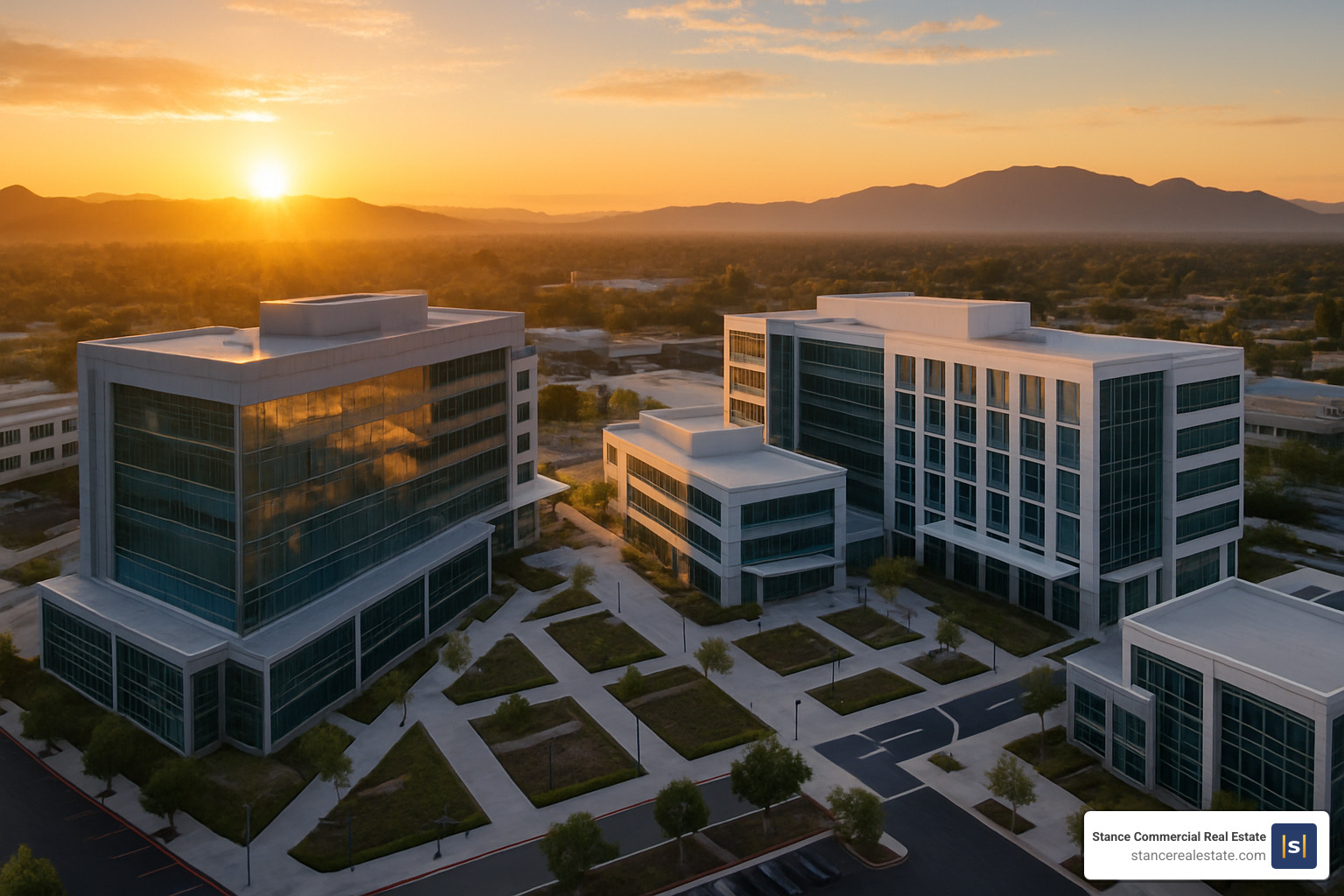
Why Riverside's Healthcare Real Estate Market is Booming
Healthcare-related commercial real estate in Riverside, California, has become one of the Inland Empire’s most competitive sectors. With medical office space in high demand and limited supply—typically only around nine suites available for lease at any given time—vacancy rates remain low, hovering between 5–7%. This tight market signals more than just scarcity; it highlights strong, sustained demand and a resilient healthcare economy. For investors and medical providers alike, this creates a dynamic environment where the right property can offer long-term stability and strong returns.
Key Market Snapshot:
- Vacancy Rate: 5–7% (well below general office space)
- Purchase Prices: $250–$350 per square foot
- Cap Rates: 5.5–7%
- Annual Appreciation: 3–5% in prime corridors
- Parking Requirement: 4.44 spaces per 1,000 SF
- Average Property Size: 30,103 SF
Several forces are powering this boom: an aging population, UC Riverside’s expanding research footprint, and steady migration from coastal counties to the more affordable Inland Empire. Major developments such as the $580 million Wellness Village campus in nearby Mead Valley underscore investor confidence.
Most facilities range from 1,000 SF boutique suites to 10,000 SF multi-specialty centers. Demand is especially strong for urgent care, imaging, and behavioral health practices located near hospital clusters along the 91, 60, and 215 freeways.
I’m Joe Stance, founder of Stance Commercial Real Estate. Over the last eighteen years, I have helped hundreds of providers lease and purchase millions of square feet throughout Riverside. The insights that follow will help you steer this high-demand niche.
Why Riverside’s Healthcare Property Market Matters
Healthcare properties outperform most other commercial asset classes during economic swings thanks to long lease terms and essential-service tenants. Pair that resilience with 3–5% annual value growth and Riverside becomes a compelling location for both providers and investors.
Market Overview of Commercial Real Estate Healthcare Facilities in Riverside, California
The healthcare facilities commercial real estate market in Riverside tells a story of scarcity and opportunity. Picture this: on any given day, only about 9 medical office spaces sit available for lease across the entire Riverside area. That's like having nine parking spots for a hundred cars – it creates some serious competition.
This tight market reflects what we're seeing throughout the Inland Empire. Healthcare providers often find themselves in bidding wars, and the smart ones know they need to move fast when the right property hits the market.
The numbers paint an interesting picture. While Riverside's overall commercial real estate market averages $567 per square foot, medical office purchases typically range from $250 to $350 per square foot. This pricing difference reflects the specialized market with specific location and infrastructure needs.
Most healthcare facilities in our market range from small 1,000 square foot practices to larger 10,000 square foot multi-specialty centers. The average commercial property size in Riverside is 30,103 square feet, but medical facilities tend to be more intimate and patient-focused in their scale.
Investors love medical office properties for good reason. Capitalization rates range from 5.5% to 7%, with the highest quality properties commanding the lowest cap rates. Medical tenants typically sign long-term leases and have excellent payment histories.
Supply & Demand for Healthcare Facilities in Riverside, California
Here's the reality of Riverside's healthcare real estate market: we're dealing with a classic supply shortage. Those 5-7% vacancy rates signal a market where demand consistently outpaces what's available.
Unlike other commercial sectors, we're not seeing much new ground-up construction of medical facilities. Most new supply comes from adaptive reuse projects – taking older office buildings and converting them into medical spaces. Converting an existing building is often faster and more cost-effective than starting from scratch.
Limited new construction reflects the reality of developing medical facilities. The approval process takes longer, development costs run higher, and many developers in the Inland Empire prefer industrial projects right now. This supply constraint supports both rental rates and property values.
Key Growth Drivers
Several powerful forces are driving growth in Riverside's healthcare market. The population boom in the Inland Empire is the big story here. We're talking about 2.41 million residents within a 20-mile radius of nearby Moreno Valley – that's a lot of people who need medical care.
UC Riverside's research growth adds another layer to this story. With over 53,000 students enrolled at local universities, we're seeing demand for both student health services and attracting medical professionals to the area.
The Inland Empire migration pattern is fascinating to watch. Families and healthcare professionals are relocating from higher-cost coastal areas, bringing both patient needs and medical expertise.
The $580 million Wellness Village campus in nearby Mead Valley represents the scale of investment flowing into regional healthcare infrastructure. This 450,000-square-foot integrated behavioral and medical health campus shows that major institutions have serious confidence in our market's long-term growth prospects.
Facility Types Most in Demand
The Riverside market shows clear preferences for specific types of healthcare facilities. Urgent care centers lead the pack, driven by changing patient preferences for convenient, immediate care. These facilities typically need 2,500 to 5,000 square feet with excellent visibility and abundant parking.
Imaging centers represent another high-demand category, though they come with specialized requirements like lead-lined walls for X-ray equipment and reinforced floors for heavy machinery.
Ambulatory surgery centers (ASCs) are increasingly popular as more procedures move from expensive hospital settings to outpatient facilities. These require 5,000 to 10,000 square feet with specialized HVAC systems and medical gas connections.
Behavioral health facilities have seen explosive growth, partly driven by increased awareness and the integration of mental health services into primary care.
Location, Design & Compliance Essentials
Finding the right location for commercial real estate isn't just about square footage and rent - it's about navigating a complex web of regulations, patient needs, and operational requirements that can make or break your practice.
The regulatory landscape starts with zoning verification. Not every commercial zone allows medical offices, and some require conditional use permits for specialized services. OSHPD (Office of Statewide Health Planning and Development) regulations kick in for certain facility types, while ADA compliance goes far beyond basic accessibility.
HIPAA compliance shapes your entire floor plan. Patient consultation areas need proper sound barriers, and records storage requires secure, restricted access zones. These aren't afterthoughts - they're fundamental design elements that affect everything from your initial build-out to daily operations.
Medical Office Space for Lease Riverside listings highlight compliance features as selling points because savvy healthcare providers know these details determine operational success.
Proximity & Accessibility Factors
Hospital clusters create natural medical corridors where everyone benefits. Referral relationships flow more easily when specialists are located near primary care providers and hospital services. Riverside's medical facilities naturally gravitate toward these clusters, creating synergies that help practices thrive.
The 91, 60, and 215 freeway corridors provide regional patient access, but the sweet spot is being within 5-10 minutes of major interchanges while maintaining visibility from arterial roads. Patients want convenience, and staff need reasonable commutes to reduce turnover.
Public transit access matters more than many providers realize. Practices serving diverse patient populations often find that bus route proximity affects patient retention and no-show rates.
Typical Sizes & Specialized Build-Out Features
Healthcare facility sizing in Riverside follows predictable patterns based on practice type and provider count. Small practices typically need 1,000 to 2,500 square feet, while medium practices require 2,500 to 5,000 square feet. Large single-specialty practices often occupy 5,000 to 10,000 square feet.
The 2-3 exam rooms per provider ratio serves as your baseline for space planning, but you'll also need consultation rooms, patient waiting areas, and administrative space.
Specialized build-out features separate medical facilities from standard office space. Improved plumbing systems support multiple sinks and specialized equipment. Dedicated electrical circuits handle medical equipment loads that would overwhelm standard office electrical systems.
HVAC systems with high air exchange rates aren't just comfort features - they're infection control necessities. Sound insulation between exam rooms protects patient privacy and creates the professional environment patients expect.
Regulatory, Zoning & Compliance Checklist
Medical-use zoning verification comes first because everything else depends on it. Some areas require conditional use permits for controlled substances or specialized procedures.
Medical waste disposal requirements exceed standard commercial waste management. You'll need specialized disposal contracts and appropriate storage areas within your facility. Fire codes for medical facilities include improved egress requirements and emergency lighting.
Environmental compliance varies by service type but may include X-ray equipment licensing, hazardous material storage protocols, and air quality monitoring.
Leasing vs. Buying: Process, Best Practices & Financial Analysis
Choosing between leasing and purchasing commercial real estate isn't just about monthly payments - it's about your practice's future and how you want to build wealth over time.
Most new practices start by leasing to keep their cash available for medical equipment, hiring staff, and building patient volume. Established practices often shift toward purchasing once they've proven their location works and want the tax benefits and equity building that comes with ownership.
Lease timelines for medical facilities typically take 6-12 months from your first property tour to seeing your first patient. That includes 3-4 months just for build-out, since medical spaces need specialized plumbing, electrical, and HVAC work. Purchase transactions move faster at 4-6 months, but require more upfront capital.
The Letter of Intent (LOI) stage sets everything in motion. This is where we negotiate your base rent, tenant improvement allowances, lease term, and renewal options. Medical tenants often get higher TI allowances because landlords know you're installing expensive specialized systems they'll benefit from long-term.
SBA loans can be game-changers for healthcare facility purchases. They often require just 10-15% down for owner-occupied medical facilities, compared to 25-30% for conventional commercial loans.
Understanding Commercial Real Estate Lease Agreement terms becomes crucial since medical leases include provisions most other businesses never see.
Step-by-Step Leasing Roadmap
Start with an honest needs assessment at least 6-12 months before you want to move in. I sit down with providers to map out not just their current needs, but where they'll be in five years.
Property tours require a different eye than most commercial spaces. The location and square footage matter, but can you actually deliver quality patient care there? We look at natural light quality, HVAC performance, sound insulation between rooms, and whether the layout supports efficient patient flow.
Negotiation goes way beyond the base rent number. Your total occupancy cost includes common area maintenance, utilities, insurance, and property taxes. Medical practices often have higher utility costs due to specialized equipment running extended hours.
Build-out coordination makes or breaks your timeline. I recommend assembling your full project team - architect, contractor, equipment suppliers, and IT specialists - before you even sign the lease.
Purchase & Investment Workflow
Due diligence for healthcare facilities digs deeper than typical commercial purchases. We verify zoning compliance for your specific medical use, conduct environmental assessments, and review any existing tenant leases if you're buying an investment property.
Financing options vary significantly based on your situation. Conventional commercial mortgages typically require 20-30% down. SBA 504 loans for owner-occupied facilities often provide better terms with lower down payments.
Escrow and closing processes involve additional inspections related to medical equipment, environmental compliance, and regulatory approvals.
Advantages & Disadvantages of Leasing vs. Buying in Riverside
Leasing works best when you need to preserve capital for medical equipment and operations, want flexibility to relocate as your practice grows, or prefer focusing on patient care rather than property management.
Buying makes sense when you want long-term cost control, tax benefits through depreciation and mortgage interest deductions, and the ability to build equity over time. Ownership gives you complete control over facility modifications.
The leasing downside includes ongoing rent payments with no equity building, potential rent increases at renewal, and restrictions on facility modifications.
Buying disadvantages include significant upfront capital requirements, responsibility for all maintenance and repairs, and reduced flexibility to relocate.
How Brokers Add Value
Site selection goes far beyond finding available space. We analyze demographics to ensure sufficient patient volume, map competitors to avoid oversaturated areas, and evaluate traffic patterns for patient accessibility.
Negotiation expertise becomes crucial in Riverside's tight market where multiple offers are common. We structure offers that stand out while protecting your interests.
Compliance guidance helps steer the maze of zoning, ADA, HIPAA, and other regulatory requirements affecting healthcare facilities.
Our Commercial Real Estate Services Industry expertise includes understanding healthcare-specific lease terms and long-term strategic planning for practice growth.
Rental & Investment Metrics
Base rents typically range from $2.50 to $4.00 per square foot annually, with premium locations near major hospitals commanding higher rates.
Net-net-net (NNN) costs add another $1.50 to $3.00 per square foot annually for taxes, insurance, and common area maintenance.
Return on investment scenarios for healthcare facility purchases typically show break-even points of 7-10 years compared to leasing, assuming 3-5% annual appreciation and available tax benefits.
Technology, Incentives & Future Outlook
Technology and public-sector funding are rapidly reshaping commercial real estate.
Emerging Investment Opportunities
- Behavioral health campuses – fastest-growing segment, often backed by long-term government contracts.
- Mixed-use medical developments – pharmacies, healthy food options, and fitness amenities within a single project.
- Value-add conversions – outdated offices turned into compliant medical space at below-market acquisition costs.
- Telehealth-ready suites – smaller, tech-heavy exam rooms paired with robust data infrastructure.
Taken together, these trends point to a Riverside market that will stay tight—and innovative—for years to come.
Frequently Asked Questions about Riverside Healthcare Real Estate
How close should my clinic be to a hospital?
The sweet spot for hospital proximity really depends on what type of practice you're running. If you're in a hospital-dependent specialty like emergency medicine or surgery, you'll want to stay within a 5-minute drive for those urgent patient transfers and emergency consultations that can't wait.
For referral-based specialists, that 10-15 minute range often works beautifully. You're close enough to maintain those crucial referral relationships with hospital physicians, but far enough out to potentially snag better property values. I've worked with imaging centers that found this distance perfect - they could still rush over for emergency reads when needed, but their rent was significantly lower than the properties right next to the hospital.
Primary care practices have more flexibility with location. Your patients care more about convenient parking and easy access from their neighborhoods than whether you're next door to the hospital. That said, you still want reasonable access for those times when you need to refer patients or handle emergencies.
The key is thinking about your daily workflow. How often do you actually need to be at the hospital? How critical is response time for your specialty? These practical considerations should drive your location decision more than any arbitrary distance rule.
What parking ratio is required for an urgent-care facility?
Urgent care facilities need more parking than your typical medical office, and there's a good reason for that. While standard medical offices require 4.44 spaces per 1,000 square feet, urgent care facilities typically need 5-6 spaces per 1,000 square feet due to their walk-in nature and higher patient turnover.
Think about it - regular medical offices work on appointments, so patient flow is somewhat predictable. Urgent care is the opposite. You might have two patients at 2 PM and twelve patients at 6 PM when everyone gets off work with their sick kids.
Peak hour analysis becomes crucial for urgent care parking planning. These facilities see their biggest rushes during evenings and weekends when primary care offices are closed. That's exactly when people realize they can't wait until Monday for that cough or sprained ankle.
One smart solution I've seen work well is shared parking arrangements with complementary businesses. If you're in a mixed-use development, you might share spaces with a business that's busy during your slow hours. Just make sure the arrangement is formal and legally documented.
The bottom line? Don't skimp on parking for urgent care. Nothing frustrates sick patients more than driving around looking for a parking spot when they already feel terrible.
How Stance CRE Can Help You
For healthcare providers entering this market, my advice remains consistent: start early, plan thoroughly, and work with experienced professionals. The tight inventory means good properties move quickly, but the right preparation positions you to act decisively when opportunities arise.
Investors should take note of the unique characteristics that make healthcare real estate so attractive. Long-term leases, stable tenants, and recession-resistant demand create an investment profile that's hard to match in other commercial sectors.
At Stance Commercial Real Estate, we've built our reputation on putting your success first. Our faith-driven approach means we prioritize your long-term success over short-term commissions. When you're ready to explore the opportunities in commercial real estate in Riverside, we're here to guide you through every step of the process with the local expertise and personal attention you deserve.
The healthcare real estate market in Riverside isn't just growing—it's thriving. Whether you're healing patients or building investment portfolios, this market offers the stability, growth potential, and community impact that makes commercial real estate so rewarding.


Understanding Landlord Representation in Commercial Real Estate
Why Landlord Representation Services Are Essential for Property Success
Landlord Representation Services are specialized commercial real estate solutions where licensed brokers act exclusively for property owners to maximize rental income, minimize vacancies, and grow long-term asset value through strategic marketing, tenant screening, and expert lease negotiation.
Key Components of Landlord Representation Services
- Property Marketing & Tenant Attraction – Digital campaigns, broker networks, targeted outreach
- Market Analysis & Pricing Strategy – Data-driven rent optimization and competitive positioning
- Tenant Screening & Risk Management – Financial verification and lease structuring
- Lease Negotiation & Legal Compliance – Terms optimization and regulatory adherence
- Ongoing Asset Management – Retention programs and property repositioning
Professional representation typically trims vacancy periods by up to 30% and lifts rental rates 10-15% compared with self-managed space. By pairing market intelligence with proven leasing tactics, your property becomes the obvious choice for quality tenants.
I’m Joe Stance. Over the past eighteen years in the Inland Empire I’ve guided hundreds of landlords through successful Landlord Representation Services, leasing millions of square feet and protecting their interests. The right representation boosts immediate cash flow and safeguards future value.
Landlord Representation Services Explained
Think of Landlord Representation Services as having a dedicated champion for your commercial property. We're licensed real estate professionals who work exclusively for you, the property owner, to squeeze every dollar of value from your investment while keeping those vacancy signs in storage.
This isn't your typical property management setup. We focus laser-sharp on one thing: making your property the most attractive option in the market. That means developing smart leasing strategies, positioning your building to stand out from the crowd, and negotiating lease terms that protect your wallet and your future.
The agency relationship is key here. When we represent you as a landlord, we have a legal duty to put your interests first. Every decision, every negotiation, every marketing campaign is designed with one goal: maximizing your property's performance.
Our day-to-day work covers the full spectrum of leasing success. We analyze market conditions to price your space competitively, develop targeted marketing campaigns that highlight what makes your property special, and screen potential tenants to ensure they're financially solid and a good fit for your building.
Value creation happens through multiple smart moves: setting rental rates based on real market data, cutting down vacancy time through proven marketing techniques, and structuring lease terms that give you steady cash flow today and security tomorrow. We also spot opportunities where small property improvements can command significantly higher rents.
Whether you own a single office building in Riverside or manage multiple industrial properties across the Inland Empire, our approach adapts to fit your specific investment goals and timeline.
Difference Between Landlord Representation Services and Tenant Representation
Here's where things get interesting. Landlord representation and tenant representation are like two sides of a coin - they serve completely different masters with opposite goals.
| Aspect | Landlord Representation | Tenant Representation |
|---|---|---|
| Primary Goal | Maximize rental income and property value | Minimize occupancy costs and optimize space |
| Negotiation Focus | Higher rents, favorable lease terms, tenant improvements limits | Lower rents, tenant-friendly terms, maximum TI allowances |
| Risk Profile | Minimize vacancy, ensure tenant creditworthiness | Flexibility, expansion options, early termination rights |
| Service Scope | Property marketing, tenant screening, lease structuring | Space search, market analysis, lease negotiation |
| Success Metrics | Occupancy rates, rental income, NOI growth | Cost per square foot, lease flexibility, total occupancy cost |
The bottom line? Tenant representatives fight to save their clients money, while we fight to make you money. When a tenant rep negotiates for lower rent and maximum tenant improvement allowances, we're on the other side pushing for fair market rates and reasonable improvement budgets.
This isn't personal - it's business. Both sides need skilled representation to ensure fair deals. But as your landlord representative, we wake up every morning thinking about how to improve your property's performance and profitability.
Why Landlord Representation Services Matter in Today's Market
Today's commercial real estate market is like trying to hit a moving target while riding a roller coaster. Market volatility, changing tenant expectations, and increased competition make professional representation more valuable than a good cup of coffee on Monday morning.
Every month your property sits vacant is money walking out the door that you'll never see again. Professional landlord representation typically reduces vacancy periods by tapping into established broker networks, running targeted marketing campaigns, and maintaining relationships with active tenants looking for space.
The numbers don't lie: properties with professional landlord representation achieve 10-15% higher rental rates on average compared to owner-managed properties. That's not magic - it's the result of expert market positioning and skilled negotiation.
Tenant turnover costs can eat into your profits faster than you'd expect. Professional representation can decrease turnover by up to 25% through proactive tenant retention programs and relationship management that keeps good tenants happy and signing renewal leases.
Current market trends show tenants increasingly want flexible lease terms, sustainable building features, and technology-enabled spaces. We stay on top of these shifts, helping position your property to attract today's tenants while maintaining strong investment returns that make sense for your bottom line.
Core Responsibilities & Value Drivers
When you work with Landlord Representation Services, you're getting much more than someone to show your property. You're partnering with professionals who understand that every decision impacts your bottom line and long-term investment success.
Market analysis is where everything starts. We're constantly watching what's happening in your neighborhood and across the Inland Empire. Are new businesses moving in? Is there a construction boom affecting supply? What are tenants actually paying for similar spaces? This isn't guesswork – it's data-driven intelligence that helps us position your property to win.
Think of pricing strategy as finding that sweet spot where you attract great tenants without leaving money on the table. We look at comparable properties, but we also dig deeper. Maybe your building has that extra parking everyone wants, or you're closer to the freeway than your competition. These advantages can justify higher rents when positioned correctly.
Targeted marketing means your property gets seen by the right people at the right time. We're not just throwing up a "For Lease" sign and hoping for the best. Professional photos, detailed property specs, and strategic distribution through broker networks and online platforms ensure qualified prospects know about your space.
Tenant screening protects your investment from day one. We thoroughly vet potential tenants' finances, check references, and review their business plans. It's much easier to say no to a risky tenant upfront than to deal with payment problems or early lease breaks later.
When it comes to lease negotiation, this is where our experience really pays off. We structure deals that attract quality tenants while protecting your interests through appropriate security deposits, rent escalations, and lease terms that make sense for your property type and market conditions.
Market Knowledge & Research
Knowledge is power in commercial real estate, and we make it our business to know everything happening in your market. The difference between good representation and great representation often comes down to having the most current, accurate information when making decisions.
Macro trends paint the big picture. Interest rates, employment levels, and industry growth patterns all influence tenant demand. When we see major employers expanding in Riverside or new infrastructure projects breaking ground, we know how these changes might affect your property's value and rental potential.
Micro trends get down to the details that really matter for your specific property. We track absorption rates in your immediate area, monitor new construction that could create competition, and watch tenant movement patterns. This granular analysis helps us price your space competitively and spot opportunities before they become obvious to everyone else.
Understanding vacancy rates requires local market expertise because they vary dramatically by property type and location. What works in downtown Riverside might not apply to industrial properties in the outskirts, and we know these nuances matter for your success.
For property owners serious about maximizing returns, Managing Commercial Property Expenses becomes crucial for maintaining competitive operating costs while growing net operating income.
Tenant Attraction & Retention Programs
Finding great tenants requires casting a wide net with the right bait. Our digital campaigns use search engine optimization and targeted online advertising to ensure your property appears when tenants are actively searching. We're not just posting listings – we're creating compelling content that makes prospects want to learn more.
Broker networks remain incredibly important because many commercial deals involve tenant representatives. We maintain strong relationships with tenant brokers throughout the Inland Empire, ensuring your property gets maximum exposure to qualified prospects who might be perfect fits.
Relationship management extends far beyond lease signing. We stay in regular contact with existing tenants, addressing concerns quickly and identifying opportunities for renewals or expansions before tenants start looking elsewhere. Happy tenants are profitable tenants.
Following tenant screening guidance from the Federal Trade Commission ensures our evaluation process remains fair and legal while protecting your interests.
Lease Structuring & Negotiation Power
Great lease negotiation creates win-win outcomes that support long-term relationships while protecting your investment. We're not trying to squeeze every penny from tenants – we're structuring deals that make sense for everyone involved.
Rent escalations protect your income from inflation while staying competitive. We structure these increases based on current market conditions, your property type, and lease length. The goal is ensuring your rental income grows appropriately without pricing out good tenants.
Tenant improvement allowances require careful balance. Too little and you can't attract tenants; too much and you're giving away profit. We analyze market standards and specific tenant needs to negotiate TI packages that facilitate deals without excessive owner investment.
Security deposits and personal guarantees provide crucial protection against tenant default. We evaluate each tenant's creditworthiness to determine appropriate security requirements – enough protection for you, but not so much that we scare away good prospects.
Understanding Commercial Real Estate Lease Agreement fundamentals helps property owners appreciate why professional lease negotiation and structuring makes such a difference in long-term success.
How Representatives Maximize Occupancy & Income
The secret to maximizing your property's performance isn't just finding tenants—it's creating a systematic approach that keeps spaces filled with quality tenants paying optimal rents. Landlord Representation Services achieve this through strategic planning that addresses every aspect of your property's income potential.
Vacancy minimization starts long before your current tenants even think about leaving. We maintain detailed tracking of every lease expiration and begin conversations about renewals 12-18 months in advance. This gives us plenty of time to address any concerns your tenants might have and negotiate terms that work for everyone.
When we do need to find new tenants, our proactive approach means we're already marketing your space while current tenants are still occupying it. This overlap dramatically reduces the dreaded "dark periods" that eat into your profits.
Rent optimization requires constant attention to market conditions. We're not just looking at what similar properties are charging—we're analyzing why some properties command premium rents while others sit empty. Your property's unique advantages, whether it's superior parking, flexible floor plates, or an ideal location, become the foundation for achieving above-market rents.
The numbers tell the story: properties with professional landlord representation typically achieve 10-15% higher rental rates and reduce vacancy periods by up to 30%. That's real money back in your pocket.
Data-Driven Marketing Strategies
Today's tenants start their space search online, which means your property needs to shine in digital channels. Our data-driven marketing strategies ensure your space gets seen by the right prospects at the right time.
SEO optimization for property listings means when a tenant searches for "office space near Riverside" or "industrial warehouse Inland Empire," your property appears at the top of their results. We craft property descriptions using the exact terms tenants are searching for, making sure your space gets maximum visibility.
Social media marketing extends your reach beyond traditional commercial real estate channels. Professional photography and targeted advertising help showcase your property's personality and unique features to a broader audience. Sometimes the perfect tenant finds your space through a well-placed LinkedIn post or Facebook ad.
Drone tours and virtual reality technology have revolutionized how we market properties. Prospective tenants can experience your space from anywhere, which is especially valuable for out-of-area businesses or during times when in-person tours aren't practical.
Community positioning highlights the advantages of your property's location. We don't just mention that you're "conveniently located"—we explain how your location helps tenants' businesses succeed. Easy freeway access reduces employee commute stress. Nearby restaurants and services keep workers happy. Proximity to suppliers or customers improves operational efficiency.
Financial & Legal Risk Management
Protecting your investment requires vigilant attention to both financial and legal risks throughout the leasing process. Our systematic approach identifies potential problems early and implements safeguards that protect your interests.
Credit checks and financial analysis go beyond basic credit scores. We review financial statements, analyze cash flow patterns, and check business references to ensure prospective tenants can fulfill their lease obligations for the entire term.
Lease auditing involves regular review of existing agreements to ensure compliance and identify opportunities. We monitor rent escalations to make sure you're receiving proper increases, track expense recoveries to ensure accurate billing, and watch lease option deadlines that could impact your property's future.
Compliance review covers multiple regulatory areas that could expose you to liability. From ADA accessibility requirements to environmental regulations, we ensure your lease agreements include appropriate compliance provisions and that your property meets all applicable legal standards.
Selecting a Top-Tier Landlord Representation Service
Finding the right Landlord Representation Services partner can make the difference between a property that struggles with vacancies and one that consistently generates strong returns. After helping hundreds of property owners over the past decade, I've seen how the right representation transforms investment outcomes.
The selection process goes far beyond checking basic credentials. You need someone who truly understands your property type, knows your local market inside and out, and shares your commitment to maximizing long-term value.
Local expertise makes an enormous difference in commercial real estate. Market knowledge, established broker relationships, and understanding of local regulations all contribute to faster leasing and better terms. Here in Riverside and throughout the Inland Empire, we've built these relationships over years of consistent, ethical business practices.
Performance metrics should be clearly defined and regularly reported. Look for representatives who can share specific data on their average vacancy periods, rental rate achievements, and tenant retention rates. These numbers tell the real story of representation effectiveness, not just marketing promises.
Checklist for Evaluating Landlord Representation Services
A systematic approach helps you compare potential representatives objectively. Start by requesting references from current and former clients with similar properties. Don't just ask for names – dig into specific results and measurable outcomes they achieved.
Market knowledge separates good representatives from great ones. Ask about their familiarity with your property type and local market conditions. Can they discuss recent comparable transactions? Do they understand current tenant demands and market trends affecting your property?
Review their marketing toolkit and capabilities. Modern landlord representation requires sophisticated digital marketing, professional photography, and access to multiple listing platforms. Their marketing materials should look professional and highlight properties effectively.
Negotiation success becomes evident through examples of lease structures they've achieved. Look for representatives who can balance competitive positioning with appropriate risk management.
For comprehensive information about our approach to property owner representation, visit our Landlords page to see how we structure our services and measure success.
Questions to Ask Prospective Representatives
The right questions reveal both technical competence and working relationship compatibility. Start with service scope questions: What specific services are included? How do they develop leasing strategies? What's their approach to tenant screening and qualification?
Performance expectations require honest discussion. What are realistic vacancy targets for your property type and market? How do they measure success? What's their average time-to-lease for similar properties?
Ask about their marketing approach and budget. How do they reach prospective tenants? What digital marketing tools do they use? How do they differentiate properties in competitive markets?
Communication and reporting preferences need alignment from the start. How frequently will you receive updates? What information is included in performance reports? How do they handle urgent situations?
Finally, test their market knowledge and strategic thinking. How do they stay current on market trends? What's their assessment of current conditions for your property? How do they determine appropriate rental rates?
Frequently Asked Questions about Landlord Representation Services
What is the typical fee structure for Landlord Representation Services?
Most Landlord Representation Services work on a commission basis, which means you only pay when we successfully lease your space. It's a performance-based approach that aligns our interests with yours – we succeed when you succeed.
Commission rates typically range from 3-6% of the total lease value for most office and retail properties. The exact percentage depends on several factors: your property type, the lease length, and current market conditions in your area.
Here's something interesting about how lease terms affect pricing: longer leases often carry higher total commissions but actually cost you less per year. A five-year lease might carry a 4% commission, while a ten-year lease could be 6% total – but that 6% is spread over twice as many years, making your annual representation cost lower.
Some high-value or complex properties involve retainer agreements with exclusive representation. These retainers get credited toward your final commission, but they ensure your property receives dedicated attention and resources from day one.
Performance bonuses are becoming more common, especially when we exceed your expectations. These might kick in when we achieve rental rates above certain targets, fill vacancies faster than market averages, or secure particularly strong tenants for your property.
The investment typically pays for itself quickly. Properties with professional representation achieve 10-15% higher rental rates on average, often more than covering the representation costs while reducing your vacancy periods.
How long does it take to fill a vacancy with professional representation?
The honest answer is: it depends on your property and market conditions. But professional representation consistently reduces vacancy periods compared to going it alone, mainly because we have established relationships and know exactly where to find qualified tenants.
Office properties in healthy markets typically lease within 3-6 months with professional representation. In more challenging markets or for properties needing improvements, this can extend to 9-12 months. Location, building condition, and how we position your property against competitors all play major roles in timing.
Industrial properties often move faster – usually 2-4 months – because there's typically less available inventory in most markets. However, if your industrial space requires specialized improvements or serves a very specific use, it might take longer to find the right tenant match.
Retail properties face unique challenges in today's changing market, with leasing timelines often running 6-12 months or longer. The retail landscape has shifted dramatically, requiring specialized marketing approaches and very careful tenant selection to ensure long-term success.
Property class makes a significant difference in timing. Class A properties generally lease faster than Class B or C buildings. However, professional representation helps lower-class properties compete more effectively through strategic positioning and targeted marketing campaigns.
Market conditions beyond our control – overall vacancy rates, new construction coming online, and broader economic factors – all influence timing. The advantage of professional representation is that we monitor these variables constantly and adjust our strategies to minimize your vacancy periods.
How Stance CRE Can Help You
At Stance Commercial Real Estate, we've built our reputation on a simple idea: your success comes first. That means we're not interested in quick deals that look good on paper but fall apart later. We want long-term relationships with property owners who see real results from our partnership.
Our deep roots in Riverside and the Inland Empire give us advantages that out-of-area firms simply can't match. We know which tenants are expanding, which buildings are struggling, and what's driving demand in each submarket. This local knowledge translates directly into faster leasing and better terms for your property.
The numbers tell the story. Professional Landlord Representation Services typically increase rental income by 10-15% while reducing vacancy periods by up to 30%. When you factor in the stress reduction and time savings, the return on investment becomes even more compelling.
But it's not just about the money. It's about having a trusted partner who understands your goals and works tirelessly to achieve them. Someone who answers the phone when tenants call with problems, who knows how to structure leases that protect your interests, and who can spot opportunities before they become obvious to everyone else.
Whether you own a single office building or manage a portfolio across the region, we adapt our approach to fit your specific situation. No cookie-cutter solutions or one-size-fits-all strategies—just personalized service that delivers measurable results.
Ready to see what professional representation can do for your property? We'd love to show you how our proven approach can maximize your investment returns while minimizing the day-to-day hassles of property ownership. Check out what we do and let's start a conversation about your property's potential.
Your investment deserves expert representation. We're here to deliver it with the professionalism, market knowledge, and personal attention that sets successful properties apart from the rest.