


The BRRRR Method: A Step-by-Step Guide to Real Estate Success
Understanding the BRRRR Investing Strategy for Commercial Real Estate Success
Modern commercial properties in the Inland Empire showcasing investment opportunities for the BRRRR strategy
The brrrr investing strategy is a proven method for rapidly building a commercial real estate portfolio. This five-step process allows investors to recycle their initial investment into multiple properties, creating a powerful wealth-building cycle by forcing appreciation and generating passive income.
Here's how the BRRRR method works:
- Buy - Acquire an undervalued commercial property below market value.
- Rehab - Renovate to increase property value and rental appeal.
- Rent - Secure quality tenants to generate positive cash flow.
- Refinance - Pull out equity based on the improved property value.
- Repeat - Use the extracted capital to purchase the next property.
This strategy enables you to build a portfolio with minimal personal capital, achieve higher returns than traditional buy-and-hold strategies, and scale your investments efficiently.
As Joe Stance, founder of Stance Commercial Real Estate, I've seen how the brrrr investing strategy thrives in our dynamic Inland Empire market. With over eighteen years of experience in Riverside, my team has guided countless investors through this process, leveraging the area's tremendous value-add potential.
Deconstructing the BRRRR Method: The Five Core Stages
The BRRRR investing strategy is a powerful wealth-building machine, but each stage requires careful planning and execution. Let's walk through each step to see how it works in the real world.
Step 1: Buy – Acquiring the Right Commercial Property
The foundation of a successful BRRRR investing strategy is finding the right deal. We're looking for undervalued commercial assets with untapped potential-the diamonds in the rough that other investors overlook. These are often distressed properties, such as buildings facing foreclosure or those owned by landlords who have deferred maintenance. Off-market deals, found through networking and relationship building, are also gold mines.
Before purchasing, a thorough market analysis is critical to calculate the After Repair Value (ARV)-what the property will be worth after your improvements. The 70% rule is a helpful guideline: you shouldn't pay more than 70% of the ARV minus renovation costs. For example, if a property's ARV is $800,000 and rehab costs are $80,000, your maximum offer should be around $480,000 ($800,000 x 0.70 - $80,000).
Due diligence is non-negotiable. Inspect the property from foundation to roof, review existing leases, and verify permits. For financing the initial purchase, many investors use short-term hard money loans or private lenders for their speed and flexibility. For more guidance, see our guide on How to Invest in Commercial Real Estate.
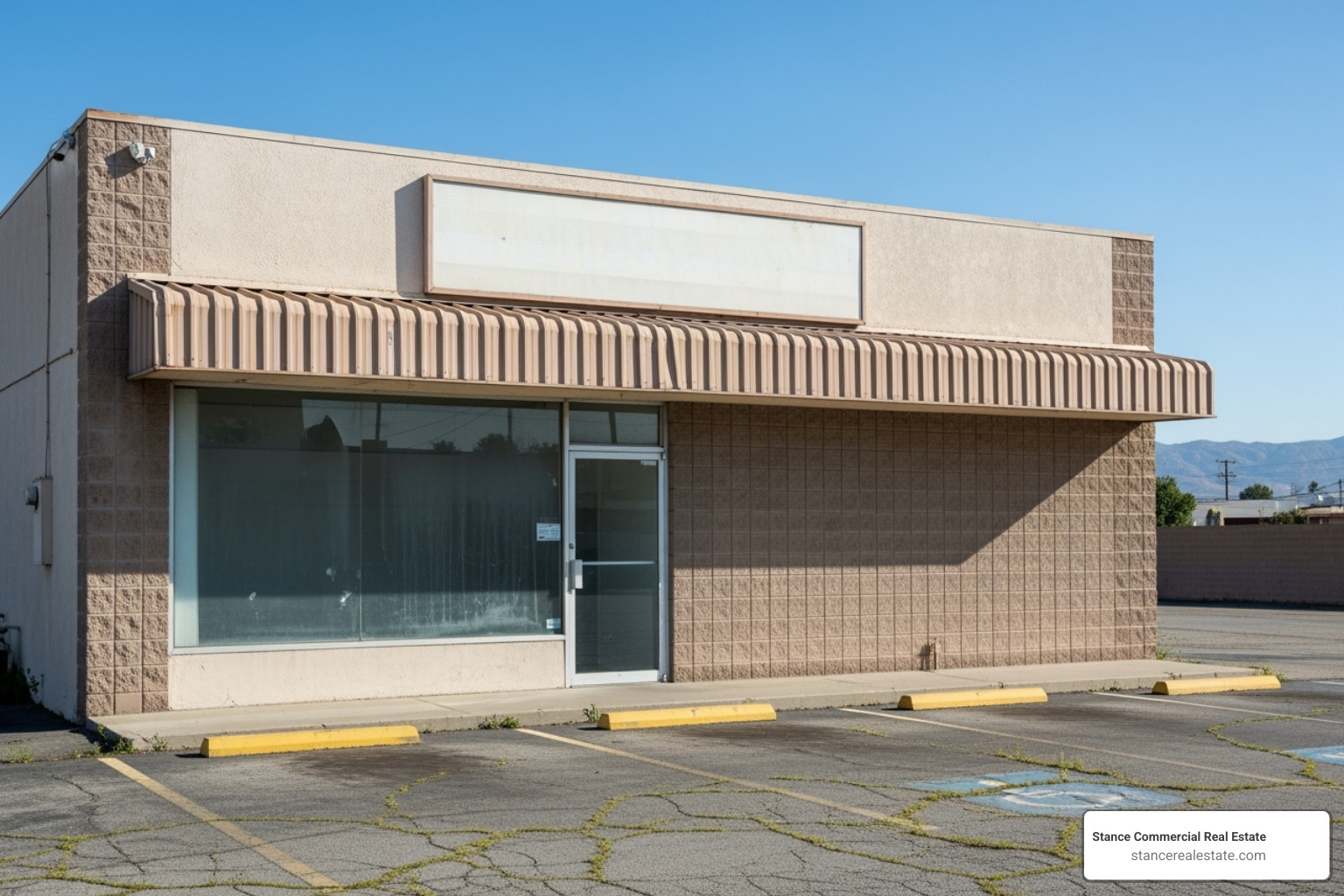
A vacant retail storefront in the Inland Empire, ripe for a BRRRR change.
Step 2: Rehab – Forcing Appreciation Through Renovation
The rehab phase is where you create forced appreciation, actively increasing your property's value. Focus on smart renovations that deliver the highest ROI on upgrades. For commercial properties, this often means facade updates, HVAC system upgrades, or reconfiguring floor plans to meet modern business needs. For industrial properties, increasing clear ceiling height or adding loading docks can significantly boost rental rates.
Effective project management is crucial. You'll need to coordinate contractors, manage timelines, and stay within budget, always including a 10-15% contingency for unexpected issues. Building relationships with reliable commercial contractors makes all the difference, as they can prevent costly delays and ensure quality work. You're renovating to appeal to commercial tenants and future buyers. For more on strategic improvements, explore our guide on Commercial Building Investment.
Step 3: Rent – Stabilizing the Asset and Generating Cash Flow
With renovations complete, it's time to find quality tenants to create stable, predictable income. This requires smart marketing and thorough screening. Commercial leasing has unique structures; you'll encounter net leases (often called NNN leases, where tenants pay most expenses) or gross leases (where you cover them). Understanding which structure fits your property and market is key.
Tenant screening for businesses involves reviewing financial statements and understanding their business model. Setting competitive rental rates is a balance-price too high and you'll sit vacant, too low and you leave money on the table. Your goal is to achieve positive cash flow and a healthy Debt service coverage ratio (DSCR). Lenders typically want to see a DSCR of at least 1.25, meaning your income is 25% higher than your debt payments. Learn more about building income streams in our article on Commercial Real Estate Passive Income Explained.
Step 4: Refinance – Recouping Your Capital for Reinvestment
This is where the magic happens. Your renovated, tenanted property is now worth significantly more, and it's time to open up that equity with a cash-out refinance. The process starts with a new property appraisal. Lenders will then offer a new loan based on a percentage of this higher value-typically 70-80% loan-to-value (LTV) for commercial properties.
Lenders will require proof of stable rental income and a good DSCR. Some also have a seasoning period, requiring you to own the property for six to twelve months. For example, if you bought a property for $400,000, spent $100,000 on rehab, and it now appraises for $750,000, a 75% LTV loan would be $562,500. After paying off your initial $500,000 costs, you'd get $62,500 back to reinvest. This recycling capital is the engine of the BRRRR strategy. Learn more about evaluating opportunities at What is a Good Cap Rate for Commercial Real Estate.
Step 5: Repeat – Scaling Your Commercial Real Estate Portfolio
Now you're ready to do it all over again. Portfolio growth through the BRRRR investing strategy creates a snowball effect, where each successful project funds the next. With each cycle, you gain experience, build relationships, and benefit from economies of scale. This disciplined approach is how you build long-term wealth and a commercial empire, one property at a time. For tools to track your portfolio, visit Commercial Real Estate Portfolio Analysis.
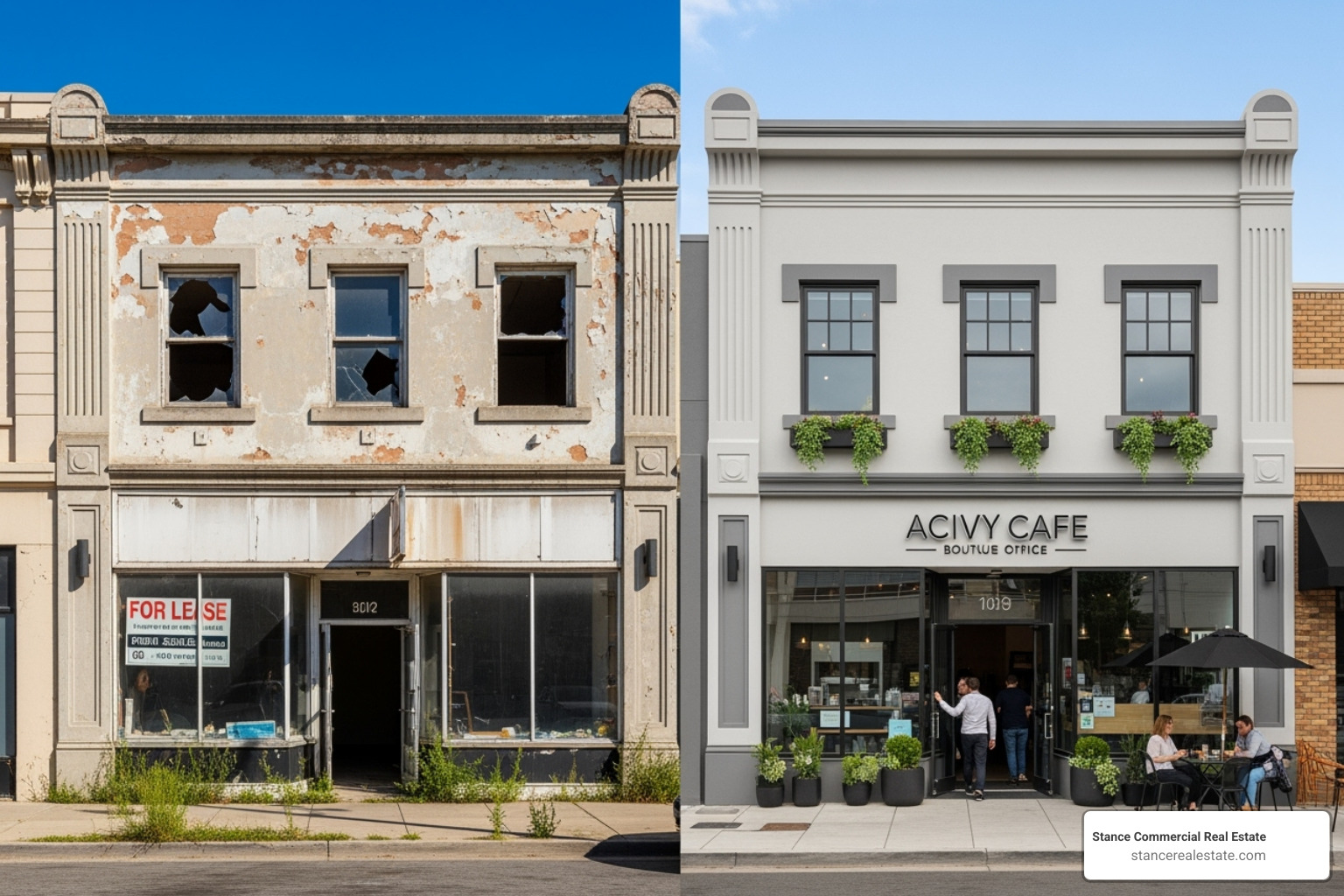
Before and after: A dilapidated commercial property transformed into a thriving, tenanted asset through the BRRRR strategy.
The BRRRR Investing Strategy: A Balanced Look at Benefits and Risks
Like any investment strategy, the BRRRR method has significant upsides and potential pitfalls. Success requires patience, dedication, and a realistic understanding of what you're getting into.
The Powerful Benefits of the BRRRR Investing Strategy
The allure of the brrrr investing strategy is its power to accelerate wealth creation. The primary benefits include rapid portfolio expansion by recycling the same capital, and a high return on investment, often leading to low-money-in deals. You're not waiting for the market to improve; you're creating value through forced appreciation with strategic renovations. Once stabilized, these properties generate consistent passive cash flow, building substantial long-term wealth as you repeat the process. For more on building these income streams, explore The Ultimate Guide to Generating Passive Income.
Navigating the Risks and Potential Pitfalls
It's crucial to be aware of the risks. The BRRRR method is not a guaranteed path to riches and requires careful management to avoid common pitfalls.
- Overleveraging: Acquiring properties quickly can be intoxicating, but taking on too much debt makes your portfolio vulnerable to market shifts or tenant issues.
- Market Risk: Economic downturns can impact property values and your ability to find tenants, potentially leading to appraisal gaps during the refinance stage.
- Renovation Issues: Cost overruns and construction delays are common. A $50,000 rehab budget can easily swell, and every month of delay is a month of carrying costs without income.
- Extended Vacancies: Finding the right commercial tenant can take time. Meanwhile, mortgage payments and operating costs continue.
- Refinancing Difficulties: Lending standards and interest rates can change, making it harder to qualify for a refinance or reducing the amount of cash you can extract.
Managing these risks requires thorough preparation, conservative budgeting, and a strong team of professionals. For investors seeking different risk profiles, consider exploring Low Risk Real Estate Investing Strategy options.
BRRRR vs. Other Commercial Real Estate Strategies
Understanding how the brrrr investing strategy stacks up against other popular investment approaches helps clarify when it's the right tool for the job. Each method suits different goals, timelines, and risk tolerances.
Here's a comparison of three common strategies:
| Criteria | BRRRR Investing Strategy | Traditional Buy-and-Hold | Commercial Flipping |
|---|---|---|---|
| Capital Required | Low (recycled) | Moderate to High | Moderate to High |
| Timeline | Medium-term (3-12 months/cycle) | Long-term (years) | Short-term (3-12 months) |
| Risk Level | Medium-High | Medium | High |
| Primary Goal | Portfolio Growth & Cash Flow | Passive Cash Flow & Appreciation | Capital Gain |
| Management Intensity | High (initially), then Moderate | Low to Moderate | High |
The BRRRR method's unique advantage is its focus on capital recycling, allowing for rapid portfolio growth funded by the assets themselves. It contrasts with flipping, which targets a single capital gain, and traditional buy-and-hold, where capital remains tied up in one property for long-term, slower growth. For a broader overview of your options, check out Different Real Estate Investment Strategies.
Essential Skills for a Successful BRRRR Investing Strategy
Executing the BRRRR method requires more than just capital; it demands a specific set of skills. Mastering these is key to navigating the complexities of each deal.
An investor reviews blueprints and financial documents on a commercial construction site.
- Market Knowledge: You need a deep understanding of local property values, rental rates, and economic trends to spot opportunities.
- Deal Analysis: Accurately calculating the After Repair Value (ARV) and applying metrics like the 70% rule is crucial for ensuring a deal is profitable from the start.
- Project Management: You must effectively coordinate contractors, manage budgets, and oversee timelines to keep the rehab phase on track and avoid costly overruns.
- Negotiation Skills: Strong negotiation is vital when dealing with sellers, lenders, contractors, and tenants to protect your bottom line at every stage.
- Financial Literacy: Understanding commercial financing, from loan-to-value ratios to debt service coverage, is essential for securing the right loans.
The brrrr investing strategy is not a solo endeavor. Success depends on building a reliable team of commercial contractors, lenders, and real estate agents who have deep local expertise. At Stance Commercial Real Estate, we've spent decades building these relationships in the Riverside market to help investors execute their vision with confidence. To learn more, see The Insiders Guide to Commercial Real Estate Services and Investments.
Frequently Asked Questions about the BRRRR Method
Here are answers to the most common questions we hear from investors considering the brrrr investing strategy for commercial real estate.
How do you finance the initial purchase and rehab of a BRRRR property?
Financing the 'Buy' and 'Rehab' stages typically involves short-term solutions like hard money loans, private money lenders, or a commercial line of credit. These options offer the speed and flexibility needed to acquire a property and fund renovations. They are designed to be temporary and are paid off during the 'Refinance' stage, when you secure a long-term, conventional commercial mortgage based on the property's higher After Repair Value (ARV).
What makes a good commercial property for the BRRRR method?
A good BRRRR candidate is an undervalued property with significant value-add potential in a solid location. In the Inland Empire, this could be a Class C office building that can be upgraded, a retail strip with high vacancy due to poor management, or an older warehouse needing modernization like higher ceilings or more loading docks. The key is finding a property where you can force appreciation through renovation and attract quality tenants who will pay higher rents.
Are there specific considerations for BRRRR in Canada versus the U.S.?
Yes. While the core brrrr investing strategy is the same, the execution differs. In Canada, cash-out refinancing can be more conservative, potentially limiting the capital you can extract. In the United States, lenders often have "seasoning" requirements, meaning you must hold the property for a period (typically 6-12 months) before refinancing. Tax laws and financing regulations also vary significantly. Partnering with local experts who understand these regional nuances is essential for success in either country.
How Stance CRE Can Help You
The brrrr investing strategy is a dynamic method that transforms investment dollars into a powerful engine for portfolio growth. Instead of tying up capital for years, you strategically renovate undervalued commercial properties and extract your investment through refinancing, using the same money to build wealth over and over again.
Success with BRRRR requires diligence, deep market expertise, and a strong professional team. This is where local knowledge becomes invaluable. The Inland Empire has unique characteristics, and understanding its commercial growth patterns, renovation costs, and key players can make or break a deal.
At Stance Commercial Real Estate, we have spent decades building this exact expertise in the Riverside and Inland Empire markets. We help investors analyze opportunities through the lens of the entire BRRRR cycle, from identifying undervalued assets to ensuring a profitable exit through refinancing. Our goal is to help you create long-term wealth through strategic reinvestment and value creation.
Ready to build your commercial real estate portfolio? See what we do.
