

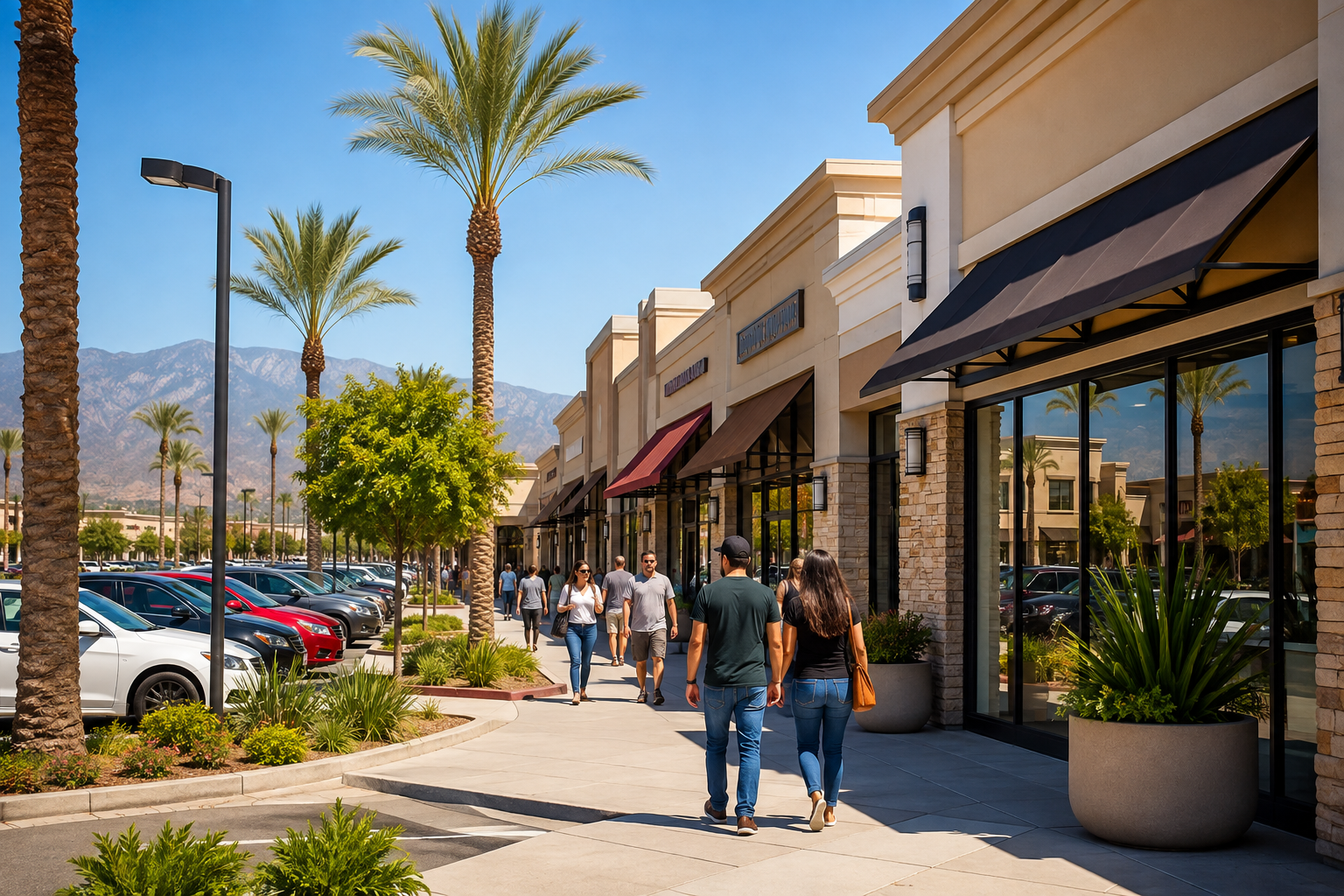
What Makes a Retail Location Successful?
Finding a storefront is relatively easy. Finding a retail location that gives a business the right conditions to attract customers, operate efficiently, build awareness, and remain profitable over time requires much more thought.
A successful retail location is rarely defined by one factor. High traffic counts can be valuable, but traffic means little if the people passing the property are not part of the retailer's target market. An attractive shopping center may create a strong first impression, but poor access can discourage repeat visits. Even an affordable retail space for lease can become expensive when weak visibility, inadequate parking, or an unsuitable tenant mix limits sales.
The Right Customers Matter More Than the Largest Crowd
One of the first questions businesses ask about a potential retail location is how much traffic passes the property. Vehicle counts and pedestrian activity deserve attention, but raw numbers do not tell the entire story. The more important question is whether those people are likely customers.
A specialty boutique, quick-service restaurant, medical retailer, neighborhood market, and furniture showroom can have completely different ideal trade areas. Before committing to a commercial space, businesses should examine population characteristics, household income, daytime employment, nearby residential development, customer age ranges, spending habits, and other factors relevant to their particular concept.
This is especially important in Riverside County because one neighborhood can behave differently from another only a few miles away. Riverside itself illustrates the size of the opportunity.
Those numbers are impressive, but successful retail real estate decisions go deeper. A business needs to understand the smaller trade area surrounding an individual property. The best location is where the characteristics of the surrounding customers closely match the people most likely to buy the product or service.
Visibility Helps Turn Traffic Into Customers
A retailer cannot benefit from passing traffic if potential customers never notice the business. Visibility remains one of the most practical advantages a retail property can provide.
Businesses evaluating retail space for rent in Riverside, CA should consider sightlines from major streets, building orientation, monument signage, storefront exposure, landscaping, neighboring structures, and the speed at which vehicles pass the property. A storefront visible for several seconds while drivers approach an intersection can have significantly greater practical exposure than a building hidden behind another structure.
Signage is equally important. Retailers should investigate what signage is permitted before signing a lease rather than assuming that a preferred sign can be installed later. Building signs, monument signs, window graphics, and directional signs can all influence how easily customers recognize and locate a business.
Visibility is particularly valuable in a city like Riverside, where major commercial corridors coexist with established neighborhoods and smaller community-oriented shopping districts. Riverside is a substantial Southern California city, yet many parts of it still have the familiar feeling of a smaller community. Customers develop routines around favorite shopping centers, restaurants, coffee shops, service businesses, and neighborhood corridors. Becoming visible within those routines can be enormously valuable.
Easy Access Can Be Just as Important as Exposure
A highly visible retail property can still struggle when getting into it is frustrating. Customers generally want convenience, particularly when they are making frequent or relatively small purchases.
When comparing Riverside retail spaces, business owners should physically drive the surrounding streets rather than evaluating access exclusively from a map. Can customers turn into the property from both directions? Is there a traffic signal nearby? Does a center have multiple entrances? Is the driveway obvious? Are customers forced to make a U-turn? Does congestion make entering or leaving difficult during peak periods?
Parking deserves the same scrutiny. The total number of spaces does not necessarily reveal how well parking functions. A retailer should consider where those spaces are located, how heavily neighboring tenants use them, whether employees occupy prime customer spaces, and what the parking lot looks like during the busiest periods of the day.
Accessibility should also reflect the habits of the target customer. Some concepts depend heavily on automobiles, while others benefit from pedestrian connections, public transportation, nearby offices, residential density, or a combination of several transportation patterns. The correct accessibility profile depends on how customers actually reach the business.
Neighboring Tenants Can Strengthen a Retail Location
A retailer does not operate in isolation. In a multi-tenant center, surrounding businesses can significantly influence customer traffic and the overall perception of a location.
Businesses should look beyond whether neighboring tenants appear successful. They should consider whether those tenants attract compatible customers. Two businesses do not need to sell related products to benefit each other. They simply need overlapping customer profiles or shopping patterns.
The strongest retail centers often contain complementary businesses that give customers several reasons to visit. Fitness concepts may bring customers early in the morning and after work. Medical and service businesses can create daytime traffic. A grocery store might generate frequent trips that benefit a nearby restaurant, salon, fitness studio, service provider, or specialty retailer. Restaurants can extend activity into evenings.
Competition also requires context. A competing business nearby is not automatically negative. In some categories, clustering creates a recognized destination that attracts more customers to the area. In others, a nearby competitor may divide a limited customer base. Effective commercial real estate site selection considers both complementary businesses and direct competitors before determining whether the surrounding environment supports the concept.
The Economics of the Space Must Support the Business
A beautiful storefront in a popular center is not automatically a successful retail location if occupancy expenses place too much pressure on the business.
Businesses evaluating retail space need to understand the complete cost of occupancy. Base rent is only the starting point. Depending on the lease structure, additional expenses can include common area maintenance charges, property taxes, insurance, utilities, maintenance responsibilities, signage, improvements, and other operating costs.
The lowest rent does not automatically represent the best deal, either. A more expensive location can sometimes justify its cost through stronger customer traffic, superior visibility, convenient parking, better neighboring tenants, or a more valuable trade area. Conversely, paying premium rent for advantages that do not matter to the business can weaken profitability.
This is where site selection and financial planning intersect. Businesses should evaluate projected sales against total occupancy expenses and consider how those costs could change throughout the lease term. A retail property should support the operating model rather than forcing the operating model to support the property.
Riverside Offers Distinct Retail Trade Areas
Riverside is particularly interesting for retailers because it combines the scale of a regional economic center with neighborhoods that retain distinct personalities. Downtown, established residential neighborhoods, freeway-oriented commercial areas, university-influenced districts, and suburban retail corridors can serve noticeably different customer bases.
The City of Riverside Economic Development data dashboard estimates a population of roughly 2.7 million people within a 20-mile radius of the city and a Riverside trade-area population exceeding 1.86 million. The city also reports a 2024 average household income of approximately $113,485. These figures help illustrate why commercial real estate in Riverside, CA continues to attract retailers, investors, and businesses.
Yet Riverside's appeal is not limited to statistics. There is an approachable quality to doing business here. A customer can shop at a major retail center and, a short drive later, stop at a locally owned restaurant where familiar faces are part of the experience. Historic neighborhoods, tree-lined streets, established shopping districts, universities, healthcare facilities, and newer development all contribute to a city that is large enough to generate substantial commercial activity without completely losing its hometown character.
For retailers, that makes local knowledge particularly important. Two properties that appear comparable on paper may serve very different customer patterns because of neighborhood identity, traffic flow, nearby employers, schools, residential areas, or established shopping habits.
A Successful Site Must Work Five or Ten Years From Now
Retailers should not select a property solely according to present conditions. Most commercial leases create a multi-year commitment, so businesses need to consider what could happen around a property during that period.
Planned residential development can expand a customer base. New employers can increase daytime population. Infrastructure improvements can make an area easier to reach. Conversely, road construction, changing traffic patterns, major tenant vacancies, or new competitive projects can alter the attractiveness of a location.
Modern retailers have access to increasingly sophisticated data for evaluating these possibilities. Retailers can now analyze demographic information, foot traffic, consumer spending, competitive intelligence, and predictive information when evaluating expansion opportunities.
Data is valuable, but it works best when paired with firsthand market knowledge. Walking a property, driving surrounding streets at different times, observing customer behavior, studying neighboring tenants, and understanding upcoming local developments can reveal information that spreadsheets alone may overlook.
The Physical Space Has to Fit the Retail Concept
Location is not only about where the building sits. The building itself must support the business.
A retailer searching for commercial space should evaluate square footage, storefront width, ceiling height, storage, loading access, utility capacity, HVAC, plumbing, restrooms, accessibility requirements, floor plan efficiency, and opportunities for signage. Restaurants may require grease interceptors, venting, specialized electrical service, or patio opportunities. Service businesses may prioritize private rooms. Traditional retailers may need open merchandising areas and strong storefront exposure.
The condition of the premises also affects startup costs. A second-generation retail or restaurant space may contain improvements that reduce the cost and time required to open, although existing improvements should always be evaluated carefully rather than assumed to be usable.
Businesses should also think about growth. A space that barely accommodates current operations may become restrictive sooner than expected. On the other hand, paying for substantially more square footage than the business can productively use can create unnecessary overhead. The objective is to find commercial space that balances current needs with realistic future plans.
Frequently Asked Questions About Successful Retail Locations
Choosing a retail property involves much more than finding an available storefront. These questions address several of the factors businesses commonly encounter during a commercial property search.
What is the most important factor in a successful retail location?
There is no single factor that works for every retailer. Customer demographics, access, visibility, traffic, occupancy costs, competition, and neighboring tenants should be evaluated together. The strongest location is generally the one that best aligns the property with the retailer's specific customer and operating model.
Is a high-traffic location always better?
No. High traffic is useful only when it represents potential customers and those customers can conveniently access the business. A location with lower overall traffic but a much stronger target demographic may produce better results. Retailers should consider traffic quality as well as quantity.
How important is parking when choosing retail space?
Parking can be extremely important, particularly for businesses that depend on convenience or frequent customer turnover. Businesses should examine not only parking ratios but also parking location, shared demand, peak usage, ease of circulation, and accessibility from the storefront.
Should I choose a cheaper location to keep overhead low?
Lower occupancy costs can be beneficial, but rent should never be considered without examining what the location provides in return. A less expensive property that reduces visibility or customer access may cost the business more in lost revenue than it saves in rent. The objective should be sustainable occupancy costs in a location capable of supporting the business.
How Stance CRE Can Help You
Selecting a retail location requires an understanding of both commercial real estate and the community surrounding it. At Stance CRE, we bring those perspectives together. Our team consists not only of experienced commercial real estate brokers but also Inland Empire locals who understand how Riverside County's neighborhoods, commercial corridors, businesses, and development patterns fit together.
Joe and Heidi Stance founded the company in 2018 with a vision of changing the commercial real estate industry for the better. Since then, we have sold or leased nearly every type of commercial real estate product around Riverside. When asked what type of CRE we specialize in, our answer is Riverside. We consider ourselves generalists because our experience extends across retail, office, industrial, investment, and specialized commercial properties throughout the area.
That local perspective is especially useful during retail site selection. Riverside is more than traffic counts and demographic reports. It is a collection of established neighborhoods, busy commercial corridors, locally loved businesses, regional destinations, and growing areas, all connected within a city that manages to feel surprisingly close-knit for its size. We help clients look beyond an available storefront and consider the customers, access, visibility, surrounding businesses, property characteristics, lease economics, and long-term potential that can influence whether a location truly supports their goals.
Whether you are searching for retail space in Riverside CA, evaluating commercial space for rent, expanding an existing operation, or looking for a niche property somewhere in the Inland Empire, Stance CRE can help you approach the search with local knowledge and practical commercial real estate experience. To discuss your business, property requirements, and the type of location that could position you for long-term success, call 909-772-1212.
