


How to Turn an Underperforming Commercial Property Into a Better Investment
Owning commercial real estate in Riverside, CA, can be a rewarding investment, but not every property performs as expected. A retail center may struggle with vacancies, an office building may generate less rental income than anticipated, or an industrial property may require improvements before attracting quality tenants. Even properties in desirable locations can become financial burdens when operating expenses rise, leases become outdated, or changing business needs affect demand.
Fortunately, an underperforming commercial property does not necessarily mean a failed investment. With the right strategy, many commercial property owners can improve rental income, reduce unnecessary expenses, strengthen tenant relationships, and increase long-term property value. The challenge is determining which improvements will produce meaningful results and which could create additional financial pressure.
At Stance CRE, we help commercial property owners and investors throughout Riverside County identify opportunities to make their real estate work harder for them. As local commercial real estate specialists, we understand that improving a property's performance requires more than making cosmetic upgrades or increasing rent. It requires understanding the property, the surrounding market, and the businesses most likely to succeed in that location.
Identify Why Your Commercial Property Is Underperforming
Before making changes, property owners need to understand what is preventing their investment from reaching its potential. An underperforming property may suffer from high vacancy rates, below-market rents, excessive maintenance costs, outdated facilities, or an unfavorable tenant mix. In some cases, several problems contribute to disappointing financial results.
For example, a neighborhood retail center in Riverside might have attractive storefronts and convenient parking but struggle to retain tenants because its rental rates are inconsistent with nearby properties. An older office building may experience vacancies because its interior layout no longer accommodates modern businesses. Identifying these underlying issues is essential before investing in improvements.
At Stance CRE, we help owners evaluate their properties from both an investment and local market perspective. We consider lease terms, competing properties, tenant demand, accessibility, building conditions, and opportunities for repositioning. This helps owners distinguish between problems that require immediate attention and those that can be addressed through a longer-term commercial real estate investment strategy.
Evaluate Rental Income and Operating Expenses
One of the most effective ways to improve commercial property investment returns is to examine the relationship between rental income and operating expenses. A building can appear successful because it is occupied, yet still deliver disappointing returns when maintenance, insurance, property taxes, utilities, and management expenses consume too much revenue.
A useful starting point is net operating income, commonly called NOI. This represents a property's operating revenue minus its operating expenses, excluding financing costs and income taxes. Increasing NOI can make a commercial property more profitable and potentially more valuable to prospective buyers.
Consider a Riverside commercial property generating $180,000 in annual operating revenue with $75,000 in operating expenses. Its NOI would be $105,000. If strategic improvements increased revenue by $15,000 while reducing annual expenses by $5,000, NOI would rise to $125,000.
That $20,000 improvement could significantly influence the property's investment value, depending on market conditions and the capitalization rate buyers apply. Our team at Stance CRE helps owners examine local leasing opportunities, comparable properties, and market expectations to determine where financial improvements may be realistic.
Reduce Vacancies and Attract Better-Fitting Tenants
Vacancy is one of the most common reasons a commercial investment property underperforms. Every month without a tenant represents lost rental income, while expenses such as insurance, property taxes, and basic maintenance continue. Prolonged vacancies can also make a property appear less desirable to prospective tenants.
However, filling vacant space should not be the only objective. A tenant who cannot comfortably afford the rent or whose business does not suit the location may create additional problems later. Successful leasing requires attracting businesses that match the property's characteristics, surrounding customers, parking availability, and permitted uses.
Riverside offers a distinctive combination of established neighborhoods, historic commercial districts, local businesses, and growing employment centers. A storefront near Downtown Riverside may appeal to a different tenant than a commercial building serving businesses along Magnolia Avenue or an industrial facility near major transportation corridors.
Stance CRE uses our familiarity with the Riverside County commercial real estate market to help owners identify appropriate tenants, establish competitive leasing expectations, and position available spaces more effectively. Our objective is to support stable occupancy and stronger long-term rental performance.
Make Property Improvements That Deliver Real Value
Renovations can improve an underperforming property's appeal, but not every improvement produces a worthwhile return. Commercial property owners should prioritize upgrades that address tenant needs, improve functionality, reduce expenses, or resolve conditions that discourage leasing.
For retail properties, improvements might include updated storefronts, better lighting, refreshed landscaping, or clearer signage. Office buildings may benefit from flexible floor plans, modern common areas, and improved connectivity. Industrial properties may require upgraded loading areas, improved electrical capacity, or repairs that make the building more suitable for current operations.
Energy efficiency can also be part of a thoughtful improvement plan. The ENERGY STAR commercial buildings program provides guidance on evaluating building energy performance and identifying efficiency opportunities. Reducing energy consumption may help control operating costs and make certain properties more attractive to tenants.
At Stance CRE, we encourage owners to evaluate improvements against local tenant expectations and potential rental returns. A practical renovation plan should focus on the features that improve marketability rather than expensive upgrades that may not generate additional income.
Reevaluate Lease Agreements and Rental Rates
Outdated lease agreements can quietly limit a property's earning potential. Long-term tenants may be paying rents established years earlier, while inconsistent lease structures can leave owners responsible for expenses that might otherwise be shared with tenants.
However, raising rent without understanding the surrounding market can backfire. Commercial tenants evaluate total occupancy costs, including rent, utilities, maintenance obligations, and other expenses. A poorly timed increase may encourage a reliable tenant to relocate, creating a vacancy that costs more than the additional rent would have generated.
At Stance CRE, we help property owners assess commercial lease agreements, compare rental expectations with competing Riverside properties, and identify opportunities for stronger leasing arrangements. Whether negotiating a renewal or marketing vacant space, we focus on terms that support dependable income and long-term investment performance.
Consider Repositioning Your Commercial Property
Sometimes, improving an underperforming property requires changing how it is marketed or used. This approach, known as commercial property repositioning, involves identifying a more suitable purpose, tenant profile, or market position for an existing building.
For example, an older retail property might attract greater interest from medical, wellness, or professional service tenants than traditional merchandise retailers. An office building with large, outdated suites might become more marketable if divided into smaller spaces for local businesses. These changes must account for zoning, accessibility, construction costs, and applicable permits.
Riverside, CA, has a welcoming business community with a blend of historic charm and modern commercial activity. Properties that complement nearby neighborhoods and serve local business needs may have opportunities that are not immediately obvious.
Our team evaluates these possibilities through the lens of local demand. Stance CRE helps owners understand which property types and tenant categories may offer practical opportunities before they commit significant money to renovations or changes in use.
Know When Selling May Be the Better Investment Strategy
Not every underperforming commercial property should be renovated or held indefinitely. Sometimes, the cost of improvements, ongoing vacancies, or changing investment goals makes selling a more practical financial decision.
Property owners should compare the projected returns from improvements with the potential proceeds from selling. This evaluation should consider renovation costs, future rental income, financing obligations, anticipated holding periods, and the property's current market value. The objective is to determine whether additional investment is justified.
For investors interested in acquiring a replacement property, a 1031 exchange investment strategy may offer potential tax advantages. The Internal Revenue Service's guidance on like-kind exchanges explains how qualifying exchanges of investment or business real estate may allow investors to defer recognition of certain capital gains. Strict eligibility and timing requirements apply, making professional tax guidance essential.
At Stance CRE, we help Riverside County investors evaluate potential sales and acquisitions with their broader investment objectives in mind. Our local experience allows us to provide perspective on property positioning, buyer demand, and opportunities for reinvesting in commercial real estate.
Frequently Asked Questions
Improving a commercial property's performance often raises questions about costs, rental income, renovations, and investment decisions. Here are several common questions we hear from commercial property owners throughout Riverside County.
What is the fastest way to improve an underperforming commercial property?
The most effective first step is identifying the property's primary financial weakness. Filling vacant space, addressing deferred maintenance, or correcting below-market rents may improve performance. However, the right approach depends on the building's condition, existing leases, and local tenant demand. A professional commercial property evaluation can help prioritize improvements with the greatest potential impact.
How do I know whether renovating my commercial property is worth the investment?
Compare the total renovation cost with the additional rental income, expense savings, and potential property value improvements. Consider how long it may take to recover the investment and whether the upgrades match tenant expectations. Stance CRE can provide local leasing and market insight to support this decision.
Can an older commercial building still be a profitable investment?
Absolutely. Older commercial buildings can offer attractive opportunities, particularly when they occupy desirable locations or serve established business communities. In Riverside, properties with convenient access, recognizable locations, and adaptable layouts may appeal to a variety of tenants. Success depends on maintenance requirements, acquisition costs, operating expenses, and realistic rental expectations.
Should I sell my commercial property if it continues to underperform?
Selling may be appropriate when improvement costs outweigh potential returns or when another investment better supports your financial goals. Before making that decision, evaluate the property's current market value, future income potential, and the cost of holding it. A knowledgeable commercial real estate broker can help you compare your options.
How Stance CRE Can Help You
Turning an underperforming commercial property into a stronger investment begins with understanding its potential. At Stance CRE, we bring local market knowledge, commercial real estate experience, and a practical approach to helping Riverside County property owners make informed decisions. Whether your investment is struggling with vacancies, outdated lease terms, or declining income, we can help you evaluate opportunities for improvement.
Founded in 2018 by Joe and Heidi Stance, Stance Commercial Real Estate was built on a vision of changing the commercial real estate industry for the better. As Inland Empire locals, we understand the businesses, neighborhoods, and commercial properties that make Riverside such a distinctive place to invest. From retail storefronts and professional offices to healthcare facilities, warehouses, and industrial buildings, our team has experience selling and leasing nearly every type of commercial property throughout the Riverside area.
We consider ourselves Riverside commercial real estate generalists because our expertise extends across property categories rather than focusing on just one. This broad experience allows us to help investors assess leasing opportunities, reposition properties, evaluate potential acquisitions, and determine when selling may be the most practical decision. Our goal is to help you develop a commercial real estate investment strategy that reflects your property's potential and your long-term financial objectives.
If your commercial property is not delivering the returns you expected, you do not have to navigate the challenges alone. Contact Stance CRE at 909-772-1212 to discuss your property and explore opportunities to improve its performance. Whether you own a retail center, office building, industrial facility, or specialized commercial property, we are ready to help you make the most of your Riverside County real estate investment.


How to Evaluate a Commercial Property Before Making an Offer
Purchasing commercial real estate is an exciting step for any business owner or investor, but finding an attractive building is only the beginning. Imagine discovering a charming retail property near downtown Riverside, CA, or a spacious industrial building with convenient access to the 91 Freeway. The location looks promising, the asking price seems reasonable, and the possibilities are easy to envision. Before making an offer, however, there are important questions to answer about the property's condition, financial performance, location, and long-term potential.
A successful commercial property investment begins with understanding what you are actually buying. Hidden maintenance expenses, zoning restrictions, unfavorable lease agreements, and unexpected renovation costs can quickly change the financial outlook of a property. At Stance CRE, we help business owners and investors throughout Riverside County look beyond the listing details to evaluate commercial properties with confidence. Our local expertise helps clients identify opportunities, recognize potential concerns, and make informed decisions before committing to a purchase.
Start With the Property's Location and Business Potential
Location is one of the most important considerations when evaluating commercial real estate for sale. However, a desirable location means different things depending on how the property will be used. A retail business may depend on visibility, convenient parking, and consistent customer traffic, while a warehouse operator may prioritize freeway access, loading areas, and proximity to suppliers.
Riverside offers a distinctive combination of established neighborhoods, historic commercial districts, growing business corridors, and industrial areas. A storefront near the Mission Inn may offer advantages that differ significantly from those of a retail center along Magnolia Avenue or an industrial property near Interstate 215. At Stance CRE, we help clients understand these neighborhood differences and determine which locations best support their business objectives.
Location evaluations should also consider surrounding businesses, accessibility, future development, and nearby competition. A property that appears inexpensive may offer limited growth potential, while a higher-priced location could provide stronger visibility or operational advantages. Understanding these differences is essential before making a commercial real estate offer.
Evaluate the Asking Price Against the Property's Actual Value
An asking price is a starting point for negotiations, not necessarily an accurate reflection of a property's market value. Buyers should compare similar commercial properties, recent transactions, building conditions, location advantages, and income potential to determine whether the price is justified.
A thorough commercial property valuation considers more than square footage. Building age, parking availability, tenant occupancy, improvements, and permitted uses can all influence value. Two office buildings with similar floor plans may have substantially different values because one requires expensive upgrades while the other is ready for immediate occupancy.
Our team helps buyers examine comparable commercial real estate transactions throughout Riverside County and understand how local conditions affect pricing. We also help identify questions that may warrant further investigation by an appraiser or other qualified professional. This approach supports a more informed offer and reduces the likelihood of paying a premium for a property that does not meet expectations.
Review the Property's Income and Operating Expenses
For investors purchasing income-producing commercial real estate, financial performance deserves careful attention. A building with attractive rental income may initially seem like an excellent opportunity, but that income tells only part of the story. Property taxes, insurance, maintenance, management expenses, vacancies, and future repairs can significantly affect profitability.
One useful measurement is net operating income (NOI), which represents property income after operating expenses but before financing costs and income taxes. Investors often use NOI to calculate the capitalization rate, commonly called the cap rate, by dividing annual NOI by the purchase price or property value.
For example, a property generating $120,000 in annual NOI with a $2 million purchase price has a 6% cap rate. However, this calculation is only meaningful when the underlying income and expense figures are reliable.
At Stance CRE, we encourage buyers to review rent rolls, operating statements, lease terms, and expense histories before deciding what to offer. We help clients understand the property's financial picture and identify areas requiring additional verification, so their investment decisions reflect realistic expectations rather than optimistic projections.
Examine the Building's Physical Condition
A property's appearance can be misleading. Fresh paint, attractive landscaping, and updated interiors may create an excellent first impression, but expensive problems can exist behind walls, above ceilings, or beneath parking lots.
Before purchasing commercial property in Riverside, CA, buyers should consider the condition of the roof, HVAC systems, electrical equipment, plumbing, foundation, parking areas, and accessibility features. Older buildings may also require improvements to accommodate modern business operations or comply with applicable requirements.
A professional property inspection can reveal concerns that are difficult to identify during a routine showing. The American Society of Civil Engineers provides professional resources addressing building infrastructure and structural engineering, reinforcing the importance of qualified technical expertise when assessing physical conditions.
We help clients recognize when specialized inspections are appropriate and coordinate the evaluation process with qualified professionals. Understanding potential repair costs before making an offer allows buyers to establish realistic budgets, negotiate appropriate terms, and avoid unnecessary surprises.
Confirm Zoning and Permitted Property Uses
Finding the perfect building means very little if the intended business cannot legally operate there. Commercial zoning regulations determine which activities are permitted at a property and may influence parking requirements, building modifications, signage, and future expansion.
For example, a business owner purchasing a building for a restaurant may discover that the proposed use requires additional approvals or improvements. Similarly, an industrial property may not accommodate certain manufacturing or storage operations without further review.
The City of Riverside's Planning Division provides information about local planning and land-use regulations. Buyers should verify applicable requirements with the appropriate jurisdiction before relying on a property's advertised potential.
At Stance CRE, our familiarity with Riverside commercial properties helps us identify possible zoning questions early in the search. We encourage buyers to confirm permitted uses and understand potential approval requirements before making a financial commitment.
Investigate Environmental Conditions and Property History
A commercial property's previous uses can influence its suitability for future ownership. Former automotive facilities, manufacturing buildings, gas stations, and certain industrial properties may have environmental concerns that are not immediately visible.
Environmental investigations can be particularly important when purchasing older industrial properties throughout the Inland Empire. We help buyers recognize when a property's history warrants additional investigation and encourage them to work with qualified environmental professionals before completing a transaction. This protects buyers from overlooking issues that could affect financing, redevelopment, or future resale.
Review Existing Leases and Tenant Obligations
Purchasing an occupied commercial building means acquiring more than the physical property. Existing lease agreements can affect rental income, maintenance responsibilities, operating expenses, and future flexibility.
During commercial property due diligence, buyers should examine lease expiration dates, renewal options, rent increases, security deposits, and tenant improvement obligations. A property with dependable long-term tenants may offer stability, while one with several leases approaching expiration could require additional investment to attract new occupants.
Stance CRE helps investors examine how existing leases influence the overall investment opportunity. We encourage clients to evaluate tenant occupancy alongside the property's condition and financial performance, creating a clearer understanding of potential income and ownership responsibilities.
Calculate the Total Cost of Ownership
The purchase price is only one component of a commercial real estate investment. Buyers must also account for financing, closing costs, insurance, property taxes, maintenance, and improvements needed before occupying or leasing the building.
We encourage buyers to prepare a realistic ownership budget that includes immediate expenses and future capital improvements. Understanding the complete financial commitment helps determine whether a property supports business growth or investment objectives without creating unnecessary financial pressure.
Develop an Offer That Protects Your Interests
Once a property has been evaluated, the next step is developing a competitive offer that reflects its condition, value, and potential risks. A strong commercial real estate purchase offer involves more than selecting a price.
Buyers should consider appropriate contingencies for inspections, financing, title review, environmental assessments, and other necessary investigations. These provisions can provide opportunities to evaluate important information before the transaction becomes final, depending on the agreement's terms.
At Stance CRE, we use our Riverside market experience to help clients develop informed negotiating strategies. Whether purchasing a neighborhood retail center, an office building, or an industrial facility, we focus on aligning the offer with the buyer's objectives while helping them navigate the transaction process with greater confidence.
Frequently Asked Questions About Evaluating Commercial Property
Purchasing commercial real estate naturally raises questions, especially for first-time buyers. Understanding the evaluation process can make it easier to identify worthwhile opportunities and avoid expensive mistakes.
What is the most important factor when evaluating commercial property?
There is no single factor that determines whether a property is a good investment. Location, purchase price, building condition, financial performance, and intended use all matter. The best commercial property is one that meets the buyer's operational or investment needs while offering an acceptable level of financial risk.
Should I inspect a commercial property before making an offer?
An initial walkthrough is valuable before submitting an offer, but comprehensive inspections are often completed during a negotiated due diligence period. Buyers should understand the property's visible condition beforehand and consider including appropriate inspection contingencies in their purchase agreement.
How do I know whether a commercial property is overpriced?
Comparing recent sales of similar properties is an important starting point. Buyers should also evaluate rental income, operating expenses, property condition, and necessary improvements. Working with an experienced Riverside commercial real estate broker can provide valuable insight into local pricing and comparable transactions.
Why should I work with a commercial real estate broker when purchasing property?
A knowledgeable broker can help identify suitable properties, evaluate comparable sales, recognize potential concerns, and negotiate purchase terms. Local experience is particularly valuable in Riverside County, where commercial districts, property types, and business requirements vary considerably between neighborhoods.
How Stance CRE Can Help You
Evaluating commercial real estate requires careful research, local knowledge, and a clear understanding of your business or investment goals. At Stance CRE, we help buyers throughout Riverside, CA, and the surrounding Inland Empire navigate the commercial property market with confidence. Whether you are purchasing your first office building, expanding into a larger industrial facility, or acquiring an income-producing retail property, we provide the guidance needed to make informed decisions.
Founded in 2018 by Joe and Heidi Stance, Stance Commercial Real Estate was built on a vision of improving the commercial real estate experience. As longtime locals and experienced brokers, we understand Riverside beyond its property listings. Our team has sold or leased nearly every type of commercial real estate in the area, giving us a broad perspective on the opportunities and challenges buyers encounter.
Rather than limiting our expertise to a single property category, we specialize in Riverside itself. From neighborhood storefronts and healthcare facilities to office buildings, warehouses, and specialized commercial properties, we help clients evaluate locations, understand property values, and identify opportunities that support their long-term objectives. Our familiarity with the community allows us to provide personalized guidance grounded in the realities of the local commercial real estate market.
Before making an offer on a commercial property, make sure you understand its true potential. Contact Stance CRE at 909-772-1212 to discuss your commercial real estate goals. We are ready to help you explore Riverside County properties, evaluate your options, and take the next step toward a successful purchase.
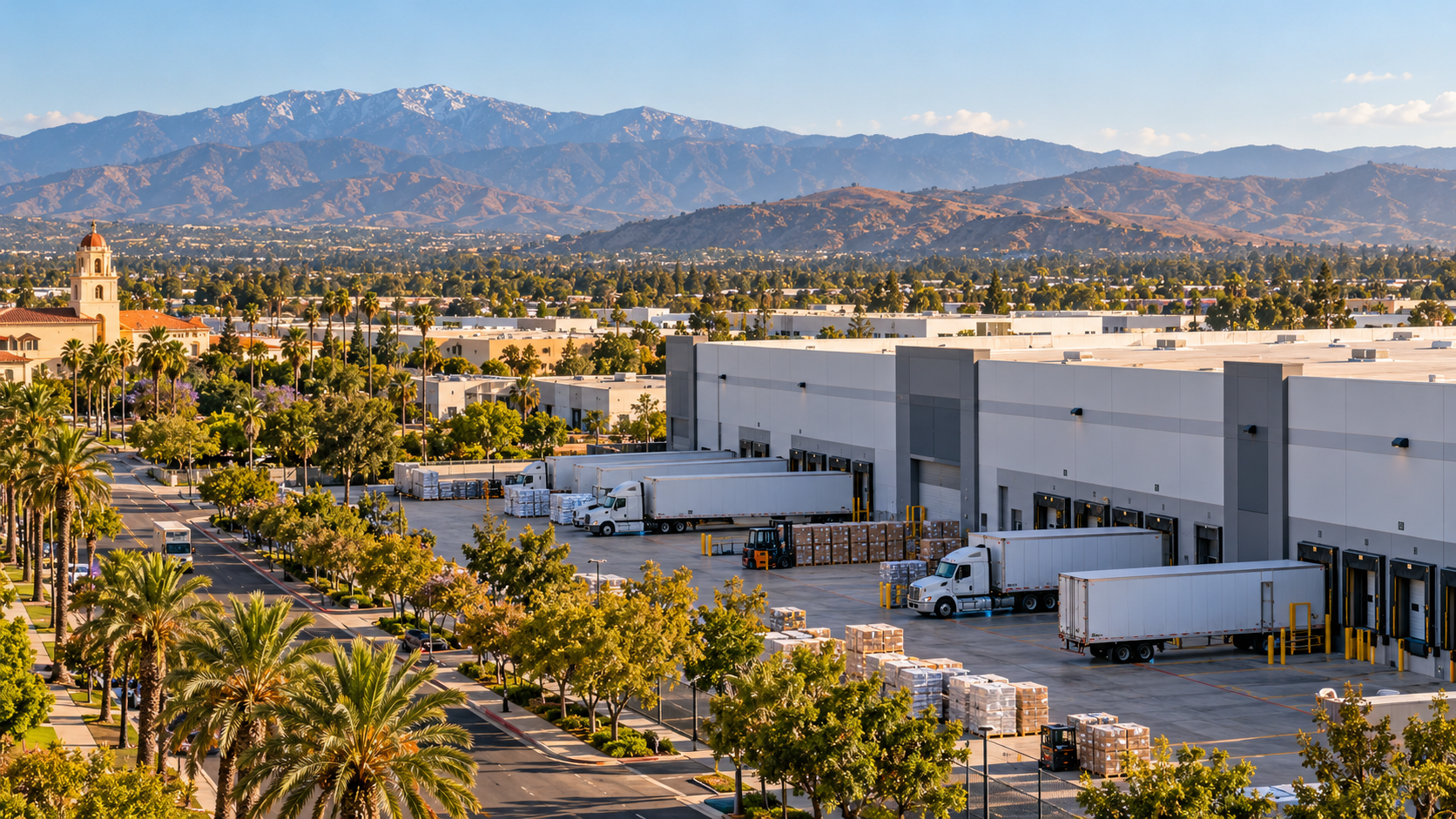
How Demographic Shifts Are Quietly Redefining Industrial Demand
Riverside, CA, has always had a way of balancing small-town charm with big-business opportunity. Along its historic streets, locally owned shops and familiar gathering places reflect a community with deep roots. Just beyond those neighborhoods, warehouses, manufacturing facilities, and distribution centers help power one of Southern California’s most important commercial markets. What many business owners and investors may not realize is that the future of these industrial properties is being shaped by something happening quietly all around them: changing demographics.
Population growth, household spending habits, workforce availability, and evolving consumer expectations are transforming industrial real estate demand throughout Riverside County. These changes influence where companies establish distribution operations, how much warehouse space they require, and which commercial properties offer the strongest long-term opportunities. At Stance CRE, we help businesses and investors recognize these shifts before making important leasing or purchasing decisions. Understanding who lives and works in a community is becoming just as important as understanding the buildings themselves.
Population Growth Is Changing Where Industrial Space Is Needed
As communities grow, so does the infrastructure required to serve them. More households create demand for groceries, furniture, building materials, healthcare supplies, and everyday consumer products. Although these purchases often happen in retail stores or online, the goods must first move through warehouses, storage facilities, and distribution networks.
The Inland Empire has become a major location for these operations because of its transportation connections and proximity to Southern California consumers. According to the U.S. Census Bureau's QuickFacts for Riverside County, the county is home to more than 2.5 million residents. This substantial population base supports businesses that depend on efficient inventory storage and regional deliveries.
For companies considering industrial property in the Inland Empire, population trends provide valuable insight into future demand. At Stance CRE, we look beyond available square footage to help clients evaluate surrounding communities, transportation access, and opportunities for continued business growth.
E-Commerce Is Reshaping Warehouse Requirements
Online shopping has changed how businesses manage inventory and fulfill customer orders. Consumers increasingly expect convenient purchasing, accurate deliveries, and reliable returns. Meeting those expectations requires industrial facilities that support faster product movement and more flexible operations.
The U.S. Census Bureau's quarterly e-commerce reports demonstrate how online retail has become an established part of American consumer spending. This shift has important consequences for warehouse space in Riverside, CA, where businesses may need facilities with loading docks, efficient truck access, sufficient parking, and layouts designed for frequent deliveries.
However, not every warehouse serves the same purpose. A regional distribution center may require substantial storage capacity, while a local delivery operation may prioritize highway access and proximity to residential neighborhoods. We help businesses identify industrial space for rent that fits their actual operating needs rather than simply selecting the largest available building.
Workforce Demographics Are Influencing Industrial Location Decisions
Industrial properties depend on more than highways and loading docks. They also depend on people. Warehouse employees, logistics coordinators, equipment operators, technicians, and manufacturing workers all contribute to successful operations. When the available workforce changes, industrial location strategies often change with it.
Riverside County offers access to communities with varied employment backgrounds and educational opportunities. Nevertheless, workforce availability can differ significantly between neighborhoods and surrounding cities. Employers must consider commuting distances, transportation routes, competition for employees, and access to workers with specialized skills.
At Stance CRE, we understand that choosing an industrial property for lease involves evaluating the surrounding business environment. A facility with attractive rental terms may become less appealing if employees face difficult commutes or operational staffing needs cannot be met. We help clients consider these practical factors alongside property costs and building features.
Changing Household Needs Are Creating New Industrial Opportunities
Demographic shifts involve more than population increases. Changes in household size, age, income, and lifestyle influence which products consumers purchase and how businesses distribute them. Growing families may increase demand for furniture and home improvement materials, while older populations may support additional healthcare products and medical supply distribution.
These patterns create opportunities for businesses operating specialized warehouses, light manufacturing facilities, and regional distribution centers. For example, a medical supply company may need secure, climate-controlled storage, while a furniture distributor may prioritize expansive floor space and convenient truck access.
We help commercial clients connect these changing consumer needs with suitable industrial buildings in the Inland Empire. By understanding the industries a property can accommodate, Stance CRE can help investors evaluate potential tenant demand and assist businesses in finding facilities that support their specific markets.
Smaller Industrial Properties Are Becoming Increasingly Important
When people think about industrial real estate in Southern California, enormous distribution centers often come to mind. However, demographic changes also influence demand for smaller properties that accommodate local contractors, service providers, manufacturers, and growing businesses.
A plumbing supplier, electrical contractor, or regional equipment distributor may not need a massive warehouse. Instead, these businesses may benefit from flex warehouse space, smaller industrial units, or buildings that combine offices with storage and operational areas. Proximity to customers and employees can matter more than sheer building size.
For business owners searching for warehouse space for lease in Riverside County, Stance CRE helps evaluate properties based on usable space, access, operational requirements, and future expansion potential. We recognize that a well-located smaller facility can sometimes provide greater practical value than a larger property farther from customers.
Demographic Trends Are Changing Industrial Investment Strategies
For commercial real estate investors, understanding demographic shifts can help identify opportunities that might otherwise be overlooked. Population patterns influence the types of businesses entering a market, their space requirements, and the long-term usefulness of industrial properties.
An investor considering industrial property for sale in Riverside should evaluate more than purchase price and current rental income. Building flexibility, local employment conditions, transportation access, surrounding development, and potential tenant industries can all affect future performance. Demographic growth alone does not guarantee strong returns, particularly when new construction increases available inventory.
At Stance CRE, we help investors approach industrial real estate investment with a local perspective. Our knowledge of Riverside County's commercial neighborhoods allows us to evaluate properties in the context of their surrounding communities, helping clients make informed decisions about potential acquisitions, leasing opportunities, and long-term ownership.
Why Riverside's Local Character Still Matters
Despite its growing importance as a commercial center, Riverside retains the welcoming character that makes it distinctive. Historic neighborhoods, tree-lined streets, family-owned businesses, and familiar community landmarks give the city an identity that extends well beyond its industrial corridors.
That character matters because industrial growth does not happen independently of the communities surrounding it. Businesses must consider neighborhood compatibility, traffic patterns, land-use regulations, and the relationship between commercial activity and nearby residents. A property that appears ideal on paper may present practical challenges because of its location.
As local commercial real estate specialists, we understand the importance of balancing business requirements with Riverside's established communities. Stance CRE helps clients consider how a location functions today and how surrounding development could influence its usefulness tomorrow.
Preparing Industrial Properties for Tomorrow's Demand
Businesses and property owners who anticipate changing needs are often better positioned to respond when opportunities arise. Industrial facilities that support multiple business uses, efficient deliveries, and adaptable operations may appeal to a broader range of potential occupants.
However, improvements should reflect actual market demand. Adding office space, modifying loading areas, upgrading electrical capacity, or changing a building's layout can involve substantial expenses. Owners should understand whether prospective tenants genuinely need those features before committing to renovations.
Stance CRE helps property owners and investors evaluate how their facilities compare with competing commercial industrial properties for lease. Our approach emphasizes practical market knowledge, tenant requirements, and thoughtful property positioning rather than assuming every industrial building needs the same improvements.
Frequently Asked Questions About Demographic Shifts and Industrial Real Estate
Understanding the relationship between demographics and industrial property demand can help businesses and investors make better decisions. The following questions address common considerations in the Riverside County industrial market.
How does population growth affect industrial real estate demand?
Population growth generally increases demand for goods and services, which can create additional requirements for storage, distribution, manufacturing, and delivery facilities. However, actual industrial demand also depends on consumer spending, business activity, transportation costs, and existing warehouse supply. Stance CRE helps clients evaluate these factors together when considering industrial properties.
What types of industrial properties benefit from changing demographics?
Distribution centers, smaller warehouses, flex industrial buildings, manufacturing facilities, and specialized storage properties may benefit from changing household and business needs. The strongest opportunities depend on local industries and tenant requirements. We help clients identify which property types align with their operational or investment goals.
Is Riverside County a good location for industrial real estate investment?
Riverside County offers access to Southern California markets, major transportation corridors, and a substantial consumer population. These advantages can support industrial activity, but individual investments require careful analysis. Property condition, financing, vacancy risk, lease terms, and local competition all influence potential returns. Working with Stance CRE provides investors with valuable local insight throughout the evaluation process.
Should businesses consider demographics before leasing warehouse space?
Yes. Demographics can influence customer proximity, workforce availability, delivery patterns, and future expansion needs. A business should also examine zoning, loading capabilities, building layout, and total occupancy costs. At Stance CRE, we help clients consider these factors before committing to industrial space for rent in the Inland Empire.
How Stance CRE Can Help You
Demographic changes are quietly transforming Riverside County's industrial real estate market, creating both opportunities and challenges for businesses, tenants, property owners, and investors. At Stance CRE, we believe successful commercial real estate decisions begin with understanding the local market. We help clients look beyond property listings to consider the people, businesses, and economic activity influencing long-term industrial demand.
Founded in 2018 by Joe and Heidi Stance, Stance Commercial Real Estate was built on a vision of improving the commercial real estate experience. As local Inland Empire residents and experienced brokers, we bring firsthand knowledge of Riverside's neighborhoods, business community, and commercial property market. Our experience includes selling and leasing nearly every type of commercial real estate throughout Riverside, from industrial facilities and distribution centers to retail properties, office buildings, and specialized commercial spaces.
When asked what type of commercial real estate we specialize in, our answer is simple: Riverside. That local focus allows us to help businesses evaluate warehouse space in Riverside, CA, guide investors exploring industrial property for sale in the Inland Empire, and assist property owners seeking qualified commercial tenants. We understand that every transaction represents an important business decision, and we work to provide the knowledge, guidance, and personal attention our clients deserve.
Whether you are expanding distribution operations, relocating your business, purchasing an investment property, or preparing an industrial building for its next tenant, Stance CRE is ready to help. Call us at 909-772-1212 to discuss your commercial real estate needs. Together, we can explore opportunities throughout Riverside County and identify properties that support your business goals today while positioning you for tomorrow's changing market.

How Office Location Impacts Business Growth and Employee Productivity
Picture a typical weekday morning in Riverside, CA. Downtown coffee shops are welcoming their regular customers, professionals are arriving at their offices near the historic Mission Inn, and business owners throughout the city are preparing for another productive day. Riverside has a way of combining the familiarity of a close-knit community with the opportunities of a growing business center. For companies establishing or expanding their presence here, choosing the right office location can make a remarkable difference.
An office is much more than a place where employees sit at desks. Its location influences how easily customers can reach a business, how comfortably employees commute, how efficiently teams collaborate, and how successfully a company can grow. A poorly located office can create unnecessary challenges, while a thoughtfully selected property can support productivity, strengthen professional relationships, and provide room for future expansion.
At Stance CRE, we understand that finding the right Riverside office space for lease requires more than comparing square footage and rental rates. As local commercial real estate specialists, we help businesses evaluate how their office location supports daily operations and long-term goals. Our familiarity with Riverside and the surrounding Inland Empire allows us to identify commercial properties that offer more than a convenient address. We help businesses find locations where they can thrive.
Why Office Location Matters for Long-Term Business Growth
The location of a business office influences nearly every aspect of its operations. Accessibility, surrounding businesses, neighborhood reputation, and proximity to customers all contribute to how effectively a company functions. Even an attractive, affordable office can become a liability if its location makes daily operations unnecessarily difficult.
For example, a professional services firm that regularly welcomes clients may benefit from an office near Downtown Riverside, where established businesses, restaurants, and civic institutions create a recognizable commercial environment. Meanwhile, a company with employees traveling throughout Riverside County may prioritize convenient access to major transportation routes.
At Stance CRE, we help businesses look beyond the immediate appeal of a property. Our approach considers how a location will serve employees, customers, and company leadership over time. When evaluating commercial office space for lease, we focus on matching the property to the business rather than expecting the business to adapt to an unsuitable location.
Employee Commutes Can Influence Productivity and Retention
A convenient commute is one of the most overlooked advantages of a well-located office. Employees who spend excessive time navigating traffic or searching for parking may arrive at work already frustrated. Over time, these challenges can affect punctuality, job satisfaction, and employee retention.
According to the U.S. Census Bureau's American Community Survey, commuting patterns provide important insight into how workers travel to their jobs and how long those trips take. For Riverside businesses, understanding where employees live and how they travel can help narrow the search for a suitable office location.
Riverside offers several distinct commercial areas, including Downtown Riverside, the University Avenue corridor, and neighborhoods near major highways. Each presents different advantages depending on employee locations and transportation needs.
When helping clients explore Riverside office space for rent, we consider accessibility from Interstate 215, State Route 91, and State Route 60, along with parking availability and surrounding amenities. Stance CRE helps businesses identify locations that make the workday more convenient, supporting a more satisfied and dependable workforce.
The Right Office Environment Encourages Better Work
Office productivity is influenced by more than employee motivation. Noise levels, lighting, temperature, workspace configuration, and opportunities for collaboration all contribute to how comfortably and effectively people work.
The U.S. General Services Administration's workplace research emphasizes the importance of creating work environments that support different activities and organizational needs. Businesses benefit from evaluating whether their office provides appropriate spaces for focused work, meetings, private conversations, and team collaboration.
A financial services company may require private offices for confidential client discussions, while a marketing firm may benefit from collaborative work areas and flexible meeting rooms. Healthcare-related administrative offices may need specialized layouts that support privacy, accessibility, and efficient workflows.
Stance CRE helps clients evaluate these practical considerations before committing to an office space lease agreement. We look at how employees will actually use the property, including natural lighting, conference room availability, accessibility, and opportunities for future improvements. Our goal is to help businesses select an office that supports productivity from the beginning.
Accessibility and Visibility Help Businesses Attract Customers
For businesses that regularly meet customers in person, office location can directly influence revenue opportunities. A property that is difficult to find, inconvenient to enter, or lacking adequate parking may discourage potential customers from scheduling appointments or returning for additional services.
Professional offices located near recognizable Riverside landmarks, established commercial corridors, and complementary businesses can benefit from convenient access and a familiar setting. A legal practice, insurance agency, or consulting firm may find that a centrally located office reinforces its professional image while making appointments easier for clients.
Visibility is not equally important for every business. Some companies depend heavily on walk-in traffic, while others operate primarily through scheduled appointments or digital communication. Understanding these differences helps prevent businesses from paying a premium for location features they may not need.
At Stance CRE, we help clients distinguish between essential location advantages and unnecessary expenses. Whether a business needs prominent professional office space for lease or a quieter location for administrative operations, we focus on finding a property that aligns with its customer relationships and business model.
Riverside Offers Unique Opportunities for Growing Companies
Riverside, CA, offers an appealing combination of historic character, established commercial districts, educational institutions, and access to the broader Southern California economy. Its tree-lined neighborhoods, familiar gathering places, and locally owned businesses contribute to an inviting atmosphere that continues to attract entrepreneurs and established companies.
The presence of the University of California, Riverside, Riverside Community College District institutions, healthcare providers, and government offices also creates opportunities for businesses serving education, professional services, healthcare, and other industries. The City of Riverside's Economic Development Division provides information about the city's commercial environment and business development initiatives.
However, not every Riverside neighborhood serves the same business needs. Downtown may appeal to firms seeking an established professional setting, while offices near major transportation corridors may better accommodate employees and clients traveling from surrounding Inland Empire communities.
Our local knowledge is especially valuable during this decision-making process. Rather than treating Riverside as one uniform commercial market, Stance CRE evaluates individual areas, property characteristics, and business requirements. We understand that choosing between Riverside office buildings involves more than comparing addresses. It requires understanding the community surrounding each property.
Choosing Office Space That Supports Future Expansion
One of the biggest mistakes growing businesses make is selecting office space based exclusively on their current needs. A location that comfortably accommodates ten employees today may become overcrowded when the company adds additional staff, departments, or customer services.
Relocating an established business can be expensive and disruptive. Moving furniture, updating technology, notifying customers, and adjusting employee routines all require time and resources. Choosing an office with reasonable expansion opportunities can help reduce these challenges.
Stance CRE helps businesses evaluate both immediate requirements and anticipated growth. When comparing office space for lease in Riverside, CA, we consider floor plans, available square footage, lease flexibility, and whether neighboring suites might offer future expansion opportunities.
We also help clients determine whether small office space for lease, a larger professional suite, or an entire office building best supports their plans. By considering future staffing and operational needs, we help businesses make decisions that remain practical as their organizations evolve.
Understanding the Financial Impact of Office Location
Office rental rates are important, but they do not tell the entire financial story. A lower monthly rent may initially appear attractive, yet additional expenses associated with parking, utilities, maintenance, renovations, and employee travel can reduce the property's overall value.
Businesses should also consider how location influences revenue. An office that improves customer convenience, strengthens employee retention, and supports efficient operations may justify a higher rental rate than a less suitable alternative.
At Stance CRE, we help businesses evaluate the total cost of occupying a property. Our experience with commercial real estate in Riverside, CA, allows us to explain important lease considerations, identify potential expenses, and help clients compare properties more effectively.
We also assist with commercial lease negotiations, helping clients understand provisions involving rental increases, maintenance responsibilities, renewal options, and improvements. Our objective is to secure office space that supports both operational performance and long-term financial stability.
Frequently Asked Questions About Office Location and Productivity
Choosing the right office raises important questions about employee satisfaction, business growth, and long-term affordability. At Stance CRE, we help Riverside businesses navigate these considerations with practical guidance grounded in local market experience.
How does office location affect employee productivity?
Office location influences productivity through commuting convenience, workplace comfort, accessibility, and nearby amenities. Employees who can reach their workplace conveniently and work in a comfortable environment may experience fewer daily distractions. Selecting an office that supports collaboration and individual concentration can also improve operational efficiency.
What should businesses prioritize when choosing office space in Riverside?
Businesses should evaluate employee commute patterns, customer accessibility, parking, office layout, total occupancy costs, and expansion opportunities. The importance of each factor depends on the company's operations. Stance CRE helps clients establish these priorities before comparing available Riverside commercial properties.
Is Downtown Riverside a good location for professional offices?
Downtown Riverside can be an attractive choice for legal practices, consulting firms, financial services companies, and other professional businesses. Its established commercial setting, recognizable landmarks, restaurants, and civic institutions provide convenient opportunities for client meetings and professional networking. However, parking, accessibility, and rental costs should be evaluated for each property.
Should a growing company lease or purchase an office building?
The answer depends on financial resources, growth expectations, and long-term business objectives. Leasing may offer greater flexibility, while purchasing can provide ownership benefits and more control over a property. Stance CRE helps businesses compare Riverside office buildings for sale with leasing opportunities to determine which approach better supports their goals.
How Stance CRE Can Help You
Finding the right office location is an investment in your employees, customers, and company's future. At Stance CRE, we believe businesses deserve more than a list of available properties. They deserve knowledgeable commercial real estate professionals who understand their objectives, recognize potential challenges, and know the Riverside market well enough to identify meaningful opportunities. Whether you need a compact professional suite or a larger corporate office, we help you find a location that works for your business.
Founded in 2018 by Joe and Heidi Stance, Stance Commercial Real Estate was built on a vision of improving the commercial real estate experience. As local Inland Empire residents and experienced brokers, we bring firsthand knowledge of Riverside's neighborhoods, commercial corridors, and business community to every client relationship. Our team has sold or leased nearly every type of commercial property throughout Riverside, giving us the versatility to serve businesses across numerous industries.
We often say that our specialty is Riverside. That local perspective is what distinguishes our approach. We understand the city's welcoming character, established business relationships, and expanding commercial opportunities. From evaluating Riverside office space for lease to negotiating favorable terms and planning for future growth, we provide the personalized guidance businesses need to make confident real estate decisions.
If your company is ready to relocate, expand, or establish a new presence in Riverside County, let us help you find an office that supports productivity and positions your business for continued success. Contact Stance CRE today at 909-772-1212 to discuss your commercial real estate needs. Together, we can identify an office location that gives your business the foundation it needs to grow.
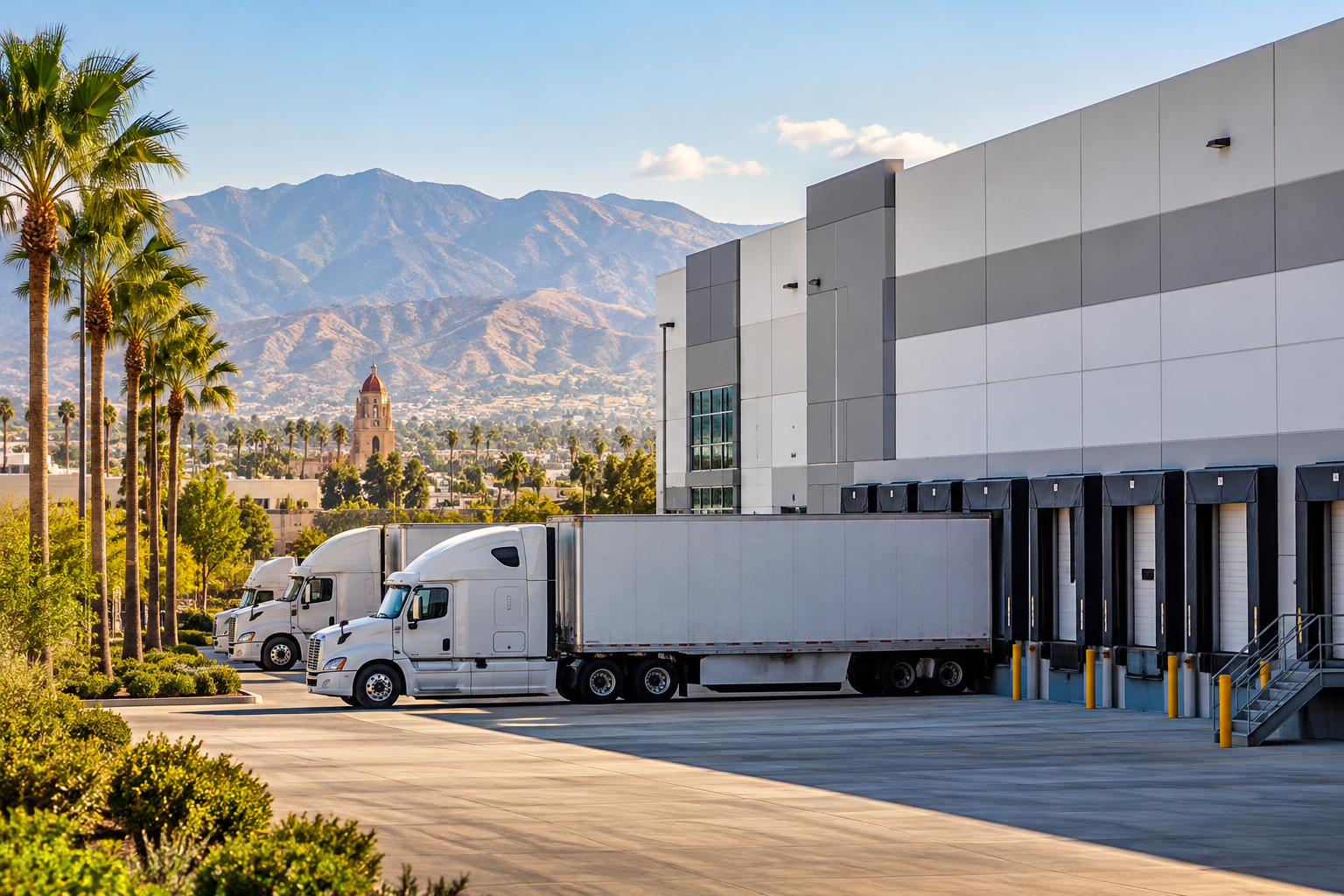
The Rise of Logistics and Distribution Facilities in Southern California
Southern California has long been a center of business activity, but one industry has become especially important to the region: logistics and distribution. From the busy ports along the coast to the warehouses and industrial parks throughout the Inland Empire, businesses depend on an extensive network of facilities to keep products moving. As companies look for faster deliveries, better inventory management, and more efficient operations, demand for well-located logistics and distribution facilities continues to shape the commercial real estate market.
Riverside, CA, sits at the heart of this activity. Known for its historic Mission Inn, charming downtown streets, and strong sense of community, Riverside also serves as an important connection between Southern California businesses and the customers they serve. Just beyond its established neighborhoods and local storefronts, industrial buildings and distribution centers support everything from regional retailers to national supply chains.
For businesses considering warehouse space in Riverside, CA, the opportunities are significant, but choosing the right property requires careful planning. At Stance CRE, we help business owners, tenants, and investors navigate the changing industrial real estate market with practical guidance and a genuine understanding of Riverside County. Whether a company needs its first warehouse or an investor is evaluating a larger distribution facility, we help clients identify properties that support their goals.
Why Southern California Has Become a Logistics Powerhouse
Southern California offers something few other regions can match: access to major ports, highways, rail connections, and millions of consumers. The Ports of Los Angeles and Long Beach handle international shipments that eventually make their way to warehouses, stores, and businesses throughout the country. Riverside County plays an important role in moving those goods from arrival points to their final destinations.
The California Freight Mobility Plan identifies the Los Angeles and Inland Empire corridor as a major freight transportation network. This connectivity helps explain why Inland Empire industrial properties remain important to businesses that need reliable access to suppliers, transportation routes, and customers.
However, proximity to major highways is only part of the equation. Businesses must also consider transportation expenses, employee accessibility, delivery schedules, and building capabilities. At Stance CRE, we help clients evaluate these practical details so they can choose locations that improve operations rather than simply provide additional square footage.
Riverside County Is at the Center of Distribution Growth
Riverside County has become an attractive destination for companies seeking industrial space without locating directly in the crowded coastal markets. Communities throughout the county offer access to transportation corridors, established commercial districts, and industrial areas designed to accommodate manufacturing, storage, and distribution operations.
Riverside itself offers an appealing balance. Its tree-lined neighborhoods, historic buildings, and locally owned businesses give the city a welcoming atmosphere, while its commercial districts support serious business activity. Nearby communities, including Moreno Valley, Jurupa Valley, Corona, and Perris, provide additional options for companies seeking warehouse space in the Inland Empire.
Still, not every industrial location serves the same purpose. A warehouse that works well for regional deliveries may be unsuitable for a manufacturer requiring specialized equipment or extensive outdoor storage. Our team understands these differences and helps clients compare industrial property in the Inland Empire based on actual business needs, not simply availability.
How E-Commerce Is Changing Warehouse Requirements
Online shopping has changed what businesses expect from their distribution facilities. Customers increasingly value convenient delivery, accurate orders, and dependable product availability. Meeting those expectations requires warehouses that support efficient receiving, storage, packaging, and shipping.
Modern facilities may need higher ceilings, multiple loading docks, adequate truck maneuvering areas, and flexible storage configurations. Companies handling frequent shipments may also require additional parking, office space, or dedicated areas for sorting and processing orders.
For businesses searching for commercial warehouse space for lease, these features can be just as important as rental rates. Stance CRE helps clients distinguish between attractive buildings and properties that genuinely support their daily operations. By understanding how a company receives, stores, and distributes products, we can narrow the search to facilities with the right capabilities.
What Businesses Should Look for in a Distribution Facility
Finding the right distribution center for lease begins with understanding how the property will function. A business receiving several deliveries each week has different requirements from a company coordinating dozens of trucks daily. The number of loading doors, warehouse layout, ceiling clearance, and access points can directly influence efficiency.
Businesses should also evaluate the following features:
- Loading and transportation access: Dock-high doors, ground-level loading, and sufficient truck circulation.
- Warehouse layout: Storage capacity, ceiling height, column spacing, and room for equipment.
- Location: Convenient access to highways, suppliers, employees, and customers.
- Operating costs: Rent, utilities, maintenance responsibilities, insurance, and potential improvements.
- Expansion potential: Flexibility to accommodate additional inventory, employees, or equipment.
A property may appear affordable initially but become expensive if its layout slows operations or requires substantial modifications. We help businesses consider these factors before committing to a lease or purchase, reducing the likelihood of costly surprises.
The Changing Industrial Market Creates New Opportunities
Although logistics and distribution have expanded considerably over the past decade, the market is not experiencing uninterrupted growth. New warehouse construction, changing shipping patterns, and shifting business requirements have created a more competitive leasing environment. For tenants and investors, understanding these changes is essential.
According to the Inland Empire Industrial Research Report for the second quarter of 2026, industrial vacancy declined to 7.8%, while leasing activity reached a quarterly record of 16.7 million square feet. Average asking rents also declined from their 2023 peak. These conditions demonstrate that the market remains active, even as businesses gain additional options when evaluating available properties.
For companies looking for industrial space for rent in the Inland Empire, greater availability can create opportunities to compare buildings, negotiate lease terms, and secure properties with desirable features. At Stance CRE, we help clients understand how local conditions affect their decisions. Our goal is to turn changing market conditions into practical advantages without encouraging businesses to take unnecessary risks.
Why Smaller Logistics Facilities Matter Too
Large distribution centers attract considerable attention, but smaller industrial properties serve an equally important purpose. Local wholesalers, contractors, manufacturers, and growing retailers frequently need facilities that accommodate inventory and equipment without the expenses associated with a massive warehouse.
A smaller commercial warehouse for lease may offer office space, convenient loading access, and sufficient storage for a business serving Riverside County customers. These properties can be particularly valuable for companies that prioritize local deliveries rather than nationwide distribution.
Stance CRE works with businesses of different sizes, recognizing that a growing Riverside company may need 5,000 square feet while another operation requires substantially more. We help clients evaluate industrial flex space, warehouse buildings, and specialized commercial properties based on their budgets, operating requirements, and plans for future growth.
Logistics Real Estate as an Investment Opportunity
The growth of Southern California distribution networks has also created opportunities for commercial real estate investors. Industrial property for sale in Riverside may appeal to buyers interested in rental income, long-term appreciation potential, or properties serving established business industries.
However, a successful investment requires more than purchasing a warehouse in a popular location. Investors should examine tenant demand, lease agreements, building conditions, operating expenses, and the potential costs of future improvements. Properties with specialized features may command attention from certain tenants but appeal to a smaller group of potential occupants.
At Stance CRE, we help investors evaluate industrial property for sale in the Inland Empire with these considerations in mind. Our local market knowledge helps clients understand how different industrial neighborhoods, building configurations, and tenant requirements may influence a property's long-term performance.
Why Local Expertise Makes a Difference in Riverside
Riverside has a character that sets it apart from many larger commercial markets. Historic architecture, established neighborhoods, independent restaurants, and familiar local businesses create a community where relationships matter. At the same time, the city's industrial districts connect local companies to one of Southern California's most important distribution networks.
Understanding that combination requires more than searching commercial listings. It involves recognizing which areas support particular business activities, how transportation routes affect operations, and what makes individual properties attractive to local tenants. Zoning requirements, permitted uses, and neighborhood characteristics can also influence whether a location is appropriate.
For Stance CRE, Riverside is more than a market we serve. It is our specialty. We bring local knowledge and hands-on commercial real estate experience to every property search, helping businesses make informed decisions about Riverside warehouse space, industrial buildings, and distribution facilities. Our clients benefit from working with professionals who understand the community as well as its commercial opportunities.
Frequently Asked Questions About Logistics and Distribution Facilities
As businesses explore Southern California's industrial real estate market, several questions frequently arise. Understanding the answers can make the search for warehouse or distribution space more manageable.
What is the difference between a warehouse and a distribution center?
A traditional warehouse primarily focuses on storing products, materials, or equipment. A distribution center generally supports more frequent movement of goods, including receiving shipments, processing orders, and coordinating deliveries.
Although the two functions often overlap, the distinction matters when choosing commercial property. Stance CRE helps businesses identify facilities with the loading capacity, layout, and transportation access appropriate for their operations.
Is Riverside County a good location for a distribution facility?
Riverside County offers access to major transportation corridors, Southern California population centers, and established industrial districts. These advantages make it worth considering for regional distribution, manufacturing, and logistics operations.
The best location depends on the company's customers, suppliers, workforce, and shipping requirements. We help businesses compare Riverside County locations to identify properties that offer the most practical advantages.
Should a business lease or purchase industrial property?
Leasing can provide flexibility and reduce the amount of capital required upfront. Purchasing may offer greater control over the property and the potential to build long-term equity.
The right choice depends on financial resources, expansion plans, and operational stability. Stance CRE helps clients compare available leasing and purchasing opportunities so they can make decisions consistent with their business objectives.
How can businesses find the right warehouse space in Riverside?
The process should begin with a clear understanding of storage needs, shipping activity, equipment requirements, employee parking, and budget. Businesses should also consider whether the facility can accommodate future growth.
Working with an experienced local commercial real estate broker can simplify the search. Our team helps identify suitable properties, evaluate important building features, and navigate lease or purchase negotiations.
How Stance CRE Can Help You
Southern California's logistics industry continues to influence how businesses operate, where they locate, and what they expect from commercial properties. Whether you are searching for a distribution center, expanding warehouse operations, or considering an industrial real estate investment, having experienced local representation can make a meaningful difference. At Stance CRE, we help businesses navigate these decisions with confidence, combining commercial real estate knowledge with a genuine understanding of Riverside County.
Founded in 2018 by Joe and Heidi Stance, Stance Commercial Real Estate was built on a vision of improving the commercial real estate experience. As Inland Empire locals and experienced brokers, we understand the opportunities and challenges facing businesses throughout the region. Our team has sold or leased nearly every type of commercial property around Riverside, including industrial buildings, retail spaces, offices, and specialized facilities. We consider Riverside itself our specialty because our expertise extends across the local commercial real estate market.
We believe finding the right property requires more than matching a business with an available building. It means understanding your goals, identifying potential obstacles, and helping you make decisions that support long-term success. Whether you need warehouse space for lease, a distribution facility, or commercial industrial property for sale, we are committed to providing knowledgeable guidance and personalized service throughout the process.
Your next business opportunity may be waiting right here in Riverside, CA. Let our team help you find a property that fits your operations, supports your growth, and positions your business for the future. Contact Stance CRE at 909-772-1212 to discuss your commercial real estate needs and discover how our local expertise can help you move forward.
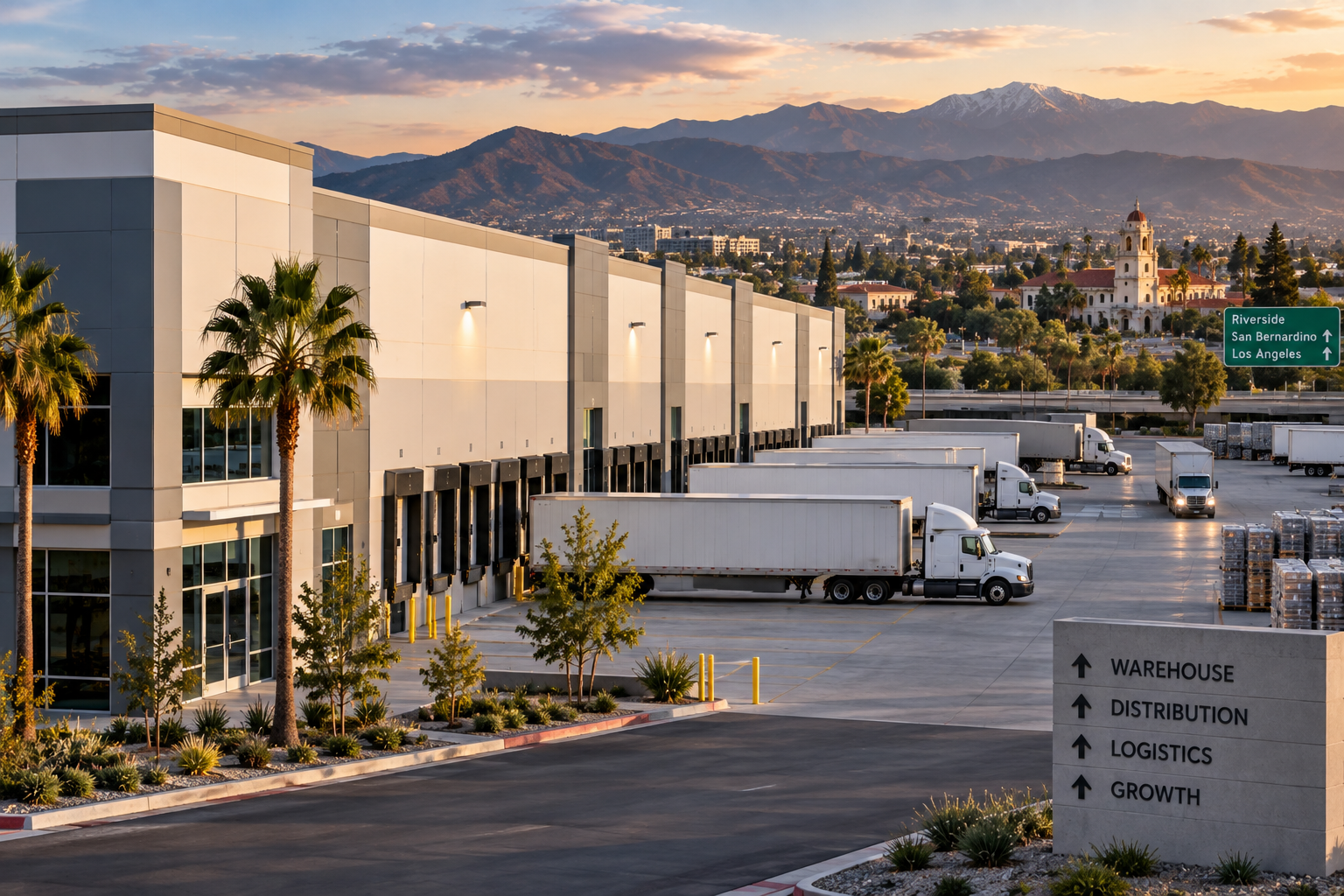
Commercial Real Estate Trends Shaping the Inland Empire
Commercial real estate across the Inland Empire has always been closely tied to growth. Warehouses follow expanding distribution networks. Retail centers evolve alongside growing communities. Office and medical users respond to shifts in employment and population. Investors watch all of these changes, looking for properties positioned to benefit from what comes next.
Today, however, understanding commercial real estate in Riverside, CA and the surrounding Inland Empire requires more than recognizing that the region is growing. Different property types are moving at different speeds, businesses are becoming more selective about the space they occupy, and investors are paying closer attention to functionality, location, operating costs, and long-term demand.
That is where Stance CRE provides an important advantage. We do not simply track available buildings. As Riverside locals and experienced commercial real estate brokers, we help business owners, tenants, landlords, and investors understand what market changes mean for their individual real estate decisions.
Industrial Real Estate Remains a Major Part of Riverside’s Growth
Drive through Riverside and the surrounding Inland Empire, and it is easy to see how important industrial real estate has become to the region. Warehouses and business parks sit alongside long-established neighborhoods, local shopping centers, and growing commercial corridors. Riverside may still have the familiar palm-lined streets, historic buildings, and community feel that locals know well, but it is also part of one of Southern California's busiest areas for moving, storing, and distributing goods.
Location plays a big role in that growth. Riverside businesses are within reach of major Southern California freeways, airports, rail connections, and the Ports of Los Angeles and Long Beach. California's freight planning highlights the Inland Empire as an important link in the movement of goods throughout Southern California. For local businesses, that connectivity continues to create demand for industrial real estate, warehouses, distribution space, manufacturing properties, and other commercial buildings.
At the same time, businesses looking for industrial warehouse rentals are becoming more particular about what they need. Square footage is important, but it is only part of the picture. A company may need convenient freeway access, plenty of parking, room for trucks and deliveries, outdoor storage, or a building that can comfortably accommodate its equipment and employees. Even the way a warehouse is laid out can make a noticeable difference in the day-to-day operation of a business.
That is where knowing Riverside becomes especially valuable. At Stance CRE, our industrial real estate services are not about handing a client a list of available warehouses and hoping one works. We take the time to understand how the business operates and where it needs to go next. Because we know Riverside and the surrounding market, we can help clients look beyond the listing details and find industrial properties that make sense for their employees, customers, deliveries, growth plans, and everyday operations.
Population and Business Growth Continue to Influence Demand
Commercial real estate ultimately follows people and economic activity, and Riverside County continues to have a substantial and growing population base. U.S. Census Bureau estimates put Riverside County's July 2025 population at approximately 2.54 million, up 5.2 percent from its April 2020 estimates base. The county also had more than 46,000 employer establishments in 2023.
That growth has implications far beyond housing. More residents create demand for healthcare providers, restaurants, retailers, professional services, entertainment, logistics, and neighborhood businesses. Each of those activities requires commercial space.
Riverside itself illustrates why this matters. The city combines the economic activity of a major Inland Empire center with a community character that still feels distinctly local. Historic neighborhoods, established shopping districts, tree-lined streets, local restaurants, healthcare facilities, and busy commercial corridors coexist within a market that continues to change.
At Stance CRE, that local perspective helps us evaluate commercial property opportunities in Riverside CA. We understand that two buildings with similar square footage can perform very differently because of access, surrounding businesses, customer patterns, visibility, parking, or neighborhood development.
Tenants Are Becoming More Selective About Commercial Space
Another important trend is greater selectivity among tenants. Businesses are looking beyond the question of whether space is available and asking whether that space supports their operations efficiently.
For companies leasing commercial spaces, that means calculating actual space requirements rather than simply assuming that bigger is better. A well-designed 3,000-square-foot property may function better than an awkward 4,000-square-foot building.
Lease structure matters just as much as physical space. Rental rate, operating expenses, tenant improvements, renewal options, permitted use, signage, maintenance responsibilities, and future expansion rights can significantly affect the real cost of occupancy.
Retail Is Becoming Increasingly Location-Specific
Retail remains another important part of the Inland Empire commercial landscape, but successful retail decisions are increasingly dependent on the specifics of the location.
Population growth can support additional restaurants, service businesses, healthcare concepts, fitness operators, specialty retailers, and neighborhood-oriented businesses. Yet strong regional demographics do not automatically make every shopping center or storefront successful.
When evaluating retail property leasing, Stance CRE considers visibility, ingress and egress, parking, neighboring tenants, signage opportunities, nearby residential development, traffic patterns, and the type of customer a business needs to reach. A location can be only a few blocks from another property and still provide a very different customer experience.
Our retail real estate services are therefore built around matching businesses with locations rather than simply matching businesses with vacancies. For retailers, restaurants, and service companies, that distinction can have a major impact on long-term performance.
Investors Are Paying Greater Attention to Fundamentals
The Inland Empire continues to attract buyers interested in commercial property investment, but today's investment decisions demand careful analysis.
Purchase price is only the beginning. Investors must consider rental income, operating expenses, tenant quality, lease expirations, vacancy exposure, maintenance requirements, potential capital improvements, financing costs, and future leasing demand. A lower-priced property is not necessarily the better investment if it carries substantial deferred maintenance or weak tenant demand.
Location remains equally important. Access to major transportation corridors continues to shape the region's commercial market, particularly for industrial properties. California continues to invest in Inland Empire transportation infrastructure, including projects intended to improve freight movement along major corridors.
Stance CRE helps investors connect those larger trends to individual properties. Because we have sold or leased nearly every type of commercial real estate product around Riverside, we approach opportunities as Riverside generalists rather than forcing every investor into one narrow property category.
Local Market Knowledge Is Becoming More Valuable
Online databases have made commercial listings easier to find, but access to listings is not the same as understanding a market.
A local commercial real estate brokerage can provide context that property data alone cannot. Why has a building remained available? Which commercial corridors are attracting particular tenants? Where is parking becoming an issue? Which areas work well for industrial users, and which locations provide stronger customer visibility?
This is one of Stance CRE's greatest strengths. Joe and Heidi Stance launched Stance Commercial Real Estate in 2018 with a vision of changing the commercial real estate industry for the better. Since then, Team Stance has worked across Riverside's diverse commercial market.
We call ourselves generalists because when someone asks what CRE product we specialize in, our answer is Riverside. That local focus allows us to help clients connect broad Inland Empire trends with the realities of individual properties, neighborhoods, landlords, tenants, and investment opportunities.
Frequently Asked Questions About Inland Empire Commercial Real Estate
Commercial real estate trends can create opportunities, but they also raise questions for businesses and investors trying to decide what to do next. These are several questions Stance CRE frequently helps clients address.
What types of commercial property are active in the Inland Empire?
The Inland Empire supports a diverse commercial market that includes industrial and warehouse properties, retail centers, professional offices, medical facilities, land, and specialized buildings. Demand varies significantly by location, building size, property condition, and user requirements, which makes property-specific analysis important.
Is Riverside a good location for businesses seeking commercial space?
Riverside provides access to a large population base, established commercial districts, transportation infrastructure, healthcare and educational institutions, and the broader Southern California economy. The right location depends on the business, however. Stance CRE evaluates factors such as customers, employees, transportation, parking, visibility, zoning, and future space requirements before recommending properties.
Should businesses lease or purchase commercial real estate?
There is no universal answer. Leasing may preserve capital and provide flexibility, while purchasing can offer greater control and potential long-term equity. We help clients compare both options based on their financial position, growth plans, operational needs, and available Riverside commercial properties.
How Stance CRE Can Help You
Commercial real estate trends matter most when they are translated into practical decisions. A growing industrial market may create one set of opportunities for a warehouse tenant and another for an investor. Population growth may strengthen a retail corridor while creating additional demand for medical offices elsewhere. Understanding those differences is where experienced local representation becomes valuable.
At Stance CRE, we are not outsiders studying Riverside from a spreadsheet. We are locals who work throughout the community and understand the commercial properties, business corridors, and neighborhoods that make this part of the Inland Empire distinctive. Since launching Stance Commercial Real Estate in 2018, Joe and Heidi Stance and Team Stance have sold or leased nearly every type of commercial real estate product around Riverside.
The Inland Empire will continue to evolve, and successful commercial real estate decisions require more than following the latest trend. They require knowing how that trend affects a particular property, business, tenant, or investment. Contact Stance CRE at 909-772-1212 to discuss your commercial real estate goals and put our Riverside market knowledge to work for you.

How Much Commercial Space Does Your Business Actually Need?
Picture a growing business on a typical morning in Riverside, CA. The doors are open, employees are settling in, customers are coming and going, and another busy day is beginning. Outside, traffic moves between Riverside's established neighborhoods, bustling commercial corridors, historic downtown, and the business districts that connect the city to the larger Inland Empire. Inside the business, however, things may be getting a little crowded. Desks have been added wherever they will fit, inventory is competing with workspace, storage is overflowing, or customers are finding that the once-comfortable location no longer accommodates the company it has become.
That is often when a deceptively simple question arises: How much commercial space does the business actually need? An owner occupying 2,000 square feet may assume that moving up to 3,000 square feet will solve the problem. A new retailer looking for its first Riverside storefront may decide that 1,000 square feet sounds about right. An expanding professional practice might begin searching for larger office space in Riverside, CA based primarily on the number of employees it expects to hire. Those numbers provide a starting point, but they do not tell the entire story.
In a diverse commercial market like Riverside, square footage alone can be misleading. A charming storefront near the heart of the city, a professional office along a busy commercial corridor, and an industrial property serving the Inland Empire may contain similar amounts of space while functioning in completely different ways. Staffing, customer traffic, inventory, equipment, storage, workflow, parking, future growth, and even the shape of the floor plan can determine whether a property feels spacious and efficient or cramped and impractical.
At Stance CRE, this is where we bring local experience into the conversation. We know Riverside, and we know the commercial properties that help keep this vibrant, close-knit city moving. Before our clients commit to a lease or purchase, we help them look beyond the number printed on a listing and think carefully about how the property will support their business every day. Our goal is not simply to help Riverside County businesses find commercial space. We help them find the right space: a property that fits their operations today, supports where they want to go tomorrow, and makes financial sense along the way.
Square Footage Is Only the Beginning
Commercial listings make square footage easy to compare, which is why businesses naturally focus on it. Searches for everything from 500 sq ft office space for rent and 1,000 sq ft office space for rent to larger retail and industrial properties are common starting points. However, two properties containing the same number of square feet can function very differently. A rectangular 2,000-square-foot office with an efficient floor plan may accommodate a team more comfortably than a 2,500-square-foot suite filled with narrow hallways, oversized reception areas, awkward corners, or rooms that cannot support the tenant's needs.
Stance CRE approaches a commercial property search by asking how the business needs to function inside the space. How many employees will regularly be on-site? How many private offices are necessary? Will customers visit the property? Does the business need conference rooms, loading areas, storage, production space, exam rooms, showrooms, or employee break areas? Once we understand those requirements, square footage becomes meaningful rather than arbitrary.
That distinction can save businesses from expensive mistakes. Paying for unused square footage increases occupancy costs throughout the lease term, while choosing a property that is too small can create operational problems almost immediately. The right property is not automatically the largest one the budget allows. It is the one where the available space supports the business efficiently.
Start With How Your Business Uses Space Today
Before searching for commercial space for rent, businesses should examine their current operations. An existing tenant can identify areas that are consistently crowded, rooms that are rarely used, storage problems, customer bottlenecks, parking shortages, or workspaces that no longer fit the way employees operate. These observations provide Stance CRE with valuable information when we begin identifying potential properties.
For a new business without an existing location, the process requires building the space plan around expected operations. The U.S. Small Business Administration recommends considering location, costs, zoning requirements, target markets, and other local factors when choosing where a business will operate. Those considerations matter because the ideal square footage cannot be separated from the property itself. A smaller, well-located storefront may serve a retailer better than a larger space away from its customer base.
We also encourage clients to separate essential space from desirable space. A conference room that will be used every day may be essential. A second oversized meeting room that will be occupied twice a month may not justify years of additional rent. This type of practical analysis allows Stance CRE to establish clearer commercial space requirements before the property search begins.
Different Businesses Need Different Kinds of Square Footage
There is no universal formula for determining commercial space needs because a retail shop, professional office, medical practice, warehouse, and distribution company use buildings very differently. Office users generally need to consider employee work areas, private offices, meeting rooms, reception, common areas, restrooms, storage, and technology infrastructure. Hybrid work schedules may change the calculation further if not every employee is present simultaneously.
Retail businesses must think about the relationship between selling space and support space. A beautifully sized sales floor accomplishes little if the business cannot store inventory efficiently. Restaurants have another set of considerations, including kitchens, dining areas, food storage, restrooms, employee areas, and equipment. Industrial users may care less about traditional office square footage and much more about clear height, loading, yard space, power, truck access, warehouse configuration, and the amount of floor area available for inventory or production.
This is one reason Stance CRE's experience across Riverside is particularly valuable. Joe and Heidi Stance describe themselves as commercial real estate generalists whose specialty is Riverside itself. We have sold or leased nearly every type of commercial real estate product around the city, giving us a practical understanding of how different businesses use different buildings. Instead of assuming a certain number of square feet will work, we can help determine what those square feet actually need to accomplish.
Plan for Growth Without Paying for Empty Space
One of the most difficult parts of determining space needs is accounting for future growth. A company leasing exactly enough space for today's workforce may outgrow its location well before the lease expires. Conversely, leasing significantly more space in anticipation of growth that may take years to materialize can leave a business paying for empty offices or unused warehouse space month after month.
The answer is usually a thoughtful growth scenario rather than simply adding an arbitrary percentage to the current requirement. Stance CRE works with clients to discuss hiring expectations, sales growth, inventory needs, equipment purchases, customer volume, and potential changes in business operations. A company expecting to add six employees has a different requirement than one considering an entirely new division, showroom, production line, or distribution operation.
Do Not Forget the Space Customers and Operations Require
Businesses sometimes calculate their needs almost entirely around employees. That may work for certain office users, but many commercial tenants need substantial space for people and functions that never appear on a payroll report. Retailers need room for shoppers. Medical practices need waiting areas and treatment rooms. Service businesses may need customer seating. Warehouses require receiving, staging, storage, packing, and shipping areas.
Parking deserves similar attention. A property may contain sufficient interior square footage but still be poorly suited to a business because of its parking configuration or site access. A busy customer-facing operation can quickly become frustrating when clients struggle to park, while an industrial tenant may discover that an otherwise attractive warehouse cannot comfortably accommodate its trucks.
There are also occupancy, accessibility, fire-safety, zoning, and building-code considerations that cannot be answered simply by calculating desired square footage. The current California Building Code establishes requirements related to building use and occupancy, life safety, accessibility, construction, and other building characteristics. California's 2025 Building Code became effective January 1, 2026. Stance CRE can help clients recognize property issues that deserve further investigation and coordinate with the appropriate professionals and agencies when necessary.
Layout Can Matter More Than the Number on the Listing
A common mistake is eliminating a property because its listed square footage falls slightly outside an initial target. Imagine a company searching for 3,000 square feet. One available property offers 2,800 square feet with an exceptionally efficient layout, while another provides 3,300 square feet but includes unusable corners, poorly placed walls, and excessive common areas. The smaller property may provide more functional space for the business.
This is where touring properties with an experienced Riverside commercial real estate broker becomes particularly useful. At Stance CRE, we are looking beyond finishes and first impressions. We consider circulation, room sizes, entrances, visibility, loading, parking, storage, customer flow, employee flow, and the possibility of modifying the space. We want clients to picture an ordinary Tuesday inside the building, not simply how impressive it looks during a 20-minute tour.
That local perspective is especially important in Riverside, CA, where commercial real estate ranges from charming downtown buildings and neighborhood storefronts to modern offices, medical properties, industrial facilities, and enormous Inland Empire distribution centers. Riverside has grown into an important center for business and commerce while maintaining the approachable, familiar character that makes the city feel smaller than it is. Understanding those individual pockets of the market can make a significant difference when deciding where and how much space to lease.
Calculate the Cost of Space You Will Actually Use
Square footage also has a direct relationship with occupancy costs. Businesses should not evaluate a property solely by asking whether the monthly rent fits the budget. They should consider how much of the property will generate value for the operation and what additional expenses may accompany the lease.
A larger property can mean more rent, utilities, maintenance, furnishings, insurance, cleaning, and improvements. Depending on the lease, tenants may also have obligations related to common area maintenance and other property expenses. The SBA recommends estimating both one-time and ongoing expenses, including office space, utilities, equipment, insurance, permits, and employee costs, to understand the broader financial picture.
Stance CRE helps clients look at the complete opportunity rather than chasing the lowest advertised rate or the largest building within budget. An efficiently designed property that supports the business may offer greater value than a cheaper space requiring substantial improvements or containing hundreds of square feet the tenant does not need.
Frequently Asked Questions About Commercial Space
Determining the right amount of commercial space involves more than applying a standard formula. These are several of the questions we frequently encourage Riverside County businesses to consider as they evaluate their requirements.
How much office space does my business need?
Start with the number of employees who will regularly use the location, then consider private offices, workstations, conference rooms, reception, storage, break areas, restrooms, circulation, and future hiring. The best calculation depends on how your employees actually work. Stance CRE can use those requirements to identify office space in Riverside, CA that offers an appropriate layout rather than focusing exclusively on total square footage.
Should I lease extra space for future growth?
Some additional capacity can be valuable, particularly when growth is reasonably foreseeable, but businesses should be cautious about paying for large amounts of unused space. We can help evaluate anticipated growth against the lease term, property configuration, market options, and occupancy costs so the decision reflects realistic business plans.
What if I find a property that is slightly smaller than my target?
Do not automatically eliminate it. An efficient layout can sometimes outperform a larger but poorly configured property. We recommend evaluating how furniture, employees, equipment, customers, inventory, and operational areas would fit before deciding whether the property is too small.
When should I contact Stance CRE about finding a new space?
Ideally, businesses should begin planning well before they must relocate. Starting early gives us time to understand your requirements, evaluate the Riverside market, tour properties, compare options, investigate important property considerations, and negotiate lease terms without unnecessary time pressure. The more we understand about your operations and future plans, the more targeted the search can become.
How Stance CRE Can Help You
Finding the right amount of space is ultimately about finding the right fit for your business. At Stance CRE, we do not want to hand you a list of available properties and leave you to decide which square-footage number looks best. We want to understand how your company operates, where it is headed, what the property needs to accomplish, and which Riverside County opportunities align with that vision.
Our roots in the Inland Empire give us a perspective that goes beyond property databases. Joe and Heidi Stance launched Stance Commercial Real Estate in 2018 with a vision to change the commercial real estate industry for the better. Since then, we have sold or leased nearly every type of commercial real estate product around Riverside. Retail space, offices, industrial properties, warehouses, niche buildings, and other commercial opportunities all contribute to the broad local experience Team Stance brings to clients.
We specialize in Riverside because this is our community. We understand the quaint, close-knit character behind a city that is also part of one of Southern California's most important commercial regions. Inland Empire business owners, investors, and tenants trust us to stay current on the local CRE market, and we use that knowledge to help clients evaluate properties based on much more than square footage.
If your business is searching for Riverside office space for rent, retail space, warehouse space, industrial property, or another commercial location, let Stance CRE help you determine what you actually need before you commit to what is available. Call 909-772-1212 to talk with Team Stance about your commercial real estate needs and start a property search built around the way your business truly operates.
Warehouse Features That Modern Tenants Expect
Warehouse space has become far more sophisticated than four walls, a roof, and a loading door. For companies involved in distribution, manufacturing, e-commerce, storage, fulfillment, and logistics, the physical characteristics of a warehouse can directly affect labor efficiency, inventory capacity, transportation costs, safety, and the ability to grow. Businesses searching for industrial warehouse space for rent increasingly need facilities designed around the way modern operations actually function.
That is especially important in Riverside, CA and the greater Inland Empire, where industrial real estate is closely connected to Southern California's enormous distribution network. Riverside combines the reach of a major commercial market with a community that can still feel surprisingly close-knit. Businesses operate near historic neighborhoods, local restaurants, familiar shopping centers, and long-established companies while remaining connected to one of the nation's most important logistics regions.
At Stance CRE, we help businesses look beyond square footage and asking rent. When a client comes to us looking for a warehouse for lease, we want to understand how that business receives products, stores inventory, moves goods, uses equipment, staffs its operation, and expects to grow. Those details help us identify warehouse properties that can support the business today without becoming an operational obstacle tomorrow.
Clear Height and Efficient Storage Capacity Matter
One of the first specifications modern warehouse tenants should evaluate is clear height. Clear height is essentially the usable vertical distance between the warehouse floor and the lowest overhead obstruction. Higher clear heights can allow businesses to install taller racking systems, increase cubic storage capacity, and make more efficient use of the footprint they are leasing.
That distinction is important because two warehouses with identical square footage can provide very different amounts of usable storage. A building with a lower clear height may require a tenant to occupy more floor space to accommodate the same amount of inventory. Depending on the operation, a taller facility may allow a company to consolidate storage, improve inventory organization, or accommodate modern material-handling systems.
Clear height has become an important consideration among industrial occupiers. The 2026 U.S. Industrial & Logistics Occupier Survey from CBRE found that clear ceiling heights were among the leading building-selection considerations cited by surveyed occupiers.
Stance CRE helps tenants evaluate this feature in context. The tallest warehouse is not automatically the best warehouse. We consider the tenant's racking configuration, product type, equipment, aisle requirements, fire-protection considerations, and expected inventory levels so that clients are pursuing industrial warehouse rentals that make sense for their actual operations.
Loading Docks, Truck Courts, and Access Can Make or Break a Warehouse
A warehouse can look ideal on a listing and become frustrating the moment trucks begin arriving. Modern tenants need to consider how easily products can move into and out of the property, which makes loading configuration one of the most important parts of a warehouse search.
Dock-high doors are particularly important for many distribution operations because they allow trailers to align with the warehouse floor for more efficient loading and unloading. Grade-level doors may be essential for businesses that move vehicles, machinery, oversized products, or equipment directly into the facility. Some companies need both. The number, dimensions, placement, and condition of these doors should all be evaluated before signing a lease.
Truck courts deserve equal attention. Adequate maneuvering room can help drivers position trailers safely and efficiently, while trailer parking may be important for operations with significant inbound or outbound volume. Tenants should also consider whether trucks can enter and exit the property without complicated turns, conflicts with employee parking, or other physical restrictions.
This is where Stance CRE's familiarity with Riverside commercial real estate becomes especially valuable. We do not want clients discovering after move-in that a promising warehouse space for rent has an awkward truck court or insufficient loading capacity. We help tenants consider these operational details early, when they still have the ability to compare properties and negotiate from a stronger position.
Location Is About More Than an Address
For industrial tenants, location is an operational decision. A building that saves money on rent may ultimately cost more if its location adds substantial mileage, creates difficult delivery routes, or puts the company farther from customers, employees, suppliers, or transportation corridors.
Modern tenants frequently prioritize transportation connectivity when selecting facilities. In fact, transportation access remains an important building-selection consideration and that markets near major transportation hubs and interstate access are particularly valued.
Riverside, CA offers an appealing combination of commercial activity and local character. A business can operate within the larger Inland Empire logistics ecosystem while still becoming part of a community where business relationships matter. For companies evaluating commercial property for lease in the area, however, even relatively small differences in location can affect travel patterns and operational efficiency.
Because Stance CRE specializes in Riverside, we bring local context into the search. Joe and Heidi Stance describe themselves as commercial real estate generalists because they have sold or leased nearly every type of commercial real estate product around the city, but when asked what they specialize in, their answer is Riverside. That local perspective allows us to help clients evaluate not simply where a warehouse appears on a map, but how the location may function for the business occupying it.
Power, Lighting, and Building Infrastructure Are Increasingly Important
Warehouse users are also asking more of building infrastructure. Automation, conveyor systems, refrigeration, charging equipment, manufacturing machinery, security systems, computers, and other technologies can create very different electrical requirements from one tenant to another.
Businesses should determine their power needs before committing to a building. Available voltage, amperage, three-phase power, electrical service capacity, and the cost or feasibility of upgrades may all need consideration. Even tenants with relatively straightforward operations should think about future equipment requirements rather than assuming today's electrical needs will remain unchanged.
Lighting matters as well. Efficient warehouse lighting can improve visibility and help reduce operating costs, while well-designed office and employee areas can make the overall workplace more functional. Modern tenants are often evaluating the entire facility rather than treating the warehouse floor as the only important component.
California's building requirements are also continuing to evolve. The California Energy Commission's 2025 Building Energy Efficiency Standards apply to qualifying permit applications beginning January 1, 2026 and include requirements affecting nonresidential construction. The state also specifically addresses warehouses within certain solar photovoltaic requirements for newly constructed nonresidential buildings.
Stance CRE can help tenants recognize when questions about infrastructure should be raised with property owners, contractors, utilities, or other qualified professionals before a lease is finalized.
Parking, Employee Areas, and Everyday Functionality Should Not Be Overlooked
Warehouses are built for products, but they also need to work for people. Employee parking, visitor parking, office areas, restrooms, break spaces, climate considerations, security, and site circulation can influence whether a facility functions well day after day.
Parking requirements can vary dramatically. A storage operation with a small staff may need relatively little employee parking, while a fulfillment center operating multiple shifts could require considerably more. Office-heavy industrial users may have different needs again. Tenants should therefore avoid assuming that a building's parking ratio will automatically fit their workforce.
The same principle applies to office space within the warehouse. Paying for substantially more office area than necessary can waste usable space and money, while insufficient office space can force a company into costly modifications. At Stance CRE, we discuss how clients intend to use a property before narrowing the search. Whether someone needs a small warehouse for rent, a larger distribution facility, or specialized industrial space, the goal is to match the building to the business rather than asking the business to adapt unnecessarily to the building.
Flexibility and Room for Growth Are Becoming Tenant Priorities
Commercial tenants rarely want to move more often than necessary. Relocating inventory, equipment, employees, technology, and business operations can be expensive and disruptive. A warehouse should therefore be evaluated not only for what a company needs now, but also for what it may need several years into the lease.
Expansion potential can take several forms. A tenant may want adjacent space that could eventually be incorporated into its premises, additional yard or trailer storage, greater electrical capacity, or a building configuration that can accommodate changing equipment and racking layouts. Lease flexibility may also matter.
That preference is visible in national industrial research. CBRE's 2026 survey identified occupancy costs and flexible lease terms among the top factors affecting building selection, and more than 90 percent of surveyed industrial and logistics occupiers planned to maintain or expand their portfolios over the following three years.
Stance CRE helps Riverside businesses approach leasing commercial spaces with that longer-term perspective. We can discuss growth plans before the property search progresses too far, helping clients identify which building characteristics could give them flexibility and which limitations could eventually force another move.
The Right Warehouse Is the One That Fits the Operation
Modern warehouse tenants have plenty of specifications to consider, but there is no universal checklist that makes one property perfect for every business. A distributor may prioritize dock positions and clear height. A light manufacturer may care more about power, ventilation, zoning, and equipment requirements. An e-commerce company may focus heavily on storage density, employee parking, and transportation access.
This is why simply searching online for warehouses to rent or industrial warehouse space for rent can only take a company so far. Listings can identify available buildings, but they do not necessarily explain how those buildings will perform for a specific operation.
Stance CRE helps bridge that gap. We bring knowledge of Riverside commercial properties together with a detailed understanding of what our clients are trying to accomplish. Our role is to help tenants ask better questions, recognize potential concerns, compare properties more intelligently, and pursue space that supports the next stage of their business.
Frequently Asked Questions About Modern Warehouse Space
Businesses searching for warehouse space in Riverside County often have similar questions about building features and leasing priorities. The answers depend on the operation, but understanding a few fundamentals can make the search much more productive.
What warehouse feature should tenants prioritize first?
There is no single feature that every tenant should prioritize. The starting point should be the company's operation. Distribution businesses may need excellent loading and truck circulation, while manufacturers may place greater emphasis on electrical capacity and zoning. Stance CRE works with clients to identify operational requirements first so that the property search is based on meaningful criteria rather than generic warehouse specifications.
How important is warehouse clear height?
Clear height can be extremely important for businesses that use pallet racking or need substantial vertical storage capacity. Higher ceilings may allow more inventory to be stored within the same floor area. However, businesses that do not require tall racking may receive little benefit from paying a premium for unnecessary height. The right specification depends on how the tenant intends to use the building.
Should tenants choose a larger warehouse to allow for growth?
Some additional capacity can be valuable, but leasing significantly more space than a company expects to use can increase occupancy costs unnecessarily. A better approach may be to consider expected growth, lease length, expansion options, neighboring availability, and the flexibility of the property. Stance CRE can help clients evaluate these factors while comparing available Riverside properties.
Why should I use a local commercial real estate broker when searching for a warehouse?
Warehouse searches involve more than locating vacancies. Local market knowledge can help businesses understand property characteristics, submarkets, transportation considerations, lease conditions, and potential opportunities. A broker who regularly works throughout Riverside can also bring practical knowledge about how different commercial areas function. For Stance CRE, Riverside is not simply another market on a map. It is our home market and the community where we have built our commercial real estate business.
How Stance CRE Can Help You
Finding the right warehouse for lease in Riverside, CA begins with understanding your business. At Stance CRE, we take the time to learn how your operation works, what features are essential, where flexibility exists, and what your long-term plans look like. We can then help you evaluate available properties based on the factors that actually matter, from clear height and loading access to parking, power, location, and room for expansion.
Our connection to the Inland Empire goes deeper than a database of available properties. Joe and Heidi Stance launched Stance Commercial Real Estate in 2018 with a vision of changing the commercial real estate industry for the better. We are local CRE brokers who understand the businesses, properties, neighborhoods, and commercial corridors that make this region distinctive. Business owners, investors, and tenants rely on our team for current insight into commercial real estate throughout the area.
We have sold or leased nearly every type of commercial real estate product around Riverside. That experience allows us to help clients searching for warehouses, industrial facilities, retail properties, offices, and more specialized buildings. Riverside may sit within one of Southern California's most active commercial regions, but it retains the familiarity and character of a community where local knowledge and long-standing relationships still count. That is exactly the kind of market where having a local commercial real estate team in your corner can make a meaningful difference.
If your business is searching for industrial warehouse rentals, commercial property for lease, or a warehouse that can support its next stage of growth, Stance CRE is ready to help. Instead of settling for a building that merely has enough square footage, let us help you find a Riverside property that works for the way your business actually operates. Call Stance CRE at 909-772-1212 to discuss your warehouse requirements and begin your commercial property search.
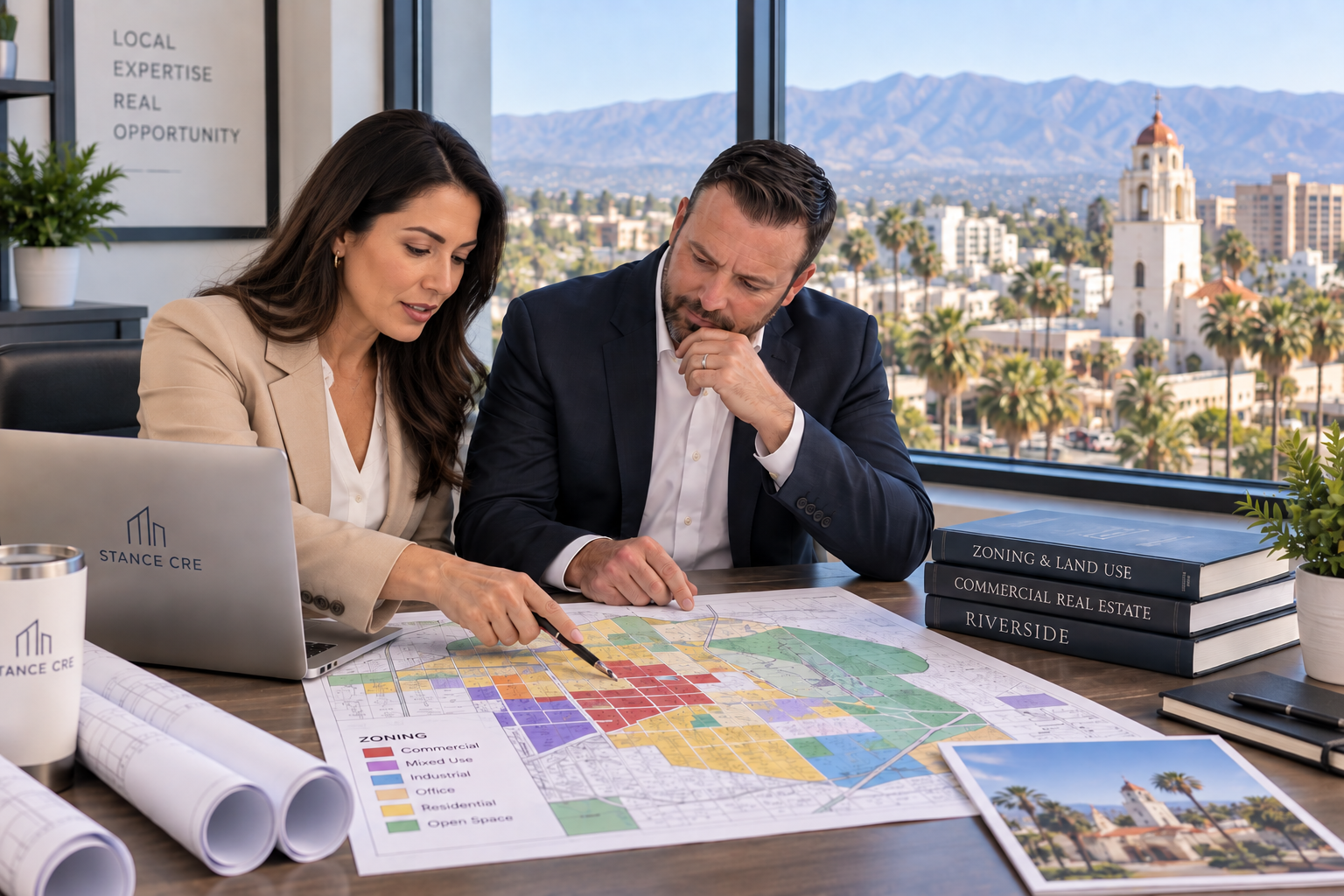
Understanding Riverside Zoning Laws for Commercial Properties
Finding a commercial property that looks perfect is only the beginning. A building may have the right square footage, excellent visibility, convenient freeway access, ample parking, and a price that fits the budget, yet still present a serious problem: the intended business use may not fit the property’s zoning requirements.
That is why zoning should be considered early in any commercial property search in Riverside, CA. Zoning regulations influence how land and buildings can be used, what types of businesses may operate at a location, how a property can be modified, and whether additional approvals may be required. For business owners and investors, overlooking these details can result in delays, unexpected expenses, or a property that cannot be used as originally planned.
At Stance CRE, we believe zoning questions belong near the beginning of the property conversation, not at the end. Because we have sold or leased nearly every type of commercial real estate product around Riverside, our local experience helps clients ask better questions, recognize potential obstacles, and focus their search on properties that make sense for their goals.
Why Riverside Commercial Zoning Matters Before You Choose a Property
Zoning is essentially a framework that determines what activities are appropriate in different areas of a community. The City of Riverside regulates zoning through Title 19 of the Riverside Municipal Code, along with other regulations related to building, grading, subdivisions, cultural resources, signage, and development standards. The city also maintains permitted-use information and requirements for commercial, mixed-use, and industrial zones.
For a commercial customer, the important question is not simply, “Is this a commercial building?” The better question is, “Can my particular business operate here under the rules that apply to this property?” Riverside includes multiple commercial, office, industrial, mixed-use, specific-plan, and other zoning designations. Two properties that appear similar from the street may therefore have very different possibilities.
This is one reason Stance CRE places so much value on local market knowledge. When helping a client evaluate commercial property Riverside opportunities, we look beyond attractive photographs and basic listing information. The goal is to understand whether the location, property characteristics, surrounding uses, and known zoning considerations make sense together before a business becomes deeply invested in a particular site.
Understanding the Difference Between a Property and Its Permitted Use
One of the easiest zoning mistakes is assuming that a building’s appearance determines how it can be used. A storefront looks like retail space. A warehouse looks industrial. An office building looks appropriate for professional services. In practice, zoning and land-use rules can be more specific.
Riverside’s zoning system includes designations such as Commercial General, Commercial Regional, Commercial Retail, Office, Industrial, Business and Manufacturing Park, and several mixed-use classifications. The city also has specific-plan districts and overlays that can introduce additional considerations. The zoning designation is therefore only the starting point for understanding what may be possible.
A company seeking office space Riverside CA, for example, has different operational needs from a restaurant, manufacturer, medical practice, logistics company, or retailer. Some uses may be permitted in a particular zone, while others may require additional review or approval. Parking, outdoor operations, signage, hours, loading, storage, building alterations, and other property characteristics can also influence whether a location is practical.
Stance CRE helps clients connect these details to the real-world property search. We want to understand what your business actually does, how customers and employees use the space, what equipment or improvements you need, and how you expect the company to grow. That information helps us identify potential questions much earlier.
Zoning Is Only One Layer of the Property Decision
A zoning designation should never be treated as a simple green light. Commercial real estate decisions can involve multiple layers of regulation and property-specific conditions. A location may also be affected by a specific plan, overlay, development standards, parking requirements, signage rules, building regulations, or other restrictions.
The City of Riverside’s zoning resources, for example, identify overlays involving cultural resources, commercial storage, setbacks, neighborhood commercial areas, building stories, and other property characteristics. The city specifically notes that its online map is for reference and recommends contacting the Planning Division for current zoning and land-use information. That is an important reminder that commercial customers should verify critical information rather than relying solely on an online listing or map.
Before making a major commitment, buyers and tenants need to understand what questions require further investigation. Stance CRE can help clients identify those questions and coordinate the commercial real estate process while appropriate zoning, planning, legal, construction, and other specialists provide guidance within their areas of expertise.
The Right Location Must Work for the Business Behind It
Every property search should begin with the business rather than the building. A retailer may prioritize visibility, traffic patterns, customer parking, signage, and neighboring businesses. An industrial company may care more about loading, truck access, storage, ceiling height, yard space, and proximity to major transportation routes. A medical office may have another set of occupancy, parking, accessibility, and improvement considerations.
That is why Stance CRE spends time learning how clients intend to use a property. If we understand your operational requirements early, we can conduct a more focused commercial property search and help flag obvious mismatches before they consume valuable time.
This approach becomes especially important for businesses moving into specialized spaces. A property previously occupied by one type of business is not automatically suitable for another. Even a previous similar use should not be treated as proof that a new operation will receive the same treatment or approvals. Verification remains essential.
A knowledgeable commercial real estate broker Inland Empire businesses can rely on should help clients think beyond square footage and rental rates. At Stance CRE, our role is to help clients see the larger picture so the property supports the business rather than becoming an obstacle to it.
Riverside Is a Big City That Still Rewards Local Knowledge
Riverside has a distinctive commercial personality. It is the largest city in the Inland Empire and a significant center for business and investment, yet many parts of the community retain the familiar, approachable feeling of a much smaller town. Historic architecture, established neighborhoods, local restaurants, independent businesses, tree-lined streets, and long-standing commercial corridors sit alongside major offices, healthcare facilities, distribution operations, industrial properties, and regional retail centers.
That mixture is part of Riverside’s appeal, but it also means commercial real estate varies significantly from one part of the city to another. Downtown Riverside is not interchangeable with Magnolia Center, Arlington, La Sierra, Orangecrest, or the industrial areas near major transportation corridors. Different neighborhoods developed at different times and for different purposes.
Stance CRE does not approach commercial real estate in Riverside CA as a collection of listings on a screen. We live and work in this market. Joe and Heidi Stance founded the company in 2018 with a vision of changing commercial real estate for the better, and the team has since sold or leased nearly every type of commercial real estate product around Riverside. When asked what product we specialize in, our answer is Riverside.
That local perspective matters when zoning questions arise because the best property decisions combine regulations with practical market knowledge. Understanding the code is important. Understanding the property, neighborhood, business environment, and client is equally important.
Zoning Questions Can Affect Both Tenants and Investors
Tenants should investigate zoning before signing a lease because a beautifully designed space has little value if the business encounters difficulties obtaining the approvals necessary to operate there. Build-out expenses can make the consequences even greater. A company that invests heavily in improvements before confirming important property and use requirements may expose itself to unnecessary risk.
Investors face a different version of the same issue. Zoning can influence the range of tenants a property may attract, how a site can potentially be repositioned, and what kinds of future improvements or redevelopment deserve further investigation. Buyers evaluating investment properties Riverside CA should therefore consider zoning and permitted uses as part of broader commercial real estate due diligence.
Stance CRE helps clients incorporate these questions into the larger transaction. Rather than looking only at the purchase price or lease rate, we help evaluate how a property fits the client’s operational or investment strategy. When specialized interpretation or formal confirmation is necessary, clients should work directly with the City of Riverside and qualified legal, planning, architectural, engineering, or other professionals as appropriate.
Frequently Asked Questions About Riverside Commercial Zoning
Zoning can feel complicated because the answer often depends on both the property and the proposed use. These questions address several issues we regularly encourage commercial customers to consider when evaluating Riverside properties.
How do I find out how a commercial property in Riverside is zoned?
The City of Riverside provides zoning information and mapping tools that can help identify the zoning designation associated with a property. However, the city notes that its mapping information is for reference and advises users to contact the Planning Division for current zoning and land-use information.
Stance CRE can help clients identify zoning questions during the property search and understand when additional verification should occur. Formal determinations regarding a proposed use should ultimately come from the appropriate government authority.
Does commercial zoning mean any business can operate there?
No. “Commercial” is a broad description, not permission for every possible commercial activity. Riverside has several commercial and mixed-use classifications, and permitted uses can vary between them. Certain businesses or activities may also be subject to additional standards or approvals.
This is why we encourage clients to discuss their specific operation rather than simply telling us they need a commercial building. The more we understand about the business, the better we can help narrow the search.
Should zoning be checked before signing a lease or purchasing a property?
Yes. Zoning and permitted-use questions should be investigated during the due diligence and site-selection process, before a client becomes irrevocably committed whenever possible. A lease or purchase agreement can create significant financial obligations, so discovering a major use issue afterward can be costly.
Stance CRE helps keep these considerations visible throughout the transaction so clients know which questions need answers before important decisions are made.
Can zoning requirements change over time?
Land-use policies and zoning regulations can change, and specific plans or other regulatory changes may affect properties over time. This is another reason businesses and investors should verify current requirements rather than relying on old marketing materials, a former tenant’s use, or assumptions about surrounding properties.
For investors especially, understanding both current conditions and the broader direction of a neighborhood can be an important part of evaluating commercial property Riverside opportunities.
How Stance CRE Can Help You
Commercial zoning does not need to turn your property search into a guessing game. Stance CRE helps business owners, investors, landlords, and tenants approach Riverside commercial real estate with the benefit of deep local market knowledge. We help clients define what they need, identify properties that align with those needs, recognize questions that deserve additional investigation, and connect the pieces of a transaction before major commitments are made.
Our connection to Riverside goes far beyond doing business here. We are locals. We have watched the Inland Empire grow into one of Southern California’s most important centers for distribution, retail, healthcare, industrial activity, professional services, and entrepreneurship. Riverside manages to be a substantial commercial city while maintaining the familiarity and character of a close-knit community, and that balance is one of the reasons we are proud to call it home.
Joe and Heidi Stance took a risk in 2018 when they launched Stance Commercial Real Estate with a vision to change the industry for the better. Since then, our team has sold or leased nearly every type of commercial real estate product around Riverside. Retail spaces, offices, industrial buildings, investment properties, specialized facilities, and unusual requirements are all part of the work we do. We call ourselves generalists because our true specialty is Riverside.
If you are looking for commercial property for lease, evaluating a purchase, relocating your company, expanding into a second location, or trying to determine which Riverside properties may fit a specialized business use, start with a team that understands the market behind the listings. Contact Stance CRE at 909-772-1212. We can help you approach your next Riverside commercial real estate decision with better questions, stronger local insight, and a clearer path toward the right property.
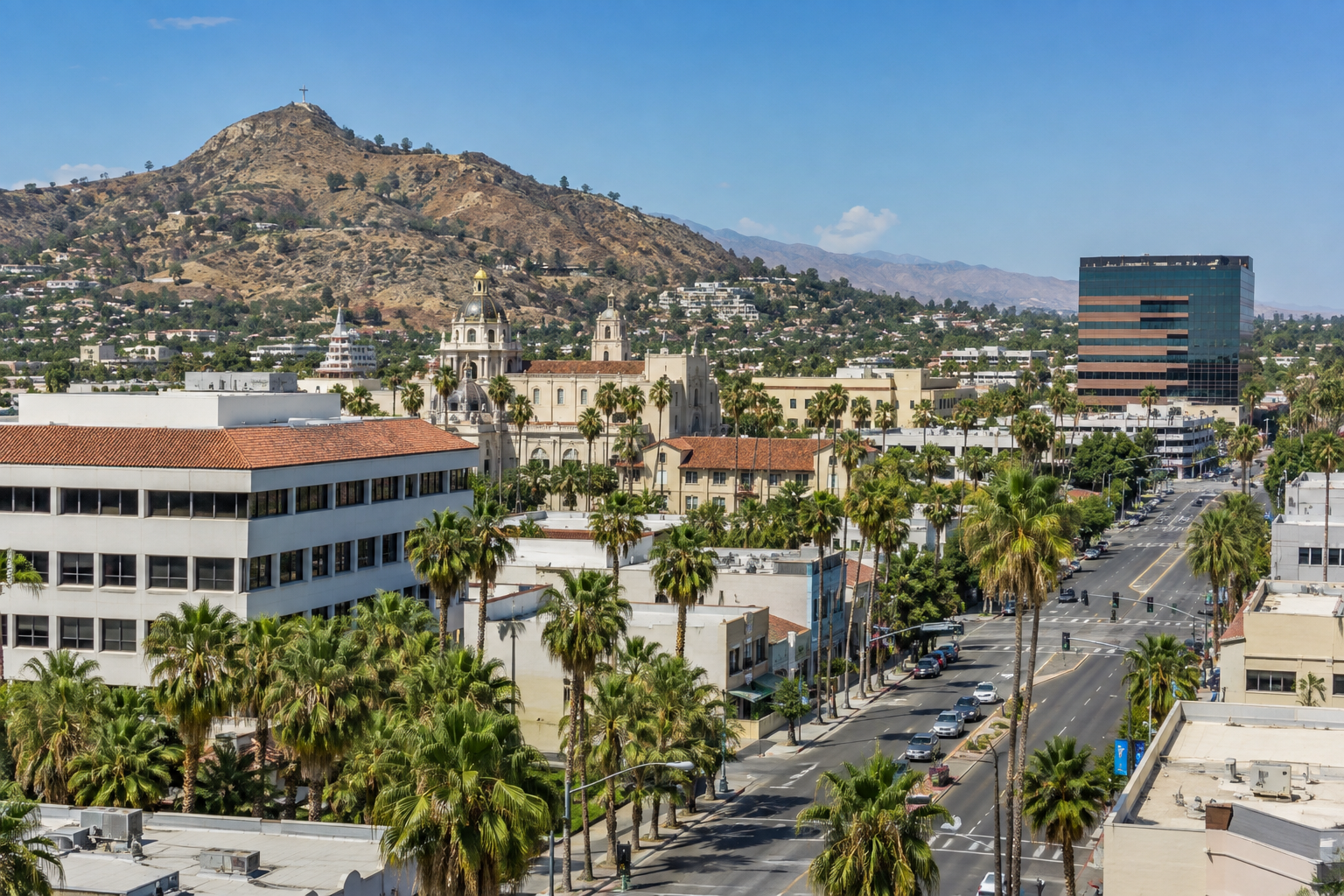
Riverside Commercial Real Estate Requires a Local Perspective
Commercial real estate is always local, but Riverside takes that principle a step further. Market reports, listing databases, demographic studies, and comparable transactions can tell part of the story. They cannot fully explain why one Riverside property attracts strong tenant interest while another seemingly comparable building a few miles away does not. They cannot tell a business owner how a particular commercial corridor feels at different times of day, how an area has changed over the years, or why one intersection may work better for a particular use than another.
Those are the details that come from knowing the market firsthand.
At Stance CRE, Riverside is not simply a territory on a brokerage map. It is our home, our business community, and the market in which we have built our expertise. Joe and Heidi Stance are locals who have sold or leased nearly every type of commercial real estate product around the city. When someone asks what type of property we specialize in, our answer is Riverside. We consider ourselves generalists because our expertise is not limited to one building category. It is rooted in understanding the local market as a whole.
For businesses, property owners, tenants, and investors, that distinction matters. Riverside commercial real estate is diverse, highly localized, and constantly evolving. Making a smart decision here requires more than finding a property that checks boxes on a listing sheet. It requires knowing Riverside.
You Cannot Understand Riverside From a Market Report Alone
Riverside is a sizable Southern California city, but its commercial districts can behave like individual markets. Downtown Riverside is different from Magnolia Avenue. University Avenue presents different opportunities from Mission Grove. Orangecrest, Sycamore Canyon, the airport area, and Riverside's established industrial corridors each have their own property inventory, traffic patterns, businesses, customers, and development histories.
The City of Riverside recognizes these differences through specific plans for distinctive areas such as Downtown, Magnolia Avenue, Mission Grove, Northside, Orangecrest, Riverside Marketplace, Sycamore Canyon Business Park, and University Avenue. These plans address development and land-use characteristics unique to individual portions of the city.
That is why our team approaches commercial property search from the ground up. We do not view a property only as a collection of statistics. We consider where it sits within Riverside, how businesses operate around it, what types of users are drawn to the area, and whether the location makes sense for what our client is actually trying to accomplish.
Having completed transactions throughout the city gives Team Stance context that is difficult to obtain from data alone. We know that moving a few miles, and sometimes only a few blocks, can change the dynamics of a commercial location. That local perspective allows us to help clients narrow their search before they spend valuable time evaluating properties that look right on paper but may not be the right fit in practice.
Riverside Is a Big City With a Remarkably Local Business Culture
Part of what makes Riverside special is its ability to feel both substantial and intimate. It is an important economic center within the Inland Empire, surrounded by major transportation infrastructure and a diverse mix of employers, healthcare facilities, universities, industrial operations, retailers, restaurants, and professional services.
Yet Riverside still has a wonderfully small-town quality. Historic architecture gives Downtown character. Mature trees line established neighborhoods. Local restaurants develop generations of loyal customers. Business owners recognize one another at community events, and longstanding commercial relationships remain important.
Joe and Heidi understand that side of Riverside because they are part of it. We do not have to arrive in town and study a neighborhood before a transaction. We have watched Riverside grow and change. We know its commercial areas from years of touring properties, talking with owners, working with tenants, negotiating transactions, and participating in the community.
That experience shapes the commercial real estate advice we provide. A client may come to us with a list of specifications, but we can help translate those specifications into a Riverside location. Instead of simply asking which properties have enough square footage, we can ask which areas make sense for the company's customers, employees, operations, growth plans, and budget.
That is the difference between knowing commercial real estate and knowing commercial real estate in Riverside.
Our Riverside Expertise Goes Beyond One Property Type
The Inland Empire is widely recognized for industrial and logistics real estate, but Riverside itself is far more diverse. Industrial facilities and distribution properties share the market with neighborhood retail centers, medical offices, professional offices, restaurants, flex buildings, automotive properties, development land, and highly specialized commercial facilities.
Team Stance has worked across that spectrum. We have sold or leased nearly every type of commercial real estate product around Riverside, which gives us the ability to look at the market broadly rather than through the lens of a single specialty.
That matters because commercial customers do not always fit neatly into property categories. A company may need warehouse space with a significant office component. A healthcare user may need a building with excellent parking and accessibility in a location convenient to patients. A retailer may care more about neighborhood demographics and neighboring businesses than raw traffic counts. An investor may be considering multiple asset classes and need to understand where Riverside demand is strongest.
Our experience as Riverside generalists allows us to start with the client's objective rather than a preferred property type. We can help identify commercial space for rent, acquisition opportunities, investment properties, and niche buildings based on what makes sense for the client.
That breadth of experience is one reason Inland Empire business owners, investors, and tenants rely on Team Stance for local commercial property insights.
We Know That the Listing Never Tells the Whole Story
A commercial listing can provide square footage, asking rent, sale price, zoning information, photographs, parking ratios, building specifications, and other useful details. What it cannot communicate is everything a local broker learns by repeatedly working in the same market.
Two retail spaces with similar rents can offer completely different opportunities. One may sit within a center that has strong local momentum, while another struggles with access or tenant turnover. Two industrial buildings may appear comparable until truck circulation, loading, neighboring uses, or freeway accessibility are considered. Office properties that look similar online may appeal to entirely different tenant groups because of their location within Riverside.
Our local experience helps put those differences into perspective.
Because we routinely work with Riverside commercial properties, we are not encountering the city for the first time with each transaction. We bring knowledge from previous tours, negotiations, transactions, conversations, and market activity into the next assignment. We understand the questions that tend to matter for different property types and can help clients recognize issues that deserve closer examination.
For commercial customers, that can make commercial site selection more efficient. Instead of touring every building that meets basic search criteria, we can focus attention on opportunities that have a stronger chance of supporting the client's actual business or investment objectives.
Local Knowledge Is Especially Important for Zoning and Property Use
Finding a building that physically accommodates a business does not necessarily mean the business can operate there. Zoning, permitted uses, parking requirements, signage, building modifications, and other regulations can influence whether a property is practical for a particular user.
The City of Riverside's zoning regulations address permitted uses and development standards along with parking, signs, noise, cultural resources, grading, and other property considerations.
Our familiarity with Riverside helps us recognize when these questions need to be addressed early. While zoning and entitlement questions should always be formally verified with the appropriate city departments and professional advisers, experience helps clients know what to ask.
That distinction can save valuable time during a commercial property search. If a business has specialized requirements, we can incorporate those needs into the search rather than treating them as an afterthought.
Our job is not simply to unlock doors and show buildings. It is to help clients understand what they are looking at and how a property fits into the larger Riverside commercial environment.
Knowing the History of a Market Helps You Understand Its Direction
Commercial real estate decisions are rarely made for the short term. Businesses may occupy a location for many years. Investors may hold properties through multiple market cycles. Owners deciding whether to sell, lease, or reposition a building need to consider not only current conditions but also how an area may evolve.
Riverside continues to plan for future growth, with the city's General Plan providing a framework for development, land use, transportation, economic activity, and other long-range priorities.
That makes local historical knowledge especially valuable. Because Joe and Heidi have built their careers in this community, our perspective is not limited to a snapshot of today's commercial real estate market. We have watched properties change hands, businesses relocate, commercial areas mature, and new opportunities emerge.
That history provides context when evaluating what may come next. No broker can predict the future of a property with certainty, but understanding where a market has been can lead to better questions about where it may be going.
For an investor, that might mean looking beyond today's occupancy to the long-term competitiveness of a location. For a tenant, it may mean considering whether the surrounding area supports future growth. For an owner, it could mean understanding how changing demand affects the property's position within the Riverside market.
Relationships Are Part of Local Market Expertise
Commercial real estate remains a relationship business, particularly in a community like Riverside.
Online databases have made property information much easier to access, but access to information is not the same as market knowledge. Owners have priorities that are not always included in marketing materials. Buildings have transaction histories. Tenants have concerns that do not appear in lease comparables. Local professionals accumulate knowledge through years of conversations and completed deals.
Team Stance has built relationships throughout Riverside because this is where we work and live. Property owners, tenants, business leaders, brokers, and other commercial professionals become part of the network that helps us remain connected to what is happening throughout the market.
Those relationships do not replace careful research, due diligence, inspections, financial analysis, or professional advice. They add context to them.
When clients come to us for commercial leasing solutions, investment guidance, property sales, or site selection, they benefit from more than access to a listing database. They gain a team that already understands the community in which the transaction is taking place.
A Local Expert Helps You See the Property Through a Riverside Lens
One of the most valuable things we can do for a client is help separate a good property from the right property.
A building can be attractive, appropriately priced, and well maintained while still being wrong for a particular business. Likewise, an investment that does not immediately stand out may deserve a closer look because of its location, tenant profile, functionality, or long-term potential.
Our role is to view those opportunities through a Riverside lens.
For a retailer, we may look closely at visibility, customer patterns, surrounding tenants, access, parking, and neighborhood characteristics. For an industrial user, freeway connectivity, loading, truck circulation, building functionality, and nearby land uses become more important. For an office or healthcare user, employee and customer accessibility, parking, surrounding amenities, and building configuration may carry more weight.
Investors evaluating commercial property Riverside opportunities need another perspective still. Current income matters, but so do tenant demand, property functionality, location quality, competing inventory, and the ability of the asset to remain attractive over time.
There is no universal checklist that identifies the best Riverside property. Local expertise is about knowing which questions matter for each client and each location.
Frequently Asked Questions About Riverside Commercial Real Estate
Commercial buyers, tenants, investors, and owners often ask how much difference local representation really makes. In Riverside, where individual commercial districts can vary substantially, market-specific experience can provide useful perspective at nearly every stage of a transaction.
Why should I choose a broker who specializes in Riverside?
A broker with substantial Riverside experience can combine market data with firsthand knowledge of local properties, commercial corridors, business patterns, owners, and transaction activity.
Team Stance has sold and leased properties across numerous commercial categories throughout Riverside. That breadth allows us to evaluate opportunities within the context of the local market instead of relying exclusively on general Inland Empire trends.
Does Team Stance specialize in a particular type of commercial property?
Our specialty is Riverside.
Joe and Heidi describe themselves as generalists because they have sold and leased nearly every type of commercial real estate product around the city. That includes experience with retail, office, industrial, and niche commercial properties.
For clients, that means the conversation begins with what they need rather than what property category we prefer to sell or lease.
What should a business consider when choosing a Riverside location?
Price and square footage are only the beginning. Businesses should consider zoning, permitted use, visibility, accessibility, parking, building configuration, surrounding businesses, customer demographics, employee access, and future growth requirements.
Our local experience helps connect those criteria with actual Riverside locations. The objective is not merely to find an available property. It is to identify a location capable of supporting the business.
Can local expertise also help commercial property investors?
Yes. Investors need to understand both individual property fundamentals and the market surrounding the asset.
Our knowledge of Riverside can help investors evaluate location quality, tenant considerations, competing properties, marketability, and other factors alongside financial metrics. A strong commercial property investment decision should consider how the asset fits into the local market today and how competitive it may remain over time.
How Stance CRE Can Help You
At Stance CRE, we believe our value comes from knowing Riverside at a level that goes beyond listings and market reports. Joe and Heidi Stance took a risk in 2018 when they launched the company with a vision of changing commercial real estate for the better. They built that company in a community they already knew and cared about. Today, our team brings together professional commercial real estate experience and the firsthand knowledge that comes from being Riverside locals.
We have sold or leased nearly every type of commercial real estate product around the city, which is why we proudly call ourselves Riverside generalists. Whether a client needs retail space, offices, industrial property, an investment opportunity, or a niche building with highly specific requirements, we understand how to approach that search within the context of the local market. We know Riverside's commercial corridors, we understand the variety within its property inventory, and we stay closely connected to the business community we serve.
Most importantly, we are not simply doing business in Riverside. We live here. We support its businesses, follow its growth, and have watched the city evolve while retaining the wonderfully close-knit character that makes it such a distinctive place to do business. That connection gives us a personal investment in helping property owners, investors, businesses, and tenants make decisions that strengthen both their own futures and the Riverside commercial community.
If you are considering buying, selling, leasing, investing, or relocating within Riverside, work with a team whose expertise is rooted in the market itself. Contact Stance CRE at 909-772-1212 to discuss your commercial real estate goals.