


Mastering Commercial Real Estate Investment: Strategies for Success
Maximizing Your Success with Commercial Real Estate Investment Strategies
Commercial real estate investment strategies are your ticket to navigating a dynamic, lucrative market. When diving into commercial real estate, the right approach can make all the difference. Here are the top strategies you should consider:
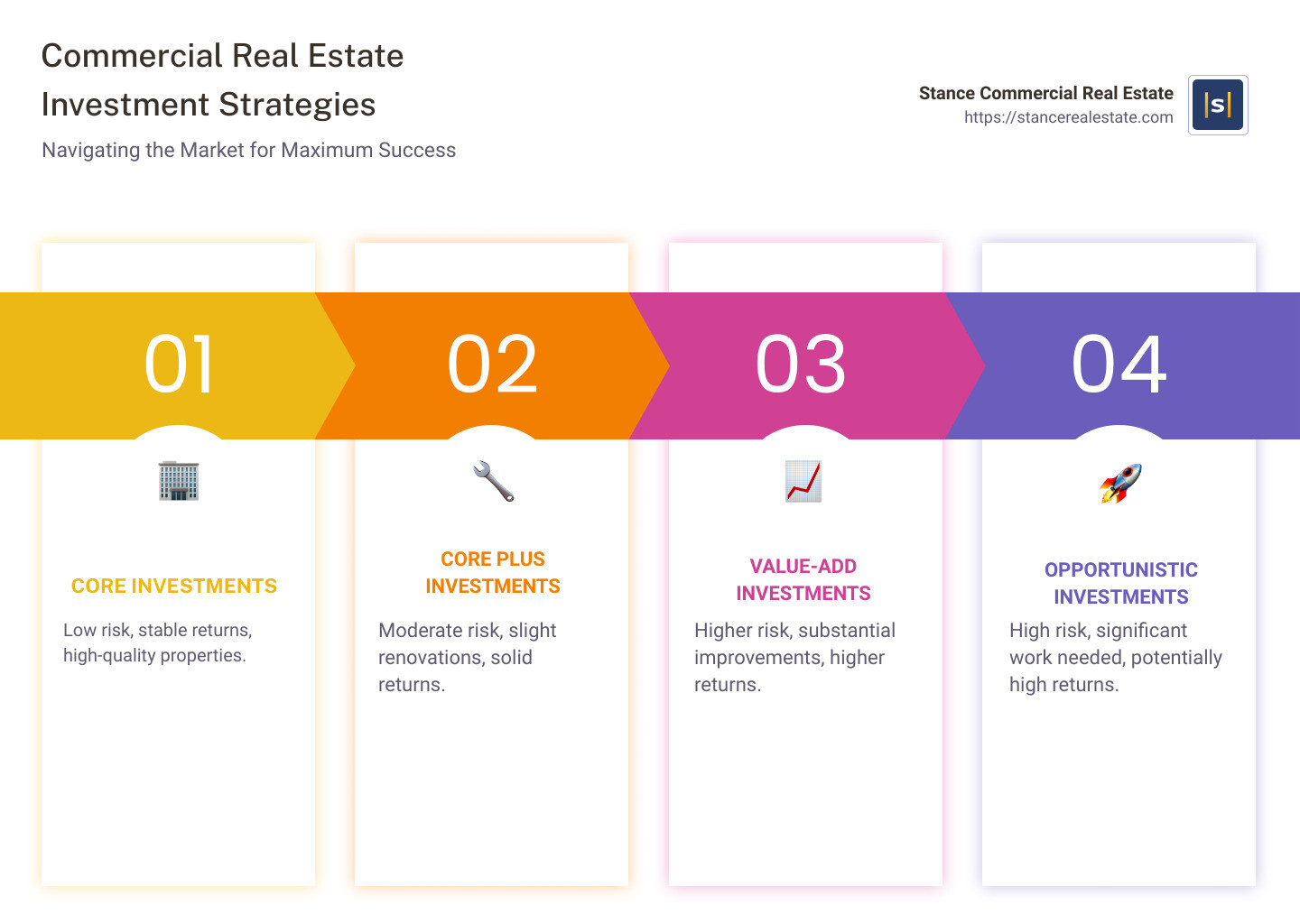
1. Core Investments: Low risk, stable returns, high-quality properties.
2. Core Plus Investments: Moderate risk, slight renovations, solid returns.
3. Value-Add Investments: Higher risk, substantial improvements, higher returns.
4. Opportunistic Investments: High risk, significant work needed, potentially high returns.
Understanding and selecting the right strategy is crucial for aligning with your financial goals and risk tolerance.
I'm Joe Stance, and I have spent 17 years mastering the landscape of commercial real estate investment strategies. With experience in leasing and selling millions of square feet of property, I have helped countless clients optimize their real estate portfolios.
Ready to dive deeper? Read on to explore the intricacies of each strategy and how to apply them for maximum success.
Types of Real Estate Investment
When it comes to investing in real estate, there are several avenues you can explore. Each type of investment offers unique opportunities and challenges.
Here is a breakdown of the most popular types of real estate investment:
Commercial Real Estate
Commercial real estate involves properties used for business purposes. This includes:
- Office buildings: High-rises, midrises, and single-tenant offices.
- Industrial properties: Warehouses, manufacturing facilities, and distribution centers.
- Retail spaces: Shopping centers, strip malls, and standalone stores.
- Multifamily units: Apartment complexes and other residential buildings with five or more units.
Commercial real estate is popular because it often offers longer leases and higher rental returns compared to residential properties. However, it requires significant capital and is more complex to manage.
Raw Land
Raw land investment involves purchasing undeveloped land. Investors can:
- Develop the land: Build residential or commercial properties.
- Hold for appreciation: Wait for the land value to increase and sell at a profit.
This type of investment requires a keen understanding of zoning laws, market trends, and development potential. It is high-risk but can yield substantial returns.
Real Estate Investment Trusts (REITs)
REITs are companies that own, operate, or finance income-producing real estate. They allow investors to:
- Buy shares: Similar to stocks, providing a way to invest in large-scale properties without directly owning them.
- Earn dividends: REITs are required to distribute at least 90% of taxable income to shareholders.
REITs offer liquidity and diversification, making them attractive for those who want to invest in real estate without the hassles of property management.
Crowdfunding
Real estate crowdfunding platforms allow multiple investors to pool their money to invest in properties that would be out of reach individually. This method:
- Democratizes investment: Allows non-institutional investors access to high-value properties.
- Offers diversification: Invest in various properties with smaller amounts of capital.
However, crowdfunding can be riskier and often involves lockup periods where your investment is illiquid.
Residential Real Estate
Residential real estate involves properties like single-family homes, condos, and townhouses. Investors can:
- Rent out properties: Generate monthly rental income.
- Flip houses: Buy, renovate, and sell for a profit.
Residential real estate is generally more accessible to individual investors and can be less risky compared to commercial properties. However, it requires active management, especially if you are handling tenant issues and maintenance.
Each type of real estate investment has its own risk and return profile. Choosing the right one depends on your financial goals, risk tolerance, and investment horizon.
Understanding Commercial Real Estate Investment Strategies
When it comes to commercial real estate investment strategies, there are four main approaches: Core, Core Plus, Value-Add, and Opportunistic. Each strategy has its own risk and return profile, catering to different investor needs and objectives.
Core Investment Strategy
Core investing is the safest form of commercial real estate investment. It involves acquiring high-quality, well-located properties, often referred to as Class A buildings. These assets are typically found in prime locations and feature low vacancy rates. The primary goal here is to generate stable revenue.
- Risk Profile: Low
- Returns: Typically below 10%
- Characteristics: Prime locations, high-quality buildings, low vacancies
Example: Think of a Class A office building in downtown New York City. These properties maintain their value well and attract high-quality tenants who sign long-term leases. This makes them resilient even in unfavorable market conditions.
Core Plus Investment Strategy
Core Plus investing is similar to Core but with a bit more risk and potential for higher returns. This strategy involves acquiring mostly stable buildings that might need some minor renovations or have tenant vacancies.
- Risk Profile: Low to moderate
- Returns: Typically between 10-14%
- Characteristics: Stable assets with potential for revenue-boosting improvements
Example: Imagine a slightly older office building in a good location that needs some updates or has a few vacant units. By renovating these units or improving common areas, the property can attract higher-paying tenants and increase overall returns.
Value-Add Investment Strategy
Value-Add investing is for those willing to take on more risk for potentially higher rewards. This strategy focuses on properties that need significant improvements or repositioning.
- Risk Profile: Moderate
- Returns: Typically between 15-19%
- Characteristics: Distressed properties needing capital investment
Example: A distressed shopping mall that requires extensive renovations to attract new tenants. Over a period of 5-7 years, investors can stabilize the asset and sell it for a substantial profit. This strategy is popular because it offers a cost-effective entry into major markets.
Opportunistic Investment Strategy
Opportunistic investing is the highest risk but offers the greatest potential returns. This strategy involves properties that need substantial investment to become profitable.
- Risk Profile: High
- Returns: Potentially exceeding 20%
- Characteristics: Extensive renovations or new developments
Example: Picture a dilapidated warehouse that can be converted into a modern office space. Such investments often go through periods of little to no income and are considered high liability. However, the potential for returns over 20% makes them attractive to certain investors.
Understanding these strategies helps investors align their financial goals with the right risk-return balance.
Key Factors for Successful Commercial Real Estate Investing
Diversification
Diversification is a cornerstone of successful commercial real estate investing. By spreading investments across different property types and geographical locations, you can reduce risk and increase potential returns. Think of it like not putting all your eggs in one basket.
Property Types: Consider investing in multifamily, industrial, retail, and office properties. Each type reacts differently to economic cycles. For example, industrial properties like warehouses have thrived with the rise of e-commerce, while retail spaces may face challenges during economic downturns.
Geographies: Spread your investments across various regions to mitigate local market risks. A downturn in one area might be balanced by growth in another. For instance, investing in both urban and suburban locations can provide stability.
Risk Reduction: By diversifying, you can protect your portfolio from significant losses. If one property type or location underperforms, others might perform well, balancing your overall returns.
Market Research
Market research is essential for making informed investment decisions. Understanding economic trends, demographic shifts, and local market conditions can help you identify promising opportunities and avoid costly mistakes.
Economic Trends: Keep an eye on broader economic indicators like GDP growth, employment rates, and interest rates. These factors can impact property values and rental demand.
Demographic Shifts: Analyze population trends. For example, an aging population might increase demand for senior living housing, while a growing tech industry could boost demand for office spaces in tech hubs.
Local Market Conditions: Investigate local factors such as zoning laws, infrastructure developments, and neighborhood dynamics. A property in a developing area with new transport links might offer significant appreciation potential.
Technology Utilization
Leveraging technology can streamline your investment process and provide a competitive edge. Real estate investment software, data-driven analysis, and deal management tools can enhance decision-making and efficiency.
Real Estate Investment Software: Tools like property management software can help track expenses, manage leases, and monitor property performance.
Data-Driven Analysis: Use analytics to evaluate market trends, property values, and rental rates. This can help you identify undervalued properties and forecast future performance.
Deal Management Software: Platforms that facilitate deal tracking and document management can save time and reduce errors, making the investment process smoother.
Networking
Building a strong network is invaluable in commercial real estate investing. Connections with industry professionals can provide insights, opportunities, and partnerships that might not be available otherwise.
Industry Connections: Attend industry events, join real estate investment groups, and connect with brokers, property managers, and other investors. These relationships can offer insider knowledge and potential deals.
Partnerships: Collaborating with other investors can pool resources and share risks. Joint ventures can be particularly useful for large projects that might be too costly or complex to undertake alone.
Adaptation
The real estate market is dynamic, and successful investors must adapt to changing conditions. Staying informed about market changes, regulatory updates, and economic cycles is crucial.
Market Changes: Keep abreast of shifts in supply and demand, technological advancements, and consumer preferences. For example, the rise of remote work has increased demand for flexible office spaces.
Regulatory Updates: Stay updated on zoning laws, tax regulations, and environmental policies. Compliance is essential to avoid legal issues and fines.
Economic Cycles: Understand how different stages of the economic cycle affect property values and rental demand. During a recession, for instance, demand for luxury office spaces might decline, while affordable housing could see increased demand.
By focusing on these key factors—diversification, market research, technology utilization, networking, and adaptation—you can navigate the complexities of commercial real estate investing and set yourself up for long-term success.
How to Choose the Right Commercial Real Estate Investment Strategy
Choosing the right commercial real estate investment strategy means understanding your risk tolerance, investment goals, time horizon, and the type of property you want to invest in.
Assessing Risk Tolerance
Your risk tolerance is a key factor in deciding which investment strategy to use. Here is a quick breakdown:
- Core Strategy: Low risk, stable revenue, and prime locations. Ideal for investors who want steady income with minimal risk. Returns are usually below 10%.
- Core Plus Strategy: Low to moderate risk. Involves improving mostly stable buildings to boost revenue. Returns range from 10-14%.
- Value-Add Strategy: Moderate risk. Focuses on properties needing capital investment and improvements. Returns typically between 15-19%.
- Opportunistic Strategy: High risk, involving substantial investment to turn properties profitable. Potential returns can exceed 20%.
Defining Investment Goals
What do you want to achieve with your investment? Your goals will help determine the best strategy.
- Income Generation: If you want regular income, core or core plus strategies might be best. These focus on stable properties with reliable tenants.
- Capital Appreciation: Looking for growth in property value? Value-add and opportunistic strategies focus on improving and selling properties for a profit.
- Portfolio Diversification: Mixing different types of properties and strategies can reduce risk and increase opportunities for returns.
Determining Time Horizon
Your investment timeline will also influence your strategy choice.
- Short-Term: Opportunistic strategies can offer high returns quickly but come with high risk.
- Medium-Term: Value-add strategies often require 5-7 years to improve and sell properties.
- Long-Term: Core and core plus strategies are more stable and can provide consistent income over many years.
Selecting Property Type
The type of property you invest in will depend on your risk tolerance, goals, and time horizon.
- Multifamily: Often seen as a safer bet due to constant demand for housing.
- Industrial: High demand due to e-commerce growth. Suitable for investors looking at long-term stable returns.
- Retail: Can be risky due to the "Amazon effect," but e-commerce-resistant options like grocery stores can be profitable.
- Office: Trends in remote work are changing this market. Look for properties with modern amenities and sustainability features.
By aligning your risk tolerance, investment goals, time horizon, and property type, you can choose the right commercial real estate investment strategy to meet your needs.
Frequently Asked Questions about Commercial Real Estate Investment Strategies
What are the CRE investment strategies?
Commercial real estate (CRE) investment strategies can be categorized into four main types: core, core-plus, value-added, and opportunistic.
- Core: This strategy focuses on low-risk investments in high-quality, fully leased properties in prime locations. These buildings, often class A, generate stable revenue with minimal need for active management or capital improvements.
- Core-Plus: Slightly riskier than core investments, core-plus strategies involve properties that are mostly stable but may require some renovations or filling tenant vacancies. These investments typically offer returns of 10-14%.
- Value-Added: This strategy targets properties that need significant improvements or repositioning. Investors take on moderate risk, aiming for returns of 15-19% by enhancing the property’s value through renovations or improved management.
- Opportunistic: The highest-risk strategy, opportunistic investments involve properties that need substantial redevelopment or are in distress. These projects can yield returns exceeding 20% but require significant capital and come with higher uncertainty.
What is a good ROI for commercial real estate investment?
A good return on investment (ROI) for commercial real estate varies based on the strategy, property type, and market conditions. Generally, investors aim for an ROI of 8-10%.
- Core investments might yield modest returns of 4-6%, reflecting their low-risk nature.
- Core-Plus strategies offer returns around 10-14%.
- Value-Added investments target 15-19%.
- Opportunistic deals can exceed 20% returns, but with higher risk.
Factors like location, property type, and market dynamics significantly influence ROI.
How do investors make money in commercial real estate?
Investors make money in commercial real estate through property appreciation and tenant rents.
- Property Appreciation: As market conditions improve, the value of the property increases. This can result from favorable economic trends, strategic property enhancements, or rising demand in the area. For instance, buying a property in a growing market like Riverside, CA, and selling it later at a higher price can generate significant returns.
- Tenant Rents: Consistent rental income is a primary revenue stream. High occupancy rates and long-term leases with reliable tenants ensure steady cash flow. Effective lease optimization, such as passing on certain costs to tenants or negotiating rent escalations, can also enhance rental income.
By understanding and leveraging these strategies, investors can maximize their returns and build a robust commercial real estate portfolio.
Conclusion
In summary, mastering commercial real estate investment requires a blend of strategic planning, market knowledge, and a tailored approach to risk and reward. From core investments offering stability to opportunistic strategies promising high returns, understanding the nuances of each commercial real estate investment strategy can significantly impact your success.
At Stance Commercial Real Estate, we pride ourselves on our deep local expertise and commitment to service excellence. Our team is not just familiar with Riverside; we live and work here, giving us unparalleled insight into the market. This local knowledge allows us to offer you the best advice and support, ensuring that your investments align with your goals and thrive in this vibrant community.
Riverside, CA, offers a unique blend of historical charm and modern opportunity, making it a prime location for commercial real estate investment. Whether you are looking to buy, sell, or lease, our hands-on approach ensures that you are not just investing in property but also in a community that suits your business needs.
Let us guide you through the complexities of commercial real estate investment. Our goal at Stance Commercial Real Estate is to provide a seamless experience from start to finish, handling the details so you can focus on what you do best—running your business.
Discover how we can help you capitalize on the opportunities in Riverside’s dynamic market. Learn more about our services and start your investment journey with a team that knows Riverside best.
By choosing Stance Commercial Real Estate, you are selecting a partner dedicated to your success with unmatched local insight. Let us help you navigate the exciting landscape of commercial real estate in Riverside.
