


New Demand for Sustainability in Commercial Real Estate
The commercial real estate industry is experiencing a profound shift driven by growing expectations around sustainability. Investors, tenants, lenders, and regulators are increasingly aligned in prioritizing buildings and portfolios that demonstrate responsible environmental, social, and governance practices. Sustainability is no longer viewed as a niche consideration or a marketing differentiator reserved for flagship properties. It is now a core component of asset value, operational resilience, and long-term competitiveness in commercial real estate.
For owners and occupiers alike, this demand reflects broader economic and societal changes. Rising energy costs, climate risk exposure, evolving tenant preferences, and heightened disclosure requirements are reshaping how properties are planned, operated, and transacted. Firms like Stance CRE are seeing firsthand how sustainability considerations influence leasing decisions, investment strategies, and redevelopment plans across office, industrial, retail, and mixed-use assets.
Understanding What Sustainability Means in Commercial Real Estate
Sustainability in commercial real estate extends well beyond energy efficiency alone. It encompasses how buildings use resources, impact occupants and communities, and adapt to long-term environmental and economic risks. This includes reducing carbon emissions, minimizing water consumption, improving indoor environmental quality, and ensuring buildings are resilient to extreme weather events and regulatory changes.
At the same time, sustainability also includes social and governance factors that affect asset performance. Social considerations involve occupant health, accessibility, and community integration, while governance focuses on transparency, reporting, and responsible decision-making. When these elements are integrated into property strategy, sustainability becomes a framework for managing risk and unlocking value rather than an isolated initiative.
Market Forces Driving the New Demand
One of the strongest drivers of sustainability demand is tenant expectation. Many corporate occupiers have established environmental and social goals that require them to lease space aligned with those commitments. Energy-efficient buildings with strong sustainability credentials help tenants reduce operating costs, meet reporting obligations, and support employee wellness and retention. As a result, properties lacking these features face increasing competitive pressure.
Investor priorities also play a critical role. Institutional investors, private equity firms, and lenders are evaluating assets through an environmental, social, and governance lens. Properties with clear sustainability strategies often benefit from improved access to capital, favorable financing terms, and enhanced exit potential. Stance CRE frequently works with clients who recognize that sustainability performance is now directly linked to investment risk and long-term valuation.
Regulatory and Policy Influences on Sustainability
Regulatory frameworks are rapidly evolving at the local, state, and national levels. Energy benchmarking ordinances, emissions caps, and mandatory disclosure requirements are becoming more common in major markets. These policies require building owners to measure, report, and in some cases reduce their environmental impact, creating both compliance obligations and strategic opportunities.
Proactive owners who invest early in sustainable upgrades are often better positioned to manage regulatory risk. They can spread capital expenditures over time, avoid penalties, and maintain flexibility as regulations tighten. Conversely, properties that delay action may face higher costs and diminished appeal. Understanding the regulatory landscape is essential for making informed decisions about asset improvement and portfolio planning.
Operational Benefits of Sustainable Buildings
Sustainable commercial properties frequently deliver tangible operational benefits. Energy-efficient systems reduce utility expenses and stabilize operating costs over time. Advanced building controls, efficient lighting, and modern HVAC systems can significantly improve performance while reducing maintenance demands.
Beyond cost savings, sustainable buildings often offer superior occupant comfort and reliability. Improved indoor air quality, thermal comfort, and lighting contribute to higher tenant satisfaction and productivity. These factors can translate into stronger tenant retention, reduced vacancy, and enhanced reputation for property owners and managers.
Sustainability as a Value Creation Strategy
From an investment perspective, sustainability is increasingly viewed as a value creation tool rather than a cost center. Strategic retrofits and sustainable design enhancements can increase net operating income, extend asset life, and support higher rents or sale prices. In competitive markets, sustainability features can differentiate a property and attract higher-quality tenants.
For repositioning and redevelopment projects, sustainability considerations are often integrated from the outset. This includes selecting durable materials, designing flexible spaces, and incorporating renewable energy solutions. Stance CRE advises clients that aligning sustainability with overall asset strategy helps ensure that investments deliver both financial and environmental returns.
The Role of Data, Metrics, and Transparency
Accurate data is foundational to effective sustainability efforts. Building owners are increasingly relying on energy monitoring, benchmarking tools, and performance analytics to understand how their properties operate. These insights enable targeted improvements and support compliance with disclosure requirements.
Transparency is equally important. Investors and tenants expect clear reporting on energy use, emissions, and sustainability initiatives. Consistent metrics allow stakeholders to compare assets, track progress, and assess risk. Properties that can demonstrate measurable improvement over time are often viewed as more resilient and forward-looking.
Challenges and Barriers to Adoption
Despite growing demand, implementing sustainability initiatives can present challenges. Upfront capital costs, uncertainty around payback periods, and operational disruptions are common concerns for property owners. Older buildings may require significant upgrades to meet modern performance standards, which can complicate planning and budgeting.
However, many of these barriers can be mitigated through phased approaches, incentive programs, and careful financial analysis. Utility rebates, tax incentives, and green financing options can help offset costs. Experienced advisors, including teams at Stance CRE, help clients evaluate trade-offs and prioritize initiatives that align with both sustainability goals and financial realities.
Future Outlook for Sustainable Commercial Real Estate
Looking ahead, sustainability is expected to become even more deeply embedded in commercial real estate decision-making. Advances in building technology, increasing climate risk awareness, and continued regulatory pressure will reinforce the importance of sustainable practices. Assets that fail to adapt may face accelerated obsolescence.
At the same time, sustainability presents opportunities for innovation and leadership. Owners who embrace sustainable strategies can enhance resilience, attract premium tenants, and position their portfolios for long-term success. As market expectations continue to evolve, sustainability will remain a defining factor in how commercial real estate is valued, developed, and operated.
Frequently Asked Questions
Sustainability in commercial real estate can seem complex, especially for owners and investors navigating changing expectations and regulations. The following questions address common concerns and provide clarity on how sustainability impacts commercial properties and decision-making.
Why is sustainability becoming so important to commercial real estate tenants?
Tenants are under increasing pressure from customers, employees, and stakeholders to operate responsibly. Leasing space in sustainable buildings helps them reduce operating costs, meet environmental reporting requirements, and create healthier workplaces. Sustainable properties also support corporate branding and employee satisfaction, making them more attractive in competitive labor markets.
Does investing in sustainability always increase property costs?
While some sustainability initiatives require upfront investment, they often reduce long-term operating expenses and risk. Energy-efficient systems, for example, can lower utility costs and maintenance needs. Over time, these savings, combined with improved tenant retention and asset value, can outweigh initial expenditures.
How does sustainability affect property value and financing?
Sustainable properties are increasingly viewed as lower-risk investments. They often command higher rents, experience lower vacancy, and attract more favorable financing terms. Lenders and investors may also prioritize assets with strong environmental performance, which can enhance liquidity and exit potential.
What is the first step for a property owner interested in sustainability?
The first step is typically to assess current building performance through energy benchmarking and operational reviews. This establishes a baseline and identifies opportunities for improvement. Working with experienced advisors such as Stance CRE can help owners develop a practical, phased strategy that aligns sustainability goals with financial and operational objectives.


The Commercial Real Estate Services Industry: What You Need to Know
Navigating the Commercial Real Estate Services Industry
When diving into the commercial real estate services industry, it’s crucial to understand its market landscape, diverse service offerings, and significant scope. This sector is vast, embracing everything from office space brokerage to multifamily rental management. Let's break it down:
- Definition: The commercial real estate services industry involves companies specializing in services like brokerage, property management, construction, and consulting.
- Market Size: The industry is projected to reach an estimated $1.3 trillion in 2024, despite a decline over the past five years.
- Types: Encompasses office spaces, industrial sites, multifamily rentals, and retail properties.
Understanding these elements can provide a clear picture of what to expect when engaging with this dynamic sector.
I’m Joe Stance. With over a decade in the commercial real estate industry and experience in the Inland Empire, I aim to guide business owners and investors through this market's complexities. Let's dive deeper into the essentials and current trends shaping the industry.
Key Segments of the Commercial Real Estate Services Industry
Understanding the key segments of the commercial real estate services industry is essential for anyone looking to invest or operate within it. Each segment has unique characteristics, benefits, and challenges. Let's explore these segments:
Office Space
Office spaces are designed for business use and vary greatly in size and function. They can be categorized into three classes:
- Class A: These are the top-tier buildings, known for their prime locations, modern amenities, and high-quality infrastructure. They are newer buildings with excellent aesthetics and are usually located in major business districts.
- Class B: These buildings are older but still in good condition. They are less expensive than Class A buildings and often targeted by investors for renovation and upgrades.
- Class C: These are the oldest buildings, typically over 20 years old, and may require significant maintenance. They are located in less desirable areas and are the least expensive.
Industrial Use
Industrial properties are used for manufacturing, production, and storage of goods. They include:
- Manufacturing: Facilities designed for the production of goods. These buildings often have large open spaces and specialized infrastructure to support heavy machinery.
- Production: Similar to manufacturing but may include facilities for processing raw materials.
- Heavy Goods: These properties are used for storing and distributing heavy products and are often located near major transportation routes to facilitate logistics.
Multifamily Rental
Multifamily rentals refer to residential properties with five or more units. These properties can serve dual purposes:
- Residential: Primarily used for housing tenants. These properties provide a stable revenue stream through rental income.
- Commercial Activity: Some multifamily properties may include commercial spaces, such as ground-floor retail or office spaces, which can generate additional income for the property owner.
Retail
Retail properties are designed for businesses that sell goods or services directly to consumers. This segment includes:
- Hotels and Resorts: These properties cater to travelers and tourists, offering lodging, dining, and entertainment services.
- Strip Malls: Small shopping centers with multiple retail outlets. They are often located in suburban areas and attract local shoppers.
- Restaurants: Standalone or within malls, these properties range from fast-food outlets to fine dining establishments.
- Healthcare Facilities: Buildings designed for medical services, such as clinics, hospitals, and specialized treatment centers.
Each of these segments offers unique opportunities and challenges. By understanding the specifics of each segment, investors and business owners can make informed decisions and maximize their returns.
Current Trends in the Commercial Real Estate Services Industry
The commercial real estate services industry is experiencing dynamic changes in 2024. Post-pandemic trends are reshaping how businesses operate and how spaces are used. Here’s a look at the key trends:
Office Spaces Rebounding
Office spaces are seeing an uptick in occupancy levels. By December 2023, major urban centers like Manhattan's office occupancy hit 52%, with over half of the workforce returning to their desks on weekdays. Yet, the preference for hybrid schedules remains strong, as many employees enjoy the flexibility of working both remotely and in the office.
Smaller office spaces are becoming more popular. Businesses now favor units around 5,000 square feet or smaller, a significant shift from larger offices. This trend is evident with major tenants like JPMorgan Chase, which reduced its commercial footprint by 400,000 square feet in 2023.
Retail Spaces Flourishing
Retail spaces, especially in prime locations, are experiencing a resurgence. Leasing activities are on the rise, with high-profile leases such as Dolce & Gabbana’s acquisition of a 23,338-square-foot space on Madison Avenue.
Consumer spending is robust, growing at a 4.0% annual rate, which supports the retail sector's vitality. Available retail space in major submarkets declined or remained steady in 9 out of 11 submarkets, highlighting a retail resurgence.
Restaurant Sector’s Recovery
The restaurant industry in major cities is bouncing back robustly. Leasing activity has surged, with vacancy rates dropping to 2.4% by late January 2023, nearly reaching pre-pandemic levels. This recovery is driven by the revitalization of city life and the return of residents, tourists, and office workers.
Optimism among restaurant operators reached 43% by August 2023, indicating growing confidence in the sector’s future. The end of the 2023 sales tax year also saw taxable sales for restaurants returning to pre-pandemic levels, further emphasizing the restaurant sector’s recovery.
Key Factors Influencing the Industry in 2024
Impact of Interest Rate Cuts
Interest rates play a crucial role in the commercial real estate services industry. The Federal Reserve has hinted at three potential interest rate cuts in 2024, with markets expecting these cuts as early as May. Lower interest rates typically make borrowing cheaper, which can spur dealmaking and refinancing activities.
For property owners, lower rates mean better loan terms. This can lead to more favorable refinancing options, allowing owners to manage their properties more efficiently or invest in new projects. However, there is uncertainty about whether the cost of capital might worsen through 2024. This unpredictability adds a layer of complexity to financial planning and investment decisions.
Overall Economic Conditions
The broader economic landscape significantly impacts commercial real estate. Economic growth, or the lack thereof, can influence everything from property values to rental demand. For instance, concerns about a potential recession loom large. TD Securities estimates a 65% likelihood of a recession in 2024, although they expect it to be mild.
Expense mitigation remains a top priority for real estate professionals, especially with revenues potentially hitting their lowest levels since 2018. Additionally, CBRE predicts a slowdown in the U.S. economy, which could tighten bank lending practices. This tightening could make it harder for businesses to secure financing for new projects or property acquisitions.
Global Factors
Global events and conditions also play a significant role in shaping the commercial real estate services industry. Geopolitical uncertainties, such as the conflicts in Ukraine and the Middle East, can create market instability. These conflicts can lead to supply chain disruptions, affecting construction and development projects.
Persistent inflation and an unpredictable energy market add further complexity. High operational costs and fluctuating energy prices can strain budgets and influence investment decisions. Moreover, a slower-than-expected economic recovery in Mainland China can have ripple effects on global markets, including real estate.
Climate risk is another growing concern. The urgency around sustainability is pushing the industry towards adopting energy-efficient solutions and complying with stricter ESG regulations. While this shift presents challenges, it also offers opportunities for innovation and leadership in sustainable practices.
Challenges and Opportunities in the Commercial Real Estate Services Industry
The commercial real estate services industry faces a host of challenges and opportunities. From rising operational costs to ESG compliance and technology modernization, understanding these factors can help stakeholders steer the complex landscape.
Rising Operational Costs
Operational costs in commercial real estate have been climbing steadily. Construction materials are more expensive due to supply chain disruptions and inflation. For instance, the price of lumber spiked dramatically during the COVID-19 pandemic, affecting project budgets.
Insurance premiums are another rising expense. As natural disasters become more frequent and severe, insurers are increasing premiums to cover potential losses. This adds a significant burden on property owners who already face high operational costs.
Inflation exacerbates these issues. The cost of goods and services rises, making everything from maintenance to new construction more expensive. This inflationary pressure can squeeze profit margins, making it critical for property managers to seek cost-effective solutions.
ESG Compliance
Environmental, Social, and Governance (ESG) compliance is no longer optional. Investors and tenants alike are demanding sustainable and responsible business practices. According to the U.S. Department of Energy, commercial buildings account for 40% of CO2 emissions and 88% of potable water consumption in the U.S.
Sustainability initiatives can lead to long-term cost savings, higher rents, and lower financing costs. For example, green-certified buildings often consume 29 to 50% less energy than non-green buildings. They also depreciate at a slower rate and attract more tenants willing to pay a premium for eco-friendly features.
Regulatory standards are tightening. Governments are implementing stricter rules to reduce carbon footprints and manage waste more effectively. In California, failure to adhere to new green initiatives can result in hefty penalties. Compliance with these regulations can be costly, but it also presents an opportunity for forward-thinking companies to lead the way in sustainable practices.
Technology and Infrastructure Modernization
The need for technology upgrades is pressing. Many commercial real estate firms still rely on outdated legacy systems, which can be inefficient and costly to maintain. Modern technology solutions can improve efficiency, data analysis, and overall operations.
Efficiency improvements are a significant benefit of modernization. Advanced software can streamline property management tasks, from tenant communications to maintenance scheduling. This not only reduces operational costs but also improves tenant satisfaction.
However, the transition to modern technology represents a substantial investment. Upgrading systems and training staff can be expensive and time-consuming. Despite these challenges, the investment is essential for staying competitive. Firms that successfully modernize their infrastructure can expect to see significant returns in the form of improved operational efficiency and better data-driven decision-making.
Frequently Asked Questions about the Commercial Real Estate Services Industry
How concentrated is the commercial real estate industry?
The commercial real estate services industry is highly fragmented. Most companies operate in small segments, focusing on specific niches like brokerage, property management, or appraisal. No single company dominates the market, with even the largest players holding less than 2% of the total market revenue. This low concentration means that competition is generally localized, and many smaller firms can thrive by specializing in particular services or regions.
Vacancy rates, property values, and credit activity significantly influence market dynamics. For example, during economic downturns, higher vacancy rates can reduce demand for new office spaces and retail centers. Conversely, lower vacancy rates can drive up property values and stimulate new construction projects.
How big is the CRE market in the US?
The commercial real estate market in the US is massive, with an estimated market size of $1.3 trillion in 2024. This market size is expected to grow over the next five years despite recent declines at a CAGR of 1.0% over the past five years.
The total value of the US CRE market is estimated to be around $20.7 trillion, with some estimates ranging between $18 to $22 trillion. This valuation underscores the significant role that commercial real estate plays in the broader economy, impacting everything from employment to investment strategies.
How is the commercial real estate market in NYC?
New York City is a critical hub for commercial real estate, and its market dynamics are closely watched. Occupancy levels in NYC have been rebounding, especially in prime locations like Fifth Avenue and SoHo. These areas are experiencing bidding wars for desirable corners, indicating strong demand despite the challenges posed by the COVID-19 pandemic.
The retail sector in NYC is flourishing, with landlords investing in more innovative and appealing environments to attract tenants. Retail construction starts were down significantly in 2023, making new space scarce. This has led to increased competition for existing spaces, driving up lease rates.
The restaurant sector is also showing signs of recovery. Leasing activity is picking up, and vacancy rates are falling as new and existing restaurants look to capitalize on the return of consumer spending. Optimism is high, with many operators expecting a full recovery as foot traffic increases and dining out becomes more common again.
How Stance CRE Can Help You
At Stance Commercial Real Estate, we believe that navigating the commercial real estate services industry requires more than just market knowledge; it demands a commitment to service over profit and a deep understanding of local dynamics.
Local Market Expertise
Riverside is a vibrant and economically diverse area with a growing demand for commercial spaces. Our team at Stance CRE has deep roots in this community, giving us unparalleled insights into local market trends, zoning laws, and economic factors that impact property values. This local expertise allows us to provide accurate appraisals and effective marketing strategies custom to Riverside's unique market.
Service Over Profit
We prioritize our clients' needs over our profit margins. Our goal is to ensure you get the best possible outcome for your property. Whether it's through meticulous property preparation, strategic pricing, or targeted marketing, we go the extra mile to make sure your property stands out.
We believe in building long-term relationships with our clients. This means providing ongoing support and advice, even after the sale is complete. Our success is measured by your satisfaction and the value we bring to your investment decisions.
Riverside: A Strategic Investment
Investing in Riverside's commercial real estate is more than just a financial decision; it's a strategic move towards sustainable growth. The city's proximity to major ports improves its appeal as a hub for industrial activities, while its rich cultural scene and growing population make it ideal for retail and office spaces. Over time, property values in Riverside have shown a consistent upward trend, driven by these intrinsic qualities coupled with substantial infrastructural developments.
By choosing to invest in Riverside, you are positioning your enterprise in a location with robust growth potential and high returns on investment. This demand drives up rental yields, making it a lucrative market for those looking to lease properties.
Partner with Us
At Stance, our deep understanding of the Riverside market sets us apart. We are not just observers but active participants and advocates of this community’s growth. Our expertise is not merely in transacting properties but in forming strategic partnerships that improve the value we deliver to our clients.
We offer custom advice that aligns with your business’s long-term goals and current market trends. Our team is skilled in navigating the complexities of the commercial real estate market, from legal and zoning challenges to securing the most favorable financing options. With Stance, you gain more than a service provider; you gain a partner who is committed to your success.
For more information on how we can assist you in your commercial real estate endeavors, visit our services page.
By understanding these key aspects, potential investors and business owners can make more informed decisions about entering the Riverside market, ensuring they choose the right properties that align with their business goals and financial strategies. With the guidance and expertise of Stance Commercial Real Estate, you can steer this dynamic market with confidence and secure a prosperous future for your business.

A Comprehensive Guide to How Interest Rate Cuts Impact Commercial Real Estate
Overview of the Impact of Recent Interest Rate Cut on Commercial Real Estate
How the recent interest rate cut could impact commercial real estate is a crucial topic for investors, developers, and businesses navigating today's financial environment. Here are the key impacts:
- Lower Borrowing Costs: Financing new projects and refinancing existing debt becomes more affordable.
- Refinancing Opportunities: Stakeholders can lock in reduced rates, improving long-term profitability.
- Increased Market Activity: Lower costs may spur new projects and investments.
- Sector-Specific Effects: Varied impacts across retail, office, industrial, and multifamily properties.
As commercial real estate stakeholders, understanding how the recent interest rate cut could impact commercial real estate is vital to making informed investment choices. Lower rates can improve cash flow, foster market growth, and open new avenues for profitability. However, it can also increase competition and influence property valuation dynamics.
My name is Joe Stance. With seventeen years of experience in Riverside's commercial real estate industry, I’ve guided numerous clients through ebbs and flows, understanding how the recent interest rate cut could impact commercial real estate investments.
Understanding Interest Rate Cuts
Interest rate cuts are crucial financial events that can significantly impact various sectors, including commercial real estate. Let's break it down:
Definition
An interest rate cut refers to the reduction of the federal funds rate, the interest rate at which banks lend to each other overnight. This rate is set by the Federal Reserve, the central bank of the United States, and serves as a benchmark for many other interest rates, including those for loans and mortgages.
The Role of the Federal Reserve
The Federal Reserve, often referred to as "the Fed," uses interest rate adjustments as a tool to manage the economy. By lowering rates, the Fed aims to stimulate economic activity by making borrowing cheaper, encouraging spending and investment.
Economic Impact
Interest rate cuts can have several effects on the economy:
- Lower Borrowing Costs: As borrowing becomes cheaper, businesses and consumers are more likely to take out loans for expansion, purchasing, or investing.
- Increased Spending: With lower interest payments, consumers and businesses have more disposable income to spend, boosting economic growth.
- Investment Incentives: Lower rates can make investments in stocks and real estate more attractive compared to savings accounts and bonds, which offer lower returns in a low-rate environment.
Key Takeaways
Interest rate cuts are a powerful tool used by the Federal Reserve to influence economic activity. By lowering rates, the Fed can stimulate borrowing, spending, and investment, which in turn can have significant implications for the commercial real estate market.
How the Recent Interest Rate Cut Could Impact Commercial Real Estate
Lower Borrowing Costs
One of the most immediate impacts of an interest rate cut is the reduction in borrowing costs. This is great news for commercial real estate stakeholders. Lower borrowing costs mean:
- Reduced Debt Service: With lower interest rates, the cost of servicing existing debt decreases. This can significantly improve cash flow for property owners and developers.
- Increased Profitability: Lower interest expenses can lead to higher net operating income (NOI), boosting the overall profitability of investment properties.
For example, a developer with a $10 million loan at a 5% interest rate would pay $500,000 annually in interest. If the rate drops to 4%, the annual interest payment falls to $400,000, saving $100,000 each year.
Refinancing Opportunities
The recent rate cut opens up attractive refinancing opportunities:
- Refinancing Existing Debt: Property owners can refinance their existing loans at lower interest rates. This can reduce monthly payments and free up capital for other investments.
- Financing New Projects: Lower rates make it cheaper to finance new developments. This can accelerate project timelines and make previously marginal projects viable.
- Flexible Financing Structures: With more favorable terms, borrowers might explore new financing structures that offer greater flexibility and lower risks.
A case study from Reuters highlights that approximately $2.75 trillion in commercial mortgage loans will mature between 2023 and 2027. Refinancing at lower rates could be a lifeline for many property owners.
Investment Opportunities
Lower interest rates can also create a fertile environment for investment:
- Increased Market Activity: Cheaper borrowing costs can stimulate market activity, with more investors looking to acquire properties.
- Project Launches: Developers might be more inclined to launch new projects, taking advantage of reduced capital costs.
- Acquisition Financing: Investors can secure more attractive financing options for new acquisitions, making it easier to expand their portfolios.
However, remain cautious. As borrowing becomes more accessible, competition for prime assets could intensify, potentially driving up prices. This dynamic was observed in the NAIOP Research Foundation Study, which noted that commercial real estate development contributed significantly to the economy, supporting numerous jobs and generating substantial wages.
In summary, the recent interest rate cut offers a blend of opportunities and challenges. Lower borrowing costs, refinancing options, and new investment opportunities can significantly impact the commercial real estate landscape.
Sector-Specific Impacts
The recent interest rate cut impacts various sectors of commercial real estate differently. Let’s break down how retail, office, industrial, and multifamily sectors are affected.
Retail Sector
Consumer Spending and Tenant Demand
Retail properties are closely tied to consumer spending. Lower interest rates often lead to increased consumer spending as borrowing costs for consumers drop, making credit more affordable. This can boost sales for retail tenants, potentially increasing demand for retail spaces.
However, as noted in a study by MSCI Real Assets, while the Commercial Property Price Index for retail remained flat, there was a 27% drop in investment sales volume. This suggests that while consumer spending may rise, the retail sector still faces challenges in attracting investment.
Office Sector
Remote Work Trends and Leasing Activity
The office sector is navigating significant changes due to the rise of remote work. Even with lower interest rates, the demand for office space is influenced by how companies adjust their work models. Many businesses are still considering whether to downsize, relocate, or redesign their office spaces.
A report by CBRE highlighted that one-fifth of all U.S. offices stood vacant in the first quarter of this year. This high vacancy rate reflects the ongoing uncertainty in the office market, despite the potential benefits of lower borrowing costs.
Industrial Sector
E-Commerce Growth and Logistics Demand
The industrial sector has been a standout performer, driven by the growth of e-commerce. Lower interest rates can further boost this sector by reducing the cost of financing for new logistics and warehouse facilities.
According to a J.P. Morgan report, industrial real estate continues to perform well. The demand for logistics space remains strong, and lower borrowing costs can help developers meet this demand by financing new projects more affordably.
Multifamily Sector
Rental Demand and Housing Affordability
Multifamily properties benefit from lower interest rates as they make financing new developments and refinancing existing properties more affordable. This can lead to an increase in the supply of rental housing, which is crucial for addressing housing affordability issues.
However, as noted by Principal Asset Management, the overall economic environment also plays a role. If rate cuts are coupled with rising unemployment, the positive impact on multifamily investments could be offset by broader economic concerns.
In conclusion, while the interest rate cut presents opportunities across various sectors, each sector faces unique challenges and dynamics. Understanding these nuances is key to making informed investment decisions in the commercial real estate market.
Market Dynamics and Economic Indicators
Understanding market dynamics and economic indicators is crucial for commercial real estate investors. Let's explore the 10-year treasury yield, inflation, and unemployment, and how they interact with interest rate changes.
10-Year Treasury Yield
The 10-year treasury yield is a benchmark for long-term interest rates. It influences borrowing costs and investment strategies in commercial real estate.
- Benchmark for Borrowing Costs: When the Federal Reserve cuts interest rates, it often leads to a decrease in the 10-year treasury yield. This can lower borrowing costs for long-term loans, making real estate investments more attractive.
- Investment Strategies: Lower treasury yields mean investors might seek higher returns in riskier assets, including commercial real estate. This can lead to increased market activity as investors look for better returns than what bonds offer.
- Market Stability: A stable or falling 10-year treasury yield can signal economic stability, which is beneficial for long-term investments.
Inflation and Unemployment
Inflation and unemployment are key indicators of economic health and can significantly impact commercial real estate.
- Inflation: Moderate inflation can be positive for real estate as it often leads to higher property values and rental income. However, high inflation can increase construction costs and reduce purchasing power, potentially dampening investment returns.
- Unemployment: Low unemployment indicates a strong economy, which can boost demand for commercial real estate. Conversely, high unemployment can lead to lower demand for office and retail spaces as businesses cut back.
Economic Health and Risk Factors
Monitoring these indicators helps investors assess the economic environment and make informed decisions.
- Economic Health: A healthy economy, characterized by low inflation and unemployment, supports robust real estate markets. Investors can expect stable or increasing property values and rental income.
- Risk Factors: Economic uncertainties, such as unexpected inflation spikes or rising unemployment, can pose risks. Investors need to balance potential rewards with these risks, ensuring they are prepared for market fluctuations.
By keeping an eye on the 10-year treasury yield, inflation, and unemployment, commercial real estate investors can better steer the market and make strategic decisions.
Frequently Asked Questions about How the Recent Interest Rate Cut Could Impact Commercial Real Estate
How do interest rates affect commercial real estate?
Interest rates have a direct impact on commercial real estate. When interest rates are low, borrowing costs decrease, making it cheaper to finance new projects or refinance existing debt. This can lead to:
- Increased Competition: Lower borrowing costs can attract more investors to the market, increasing competition for prime properties. This heightened competition can drive up property prices.
- Negotiation Power: With cheaper financing, buyers might have more leverage in negotiations, potentially securing better terms or lower prices.
- Pricing: As more investors enter the market, increased demand can push property prices higher. However, sellers may also feel pressure to adjust prices to stay competitive.
What happens to real estate when interest rates go down?
When interest rates go down, several key changes can occur in the real estate market:
- Homebuyer Demand: Lower interest rates can make mortgages more affordable, increasing demand for residential properties. Although this primarily affects the residential market, it can have a spillover effect on commercial real estate, especially in mixed-use developments.
- Inventory: Increased demand can lead to lower inventory levels as properties get snapped up quickly. This can create a seller's market, where prices rise due to limited supply.
- Home Prices: With higher demand and lower inventory, home prices typically increase. This trend can be mirrored in the commercial sector, where lower borrowing costs make investments more attractive, driving up property values.
Is commercial real estate affected by recession?
Yes, commercial real estate is significantly affected by economic downturns. Here are some ways a recession can impact the sector:
- Property Types: Different types of commercial properties are affected in various ways. For example, retail spaces might struggle if consumer spending drops, while industrial properties might fare better if e-commerce continues to grow.
- Foreclosure Risk: Economic downturns can lead to higher vacancy rates and reduced rental income, increasing the risk of foreclosure for property owners who can't meet their debt obligations.
- Profit Margins: Reduced demand and higher vacancy rates can compress profit margins. Property owners might have to lower rents or offer concessions to attract tenants, impacting overall profitability.
Understanding these dynamics can help investors make informed decisions and steer the challenges and opportunities presented by interest rate changes and economic fluctuations.
How Stance CRE Can Help You
In summary, the recent interest rate cut has the potential to significantly impact the commercial real estate market. Lower borrowing costs can make financing new projects and refinancing existing debt more affordable. This can improve cash flow and profitability for investors and developers. However, increased competition for prime properties and economic uncertainties remain challenges that stakeholders must steer.
Strategic Positioning
To strategically position yourself in this evolving landscape, it's crucial to:
- Evaluate Financing Options: Take advantage of lower interest rates by refinancing existing loans or securing new financing for upcoming projects.
- Adjust Investment Strategies: Reassess your property acquisition and development plans to align with the current market conditions.
- Monitor Economic Indicators: Keep an eye on the 10-year treasury yield and other economic indicators to anticipate future rate movements and adjust your strategies accordingly.
- Balance Risk and Reward: With increased competition, ensure thorough due diligence in investment decisions to balance potential rewards with inherent risks.
Stance Commercial Real Estate
At Stance Commercial Real Estate, we leverage our local market expertise to help you steer these changes effectively. Founded by Joe and Heidi Stance, our company emphasizes service over profit, making us a trusted partner in Riverside's commercial real estate sector. Our deep understanding of the Riverside market allows us to provide insights that go beyond basic metrics, ensuring you make informed, strategic decisions that drive growth and success.
Explore our services to see how we can help you capitalize on the opportunities in Riverside’s dynamic market. With our guidance and expertise, you can steer through this evolving financial landscape with confidence and secure a prosperous future for your business.
Investing in Riverside’s commercial real estate is not just a financial decision; it’s a strategic move towards sustainable growth. Let us guide you through the process and help you make the most of the current interest rate environment.

Explore the Best Office Spaces in Downtown Riverside
Choosing the right downtown Riverside office space can set the foundation for your business's success. Here's a quick peek at some prime options:
- 3890 11th Street: 4,615 SF available, leasing now
- 3600 Lime Street: 10,169 SF for lease
- 2300 Market Street: 3,424 SF available for rent
The downtown area offers a vibrant business ecosystem fueled by its strategic location and a wealth of amenities. Boasting a blend of modern high-rises and historic buildings, Riverside’s downtown office spaces cater to various business needs and budgets.
As someone with over a decade of experience in commercial real estate in Riverside, I understand the unique advantages and nuances of the downtown Riverside office space market. My name is Joe Stance, and I’ve seen first-hand how the right office can transform a business.
Why Choose Downtown Riverside for Your Office Space
Downtown Riverside is more than just a place to work; it's a vibrant community waiting to lift your business. Here’s why it stands out:
Location Benefits
Downtown Riverside is strategically located near major freeways like the 91, 215, and 60. This makes commuting easy for both employees and clients. The area is also well-serviced by the Riverside Transit Agency, providing extensive bus routes, and the Metrolink train service, making it accessible without a car.
Business Environment
The business environment in downtown Riverside is dynamic and diverse. The area is home to a mix of students, professionals, and families, thanks to prestigious institutions like the University of California – Riverside. This diversity enriches the community and provides businesses with a broad spectrum of potential customers and employees.
Downtown Riverside is also steeped in history, with landmarks like the Mission Inn that attract both tourists and locals. This historical ambiance adds a unique charm, making it an appealing location for businesses looking to create a distinctive identity.
Amenities
Office spaces in downtown Riverside come with a plethora of amenities that cater to various business needs. From virtual offices to meeting rooms and private offices, you’ll find everything you need to run your business smoothly.
For example, the Riverside Central Business Center offers virtual office services, open workspaces, meeting rooms, and private offices. Similarly, CustomSpace Riverside provides a range of options from meeting rooms to dedicated desks, ensuring you have the flexibility to choose what best suits your business.
Here’s a quick look at some amenities you can expect:
- Virtual Office Services: Professional business address and mail handling.
- Meeting Rooms: Fully equipped spaces for client meetings or team collaborations.
- Private Offices: Secure, lockable offices for privacy and focus.
- Dedicated Desks: Personal workspaces in a shared environment.
Community and Connectivity
Downtown Riverside is a hub of connectivity. Located near major freeways and serviced by public transport, it ensures ease of access for everyone. The area also boasts a rich cultural scene, with numerous restaurants, cafes, and shops, making it a vibrant place to work and play.
According to a Forbes article, smaller markets like Riverside are seeing a resurgence in office space demand. This trend is driven by businesses moving away from congested metropolitan areas to enjoy lower overhead costs and a higher quality of life.
Conclusion
Choosing downtown Riverside office space means positioning your business in a thriving, accessible, and amenity-rich environment. Whether you’re a startup, a growing business, or an established company, downtown Riverside offers the perfect blend of location, community, and resources to help your business thrive.
Top Office Spaces in Downtown Riverside
3890 11th Street
3890 11th Street offers a great opportunity for businesses looking for a well-established office space. Built in 1981, this property spans 19,200 SF with 4,615 SF currently available for lease. Its location in the heart of downtown Riverside makes it an attractive option for businesses wanting to be close to the action.
3600 Lime Street
For those needing more space, 3600 Lime Street is a prime choice. Built in 1982, this building boasts a total of 82,030 SF with 10,169 SF available. Its large size and modern amenities make it ideal for larger companies or those looking to expand.
3390 University Avenue
One of the newer additions to downtown Riverside, 3390 University Avenue was built in 2012. This property offers 137,122 SF in total, with 16,300 SF available for lease. The modern design and strategic location close to the University of California – Riverside make it a top pick for tech companies and startups.
2300 Market Street
2300 Market Street is another excellent option, especially for those looking for a more modern setup. Built in 2006, this property features 63,804 SF of office space, with 3,424 SF currently available. Its contemporary design and location make it suitable for businesses aiming to create a strong professional presence.
1501 Research Park Drive
For businesses needing a large, flexible space, 1501 Research Park Drive is perfect. This property, built in 2006, offers 25,670 SF of office space, all of which is currently available for lease. Its location near research and tech hubs makes it ideal for companies in the tech and research sectors.
Amenities and Services in Downtown Riverside Office Spaces
When selecting an office space, the amenities and services offered can make a huge difference in your daily operations and overall satisfaction. Downtown Riverside office spaces come packed with various features to meet diverse business needs. Here are some key amenities and services you can expect:
Virtual Office
Virtual offices are perfect for businesses that need a professional address without the cost of a full-time office. Services like those offered at Riverside Central Business Center and Turner Riverwalk provide virtual office solutions. You get a business address, mail handling, and sometimes even access to meeting rooms.
Meeting Rooms
Meeting rooms are essential for client presentations, team meetings, and brainstorming sessions. Properties like 3600 Lime Street and 3390 University Avenue offer well-equipped meeting rooms. These spaces often include high-speed internet, projectors, and comfortable seating, ensuring your meetings are productive.
Private Offices
For businesses needing more privacy, private offices are available in many downtown Riverside locations. For instance, 1501 Research Park Drive and 2300 Market Street offer private office spaces that provide a quiet, dedicated area for focused work. These offices often come with flexible lease terms, allowing you to scale up or down as needed.
Dedicated Desks
If you need a consistent workspace but don't require a private office, dedicated desks are a great option. Both CustomSpace Riverside and Turner Riverwalk offer dedicated desk solutions. You get a reserved desk in a shared environment, which can be more cost-effective while still providing a professional setting.
Additional Amenities
Many office spaces in downtown Riverside come with additional perks:
- High-Speed Internet: Reliable internet is a must, and most properties, like 1040 Iowa Ave., offer high-speed connections.
- Parking: Ample parking options are available at locations like 11728 Magnolia Avenue, making it convenient for both employees and clients.
- Security: Safety features such as surveillance cameras and secure entry systems are common, ensuring a safe work environment.
Cost of Office Space in Downtown Riverside
Understanding the cost of office space in downtown Riverside is crucial for budgeting and making informed decisions. Here's a breakdown of what you can expect.
Average Price Per Square Foot
The average cost for downtown Riverside office space is approximately $28.23 per square foot per year. However, prices can vary significantly based on the location and amenities offered.
- High-end spaces: You might find premium office spaces in prime locations costing up to $84.96 per square foot per year.
- Budget options: More affordable office spaces can be as low as $8.40 per square foot per year.
Lease Terms
Lease terms in downtown Riverside can be quite flexible. Here are some common terms you might encounter:
- Short-term leases: Ideal for startups or temporary projects, these leases can range from month-to-month to yearly.
- Long-term leases: Typically more cost-effective in the long run, these can range from 3 to 10 years, often with options to renew.
Tip: Always read the lease agreement carefully. Look out for clauses regarding rent increases, maintenance responsibilities, and early termination penalties.
Cost Comparison
To give you a clearer picture, here’s a quick comparison of some notable properties in downtown Riverside:
| Property | Size Available | Year Built | Cost per SF/YR |
|---|---|---|---|
| 3890 11th Street | 4,615 SF | 1981 | $19.20 - $30.00 |
| 3600 Lime Street | 10,169 SF | 1982 | $28.23 (average) |
| 3390 University Avenue | 16,300 SF | 2012 | $24.00 - $30.00 |
| 2300 Market Street | 3,424 SF | 2006 | $23.40 |
| 1501 Research Park Drive | 25,670 SF | 2006 | $23.40 |
As you can see, prices can vary based on the building's age, location, and amenities. For instance, newer buildings like 3390 University Avenue tend to be more expensive due to modern facilities.
Additional Costs
Don't forget to account for additional costs that might not be included in the base rent:
- Utilities: Electricity, water, and internet might be billed separately.
- Maintenance fees: Some properties charge for common area maintenance.
- Parking: While some locations offer free parking, others may charge a monthly fee.
Frequently Asked Questions about Downtown Riverside Office Space
What is the average cost of office space in Downtown Riverside?
The average cost of downtown Riverside office space is approximately $28.23 per square foot per year. However, prices can vary significantly depending on the building's age, location, and amenities.
For example:
- 3890 11th Street: Ranges from $19.20 to $30.00 per SF/YR
- 3600 Lime Street: Around $28.23 per SF/YR
- 3390 University Avenue: Between $24.00 and $30.00 per SF/YR
Always check the specifics of each property to get an accurate understanding of costs.
What amenities are typically available in Downtown Riverside office spaces?
Downtown Riverside office spaces come with a variety of amenities to suit different business needs. Here are some common features:
- Virtual Office Services: Ideal for freelancers or remote workers who need a professional address without a physical office. For instance, Turner Riverwalk and Riverside Central Business Center offer virtual office services.
- Meeting Rooms: Available in many office spaces for client meetings or team collaborations. CustomSpace Riverside offers meeting rooms as part of their package.
- Private Offices: For businesses that require privacy and a dedicated space. 1501 Research Park Drive offers private offices with complete amenities.
- Dedicated Desks: Perfect for individuals or small teams who need a consistent workspace. Available at locations like CustomSpace Riverside.
- Open Workspaces: Designed for flexibility and collaboration, often found in coworking spaces like 3615 Main Street.
How can I find the best office space in Downtown Riverside?
Finding the best office space involves a few key steps:
- Identify Your Needs: Determine the type of office space (traditional, shared, coworking, or virtual) that best suits your business.
- Set a Budget: Know how much you can afford to spend. Remember to account for additional costs like utilities, maintenance fees, and parking.
- Research Locations: Focus on popular areas like Downtown Riverside, Hunter, and La Sierra. Each has its own advantages and price ranges.
- Visit Properties: Schedule tours to see the spaces in person. This helps you get a feel for the environment and amenities.
- Consult Experts: A real estate broker or attorney can help you steer lease agreements and ensure you get the best deal.
How Stance CRE Can Help You
At Stance Commercial Real Estate, we understand that finding the perfect downtown Riverside office space is more than just about square footage. It’s about finding a location that aligns with your business goals and improves your day-to-day operations.
Local Expertise
Our roots run deep in Riverside. Founded by Joe and Heidi Stance, we pride ourselves on our intimate knowledge of the local market. This expertise allows us to offer insights that go beyond basic metrics. For example, we know which areas have the best foot traffic and which buildings offer the most modern amenities.
“Local knowledge is crucial in real estate. It’s not just about the building but the community around it,” says Joe Stance.
Service Over Profit
Our commitment to service excellence sets us apart. We prioritize your needs over profit margins. Whether it’s through meticulous property preparation, strategic pricing, or targeted marketing, we go the extra mile to ensure your satisfaction.
We believe in building long-term relationships with our clients. This means providing ongoing support and advice, even after the lease is signed. Our success is measured by your satisfaction and the value we bring to your investment decisions.
Why Choose Us?
- Deep Local Insights: We know the streets, the buildings, and even the history behind them. This allows us to offer custom advice that aligns with your business needs.
- Seamless Experience: From identifying the perfect property to negotiating contracts, we handle the complexities so you can focus on running your business.
- Ongoing Support: Our relationship doesn’t end once the lease is signed. We provide ongoing support to ensure your continued satisfaction.
If you’re considering investing in downtown Riverside office space, let Stance Commercial Real Estate guide you through the process. Our knowledge and expertise are your assets in making informed, strategic decisions that drive growth and success.
Explore our leasing office space in Riverside service page to start your journey with a team that knows Riverside best.
By choosing Stance Commercial Real Estate, you are partnering with a team committed to your success. Let’s work together to master the art of leasing office space in Riverside—a city rich in potential and history.

Buying Industrial Property in Riverside, CA: What You Need to Know
Industrial Property Market Overview in Riverside, CA
If you’re looking for industrial property for sale Riverside CA, you've come to the right place. Riverside's industrial property market is experiencing significant growth and offers plentiful opportunities for investors and business owners alike. Here’s a quick snapshot:
Key Points:
- Rapid Growth: Riverside’s industrial sector is expanding, driven by its strategic location and robust economic activities.
- High Demand: Industrial spaces, including warehouses and distribution centers, are in high demand due to the city’s role as a logistics hub.
- Diverse Offerings: The market includes a variety of properties like industrial lots, warehouses, and mixed-use developments.
Riverside, CA sits in the heart of the Inland Empire, making it a prime location for industrial businesses. This region benefits from excellent accessibility to major transportation routes, such as the I-215 and CA-91 freeways. As a result, Riverside is a central point for logistics and manufacturing industries.
My name is Joe Stance, and for seventeen years, I have worked in the commercial real estate industry in Riverside. I've guided hundreds through buying and selling industrial property for sale Riverside CA. Now, let me help you steer this vibrant market successfully.

Why Invest in Industrial Property in Riverside, CA
Logistics Center
Riverside, CA, is a key logistics center within the Inland Empire, a region known for its extensive transportation network and robust industrial base. The city's strategic location near major freeways like the I-215 and CA-91 provides businesses with excellent access to both local and national markets. This accessibility is crucial for companies involved in manufacturing, warehousing, and distribution.
For instance, the area along the Riverside Freeway (CA-91) is particularly attractive for industrial and flex spaces due to its proximity to larger markets like Los Angeles and San Bernardino. Investors and businesses looking to capitalize on Riverside’s growth should keep an eye on this corridor for high visibility and easy transportation access.
Economic Growth
Riverside is experiencing rapid economic growth, driven by a diversified economy that includes sectors such as manufacturing, retail, and logistics. This economic expansion fuels the demand for industrial properties, making it an ideal time to invest. According to recent trends, the demand for industrial spaces has been increasing, reflecting the city’s expanding economic activities.
A case in point is the booming development in the Inland Empire, where over 19 million square feet of industrial real estate is currently under construction. This growth is expected to draw more people to the area, further boosting the demand for industrial properties.
Strategic Location
Riverside’s strategic location within the Inland Empire makes it a prime choice for industrial investments. The city’s central position offers easy access to key markets in Southern California, including Los Angeles and San Bernardino. This makes it an ideal hub for logistics and manufacturing operations.
The I-215 freeway, a major north/south thoroughfare, runs from San Bernardino to Murrieta and sees daily traffic counts exceeding 155,000. Properties located along this route benefit from excellent accessibility and visibility, enhancing their investment potential.
Inland Empire
The Inland Empire, which includes Riverside, is one of the fastest-growing regions in California. With a projected population growth that could add over 1.5 million residents in the next 45 years, the demand for industrial properties is set to rise. This growth, coupled with a low unemployment rate of 4.1%, makes the region a fertile ground for industrial investments.
A recent example is the sale of a two-tenant retail property in Riverside for $2.3 million, reflecting a 4.52% cap rate. This property, featuring a Jack in the Box and a Verizon cell tower, highlights the region’s attractiveness to investors. The Inland Empire is not just a logistics hub but also a booming market for various types of commercial real estate.
Investing in industrial property for sale Riverside CA offers numerous benefits, from strategic location and economic growth to high demand and excellent accessibility. Whether you're looking to purchase a warehouse or a logistics center, Riverside provides a dynamic and promising market for industrial real estate investments.
Types of Industrial Properties Available
When considering industrial property for sale in Riverside, CA, understand the different types of properties available. Riverside offers a variety of industrial spaces, each suited to different business needs. Here’s a breakdown of the main types:
Warehouses
Warehouses are the backbone of Riverside’s industrial sector. These properties are designed for storage and distribution, making them ideal for businesses that need large spaces to store goods. Warehouses in Riverside benefit from the city’s excellent transportation links, including proximity to major freeways like the I-215.
For example, the area along the Riverside Freeway (CA-91) is particularly attractive for warehousing due to its easy access to larger markets like Los Angeles and San Bernardino.
Logistics Centers
Logistics centers are specialized properties designed to facilitate the movement of goods. These centers often include advanced features like automated sorting systems and expansive loading docks. Riverside’s strategic location within the Inland Empire makes it a prime spot for logistics centers. The region’s robust transportation network ensures that goods can be moved efficiently to and from major markets.
A case in point is the booming development in the Inland Empire, where over 19 million square feet of industrial real estate is currently under construction. This growth is expected to draw more businesses looking for logistics solutions.
Truck Yards
Truck yards are essential for companies involved in transportation and logistics. These properties provide ample space for parking and maintaining large fleets of trucks. Riverside’s proximity to major freeways and its central location in Southern California make it an ideal spot for truck yards.
For instance, properties located along the I-215 freeway benefit from excellent accessibility and visibility, enhancing their appeal to logistics companies.
Small Industrial Properties
Small industrial properties are versatile spaces that can be used for various purposes, from light manufacturing to small-scale warehousing. These properties are often more affordable and can be a great starting point for smaller businesses or startups. Riverside offers a range of small industrial properties that cater to different business needs, ensuring that even smaller enterprises can find suitable spaces.
Used Industrial Properties
Buying used industrial properties can be a cost-effective option. These properties often come with existing infrastructure, which can save time and money on setup. Riverside has a variety of used industrial properties available, many of which are located in prime areas with excellent access to transportation networks.
A notable example is the recent sale of a two-tenant retail property in Riverside for $2.3 million. This property featured a Jack in the Box and a Verizon cell tower, highlighting the region’s attractiveness to investors. The Inland Empire is not just a logistics hub but also a booming market for various types of commercial real estate.
Investing in industrial property for sale in Riverside, CA offers numerous benefits, from strategic location and economic growth to high demand and excellent accessibility. Whether you're looking to purchase a warehouse, a logistics center, or a small industrial property, Riverside provides a dynamic and promising market for industrial real estate investments.
Key Considerations When Buying Industrial Property
When buying industrial property for sale in Riverside, CA, several critical factors can significantly impact your investment. Let's break down the key considerations:
Zoning Laws
Why It Matters: Zoning laws dictate what you can and cannot do with a property. Incorrect zoning can lead to legal issues and restrict your business operations.
What to Look For: Ensure the property is zoned for industrial use. Contact Riverside’s city planning department to verify the zoning regulations. Some properties are in mixed-use zones, which may offer more flexibility but come with specific restrictions.
Property Condition
Why It Matters: The condition of the property affects both immediate repair costs and long-term maintenance expenses. A well-maintained property can save you money and hassle.
What to Look For: Conduct a thorough inspection. Look for signs of wear and tear, structural issues, and outdated systems. For example, properties built in the 2000s, like the 2008 office building on 5,193 SF, typically require fewer repairs compared to older buildings from the 1950s or 1960s.
Accessibility
Why It Matters: Accessibility influences the ease of transportation for goods and services, impacting operational efficiency and costs.
What to Look For: Choose properties with easy access to major roads and highways. Riverside’s proximity to the I-215 and CA-91 freeways makes it a prime location. Properties like the industrial property at 3100 Jefferson St., which offers 150,000 SF for lease, benefit from excellent freeway access, making them ideal for logistics and warehousing.
Future Development Plans
Why It Matters: Upcoming developments can either improve property value or increase competition. Staying informed about future projects is crucial for long-term planning.
What to Look For: Monitor the City of Riverside’s development plans. Properties near future commercial complexes or housing developments can see significant value appreciation. For instance, the booming development in the Inland Empire, with over 19 million square feet of industrial real estate under construction, indicates a thriving market that can attract more businesses.
By considering these factors, you can make an informed decision when purchasing industrial property in Riverside, CA. This approach ensures that your investment aligns with both your immediate needs and long-term goals.
Top Locations for Industrial Property in Riverside, CA
When looking for industrial property for sale in Riverside, CA, focus on the top locations that offer the best opportunities. Here are some prime areas to consider:
Riverside County
Why It’s Hot: Riverside County is a key player in the Inland Empire, known for its robust industrial market. The area is strategically located with easy access to major highways like the I-215, CA-91, and Hwy 60. This makes it a logistics hub, ideal for warehousing and distribution centers.
Key Features:
- Accessibility: Proximity to major transportation routes.
- Growth: Significant ongoing and planned developments.
- Diverse Options: From small industrial units to large-scale warehouses.
Inland Empire
Why It’s Hot: The Inland Empire, which includes Riverside County, is one of the fastest-growing industrial markets in the country. With over 19 million square feet of industrial real estate currently under construction, the area is booming.
Key Features:
- High Demand: Strong demand for industrial spaces due to the rise of e-commerce.
- Investment Potential: High return properties like vehicle parks and storage facilities are particularly lucrative.
- Strategic Location: Excellent infrastructure and connectivity.
Fontana
Why It’s Hot: Fontana, located within the Inland Empire, is a prime spot for industrial investments. The area benefits from its proximity to the I-10 and I-15 freeways, making it a logistics powerhouse.
Key Features:
- Logistics Hub: Ideal for distribution centers and manufacturing plants.
- Development: Rapid industrial growth with new projects consistently emerging.
- Accessibility: Easy access to major highways and transportation routes.
Boyle Ave
Why It’s Hot: Boyle Ave in Riverside is another excellent location for industrial properties. The area is known for its established industrial zones and proximity to key commercial areas.
Key Features:
- Established Area: Well-known industrial zone with existing infrastructure.
- Proximity: Close to downtown Riverside and major highways.
- Flexibility: Offers a range of property sizes and types, from small warehouses to large industrial complexes.
By focusing on these top locations, you can find industrial property for sale in Riverside, CA that meets your investment goals. Each area offers unique advantages, whether it's strategic location, high demand, or growth potential.
Steps to Buy Industrial Property in Riverside, CA
Buying industrial property for sale in Riverside, CA involves several crucial steps. Each step is important to ensure a smart and profitable investment. Here’s a simplified guide to help you steer the process:
Market Research
Start by conducting thorough market research. This involves:
- Understanding Market Trends: Look at the demand for industrial spaces, price trends, and future growth projections in Riverside. Platforms like CoStar provide valuable insights.
- Identifying Prime Locations: Focus on areas with high growth potential, such as Riverside County and the Inland Empire. These areas offer strategic advantages like proximity to major highways and robust infrastructure.
Property Inspection
Once you’ve identified potential properties, the next step is a detailed inspection:
- Physical Condition: Inspect the property for any structural issues, necessary repairs, or renovations. This can prevent unexpected costs down the line.
- Compliance: Ensure the property complies with local zoning laws and safety codes. Riverside has specific zones for industrial use, so it’s crucial to verify that the property meets these requirements.
Financing Options
Securing financing is a critical step in the purchase process. Some common financing options include:
- Traditional Bank Loans: These offer competitive interest rates but require a strong credit history.
- SBA Loans: Ideal for smaller businesses, these loans have specific eligibility criteria.
- Commercial Bridge Loans: Short-term loans that can bridge the gap between immediate funding needs and long-term solutions. It’s advisable to consult a financial advisor to choose the best option for your situation.
Legal Considerations
Navigating the legal landscape is essential to avoid potential pitfalls:
- Zoning Laws: Ensure the property is zoned for industrial use. Riverside has specific zoning laws that dictate what types of businesses can operate in certain areas.
- Permits and Codes: Before making any modifications, obtain the necessary permits and ensure compliance with local safety codes. This includes fire safety, building codes, and environmental regulations.
Summary
By focusing on thorough market research, detailed property inspections, securing the right financing, and understanding legal considerations, you can successfully steer the process of buying industrial property for sale in Riverside, CA. This approach not only protects your investment but also sets the stage for potential high returns in this dynamic market.
Frequently Asked Questions about Industrial Property for Sale in Riverside, CA
What is the average price of industrial property in Riverside, CA?
The average price of industrial property in Riverside, CA can vary widely based on location, size, and condition. As of recent data, properties can range from $100 to $200 per square foot. For example, a property with a 5.70% cap rate indicates a potentially profitable investment.
However, prices can fluctuate based on market conditions and specific property features. It’s advisable to consult with a local expert like Stance Commercial Real Estate to get the most accurate and up-to-date information.
How do I find industrial property for sale by owner in Riverside, CA?
Finding industrial property for sale by owner can be a bit challenging but rewarding. Here are some strategies:
- Online Platforms: Websites like LoopNet list numerous properties, including those for sale by owner.
- Local Listings: Check local newspapers and real estate publications specific to Riverside.
- Networking: Attend local business events and real estate meetups. Often, property owners prefer to sell directly to avoid agent fees.
- Real Estate Advisors: Partnering with a local firm like Stance CRE can give you access to exclusive listings not available online.
What are the benefits of buying used industrial property?
Buying used industrial property in Riverside offers several advantages:
- Cost Savings: Used properties are generally cheaper than new constructions, freeing up capital for other investments.
- Immediate Availability: Unlike new builds, used properties are often ready for immediate occupancy, allowing you to start operations or leasing sooner.
- Established Infrastructure: Older properties may already have essential infrastructure in place, reducing initial setup costs.
- Potential for Value-Add: With some renovations or upgrades, used properties can significantly increase in value, providing a strong return on investment.
For instance, a recent sale of a two-tenant retail property in Riverside, including a Jack in the Box and a Verizon cell tower, was completed for $2.3 million at a 4.52% cap rate. This demonstrates the potential profitability of well-located, used properties.
How Stance CRE Can Help You
When it comes to industrial property for sale in Riverside, CA, partnering with a knowledgeable and dedicated real estate team can make all the difference. At Stance CRE, we specialize in providing local expertise and prioritizing service over profit. Our founders, Joe and Heidi Stance, along with our team, are deeply rooted in the Riverside community, giving us a unique advantage in understanding the local market dynamics.
Local Expertise
Our intimate knowledge of Riverside’s commercial real estate landscape allows us to offer insights that go beyond basic metrics. We know the streets, the buildings, and the history behind them. This helps us provide custom advice that aligns with your business goals. For example, we can identify which locations have the best foot traffic and how future developments might affect your investment.
Service Over Profit
At Stance, we believe in building long-term relationships with our clients. Our goal is to ensure that you get the best possible outcome for your property. Whether through meticulous property preparation, strategic pricing, or targeted marketing, we go the extra mile to make sure your property stands out. We handle the complexities of commercial transactions so you can focus on running your business.
From identifying the perfect property to negotiating contracts and managing post-sale logistics, we are with you every step of the way. Our commitment to transparency, communication, and integrity ensures a seamless experience from start to finish.
If you’re considering investing in industrial property in Riverside, let us guide you through the process. Our knowledge and expertise are your assets in making informed, strategic decisions that drive growth and success.
Find how we can help you capitalize on the opportunities in Riverside’s dynamic market. Visit our Riverside Commercial Real Estate Buying Guide to start your investment journey with a team that knows Riverside best.
In conclusion, choosing Stance Commercial Real Estate means choosing a partner who values local insight and delivers exceptional service. Let us help you in Riverside—a city that’s as rich in potential as it is in history.

The Essentials of Core Real Estate Investment Strategies
Understanding Core Real Estate Investment Strategy
Core real estate investment strategy revolves around acquiring and holding high-quality properties that generate stable and predictable cash flows. These properties offer low risk and are similar to bonds in their return profile, making them attractive for investors seeking reliability and minimal volatility.
Here's a quick overview of what core real estate investment strategy involves:
- Low-Risk Assets: Acquiring fully-leased, prime location properties.
- Stable Returns: Generating consistent cash flows with minimal capital expenditures.
- Long-Term Leases: Leases often extend over many years with creditworthy tenants.
In commercial real estate, core investments are the foundation of a conservative, income-focused portfolio. These properties are often found in major urban centers, featuring blue-chip tenants and requiring little to no renovation. They are like the "safe bets" in the real estate world, primarily generating returns through rental income rather than capital appreciation.
As Joe Stance, founder of Stance Commercial Real Estate, I've spent seventeen years guiding clients through the intricacies of core real estate investment strategy. My experience in Riverside's commercial real estate market has equipped me with the insights needed to help you steer these conservative yet effective investment opportunities.
 What is Core Real Estate Investment Strategy?
Characteristics of Core Real Estate Investments
Core real estate investments are all about stability and predictability. Here are the key characteristics:
- Stabilized Assets: These properties are fully leased and generate predictable cash flows. They don't need major renovations or upgrades.
- Prime Locations: Core properties are located in major urban centers or highly desirable areas. Think of downtown office buildings or well-located retail spaces.
- Long-Term Leases: Tenants in core properties often sign long-term leases, providing a steady income stream. These leases are typically with creditworthy tenants, reducing the risk of default.
- Minimal Capital Expenditure: Because these properties are already in excellent condition, they require little to no additional investment. This keeps operating costs low and predictable.
Benefits of Core Real Estate Investments
Investing in core real estate offers several advantages:
- Predictable Cash Flow: The stable nature of core properties means you can expect consistent rental income. This is ideal for investors looking for reliability.
- Low Volatility: Core real estate investments are less susceptible to market fluctuations. While other assets may experience wild swings, core properties tend to maintain their value.
- High Tenant Retention: The quality of the properties and their prime locations attract top-tier tenants. These tenants are more likely to stay for the long term, reducing the risk of vacancies.
- Consistent Returns: With core investments, you can expect steady returns over time. The typical annualized return is between 6% and 10%, primarily generated from rental income.
In summary, core real estate investment strategy provides a conservative, low-risk approach with stable income and high-quality properties. This makes it an attractive option for investors seeking reliability and minimal volatility.
Comparing Core Real Estate with Other Strategies
When diving into real estate investments, understand where core real estate investment strategy fits in the risk-return spectrum. Let's break down three other strategies: Core Plus, Value-Add, and Opportunistic investments.
Core Plus Real Estate Investments
Core Plus real estate investments are similar to core investments but with a bit more risk and potential for higher returns. These properties are typically in good locations and are mostly stabilized but might need some light improvements or have tenant vacancies.
Key Characteristics:
- Moderate Risk: Slightly riskier than core investments due to minor property upgrades or tenant turnovers.
- Light Improvements: These properties may require cosmetic updates or minor renovations to improve their value.
- Higher Leverage: Core Plus investments often use more leverage, around 45%-60%, to finance acquisitions.
- Growth and Income: Returns are generated from both rental income and property appreciation.
Example: Imagine purchasing an older office building in a growing area that needs some updates. By renovating the units or improving common areas, the property can attract higher-paying tenants, boosting overall returns.
Value-Add Real Estate Investments
Value-Add investments involve properties that need significant improvements to improve cash flow and value. This strategy focuses on acquiring underperforming assets and implementing strategic planning to increase their worth.
Key Characteristics:
- Moderate to High Risk: These properties require substantial investment in renovations and management changes.
- Property Improvements: Extensive upgrades, such as modernizing units, rebranding, or improving amenities, are essential.
- Strategic Planning: Success depends heavily on the execution of a well-thought-out improvement plan.
- Higher Returns: Due to the increased risk and effort, investors can expect higher potential returns, typically between 11%-16%.
Example: Think of buying a distressed shopping mall that requires extensive renovations to attract new tenants. Over 5-7 years, you can stabilize the asset and sell it for a substantial profit.
Opportunistic Real Estate Investments
Opportunistic investments are the highest risk and offer the greatest potential returns. These involve properties that need substantial investment to become profitable, such as ground-up developments or major renovations.
Key Characteristics:
- Highest Risk: These projects require significant capital, expertise, and a keen understanding of market conditions.
- Ground-Up Development: Building new properties from scratch or redeveloping existing ones into different types.
- Major Renovations: Changing dilapidated or underused properties into valuable assets.
- Potential High Returns: With the highest risk comes the potential for returns greater than 16%.
Example: Picture developing a new mixed-use property in an emerging neighborhood. This project involves extensive planning and construction but has the potential for significant returns once completed and leased.
In summary, each real estate investment strategy offers unique opportunities and challenges. Core investments provide stability and low risk, while Core Plus, Value-Add, and Opportunistic strategies offer higher returns with increased risk. Understanding these differences will help you align your investment choices with your goals and risk tolerance.
Key Factors in Core Real Estate Investment
When it comes to core real estate investment strategy, three key factors play a crucial role: location, tenant quality and lease terms, and capital structure and leverage.
Importance of Location
Location is the cornerstone of any successful real estate investment. For core investments, properties are typically situated in urban centers and prime markets where demand is high.
- Urban Centers: These areas are busy with activity, offering numerous amenities and attractions. Properties in urban centers tend to have higher occupancy rates and stable rental income.
- Prime Markets: These are well-developed areas with robust economic fundamentals. Investing in prime markets ensures that the property remains desirable and retains its value over time.
Example: Imagine owning a fully-leased office building in downtown Manhattan. The property's prime location ensures consistent demand and stable rental income.
Tenant Quality and Lease Terms
The quality of tenants and the terms of leases are vital for the stability of core real estate investments.
- Creditworthy Tenants: Core properties usually attract blue-chip, high-quality tenants with strong financial backgrounds. This minimizes the risk of rent defaults.
- Long-Term Leases: These leases, often spanning 10 years or more, provide predictable cash flows and reduce the risk of vacancy.
- Stable Occupancy: High-quality tenants and long-term leases contribute to stable occupancy rates, ensuring consistent income.
Example: Leasing a commercial space to a major retailer like Walgreens on a 30-year lease guarantees long-term stability and predictable cash flows.
Capital Structure and Leverage
The capital structure and level of leverage used in core real estate investments significantly impact their risk profile.
- Low Leverage: Core investments typically use low leverage, around 40%-45% debt. This conservative approach reduces financial risk and ensures that the property can withstand market fluctuations.
- Impact on Risk Profile: Lower leverage means less debt to service, which translates to lower risk. This is crucial for maintaining the stability and predictability that core investors seek.
Example: Financing a property with 40% debt ensures that even if the market dips, the investment remains secure and less likely to face foreclosure.
The core real estate investment strategy focuses on high-quality locations, creditworthy tenants, long-term leases, and conservative leverage. These elements work together to provide stable and predictable returns, making core investments a safe and reliable choice for conservative investors.
Expected Returns and Financial Performance
Scenario Analysis
Understanding the expected returns and financial performance of a core real estate investment strategy is essential for making informed decisions. Let's explore different scenarios and how they impact returns.
Expected Annualized Return
Core real estate investments typically offer an annualized return in the range of 7%-10%. This return is generated primarily through stable cash flows rather than significant price appreciation.
- Cash Flow vs. Appreciation: In core investments, most returns come from the rental income generated by the property. Appreciation plays a smaller role compared to other investment strategies like value-add or opportunistic.
Stable Growth
Core properties are usually located in prime markets with high demand, ensuring stable growth over time. The steady income from long-term leases with creditworthy tenants contributes to this stability.
- Example: Owning a fully-leased office building in downtown Chicago with tenants like law firms or financial institutions ensures reliable rental income, even during economic downturns.
Market Cycles
Real estate markets go through cycles of growth and decline. Core investments are less affected by these cycles due to their conservative nature.
- Buy Low, Sell High: While core properties are usually held for long periods, buying during a market low and selling during a high can maximize returns. However, the focus remains on income stability rather than capital gains.
Declining Market
Even in a declining market, core real estate investments can maintain positive returns due to their stable cash flows.
- Scenario: If the market declines over a 5-year period, the cap rate might rise, and NOI (Net Operating Income) may grow more slowly. Despite this, core investments can still avoid capital loss because of the steady rental income.
- Example: During the 2008-2009 financial crisis, many core properties continued to generate positive returns, while equity markets suffered significant losses.
In conclusion, the core real estate investment strategy offers predictable annualized returns primarily through stable cash flows. While appreciation plays a secondary role, the focus on high-quality locations, long-term leases, and low leverage ensures resilience even in declining markets. This makes core real estate a reliable choice for conservative investors seeking consistent returns.
Frequently Asked Questions about Core Real Estate Investment Strategy
What is a core strategy in real estate?
A core strategy in real estate focuses on investing in high-quality, low-risk properties that provide stable and predictable returns. These properties are usually located in prime urban areas, are fully leased, and require minimal capital expenditure. The main goal is to generate steady income rather than seeking high capital appreciation.
What are the 4 pillars of real estate investing?
The four pillars of real estate investing are:
- Cash Flow: This is the net income generated from a property after all expenses are paid. For core real estate investments, cash flow is a significant part of the returns due to stable rental income.
- Appreciation: This refers to the increase in property value over time. While not the primary focus for core investments, appreciation can still contribute to overall returns.
- Amortization: This involves paying down the mortgage on a property, increasing equity. Over time, as tenants pay rent, the mortgage balance decreases, building owner equity.
- Tax Benefits: Real estate investments often come with tax advantages, such as depreciation deductions and tax deferral opportunities. These benefits can improve the overall return on investment.
What is the best strategy for investing in real estate?
The best strategy for investing in real estate depends on your financial goals, risk tolerance, and investment horizon. Here are some common strategies:
- Residential Rental Properties: Investing in single-family homes, condos, or townhouses to generate rental income. This strategy is accessible and can provide steady returns.
- Core Real Estate Investments: Ideal for conservative investors seeking low risk and stable returns. These investments focus on high-quality properties in prime locations with long-term leases.
- Value-Add and Opportunistic Investments: Suitable for investors willing to take on more risk for higher returns. These strategies involve property improvements and development projects.
In conclusion, understanding your personal investment goals and risk tolerance will help you choose the best real estate investment strategy. Whether you prefer the stability of core real estate or the potential high returns of value-add projects, there is a strategy to fit your needs.
How Stance CRE Can Help You
At Stance Commercial Real Estate, we pride ourselves on our deep understanding of the Riverside market and our commitment to service excellence.
Investing in core real estate is about more than just acquiring properties; it’s about making informed, strategic decisions that align with your long-term goals. Our expertise in the Riverside area allows us to identify prime locations and high-quality properties that offer stable and predictable returns.
Local Market Expertise
Riverside, CA, offers a unique blend of historical charm and modern opportunity. Our team lives and works here, giving us unparalleled insight into the local market. We know the streets, the buildings, and the community. This local expertise allows us to provide custom advice that aligns with your investment goals.
Service Over Profit
At Stance, we prioritize service over profit. We believe in building long-term relationships with our clients, guiding them through every step of their real estate journey. From identifying the perfect property to negotiating contracts and managing post-sale logistics, we are with you every step of the way.
Our goal is to ensure that every client is fully supported and satisfied with their real estate investment. We handle the complexities of commercial transactions so that you can focus on what you do best—running your business.
Partner with Us
If you’re considering investing in core real estate, let Stance Commercial Real Estate guide you through the process. Our knowledge and expertise are your assets in making informed, strategic decisions that drive growth and success.
Find how we can help you capitalize on the opportunities in Riverside’s dynamic market. Learn more about our services and start your investment journey with a team that knows Riverside best.
By choosing Stance Commercial Real Estate, you are selecting a partner dedicated to your success with best local insight. Let us help you steer the exciting landscape of commercial real estate in Riverside.
Your Roadmap to Investing in Commercial Real Estate
Why Investing in Commercial Real Estate is a Smart Move
How to invest in commercial real estate may seem daunting, but with the right approach, it can be highly profitable. Here’s a quick snapshot to get you started:
- Understand the Market: Know the difference between commercial and residential real estate.
- Analyze Comparables: Compare similar properties to gauge market value.
- Set Success Metrics: Learn key formulas and metrics to track performance.
Investing in commercial real estate involves unique challenges and rewards compared to residential properties. For instance, commercial real estate often requires a higher upfront investment but promises higher income potential due to longer lease terms and income tied to usable square footage.
I’m Joe Stance. With seventeen years in commercial real estate, I have helped many steer their first steps into this exciting investment territory. Let me guide you on how to invest in commercial real estate effectively.
Ready to dive deeper? Let’s explore each essential step in detail.
Understanding Commercial Real Estate
Ready to dive into the next steps? Let’s explore how to invest in commercial real estate effectively.
Benefits of Investing in Commercial Real Estate
Investing in commercial real estate offers several advantages that can make it a lucrative venture. Let's explore some of the key benefits.
Higher Income Potential
One of the most compelling reasons to invest in commercial real estate is the potential for higher income. Commercial properties generally offer a return on investment (ROI) of 6-12%, compared to just 1-4% for single-family residential properties. The higher rental yields are a significant draw for investors looking to maximize their income.
Additionally, commercial properties often face lower vacancy risks. For example, a vacancy in a 25-unit office building has a smaller impact on your income than a vacancy in a duplex. Longer lease terms also contribute to income stability by reducing tenant turnover.
Cash Flow Advantages
Commercial real estate investments provide a consistent stream of income, thanks to longer lease periods. This stability is further improved by triple net leases, where tenants cover real estate taxes, property insurance, and maintenance costs. This setup not only boosts your cash flow but also reduces your operational expenses.
Moreover, commercial properties often have more units, allowing you to achieve economies of scale. This means you can multiply your income streams more quickly compared to residential properties.
Less Competition and Longer Leases
The commercial real estate market is less saturated than the residential market. The perceived difficulty of commercial investing keeps many potential investors at bay, resulting in less competition. This can provide you with more opportunities to find profitable deals.
Commercial leases are generally longer than residential leases, often spanning multiple years. These longer lease agreements offer you impressive returns and significant monthly cash flow.
Business Relationships
Investing in commercial real estate allows you to build business-to-business relationships. These relationships are often more professional and neighborly compared to residential tenant interactions. You may even have the opportunity to network with business owners renting in your building, which can be beneficial for expanding your community ties and professional network.
Limited Operational Hours
One of the lesser-known perks of commercial real estate is that you typically share working hours with your tenants. This means you won't have to deal with around-the-clock maintenance requests, unlike residential properties. This allows for a better separation between property ownership and personal life.
These benefits make commercial real estate a compelling investment option. From higher income potential to less competition and longer leases, the advantages are numerous. Ready to dive in? Let's explore how to invest in commercial real estate effectively.
How to Invest in Commercial Real Estate
Step 1: Understand the Differences
Before diving into commercial real estate, it's crucial to grasp how it differs from residential real estate. Commercial properties are valued based on usable square footage and longer leases, which can result in higher income potential.
Tenant type and location play a pivotal role. For instance, a corporate office will thrive in an urban area, unlike a residential neighborhood.
Step 2: Analyze Comparables
To determine the market value of a property, you'll need to analyze comparables or "comps." These are prices paid for recently sold properties similar in location, size, and style.
- Square Footage: Ensure the property you're evaluating falls within 10% of the square footage of your comps for accuracy.
- Market Trends: Look at recent sales and future developments in the area to gauge potential appreciation or depreciation.
Step 3: Use the Right Success Metrics
Commercial real estate investing involves various calculations. Here are three key metrics:
- Net Operating Income (NOI): This is all revenue minus operating expenses like insurance, property management fees, and property tax.
- Cap Rate: This ratio of NOI to property value helps estimate future profits.
- Cash on Cash: This measures the return on out-of-pocket cash invested relative to the portion that was financed.
These metrics offer a snapshot of an investment’s performance and future profitability.
Step 4: Reserve Cost Contingencies
Always set aside rainy day funds for unexpected expenses. This can cover early vacancies, renovations, or other upfront costs. A typical contingency budget ranges from 5% to 15% of your total budget.
- Capital Reserves: These are funds set aside for unexpected expenses and are built into the operating budget. This ensures you have the cash flow to handle unforeseen issues.
Step 5: Avoid Common Mistakes
Mitigating risk is key to successful commercial real estate investing. Here are common pitfalls to avoid:
- Improper Valuations: Each commercial property is unique. Ensure you accurately account for all variances in your valuation.
- Financial Ignorance: Understand the financial intricacies, such as loan-to-value (LTV) ratios and debt service coverage ratios (DSCR).
- Neglecting Due Diligence: Take the time to thoroughly research a property before buying. It’s better to lose a deal than to buy into a bad one.
By following these steps and avoiding common mistakes, you'll be well on your way to making informed and profitable commercial real estate investments.
Commercial Real Estate Investment Strategies
Investing in commercial real estate can be a rewarding journey if you choose the right strategy. Here are three main strategies to consider: Real Estate Investment Trusts (REITs), Rental Properties, and Development Projects.
Real Estate Investment Trusts (REITs)
REITs are a great option for those who want to invest in real estate without the hassle of managing properties. These trusts pool money from multiple investors to buy and operate income-producing real estate.
Advantages of REITs:
- Hands-off Investing: You don’t have to worry about property management.
- Diversification: REITs often own a variety of property types, from office buildings to shopping centers.
- Liquidity: Many REITs are publicly traded, making it easy to buy and sell shares.
Example: Imagine you want to invest in a shopping mall but don't have millions to buy one. By purchasing shares in a REIT, you can own a piece of that mall and earn a portion of the rental income.
Rental Properties
Owning rental properties is a more hands-on approach but can offer consistent rental income. This strategy involves buying properties and leasing them out to tenants.
Key Points:
- Rental Income: Provides a steady cash flow.
- Property Management: You can manage the property yourself or hire a property management firm.
- Tenant Relations: Building good relationships with tenants can lead to longer leases and fewer vacancies.
Example: Consider buying a small apartment building. You collect rent from tenants each month, which can cover your mortgage and other expenses, leaving you with a profit.
Development Projects
Development projects involve building new commercial properties or significantly renovating existing ones. This strategy can be risky but offers high potential returns.
Steps Involved:
- New Builds: Constructing new properties from scratch.
- Commercial Development: Changing raw land or outdated properties into modern commercial spaces.
- Market Demand: Researching the market to ensure there is demand for the new development.
Example: Suppose you purchase an old warehouse in a growing urban area. By converting it into modern office spaces, you can attract tech startups and increase the property's value significantly.
Each of these strategies has its own set of risks and rewards. By understanding your goals and risk tolerance, you can choose the strategy that best aligns with your investment objectives.
Frequently Asked Questions about Investing in Commercial Real Estate
How Much Do I Need to Invest in Commercial Real Estate?
Investing in commercial real estate often requires a significant amount of capital upfront. However, the exact amount can vary widely based on the type and location of the property.
- Initial Costs: You need to consider the down payment, which typically ranges from 20% to 30% of the property's value. Additionally, budget for closing costs, appraisal fees, and inspection costs.
- Financing Options: Various financing options can help you manage these costs. Loans such as Small Business Administration (SBA) 7(a) loans, Certified Development Company (CDC) / SBA 504 loans, and conventional loans are popular choices. Each has unique terms and eligibility requirements, so choose the one that best fits your needs.
How to Invest in Commercial Real Estate with Little Money?
You don't need to have a fortune to start investing in commercial real estate. Here are a few strategies to consider:
- Partnerships: Teaming up with other investors can help you pool resources and share the financial burden. This approach allows you to invest in larger properties that might be out of reach individually.
- Crowdfunding: Platforms like Fundrise or RealtyMogul allow you to invest smaller amounts alongside other investors. This method provides access to commercial properties without the need for a large initial investment.
- REITs: Real Estate Investment Trusts (REITs) let you invest in commercial properties through the purchase of shares, similar to buying stocks. This is a hands-off way to diversify your portfolio with minimal investment.
What Are the Risks of Investing in Commercial Real Estate?
Commercial real estate investing comes with its own set of risks. Here are some key risks to consider:
- Market Volatility: Economic downturns can affect property values and rental income. It's crucial to have a plan for handling market fluctuations.
- Tenant Risk: The success of your investment often depends on your tenants. High vacancy rates or unreliable tenants can lead to financial instability.
- Property Management: Managing commercial properties can be complex and time-consuming. Hiring a professional property management team can mitigate some of this risk, but it also adds to your costs.
Understanding these risks and preparing for them can help you make more informed investment decisions.
How Stance CRE Can Help You
Investing in commercial real estate can be a rewarding journey, but it comes with its own set of complexities and risks. This is where partnering with a knowledgeable and experienced team, like ours at Stance Commercial Real Estate, can make all the difference.
Stance Commercial Real Estate: Your Partner in Riverside
At Stance Commercial Real Estate, we are more than just a real estate agency. We are your partners in navigating the complexities of the commercial real estate landscape. Our deep understanding of the Riverside market sets us apart. We don't just work here; we live here, giving us unique insights into the community's dynamics.
Local Market Expertise
Our local expertise is not just about knowing the streets and buildings. It's about understanding the history, culture, and future developments that can impact your investment. We can provide you with insights that go beyond basic metrics, such as which locations have the best foot traffic and how demographic shifts might influence the market.
Service Over Profit
We pride ourselves on our commitment to service excellence. Our goal is to provide a seamless experience from start to finish. We handle the complexities of commercial transactions so that you can focus on what you do best—running your business. From identifying the perfect property to negotiating contracts and managing post-sale logistics, we are with you every step of the way.
Our dedication to transparency, communication, and integrity ensures that you are not just investing in a property but also in a community that suits your business needs.
Ready to Invest?
If you're considering investing in commercial real estate in Riverside, let us guide you through the process. Our knowledge and expertise are your assets in making informed, strategic decisions that drive growth and success.
Find how we can help you capitalize on the opportunities in Riverside’s dynamic market. Visit our commercial real estate services page to learn more and to start your investment journey with a team that knows Riverside best.
Investing in Riverside’s commercial real estate is not just a financial decision; it’s a strategic move towards sustainable growth. With the guidance and expertise of Stance Commercial Real Estate, you can steer this dynamic market with confidence and secure a prosperous future for your business.

The Art of Selling Commercial Real Estate
Why Selling Commercial Real Estate is Essential and Complex
How to sell commercial real estate can be a daunting task. Let's break it down step-by-step to make it easier:
- Conduct a detailed property evaluation.
- Prepare a comprehensive market analysis.
- Determine the optimal "Go to Market" value.
- Prepare the property for sale.
- Create an effective marketing & sales plan.
Successfully selling commercial real estate is crucial for maximizing investments and achieving profitable returns. However, the complexity involved—from property evaluations to negotiations—requires strategic planning and meticulous execution.
I'm Joe Stance, a commercial real estate expert with seventeen years of experience in the Inland Empire. I have overseen millions of square feet in transactions and founded Stance Commercial Real Estate to prioritize client needs over commissions.
Understanding the Commercial Real Estate Market
Selling commercial real estate isn't just about listing a property and waiting for buyers. It's about understanding the market trends, economic factors, and local conditions that influence property values and buyer interest. Let's break it down.
Market Trends
Understanding current market trends is key to selling commercial real estate. Market trends tell us which property types are in demand and which are oversaturated. For example, the rise of e-commerce has driven demand for industrial properties like warehouses, while traditional retail spaces may be struggling.
Case Study: In recent years, office spaces in tech hubs have seen increased demand due to the booming tech industry. On the other hand, retail spaces in smaller towns might face challenges due to the shift towards online shopping.
Economic Factors
Economic factors play a huge role in the commercial real estate market. Key indicators such as GDP growth, employment rates, and interest rates can significantly impact property values and rental demand.
Example: During economic downturns, businesses may downsize, leading to increased vacancies in office buildings. Conversely, during economic booms, the demand for commercial spaces can skyrocket, driving up prices.
Local Market Conditions
Local market conditions are just as important as national trends. Factors like zoning laws, infrastructure developments, and neighborhood dynamics can make or break a sale.
Tip: Always research the local market. For instance, if you are selling an office building in a city planning a new subway line, highlight this future development to potential buyers.
Understanding the commercial real estate market is the foundation of a successful sale. Knowing the market trends, economic factors, and local conditions will help you price your property correctly and attract serious buyers.
Preparing Your Commercial Property for Sale
Before you put your commercial property on the market, preparation is crucial. This involves getting an accurate appraisal, assessing the property’s condition, and making necessary improvements. Let’s break it down.
Get an Appraisal
An appraisal is your starting point. It provides an accurate market value for your property, helping you set a realistic asking price. An experienced appraiser will evaluate the property using three main approaches:
- Comparative Sales: Looks at similar properties recently sold.
- Capitalized Income: Evaluates the income the property generates.
- Replacement Cost: Considers what it would cost to replace the property.
Example: If you have an office building generating $100,000 in annual net income and similar properties in the area have sold for $1 million, your appraiser might use these figures to determine a fair market value.
Prepare the Property
Once you have an appraisal, it’s time to get your property in top shape. Here are the key steps:
Deferred Maintenance
Deferred maintenance can be a deal-breaker. Fixing issues like plumbing leaks, electrical problems, or structural damage can make your property more attractive to buyers.
Tip: Address deferred maintenance issues promptly. Any commercial real estate buyer will spot these problems, and that could cost you the deal.
Capital Improvements
Consider making capital improvements to increase your property’s value. This does not mean a full rehab but think about upgrades that can improve energy efficiency or add curb appeal.
Example: Adding modern lighting or improving landscaping can make a significant difference.
Staging
Just like residential properties, staging can help sell commercial real estate. While this is not always possible if your building is fully occupied, dressing up vacant spaces can make them more appealing.
Tip: Think about investing in some in-demand amenities or even improving the property’s exterior. A well-staged property can attract more attention and sell faster.
Accurate Market Value
Understanding your property’s market value is essential. Combine your appraisal with local market research to set a competitive price.
Example: If you are selling a self-storage facility in an area with high demand and low vacancy, you can leverage that in your asking price.
Experienced Appraiser
Hiring an experienced appraiser can make all the difference. They bring expertise and a deep understanding of the market, ensuring you get an accurate valuation.
An experienced appraiser will be able to provide you with an accurate market value of your commercial property.
Pricing Your Commercial Property
Calculating Your Internal Rate of Return
Pricing your commercial property correctly is crucial for attracting buyers and maximizing your return on investment (ROI). One key metric to consider is the Internal Rate of Return (IRR). This helps you understand the profitability of your investment over time.
Fair Market Value
To set a competitive price, you first need to determine the fair market value of your property. This involves a detailed analysis of the local market, including recent sales of similar properties (sales comps). For example, if similar properties in your area are selling for $200 per square foot, that’s a good benchmark for your own pricing.
IRR is a metric used to evaluate the profitability of your investment. It considers all cash flows from the property, including rental income and eventual sale proceeds, discounted back to their present value. A higher IRR indicates a more profitable investment.
Example:
Imagine you bought a property for $1 million. Over five years, you collect $500,000 in rental income and sell the property for $1.5 million. Your IRR would factor in these cash flows and the initial investment to give you a percentage that represents your annual return.
Sales Comps and Market Research
Sales comps are recent sales of similar properties in your area. They provide a baseline for setting your price. For instance, if three nearby office buildings sold for an average of $2 million, your property should be priced similarly, adjusted for any unique features or conditions.
Market research is also essential. Understanding current trends, such as whether demand is rising or falling, can help you price your property more effectively. For example, if the market is cooling, you may need to be more flexible with your pricing.
Investment Analysis
To make an informed pricing decision, conduct a thorough investment analysis. This includes calculating your IRR, assessing your net operating income (NOI), and understanding your cap rate.
Net Operating Income (NOI):
NOI is your property’s income after operating expenses but before taxes and financing costs. A positive NOI is a good indicator of profitability.
Cap Rate:
The cap rate is the ratio of NOI to the property’s value. For example, if your property generates $100,000 in annual NOI and is valued at $1 million, the cap rate is 10%. A higher cap rate generally means a better return, but it can also indicate higher risk.
Profitability
Your goal is to ensure the property is profitable. By using metrics like IRR, NOI, and cap rate, you can get a clear picture of your property’s financial performance. For instance, a property with a high IRR and positive NOI is likely to attract more buyers.
By carefully calculating your IRR and doing thorough market research, you can set a competitive price that reflects the true value of your commercial property.
How to Sell Commercial Real Estate
Work with a Commercial Real Estate Broker
Working with a commercial real estate broker can save you a lot of time and effort. Brokers have extensive networks and deep market knowledge, which can help you get the best price for your property.
Advantages of Using a Broker:
- Network: Brokers have a vast network of potential buyers. They can connect you with serious investors quickly.
- Negotiation Skills: Experienced brokers are skilled negotiators. They can help you get the best possible deal.
- Time Savings: Brokers handle the marketing, showings, and paperwork, freeing up your time for other important tasks.
- Market Knowledge: Brokers are up-to-date on market trends and can provide valuable insights into pricing and strategy.
While brokers do charge a commission, their expertise and connections often make this a worthwhile investment.
List Your Property for Sale
Creating a compelling listing is crucial for attracting buyers. Here’s how to do it:
Use Listing Platforms:
- LoopNet: One of the most popular platforms for commercial real estate listings.
- Showcase: Great for showcasing high-quality images and detailed property descriptions.
- Ten-X Commercial: An online marketplace for buying and selling commercial real estate.
- CREXi: Offers a comprehensive platform for marketing and managing commercial real estate transactions.
- Commercial Exchange: Another platform to get your property in front of serious buyers.
Essential Listing Information:
- Zoning: Make sure to include the zoning information.
- Square Footage: Clearly state the total square footage.
- Price: List your asking price.
- Photographs: Include high-quality images of your property.
A well-crafted listing can make your property stand out and attract more potential buyers.
Find Buyers Off Market
Sometimes, the best buyers aren't looking at public listings. Here’s how to find them:
Leverage Off-Market Data:
- Reonomy: This platform provides comprehensive off-market data, including public records and ownership details.
- Public Records: Use public records to identify potential buyers who have purchased similar properties recently.
Tap into Your Network:
- Business Events: Attend local business events and real estate meetups to network with potential buyers.
- Owner-Occupiers: Reach out to businesses that might want to own their space instead of leasing.
By using off-market data and leveraging your network, you can find serious buyers who are ready to make a deal.
Marketing Your Commercial Property
Marketing your commercial property effectively is key to attracting the right buyers. Here’s how to do it:
Use Commercial Property MLS
A Multiple Listings Service (MLS) is a powerful tool for getting your property in front of potential buyers. Platforms like LoopNet, CoStar, and Xceligent are popular for commercial listings. These platforms allow you to reach a wide audience and provide detailed information about your property.
Benefits of Using MLS:
- Wide Exposure: Your property gets seen by thousands of potential buyers.
- Detailed Listings: Include important details like dimensions, amenities, and photos.
- Professional Network: Brokers and agents often use MLS to find properties for their clients.
Tap into Your Network
Your commercial real estate network can be one of your best assets when selling a property. Here’s how to leverage it:
Attend Business Events
Local business events and real estate meetups are great places to network. You can meet potential buyers and learn about their needs. This face-to-face interaction can be more effective than online communication.
Reach Out to Owner-Occupiers
Owner-occupiers are businesses that might want to own their space instead of leasing. These buyers are often more motivated and willing to pay a premium. Reach out to local businesses and let them know your property is available.
Create a Comprehensive Marketing Plan
A well-thought-out marketing plan is essential. Here’s what to include:
- Professional Photography: High-quality photos make your property stand out. Consider hiring a professional photographer.
- Online Listings: Use platforms like LoopNet, CoStar, and Xceligent to list your property. Include detailed descriptions and high-quality images.
- Social Media: Share your property on social media platforms like LinkedIn and Instagram. Use videos to give virtual tours and engage potential buyers.
- Local Signage: Don’t underestimate the power of a well-placed sign. Make sure it’s visible and provides essential information.
Use Professional Photography
Professional photography can make a huge difference. High-quality photos attract more interest and can lead to faster sales. Here are some tips:
- Highlight Key Features: Show off the best parts of your property, like modern amenities or unique architectural details.
- Include Floor Plans: Visual aids like floor plans help buyers understand the layout.
Leverage Online Listings
Online listings are crucial for reaching a broad audience. Here’s how to make the most of them:
- Detailed Descriptions: Provide comprehensive information about the property, including dimensions, amenities, and zoning details.
- Engaging Content: Use videos and virtual tours to make your listing more attractive.
Use Social Media
Social media can be a powerful marketing tool. Platforms like LinkedIn and Instagram allow you to reach a broad audience quickly. Share engaging content, such as:
- Property Videos: Short, professional videos showcasing the property.
- Client Testimonials: Positive reviews from previous clients can build trust and attract buyers.
Install Local Signage
Local signage can attract attention from passersby who might be interested in your property. Make sure your signs are:
- Visible: Place them in high-traffic areas.
- Informative: Include key details like contact information and a brief description of the property.
By combining these strategies, you can effectively market your commercial property and attract the right buyers.
Negotiating the Sale
Negotiating the sale of your commercial property is a critical step that can significantly impact your final return. Here are some key strategies to master this art:
Understand Market Research
Before entering negotiations, arm yourself with detailed market research. Knowing the local market conditions, recent sales comps, and current trends will give you a strong foundation. Nathan Bragg emphasizes that thorough property evaluation and market analysis can make negotiations smoother, as "the facts of the market speak for themselves."
Develop Clear Negotiation Strategies
Price and terms are usually the main points of negotiation. Be clear about your seller's bottom line and what's essential to them. Keep this information confidential between you and your agent. Focus on presenting data-backed reasons for your asking price, using market comps and property evaluations.
Flexibility is Key
Flexibility can be a powerful tool in negotiations. While you should have a clear idea of your must-haves, being open to compromise on less critical points can help close the deal faster. For instance, if timing is flexible for you but crucial for the buyer, accommodating their schedule might secure a better price.
Must-Haves vs. Wants
Identify your must-haves versus wants before negotiations begin. Must-haves are non-negotiable elements like the minimum sale price or specific contract terms. Wants are areas where you can be more flexible, such as closing dates or minor repairs.
Consult Legal Experts
For contractual issues, always consult with legal experts. Attorneys are crucial for reviewing and finalizing contracts to ensure all legal aspects are covered.
Use Case Studies and Data
Presenting case studies and data can bolster your negotiation position. Show potential buyers how similar properties have performed and justify your asking price with solid evidence. This approach appeals particularly to business or investment buyers who rely on data for decision-making.
By mastering these negotiation strategies, you can steer the complexities of selling commercial real estate and secure the best possible outcome.
Closing the Sale
Closing the sale of a commercial property involves several critical steps. Let's break down the key areas: paperwork requirements, financing considerations, and tax implications.
Paperwork Requirements
The paperwork is one of the most crucial aspects of closing a commercial real estate sale. Ensure all documents are completed accurately and in the correct order.
Sales Agreement
The sales agreement outlines the terms and conditions of the sale. Both parties must review and sign this document to proceed.
Deed
The deed transfers ownership from the seller to the buyer. This legal document must be signed and notarized.
Title Commitment
A title commitment guarantees that the title company will issue a title insurance policy after closing. This document ensures there are no legal issues with the property's title.
Additional Documents
Depending on the state or local government requirements, additional documents may include:
- Disclosure forms
- Loan payoff statements
- Inspection reports
Make sure to consult with a real estate attorney to ensure all paperwork is in order.
Financing Considerations
Financing can significantly impact the closing process. Various factors need to be considered to ensure a smooth transaction.
Buyer Financing
Buyers often need to secure a loan to purchase commercial property. This can delay the closing process, especially if the loan takes time to finalize. Ensure the buyer is pre-approved to minimize delays.
Seller Financing
In some cases, the seller may offer financing to the buyer. This involves the seller acting as the lender, which can speed up the closing process but requires thorough legal documentation.
Loan Process
Both buyer and seller should understand the loan process timelines. This includes:
- Loan application and approval
- Appraisal and inspection
- Underwriting and final approval
Tax Implications
Tax implications are another critical aspect of closing a commercial real estate sale. Federal and state taxes can affect both the buyer and the seller.
Federal and State Taxes
Selling commercial property often results in capital gains tax. The rate depends on how long you've owned the property and your income level.
IRS Reporting
Both parties must report the sale to the IRS. This includes filling out the appropriate forms, such as Form 1099-S.
1031 Exchange
A 1031 exchange allows you to defer paying capital gains taxes by reinvesting the proceeds into another property. This process requires careful planning and adherence to strict timelines:
- Identify a new property within 45 days
- Close on the new property within 180 days
Consult a tax professional to steer the complexities of a 1031 exchange.
By understanding these key elements, you can ensure a smooth closing process for your commercial real estate sale.
Frequently Asked Questions about Selling Commercial Real Estate
How do investors make money in commercial real estate?
Investors have several avenues to make money in commercial real estate:
- Rental Income: The most straightforward method is through rental income. Commercial properties, such as office spaces, retail stores, and industrial units, often have longer lease terms, providing stable and predictable cash flow.
- Property Appreciation: Over time, the value of commercial properties can increase, allowing investors to sell at a profit. Factors like location, market conditions, and capital improvements can significantly impact appreciation.
- Value-Add Opportunities: Investors can increase a property's value through renovations, better property management, or by increasing occupancy rates. For example, upgrading outdated office spaces or adding amenities can attract higher-paying tenants.
- Tax Benefits: Commercial real estate investors can take advantage of various tax benefits, including depreciation, interest deductions, and 1031 exchanges, which allow deferring capital gains taxes by reinvesting in another property.
What are the common mistakes to avoid when selling commercial property?
Selling commercial real estate can be lucrative, but it's easy to make mistakes that can cost you time and money. Here are some common pitfalls to avoid:
- Incorrect Pricing: Overpricing or underpricing your property can be detrimental. Overpricing can result in the property sitting on the market too long, while underpricing can lead to lost revenue. Use sales comps and market research to determine a fair market value.
- Poor Paperwork Management: Incomplete or incorrect paperwork can lead to legal issues and delays. Ensure all documents, including title reports, environmental surveys, and financial statements, are accurate and up-to-date.
- Going Rogue: Attempting to sell without professional help can be risky. Commercial real estate transactions are complex, and having an experienced broker can provide valuable insights and negotiation skills.
- Ignoring Market Conditions: Selling in a down market without proper evaluation can lead to lower offers. Be patient and wait for favorable market conditions if possible.
- Lack of Property Preparation: Failing to address deferred maintenance or make necessary improvements can turn off potential buyers. Ensure the property is in good condition and presentable.
By avoiding these mistakes, you can streamline the selling process and achieve a better outcome for your commercial property.
How Stance CRE Can Help You
At Stance CRE, we understand that selling commercial real estate is more than just a transaction—it's a strategic move that requires local expertise and a commitment to service over profit. Our team has deep roots in the Riverside community, and we leverage our local knowledge to help you steer the complexities of the commercial real estate market.
Local Expertise
In the fast-moving market of Southern California, having a local expert on your side can make all the difference. Our team knows the ins and outs of Riverside and the surrounding areas. We stay updated on market trends, zoning laws, and economic factors that impact property values. This allows us to provide you with accurate appraisals and effective marketing strategies custom to the local market.
Service Over Profit
At Stance Commercial Real Estate, we prioritize your needs over our profit margins. Our goal is to ensure you get the best possible outcome for your property. Whether it's through meticulous property preparation, strategic pricing, or targeted marketing, we go the extra mile to make sure your property stands out.
We believe in building long-term relationships with our clients. This means providing ongoing support and advice, even after the sale is complete. Our success is measured by your satisfaction and the value we bring to your investment decisions.
For more information on how we can assist you in your commercial real estate endeavors, visit our services page.
By choosing Stance Commercial Real Estate, you are partnering with a team that is committed to your success. Let's work together to master the art of selling commercial real estate.

How to Determine a Good Cap Rate for Your Commercial Real Estate Investments
What is a good cap rate for commercial real estate? Simply put, the ideal cap rate varies depending on an individual's risk tolerance, investment strategy, and the specific property type.
Here's a quick guide to cap rates:
- Low cap rates (below 5%): Lower risk, longer time to see returns.
- Medium cap rates (5–8%): Balanced risk and return.
- High cap rates (above 8%): Higher risk, quicker returns.
Choosing the right cap rate is essential for making sound commercial real estate investments. But what exactly is a cap rate?
A cap rate, or capitalization rate, is a key metric in commercial real estate. It helps investors estimate the potential return on their investment. Knowing this helps guide investment decisions and steer risks. Lower cap rates usually indicate lower risk but also lower potential returns. Conversely, higher cap rates suggest higher risk but a chance for higher returns.
At Stance Commercial Real Estate, we understand that scrutinizing cap rates is crucial for making informed investment choices. My name is Joe Stance, and with seventeen years of experience in the commercial real estate industry and millions of square feet leased and sold, I have guided hundreds of clients in understanding what makes for a good cap rate.

In commercial real estate, the capitalization rate, or cap rate, is a key metric that helps investors gauge the potential return on their investment. It’s a simple yet powerful tool that can help you make smarter investment decisions.
How to Calculate Cap Rates
Calculating the cap rate is straightforward. Here's the formula:
Cap Rate = Net Operating Income (NOI) / Property Value
Let’s break it down:
- Net Operating Income (NOI): This is the annual income generated by the property, minus operating expenses. It includes rent and other income but excludes mortgage payments and taxes.
- Property Value: This is the current market value of the property. It can be the purchase price or the appraised value.
Cap Rate vs. ROI
Cap rate and return on investment (ROI) are not the same. Here's how they differ:
- Cap Rate: Indicates the rate of return on a property based on its current income and value. It’s a snapshot of the property's performance now.
- ROI: Measures the total return over a specific period, taking into account variables like property appreciation and financing costs.
While cap rates help you understand the current yield of a property, ROI provides a broader view of the investment’s overall profitability.
Example: If you buy a property for $1 million and it generates $70,000 in NOI, your cap rate is 7%. However, if you sell the property five years later for $1.5 million, your ROI calculation would include the capital gain, making it a more comprehensive measure of your investment’s success.
Risk Assessment: Cap rates also help in assessing risk. Lower cap rates usually indicate lower risk but also lower returns. Higher cap rates suggest higher risk but the potential for higher returns.
By understanding both cap rates and ROI, you can make more informed decisions about which properties to invest in and what to expect in terms of returns and risks.
Factors Influencing Cap Rates
Cap rates are influenced by several key factors: location, property type, asset class, and market conditions. Understanding these elements helps investors determine what is a good cap rate for commercial real estate.
Location
Location, location, location—the golden rule of real estate. A property's location significantly impacts its cap rate.
- Urban vs. Suburban: Properties in urban areas often have lower cap rates because they are in high demand. Urban areas like downtowns attract more businesses and tenants, leading to higher property values. Suburban properties typically have higher cap rates due to lower demand and perceived higher risk.
- High-Traffic Areas: Properties in high-traffic locations—like busy retail streets or near major highways—usually command lower cap rates. These areas are less risky because they attract more tenants and customers.
- Economic Strength: Cities with strong economies, like San Francisco, have lower cap rates compared to weaker markets like Baton Rouge. A robust economy means more jobs, higher incomes, and greater demand for commercial spaces.
Property Type
Different types of properties have varying cap rates due to their unique risks and returns.
- Multifamily: Multifamily properties often have lower cap rates. People always need places to live, making these investments relatively stable. For example, the national average cap rate for multifamily properties in February 2022 was 5.1%.
- Office: Office buildings can have higher cap rates, around 7.1%, due to economic sensitivity. If the economy slows, businesses may downsize, leading to higher vacancies.
- Retail: Retail properties have an average cap rate of 6.9%. The rise of e-commerce has added risk to retail investments, increasing cap rates.
- Industrial: Industrial properties, like warehouses, had a cap rate of 6.3% in early 2022. The boom in e-commerce has increased demand for these spaces, slightly lowering cap rates.
- Hotels: Hotels are considered high-risk due to their dependence on economic cycles and travel trends. They often have the highest cap rates among property types.
Asset Class
Commercial properties are categorized into Class A, B, or C, which affects their cap rates.
- Class A: These are top-tier properties with the best locations, highest-quality finishes, and strongest tenants. They have the lowest cap rates, typically between 4-8%.
- Class B: These properties are a step down from Class A but still decent. They have moderate finishes and tenant quality, with cap rates ranging from 6-9%.
- Class C: These are older properties with basic finishes and lower-quality tenants. They have the highest cap rates, usually between 7-10%.
Market Conditions
Cap rates are also influenced by broader market conditions.
- Interest Rates: When interest rates rise, cap rates tend to increase as well. Higher interest rates mean higher borrowing costs, which can reduce property values.
- Economic Cycles: Cap rates fluctuate with economic cycles. In a booming economy, cap rates generally fall due to increased demand for commercial properties. In a downturn, cap rates rise as risks increase.
- Historical Trends: Looking at historical cap rate trends can provide context. For example, in Q1 2023, the average going-in cap rate increased to 4.72%, indicating a stabilization after a period of rising rates.
By understanding these factors, investors can better assess cap rates and make more informed decisions about their commercial real estate investments.
What is a Good Cap Rate for Commercial Real Estate?
Determining what is a good cap rate for commercial real estate depends on various factors. Let's break it down by national averages, property classes, and specific markets.
National Averages
On a national level, average cap rates for commercial real estate typically range from 4% to 10%. This wide range reflects differences in property types, locations, and market conditions.
- 4% to 5%: Lower cap rates generally indicate lower risk and higher property values. These are common in prime locations with high demand.
- 6% to 7%: Mid-range cap rates suggest moderate risk and are often seen in secondary markets or properties with stable income but some potential for growth.
- 8% to 10%: Higher cap rates indicate higher risk and potentially lower property values. These might be found in less desirable locations or properties needing significant improvements.
Class-Specific Cap Rates
Commercial real estate is categorized into classes based on quality and location, which influences cap rates.
- Class A: These top-tier properties are usually in prime locations and feature high-end finishes. Cap rates for Class A properties typically range from 4% to 8%.
- Class B: Mid-tier properties that are well-maintained but not as high-end as Class A. Expect cap rates between 6% and 9%.
- Class C: Lower-tier properties, often older and in less desirable locations, with cap rates from 7% to 10%.
Market-Specific Cap Rates
Cap rates also vary by market tier, which reflects the overall economic strength and demand in different locations.
- Tier I Markets: These are top markets with strong economies and high demand, such as New York City and San Francisco. Cap rates here range from 4% to 5.25%.
- Tier II Markets: These are secondary markets with good economic conditions but less demand than Tier I. Cap rates range from 5.5% to 6.75%.
- Tier III Markets: These markets have higher risk and lower demand, often in less economically vibrant areas. Cap rates range from 7% to 8.5%.
Risk vs. Return
It is crucial to balance risk and return when evaluating cap rates. Higher cap rates often come with higher risks but potentially higher returns. Lower cap rates usually mean lower risk but also lower returns. For example, a 10% cap rate suggests a higher risk but might offer quicker returns on investment, while a 4% cap rate indicates a safer, but slower, return.
Market fluctuations and economic conditions also impact cap rates. For instance, during economic downturns, cap rates tend to rise as risks increase. Conversely, in a booming economy, cap rates generally fall due to increased demand for commercial properties.
How to Use Cap Rates in Investment Decisions
Cap rates are a powerful tool for making informed investment decisions in commercial real estate. Here's how you can use them effectively:
Screening for Investment Opportunities
Cap rates make it easier to screen properties quickly. Properties with low cap rates can indicate stable, lower-risk investments. For example, a 4% cap rate suggests steady, but slow returns. These are often found in prime locations or high-demand markets.
On the other hand, high cap rates (e.g., above 8%) might signal higher risk but also higher potential returns. These properties could be in emerging markets or require significant improvements.
Risk mitigation is essential when dealing with high cap rates. Look for ways to reduce risks, such as improving property conditions or securing long-term leases with creditworthy tenants.
Comparing Similar Properties
When comparing similar properties, cap rates can highlight valuation differences. For instance, two office buildings in the same area might have different cap rates due to factors like tenant quality or lease terms.
Return on investment (ROI) and appreciation potential are easier to gauge with cap rates. A property with a cap rate of 6% may offer a better ROI compared to one with a cap rate of 4%, assuming the risks are manageable.
Verifying Property Value
Cap rates are also useful for verifying property value during underwriting. Lenders and investors often consider cap rates alongside other metrics like debt yield and loan to value (LTV).
For example, a property with a cap rate of 5% and a high LTV might be seen as riskier compared to a property with a cap rate of 7% and a lower LTV.
Understanding these nuances helps you make more informed decisions and secure better financing terms.
By using cap rates to screen, compare, and verify, you can make smarter investment choices in commercial real estate.
Frequently Asked Questions about Cap Rates
Is 7.5% a good cap rate?
A cap rate of 7.5% can be considered good depending on the risk profile and market context.
For instance, Class B properties in Tier III markets might commonly have cap rates in this range. These markets are generally less competitive and have higher risk, which is why they offer higher returns.
However, a 7.5% cap rate might indicate higher risk factors like lower tenant quality or potential for vacancies. Always balance cap rate with your risk tolerance and other factors like property condition and market stability.
What is a bad cap rate?
A "bad" cap rate isn't universally defined, but it usually implies either high risk or low returns.
- High Cap Rates: Cap rates above 10% might suggest high risk. These properties may have issues like poor location, high vacancy rates, or deferred maintenance. For example, a Class C suburban hotel might have a cap rate in the double digits, reflecting its higher risk.
- Low Cap Rates: Cap rates below 4% might not provide sufficient returns relative to the investment risk. These are often found in prime locations or Class A properties. While they are lower risk, the returns might not justify the investment unless there's significant potential for appreciation or income growth.
Is a 5.25% cap rate good?
A 5.25% cap rate can be deemed good, especially for Class A properties in Tier I markets.
- Class A Properties: These are top-tier, often new or recently renovated buildings with high-quality finishes and amenities. They attract creditworthy tenants, which lowers risk.
- Tier I Markets: These are major metros like New York City or San Francisco. These areas have strong economic fundamentals and high demand, which supports lower cap rates.
In these contexts, a 5.25% cap rate balances moderate returns with low risk, making it a favorable investment for risk-averse investors.
Understanding these nuances helps you make more informed decisions and secure better financing terms.
By using cap rates to screen, compare, and verify, you can make smarter investment choices in commercial real estate.
How Stance CRE Can Help You
In summary, determining what is a good cap rate for commercial real estate involves understanding your investment goals, risk tolerance, and the specific market conditions. Cap rates are not one-size-fits-all and can vary significantly based on location, property type, and asset class.
At Stance Commercial Real Estate, we specialize in helping investors steer these complexities. Our deep local expertise and commitment to service excellence ensure that your investments align with your goals and thrive in their respective markets.
Investment Strategy
Choosing the right investment strategy is crucial. Whether you are looking for stable, long-term returns or higher-risk, high-reward opportunities, understanding cap rates can guide your decision-making process. For example, a low-risk investor might prefer properties with cap rates in the 4-5.25% range, typically found in Tier I markets. On the other hand, a high-risk investor might target properties with cap rates of 7-10%, which often offer higher returns but come with increased risk.
Risk Tolerance
Your risk tolerance plays a significant role in determining what cap rate is suitable for you. If you are risk-averse, you might opt for properties with lower cap rates, which generally indicate more stable, lower-risk investments. Conversely, if you have a higher risk tolerance, properties with higher cap rates might be more appealing, offering the potential for greater returns but with increased risk.
By aligning your investment strategy with your risk tolerance and understanding the market-specific cap rates, you can make more informed and confident investment decisions.
For more detailed insights and personalized guidance, visit our Commercial Real Estate Information page.
Invest wisely and let us help you achieve your real estate goals with confidence and clarity.

Mastering Commercial Real Estate Investment: Strategies for Success
Maximizing Your Success with Commercial Real Estate Investment Strategies
Commercial real estate investment strategies are your ticket to navigating a dynamic, lucrative market. When diving into commercial real estate, the right approach can make all the difference. Here are the top strategies you should consider:
1. Core Investments: Low risk, stable returns, high-quality properties.
2. Core Plus Investments: Moderate risk, slight renovations, solid returns.
3. Value-Add Investments: Higher risk, substantial improvements, higher returns.
4. Opportunistic Investments: High risk, significant work needed, potentially high returns.
Understanding and selecting the right strategy is crucial for aligning with your financial goals and risk tolerance.
I'm Joe Stance, and I have spent 17 years mastering the landscape of commercial real estate investment strategies. With experience in leasing and selling millions of square feet of property, I have helped countless clients optimize their real estate portfolios.
Ready to dive deeper? Read on to explore the intricacies of each strategy and how to apply them for maximum success.
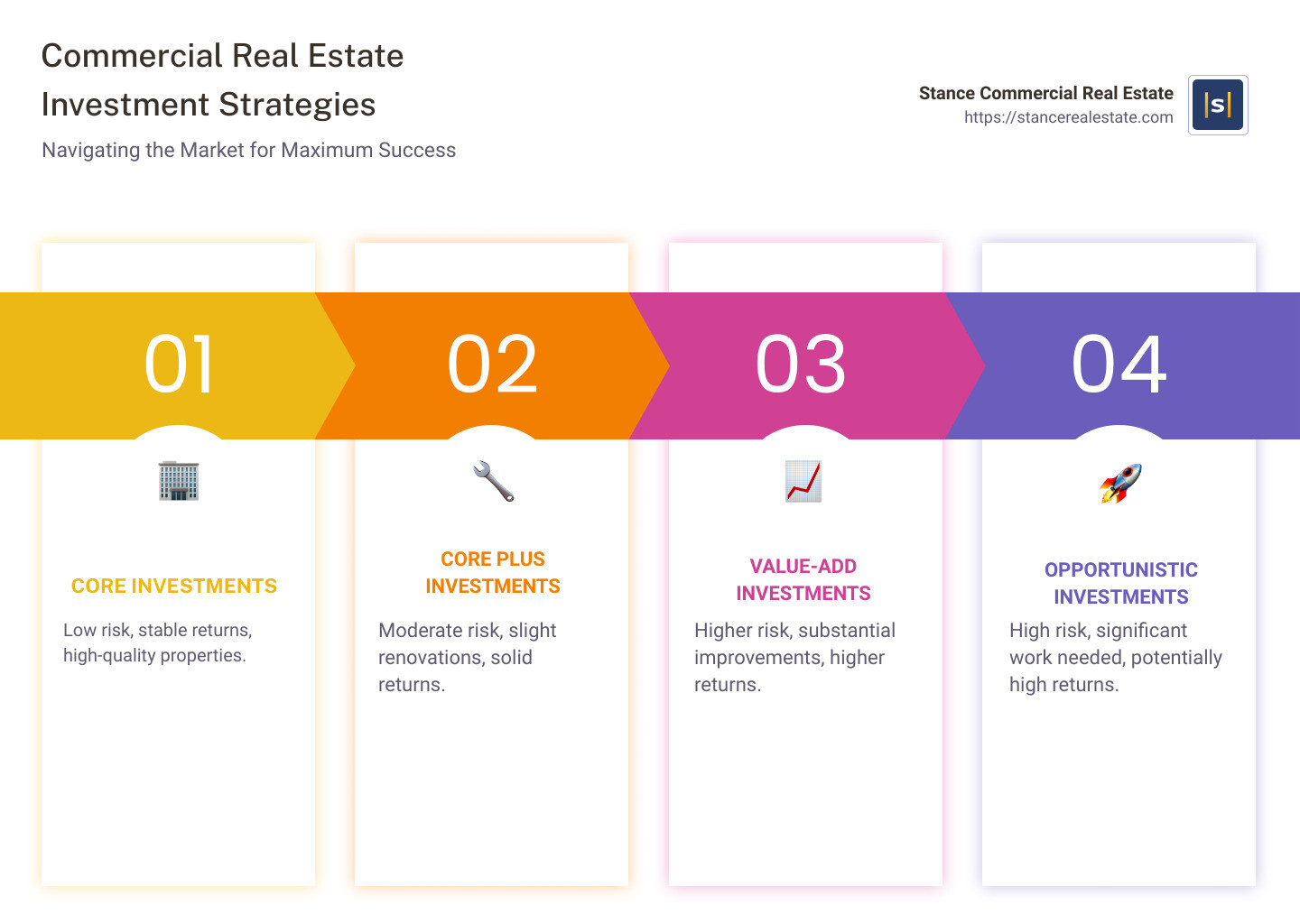
Types of Real Estate Investment
When it comes to investing in real estate, there are several avenues you can explore. Each type of investment offers unique opportunities and challenges.
Here is a breakdown of the most popular types of real estate investment:
Commercial Real Estate
Commercial real estate involves properties used for business purposes. This includes:
- Office buildings: High-rises, midrises, and single-tenant offices.
- Industrial properties: Warehouses, manufacturing facilities, and distribution centers.
- Retail spaces: Shopping centers, strip malls, and standalone stores.
- Multifamily units: Apartment complexes and other residential buildings with five or more units.
Commercial real estate is popular because it often offers longer leases and higher rental returns compared to residential properties. However, it requires significant capital and is more complex to manage.
Raw Land
Raw land investment involves purchasing undeveloped land. Investors can:
- Develop the land: Build residential or commercial properties.
- Hold for appreciation: Wait for the land value to increase and sell at a profit.
This type of investment requires a keen understanding of zoning laws, market trends, and development potential. It is high-risk but can yield substantial returns.
Real Estate Investment Trusts (REITs)
REITs are companies that own, operate, or finance income-producing real estate. They allow investors to:
- Buy shares: Similar to stocks, providing a way to invest in large-scale properties without directly owning them.
- Earn dividends: REITs are required to distribute at least 90% of taxable income to shareholders.
REITs offer liquidity and diversification, making them attractive for those who want to invest in real estate without the hassles of property management.
Crowdfunding
Real estate crowdfunding platforms allow multiple investors to pool their money to invest in properties that would be out of reach individually. This method:
- Democratizes investment: Allows non-institutional investors access to high-value properties.
- Offers diversification: Invest in various properties with smaller amounts of capital.
However, crowdfunding can be riskier and often involves lockup periods where your investment is illiquid.
Residential Real Estate
Residential real estate involves properties like single-family homes, condos, and townhouses. Investors can:
- Rent out properties: Generate monthly rental income.
- Flip houses: Buy, renovate, and sell for a profit.
Residential real estate is generally more accessible to individual investors and can be less risky compared to commercial properties. However, it requires active management, especially if you are handling tenant issues and maintenance.
Each type of real estate investment has its own risk and return profile. Choosing the right one depends on your financial goals, risk tolerance, and investment horizon.
Understanding Commercial Real Estate Investment Strategies
When it comes to commercial real estate investment strategies, there are four main approaches: Core, Core Plus, Value-Add, and Opportunistic. Each strategy has its own risk and return profile, catering to different investor needs and objectives.
Core Investment Strategy
Core investing is the safest form of commercial real estate investment. It involves acquiring high-quality, well-located properties, often referred to as Class A buildings. These assets are typically found in prime locations and feature low vacancy rates. The primary goal here is to generate stable revenue.
- Risk Profile: Low
- Returns: Typically below 10%
- Characteristics: Prime locations, high-quality buildings, low vacancies
Example: Think of a Class A office building in downtown New York City. These properties maintain their value well and attract high-quality tenants who sign long-term leases. This makes them resilient even in unfavorable market conditions.
Core Plus Investment Strategy
Core Plus investing is similar to Core but with a bit more risk and potential for higher returns. This strategy involves acquiring mostly stable buildings that might need some minor renovations or have tenant vacancies.
- Risk Profile: Low to moderate
- Returns: Typically between 10-14%
- Characteristics: Stable assets with potential for revenue-boosting improvements
Example: Imagine a slightly older office building in a good location that needs some updates or has a few vacant units. By renovating these units or improving common areas, the property can attract higher-paying tenants and increase overall returns.
Value-Add Investment Strategy
Value-Add investing is for those willing to take on more risk for potentially higher rewards. This strategy focuses on properties that need significant improvements or repositioning.
- Risk Profile: Moderate
- Returns: Typically between 15-19%
- Characteristics: Distressed properties needing capital investment
Example: A distressed shopping mall that requires extensive renovations to attract new tenants. Over a period of 5-7 years, investors can stabilize the asset and sell it for a substantial profit. This strategy is popular because it offers a cost-effective entry into major markets.
Opportunistic Investment Strategy
Opportunistic investing is the highest risk but offers the greatest potential returns. This strategy involves properties that need substantial investment to become profitable.
- Risk Profile: High
- Returns: Potentially exceeding 20%
- Characteristics: Extensive renovations or new developments
Example: Picture a dilapidated warehouse that can be converted into a modern office space. Such investments often go through periods of little to no income and are considered high liability. However, the potential for returns over 20% makes them attractive to certain investors.
Understanding these strategies helps investors align their financial goals with the right risk-return balance.
Key Factors for Successful Commercial Real Estate Investing
Diversification
Diversification is a cornerstone of successful commercial real estate investing. By spreading investments across different property types and geographical locations, you can reduce risk and increase potential returns. Think of it like not putting all your eggs in one basket.
Property Types: Consider investing in multifamily, industrial, retail, and office properties. Each type reacts differently to economic cycles. For example, industrial properties like warehouses have thrived with the rise of e-commerce, while retail spaces may face challenges during economic downturns.
Geographies: Spread your investments across various regions to mitigate local market risks. A downturn in one area might be balanced by growth in another. For instance, investing in both urban and suburban locations can provide stability.
Risk Reduction: By diversifying, you can protect your portfolio from significant losses. If one property type or location underperforms, others might perform well, balancing your overall returns.
Market Research
Market research is essential for making informed investment decisions. Understanding economic trends, demographic shifts, and local market conditions can help you identify promising opportunities and avoid costly mistakes.
Economic Trends: Keep an eye on broader economic indicators like GDP growth, employment rates, and interest rates. These factors can impact property values and rental demand.
Demographic Shifts: Analyze population trends. For example, an aging population might increase demand for senior living housing, while a growing tech industry could boost demand for office spaces in tech hubs.
Local Market Conditions: Investigate local factors such as zoning laws, infrastructure developments, and neighborhood dynamics. A property in a developing area with new transport links might offer significant appreciation potential.
Technology Utilization
Leveraging technology can streamline your investment process and provide a competitive edge. Real estate investment software, data-driven analysis, and deal management tools can enhance decision-making and efficiency.
Real Estate Investment Software: Tools like property management software can help track expenses, manage leases, and monitor property performance.
Data-Driven Analysis: Use analytics to evaluate market trends, property values, and rental rates. This can help you identify undervalued properties and forecast future performance.
Deal Management Software: Platforms that facilitate deal tracking and document management can save time and reduce errors, making the investment process smoother.
Networking
Building a strong network is invaluable in commercial real estate investing. Connections with industry professionals can provide insights, opportunities, and partnerships that might not be available otherwise.
Industry Connections: Attend industry events, join real estate investment groups, and connect with brokers, property managers, and other investors. These relationships can offer insider knowledge and potential deals.
Partnerships: Collaborating with other investors can pool resources and share risks. Joint ventures can be particularly useful for large projects that might be too costly or complex to undertake alone.
Adaptation
The real estate market is dynamic, and successful investors must adapt to changing conditions. Staying informed about market changes, regulatory updates, and economic cycles is crucial.
Market Changes: Keep abreast of shifts in supply and demand, technological advancements, and consumer preferences. For example, the rise of remote work has increased demand for flexible office spaces.
Regulatory Updates: Stay updated on zoning laws, tax regulations, and environmental policies. Compliance is essential to avoid legal issues and fines.
Economic Cycles: Understand how different stages of the economic cycle affect property values and rental demand. During a recession, for instance, demand for luxury office spaces might decline, while affordable housing could see increased demand.
By focusing on these key factors—diversification, market research, technology utilization, networking, and adaptation—you can navigate the complexities of commercial real estate investing and set yourself up for long-term success.
How to Choose the Right Commercial Real Estate Investment Strategy
Choosing the right commercial real estate investment strategy means understanding your risk tolerance, investment goals, time horizon, and the type of property you want to invest in.
Assessing Risk Tolerance
Your risk tolerance is a key factor in deciding which investment strategy to use. Here is a quick breakdown:
- Core Strategy: Low risk, stable revenue, and prime locations. Ideal for investors who want steady income with minimal risk. Returns are usually below 10%.
- Core Plus Strategy: Low to moderate risk. Involves improving mostly stable buildings to boost revenue. Returns range from 10-14%.
- Value-Add Strategy: Moderate risk. Focuses on properties needing capital investment and improvements. Returns typically between 15-19%.
- Opportunistic Strategy: High risk, involving substantial investment to turn properties profitable. Potential returns can exceed 20%.
Defining Investment Goals
What do you want to achieve with your investment? Your goals will help determine the best strategy.
- Income Generation: If you want regular income, core or core plus strategies might be best. These focus on stable properties with reliable tenants.
- Capital Appreciation: Looking for growth in property value? Value-add and opportunistic strategies focus on improving and selling properties for a profit.
- Portfolio Diversification: Mixing different types of properties and strategies can reduce risk and increase opportunities for returns.
Determining Time Horizon
Your investment timeline will also influence your strategy choice.
- Short-Term: Opportunistic strategies can offer high returns quickly but come with high risk.
- Medium-Term: Value-add strategies often require 5-7 years to improve and sell properties.
- Long-Term: Core and core plus strategies are more stable and can provide consistent income over many years.
Selecting Property Type
The type of property you invest in will depend on your risk tolerance, goals, and time horizon.
- Multifamily: Often seen as a safer bet due to constant demand for housing.
- Industrial: High demand due to e-commerce growth. Suitable for investors looking at long-term stable returns.
- Retail: Can be risky due to the "Amazon effect," but e-commerce-resistant options like grocery stores can be profitable.
- Office: Trends in remote work are changing this market. Look for properties with modern amenities and sustainability features.
By aligning your risk tolerance, investment goals, time horizon, and property type, you can choose the right commercial real estate investment strategy to meet your needs.
Frequently Asked Questions about Commercial Real Estate Investment Strategies
What are the CRE investment strategies?
Commercial real estate (CRE) investment strategies can be categorized into four main types: core, core-plus, value-added, and opportunistic.
- Core: This strategy focuses on low-risk investments in high-quality, fully leased properties in prime locations. These buildings, often class A, generate stable revenue with minimal need for active management or capital improvements.
- Core-Plus: Slightly riskier than core investments, core-plus strategies involve properties that are mostly stable but may require some renovations or filling tenant vacancies. These investments typically offer returns of 10-14%.
- Value-Added: This strategy targets properties that need significant improvements or repositioning. Investors take on moderate risk, aiming for returns of 15-19% by enhancing the property’s value through renovations or improved management.
- Opportunistic: The highest-risk strategy, opportunistic investments involve properties that need substantial redevelopment or are in distress. These projects can yield returns exceeding 20% but require significant capital and come with higher uncertainty.
What is a good ROI for commercial real estate investment?
A good return on investment (ROI) for commercial real estate varies based on the strategy, property type, and market conditions. Generally, investors aim for an ROI of 8-10%.
- Core investments might yield modest returns of 4-6%, reflecting their low-risk nature.
- Core-Plus strategies offer returns around 10-14%.
- Value-Added investments target 15-19%.
- Opportunistic deals can exceed 20% returns, but with higher risk.
Factors like location, property type, and market dynamics significantly influence ROI.
How do investors make money in commercial real estate?
Investors make money in commercial real estate through property appreciation and tenant rents.
- Property Appreciation: As market conditions improve, the value of the property increases. This can result from favorable economic trends, strategic property enhancements, or rising demand in the area. For instance, buying a property in a growing market like Riverside, CA, and selling it later at a higher price can generate significant returns.
- Tenant Rents: Consistent rental income is a primary revenue stream. High occupancy rates and long-term leases with reliable tenants ensure steady cash flow. Effective lease optimization, such as passing on certain costs to tenants or negotiating rent escalations, can also enhance rental income.
By understanding and leveraging these strategies, investors can maximize their returns and build a robust commercial real estate portfolio.
Conclusion
In summary, mastering commercial real estate investment requires a blend of strategic planning, market knowledge, and a tailored approach to risk and reward. From core investments offering stability to opportunistic strategies promising high returns, understanding the nuances of each commercial real estate investment strategy can significantly impact your success.
At Stance Commercial Real Estate, we pride ourselves on our deep local expertise and commitment to service excellence. Our team is not just familiar with Riverside; we live and work here, giving us unparalleled insight into the market. This local knowledge allows us to offer you the best advice and support, ensuring that your investments align with your goals and thrive in this vibrant community.
Riverside, CA, offers a unique blend of historical charm and modern opportunity, making it a prime location for commercial real estate investment. Whether you are looking to buy, sell, or lease, our hands-on approach ensures that you are not just investing in property but also in a community that suits your business needs.
Let us guide you through the complexities of commercial real estate investment. Our goal at Stance Commercial Real Estate is to provide a seamless experience from start to finish, handling the details so you can focus on what you do best—running your business.
Discover how we can help you capitalize on the opportunities in Riverside’s dynamic market. Learn more about our services and start your investment journey with a team that knows Riverside best.
By choosing Stance Commercial Real Estate, you are selecting a partner dedicated to your success with unmatched local insight. Let us help you navigate the exciting landscape of commercial real estate in Riverside.