

How E-Commerce Growth Is Shaping Industrial Real Estate
Why E-Commerce Is Changing the Industrial Real Estate Landscape
E-commerce has become one of the most powerful forces driving the evolution of industrial real estate. As online shopping becomes deeply woven into everyday consumer behavior, its influence on physical infrastructure continues to expand. Today, e-commerce accounts for nearly 19% of core retail sales—a share that continues to rise—and requires about three times more warehouse space per dollar of sales than traditional brick-and-mortar retail.
This fundamental shift is redefining logistics and development strategies across the industry. Developers and investors are prioritizing larger, taller, and more technologically advanced facilities designed for automation, robotics, and rapid fulfillment. At the same time, proximity to consumers has become a key competitive advantage, fueling demand for last-mile distribution centers in and around dense urban markets. Together, these trends are reshaping the landscape of industrial real estate and setting the pace for the next decade of growth and innovation.
The core impacts of e-commerce on industrial real estate are multifaceted and profound:
- Massive Space Demand: The scale is immense. Every $1 billion in new e-commerce sales generates an estimated demand for 1.25 million square feet of new distribution space. As online sales grow by hundreds of billions annually, the need for logistics real estate expands exponentially.
- Warehouse Evolution: The modern warehouse bears little resemblance to its predecessors. New facilities are significantly larger and taller, with clear heights often exceeding 40 feet to maximize cubic storage capacity. This verticality is essential for accommodating complex racking and automated systems.
- Strategic Location Shift: The consumer expectation of same-day or next-day delivery has made proximity to the end customer paramount. This is pushing warehouse development from remote, rural areas to infill locations closer to major population centers.
- Rise of Specialized Facilities: The e-commerce ecosystem has spurred demand for a variety of specialized asset types, including micro-fulfillment centers (MFCs) for rapid urban delivery, temperature-controlled cold storage for online groceries, and vast reverse logistics hubs to process a high volume of returns.
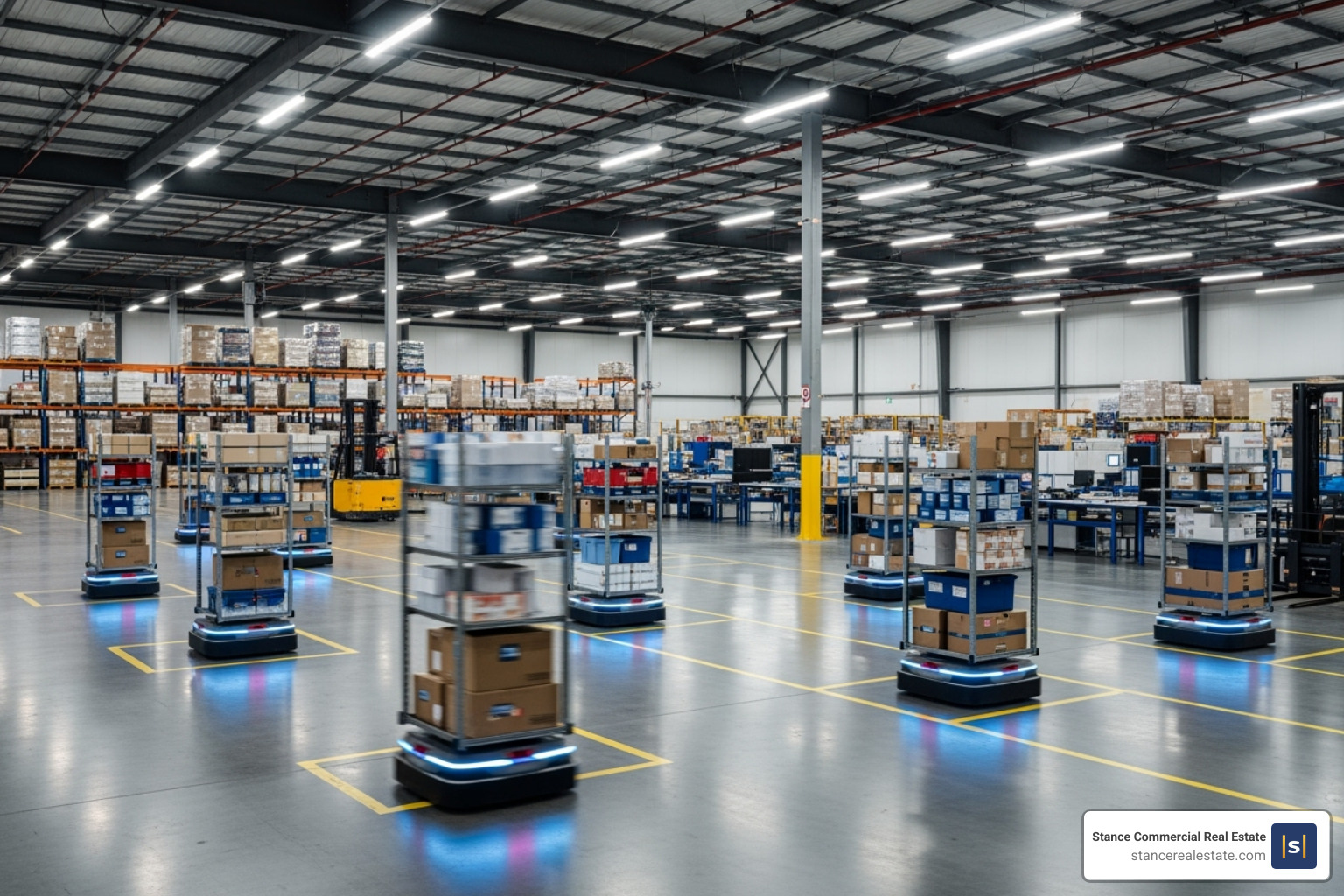
- Pervasive Technology Integration: Demand is soaring for facilities built to support automation. This includes robust power infrastructure, super-flat floors for robotics, and high-speed data connectivity for AI-driven inventory management systems.
To meet this surge, the market has responded with a historic construction cycle. Between 2022 and 2023 alone, over 1.1 billion square feet of new industrial space was delivered in the U.S. Despite this significant influx of new supply, national industrial vacancy remains structurally low at 6.7%, a testament to the powerful underlying demand. This tight market has fueled strong rental growth, with average rents rising 7.2% year-over-year. In prime logistics markets like Southern California's Inland Empire, the effects are even more pronounced, with rent growth reaching an incredible 12.1% year-over-year, highlighting the irreplaceable role of coastal logistics hubs in the global supply chain.
The Surge in Demand: Why E-Commerce Needs More (and Different) Space
The explosive growth of online retail is the single most powerful force changing the industrial real estate sector. It’s no longer just about needing more warehouses; it’s about needing smarter, faster, and more strategically located facilities designed for an entirely different supply chain model. With e-commerce requiring, on average, three times more logistics space than traditional retail to generate the same amount of sales, the pressure is on for investors, developers, and businesses to adapt to this new reality.
The 3x Space Multiplier
Unlike traditional retail, where goods ship on pallets in bulk to a few dozen store locations, e-commerce involves picking, packing, and shipping millions of individual orders directly to customers' doorsteps. This direct-to-consumer (D2C) model requires a vastly larger physical footprint for several critical reasons:
- Individual Order Fulfillment: The process for a single online order is far more complex than a bulk shipment. Each item must be individually picked from a shelf, scanned, transported to a packing station, boxed with dunnage, labeled, and sorted for shipment. This granular process requires extensive networks of conveyors, numerous packing stations, and large staging areas for outbound parcels, all of which consume significant square footage.
- Wider Product Variety: Online stores offer a seemingly endless aisle, leading to a massive proliferation of unique products, or Stock Keeping Units (SKUs). A large physical retail store might carry 50,000 SKUs, but a major e-commerce fulfillment center can easily house over a million. Storing this incredible variety requires more space and sophisticated inventory management systems to ensure items can be located and picked efficiently.
- Returns Processing (Reverse Logistics): Handling the high volume of online returns—often called the "shadow supply chain"—is a massive, space-intensive operation. E-commerce return rates can be as high as 30%, compared to under 10% for brick-and-mortar. Each returned item must be received, inspected, graded, and then either restocked, refurbished, or liquidated. This entire process requires dedicated space equivalent to a second, parallel warehouse operation.
This isn't just a theoretical multiplier. The market data is clear: an increase of $1 billion in e-commerce sales translates to a tangible need for approximately 1.25 million square feet of new distribution space.
Bigger, Taller, Faster: The New Warehouse Standard
To accommodate the complexity and velocity of e-commerce, the very design of industrial facilities is undergoing a dramatic transformation. Warehouses are evolving in their physical characteristics to maximize efficiency and throughput.
- Increased Clear Heights: Vertical space is just as important as floor space. To maximize storage density, new warehouses feature soaring clear heights, with 40 feet becoming the new standard, a significant increase from the 28-32 feet common just a decade ago. This allows for taller racking systems and multi-level automated mezzanines. The average new warehouse has increased by 3.7 feet in height compared to facilities built between 2002 and 2007.
- Larger Building Footprints: The average new warehouse has also grown by over 108,000 square feet in size compared to the same period, with facilities now regularly exceeding 1 million square feet. These massive buildings, especially prevalent in logistics hubs like Southern California's Inland Empire, are needed to house extensive inventory and complex sorting systems under one roof.
- Efficient Goods Flow: Modern facilities are designed as finely tuned engines for moving goods. This includes a higher ratio of dock doors to facilitate rapid loading and unloading, expansive truck courts for maneuvering, and dedicated trailer parking (yard space), which is critical for staging inbound and outbound freight. The interior is designed for the rapid movement of goods, often incorporating advanced conveyor systems, robotics, and super-flat floors required for specialized machinery.
This evolution is a testament to why Industrial Real Estate: Why Warehouses Are Outperforming Other Sectors. The relentless demand for industrial space that can handle high volumes at high speeds is paramount in the age of e-commerce.
How E-Commerce Growth Is Shaping Industrial Real Estate Locations and Design
Consumer demand for near-instant delivery has forced a radical rethinking of the entire supply chain. Proximity to the customer is now the paramount concern, driving a wave of innovation in where industrial facilities are located and how they are designed to function.
The "Urbanization of Warehousing": The Race for the Last Mile
Gone are the days when warehouses could be located exclusively in distant, rural areas. The promise of same-day or one-hour delivery has shifted the strategic focus to sites much closer to dense population centers—a trend known as the "urbanization of warehousing." The primary driver is last-mile delivery, the final and most expensive leg of a product's journey from the warehouse to the customer's doorstep. To shorten this leg and reduce transportation costs, companies must position inventory as close to consumers as possible.
This has fueled the rise of micro-fulfillment centers (MFCs). These are smaller (10,000 to 50,000 square feet), highly automated facilities strategically placed within or on the edge of urban areas, enabling rapid order processing and dispatch. To create these urban logistics hubs, developers are pursuing creative urban infill projects. This often involves navigating significant challenges, such as high land costs, complex zoning regulations, and community opposition (NIMBYism), but the payoff in delivery speed and efficiency is substantial. A key trend is the repurposing of obsolete commercial properties, such as vacant big-box retail stores. These locations are ideal as they are already situated in prime commercial corridors near population centers and have existing infrastructure like parking and loading areas, a convergence that ties into The Future of Mixed-Use Developments: Live-Work-Play Spaces in Demand.
The Rise of Specialized Facilities and Reverse Logistics
Beyond general warehousing, e-commerce has created explosive demand for highly specialized facilities. A major driver is the management of product returns. Online purchases have a staggeringly high return rate of nearly 30%, compared to less than 10% for in-store purchases. This has created an entire sub-industry and asset class dedicated to reverse logistics—the complex process of moving goods from customers back to the seller or a third-party processor.
These reverse logistics centers handle the labor-intensive tasks of inspection, sorting, grading, and repackaging. Because of the operational complexity and unpredictable inflow of goods, these facilities require 15-20% more space than traditional outbound operations. This hidden operational cost of e-commerce translates directly into millions of square feet of additional industrial real estate demand.
Another specialized facility seeing explosive growth is cold storage. The boom in online grocery sales and meal-kit delivery services requires a sophisticated, unbroken cold chain with precise temperature-controlled environments. These cold storage facilities are significantly more expensive to build and operate than standard warehouses due to the need for insulated metal panels, advanced refrigeration systems, and higher energy consumption. However, they command premium rents and attract long-term leases from high-credit tenants.
In land-constrained urban markets, multi-story warehouses are also emerging as an innovative solution. Pioneered in dense Asian and European cities, these facilities are now appearing in the U.S. They maximize vertical space by building up, often featuring truck ramps to allow full-sized tractor-trailers to access loading docks on the second or even third floor. These developments represent key Industrial Development Trends that are reshaping the sector in response to e-commerce pressures.
Adapting to New E-Commerce Models
New retail models that blend the online and offline worlds require highly flexible industrial solutions. Omnichannel retailing, which seeks to create a seamless customer experience across online, mobile, and physical stores, means that logistics facilities must support both direct-to-consumer parcel shipments and bulk replenishment for retail stores from the same inventory pool.
Direct-to-Consumer (D2C) brands are also a growing source of demand. As these brands scale, they are increasingly building their own logistics infrastructure, driving demand for flexible industrial spaces that can accommodate their growth. Many are using hybrid facilities that combine warehouse, office, and sometimes even showroom or content creation space. Even traditional retailers are adapting their supply chains with models like buy-online-pickup-in-store (BOPIS), which requires efficient inventory staging areas within their stores or at nearby micro-fulfillment sites, further evolving Retail Commercial Real Estate strategies.
The Tech Revolution: Automation and AI in the Modern Warehouse
To keep pace with the relentless speed and staggering volume of e-commerce, technology is no longer a luxury but an absolute necessity. Automation, artificial intelligence, and data analytics are the engines driving the efficiency of the modern warehouse. This technological revolution is not only transforming how facilities operate but is also fundamentally influencing their physical design and infrastructure requirements.
How E-Commerce Growth Is Shaping Industrial Real Estate through Automation
The growing pursuit of speed in e-commerce fulfillment has made automation not just beneficial but essential. A single large fulfillment center may now handle hundreds of thousands of individual orders each day—a volume that human labor alone cannot efficiently or accurately manage. This accelerating reliance on advanced technology is fundamentally transforming the industrial real estate landscape, influencing everything from facility design and layout to location strategy and infrastructure investment.
- Robotics and Automated Guided Vehicles (AGVs): Machines are now performing a wide range of repetitive and physically demanding tasks. This includes Autonomous Mobile Robots (AMRs) that bring shelves of goods to stationary human pickers (a "goods-to-person" system), robotic arms that can pick and place individual items, and AGVs that transport pallets and carts throughout the facility. This technology dramatically boosts productivity, reduces human error, improves workplace safety, and helps mitigate the challenges of labor shortages.
- AI-Powered Inventory and Warehouse Management: Sophisticated Warehouse Management Systems (WMS) and Warehouse Execution Systems (WES) are the brains of the operation. Artificial intelligence analyzes vast amounts of sales data to predict demand, optimizing product placement (slotting) within the warehouse to ensure popular items are located for the fastest possible retrieval. AI algorithms also orchestrate the movement of robots and direct human workers on the most efficient picking paths in real-time.
- Automated Sorting Systems: At the outbound stage, high-speed conveyor belts and automated sorting machines are essential. These systems can rapidly scan and direct thousands of packages per hour to the correct loading bay for shipment, making high-volume, direct-to-consumer shipping possible.
This deep integration of automation delivers tangible benefits beyond speed. It leads to significantly reduced long-term labor costs, a critical factor in a tight labor market, and vastly improved order accuracy, which enhances customer satisfaction and reduces the costly process of handling incorrect shipments. Consequently, modern industrial facilities must be designed from the ground up to accommodate these complex systems, requiring sufficient power capacity, robust fiber-optic networks, and perfectly flat floors with high load-bearing capacity.
Smart Buildings, IoT, and Sustainability
Beyond operational automation, e-commerce is pushing the industrial sector toward smarter, more sustainable buildings. These features not only reduce operating costs but also future-proof the investment and appeal to environmentally conscious corporate tenants.
Internet of Things (IoT) sensors are turning warehouses into intelligent, data-rich environments. These sensors can monitor everything from ambient temperature and humidity to the vibration patterns of conveyor motors. This data enables predictive maintenance, allowing facility managers to anticipate equipment failures before they occur, preventing costly downtime and operational disruptions.
Energy efficiency has become a major priority for both developers and tenants. Modern warehouses are increasingly adopting high-efficiency LED lighting with motion sensors, smart HVAC systems, and advanced insulation materials to lower substantial operational costs. Many developers are pursuing green building initiatives and LEED (Leadership in Energy and Environmental Design) certification to attract premium tenants and increase the long-term value and marketability of their properties.
The vast, flat roofs of modern warehouses are ideal for the installation of rooftop solar panels. These solar arrays can generate a significant portion of a facility's energy needs, reducing reliance on the grid and hedging against rising electricity costs. As delivery fleets rapidly electrify, EV charging stations for both employee vehicles and commercial delivery vans are also becoming essential infrastructure. These forward-looking advancements align with the growing Sustainability Demand from corporate occupiers and contribute to the broader Green Real Estate Trends reshaping the entire real estate sector.
Navigating the Market: Challenges and Opportunities for Investors
The e-commerce-driven industrial boom presents a landscape of both robust, sustained demand and significant challenges. For investors and developers, successfully navigating rising costs, land scarcity, and shifting market dynamics is crucial for capitalizing on the sector's immense long-term potential.
Key Challenges in the Industrial Sector
Understanding and mitigating these headwinds is essential for making informed and profitable investment decisions in the current environment.
- Extreme Land Scarcity: Finding well-located, entitled parcels of land near major population centers for last-mile facilities is increasingly difficult and prohibitively expensive. The entitlement process itself—securing zoning changes and permits—can take years and faces growing opposition from local communities concerned about traffic and noise.
- Rising Construction and Material Costs: Global supply chain issues and inflation have led to significant increases in the cost of key building materials like steel, concrete, and roofing components. Tariffs and transportation costs further squeeze development margins, making it harder for new projects to pencil out financially.
- Persistent Labor Shortages: The industrial sector faces a dual labor challenge: finding skilled construction workers to build new facilities and finding operational staff to run the warehouses. This competition for labor is a primary driver behind the push for greater automation within facilities.
- Supply Chain Disruptions: Delays in receiving critical building components, such as electrical switchgear or pre-cast concrete panels, can push project completion dates back by months, increasing carrying costs and delaying rental income.
- Normalizing Vacancy Rates: After years of historically low vacancy, the national industrial vacancy rate climbed to 6.7% in August 2024. This is not a sign of collapsing demand but rather a temporary imbalance caused by a massive construction pipeline delivering new supply faster than it can be absorbed in some submarkets.
- Financial Headwinds: A fluctuating interest rate environment directly impacts the cost of capital for acquisitions and development. Higher Commercial Real Estate Interest Rates can affect project viability, investor returns, and overall market liquidity.
How E-Commerce Growth Is Shaping Industrial Real Estate Investment Opportunities
Despite the challenges, the e-commerce revolution continues to create a wealth of compelling opportunities for savvy investors who know where to look.
- Value-Add Investments: One of the most attractive strategies is acquiring older, functionally obsolete industrial properties and upgrading them for modern tenants. For example, an investor could purchase a 1980s-era warehouse with 24-foot clear heights and invest in raising the roof to 36 feet, adding modern ESFR fire suppression systems, and expanding the truck court. Such upgrades can make the facility viable for e-commerce users and potentially double its rental income.
- Creative Repurposing of Obsolete Properties: Converting former big-box retail stores, defunct shopping centers, or even multi-level parking garages into last-mile delivery hubs is a highly profitable strategy. It leverages prime locations with existing infrastructure while meeting the intense demand for urban logistics space.
- Speculative Development in Core Markets: In markets with proven strong fundamentals, low vacancy, and a diverse tenant base, building new industrial facilities on a speculative basis (without a pre-committed tenant) can be highly rewarding. While it carries higher risk, it allows developers to capture peak market rents upon completion.
- Focus on High-Growth Markets: While the Inland Empire remains a top-tier market with the nation's highest rent growth at 12.1% year-over-year, other markets are also booming. Key logistics hubs to target include Dallas-Fort Worth (a critical central U.S. hub), Phoenix (serving the rapidly growing Southwest), Atlanta (the logistics capital of the Southeast), and the I-81/I-78 corridor in Pennsylvania and New Jersey (serving the entire Northeast megalopolis).
- Specialized Asset Investment: Investing in niche property types can lead to outsized returns due to less competition and specialized tenant needs. This includes developing or acquiring cold storage facilities, which command premium rents; advanced manufacturing centers for reshoring initiatives; or dedicated reverse logistics hubs, which are becoming critical infrastructure for major retailers.
Frequently Asked Questions about E-Commerce and Industrial Real Estate
Below are answers to some of the most frequently asked questions from investors, developers, and business owners about the impact of e-commerce growth on industrial real estate.
How much more space does e-commerce really need compared to traditional retail?
E-commerce operations require, on average, three times more logistics space than traditional retail for the same dollar amount of sales. This "3x multiplier" is a rule of thumb in the industry. The reason is that e-commerce warehouses must perform tasks that don't exist in a traditional retail supply chain. They must store a much wider variety of individual products (SKUs), handle the labor-intensive process of picking and packing every single customer order, and manage a high volume of customer returns, which requires its own dedicated space and workflow. To put it in perspective, every $1 billion in new e-commerce sales creates demand for approximately 1.25 million square feet of distribution space.
What is "reverse logistics" and why is it so important for industrial real estate?
Reverse logistics is the entire process of managing product returns from customers back to the seller or a third-party processor. It's a critical and costly part of e-commerce because online shoppers return items at a much higher rate—nearly 30% for some product categories—compared to less than 10% for in-store purchases. This constant flow of returned goods requires dedicated facilities and highly specific processes for receiving, inspection, sorting, repackaging, and restocking. These operations are less efficient and more chaotic than outbound fulfillment, meaning they can require 15-20% more warehouse space than standard outbound operations. This creates a significant, and often overlooked, source of additional demand for industrial real estate.
What is the difference between a fulfillment center and a distribution center?
While the terms are often used interchangeably, they traditionally describe facilities with different functions. A classic distribution center (DC) operates on a business-to-business (B2B) model. It receives goods in bulk (e.g., by the pallet or truckload) from manufacturers and ships them in bulk to a relatively small number of retail stores. In contrast, a fulfillment center (FC) is designed for e-commerce and operates on a direct-to-consumer (D2C) model. It stores individual items and is optimized for picking, packing, and shipping a very high volume of small, unique orders to thousands of individual addresses. FCs require more complex technology, more labor or automation, and more space for returns. As omnichannel retail grows, the lines are blurring, with many modern facilities designed as hybrid models that can handle both B2B and D2C operations.
Is the industrial real estate market at risk of being overbuilt?
This is a nuanced question. A recent construction boom added over 1.1 billion square feet of industrial space between 2022 and 2023, which did push the national vacancy rate up to 6.7% from historic, unsustainable lows below 4%. However, this normalization does not necessarily signal a downturn.
Several powerful, long-term factors suggest a strong outlook. The continued double-digit growth of e-commerce, the strategic reshoring of manufacturing to North America, and the need for companies to hold more "safety stock" inventory all create sustained, powerful demand. Furthermore, a significant portion of the older warehouse stock in the U.S. is functionally obsolete and cannot meet modern e-commerce needs for high ceilings, robust power, and automation. While some secondary markets may experience temporary oversupply, prime logistics hubs like the Inland Empire continue to see robust demand and rent growth. For savvy investors, analyzing the current market is key to identifying opportunities, as even a temporary rise in vacancy can create attractive entry points for long-term holds.
How Stance CRE Can Help You
The connection between e-commerce and industrial real estate is more than influential—it is transformative. We are seeing a fundamental and lasting shift in how goods move through the economy, and the impact of e-commerce growth will continue to be the primary driver of industrial real estate market dynamics for the foreseeable future.
The landscape has shifted dramatically and irrevocably. What was once a niche delivery option, same-day delivery is now a consumer expectation. Warehouses, once relegated to remote locations, have moved to the edges of our cities to enable last-mile logistics. And the facilities themselves, once simple storage sheds, are now sophisticated hubs of technology powered by robotics and artificial intelligence. The average warehouse is larger, taller, and smarter—a complete reimagining of an asset class, all driven by the relentless growth of online shopping.
For investors, developers, and businesses, success in this new era requires vision, adaptability, and deep expertise. The challenges—including intense land scarcity, rising construction costs, and the need to carefully balance new supply with market absorption—are significant. However, the opportunities they create are even greater. Value-add repositioning of older assets, creative repurposing of obsolete properties, strategic development in core markets, and investment in specialized assets like cold storage or reverse logistics hubs offer immense potential for growth and return.
This is especially true in core logistics markets like the Inland Empire, where strategic location, irreplaceable infrastructure, and a deep labor pool create exceptional and durable opportunities. Capitalizing on this potential requires more than just capital; it demands deep local knowledge and a data-driven approach to navigate the complexities of the market.
At Stance Commercial Real Estate, we have a decade of experience on the ground in the Inland Empire market. We provide the critical insights and expert guidance our clients need to make confident, informed decisions in this rapidly evolving landscape. The future of industrial real estate is digital, automated, and closer to the customer than ever before. The question is whether you are positioned to capitalize on the change. To learn how we can help you optimize your industrial real estate strategy, explore our expert commercial real estate services.
