

Defining the Value Proposition: Premium Amenities vs. Basic Infrastructure
When it comes to attracting and retaining high-quality tenants, commercial property owners often face a pivotal question: Is it smarter to compete on price or on experience? In competitive markets, the decision between offering premium amenities or lowering lease rates can significantly impact occupancy, tenant satisfaction, and long-term asset value. While reduced rents may generate short-term interest, today’s tenants—particularly corporate users and growing businesses—are increasingly evaluating properties based on how well they support productivity, brand image, employee experience, and operational efficiency.
Premium amenities such as upgraded common areas, fitness centers, collaborative spaces, smart-building technology, enhanced landscaping, and sustainability features can differentiate a property in ways that price alone cannot. However, these investments require capital and strategic positioning. On the other hand, lowering lease rates may quickly fill vacancies but can compress margins and potentially reposition the asset in a less desirable market tier. So which strategy truly wins? The answer depends on market conditions, tenant profile, and long-term ownership goals—and understanding that balance is key to maximizing performance.
Premium Amenities or Lower Lease Rates? Which Strategy Wins? — here’s the short answer before we dive in:
| Scenario | Winning Strategy |
|---|---|
| Low vacancy market (under 5%) | Premium amenities — justify higher rents |
| High vacancy market (over 10%) | Lower lease rates or concessions — fill space fast |
| Class A / Trophy assets | Premium amenities — drive rent premiums up to 5.2% |
| Class B/C commodity space | Competitive pricing — rate cuts rarely work alone |
| Suburban mixed-use or urban core | Premium amenities — 16.2% higher occupancy on average |
| Short-term hold, tight budget | Hybrid — selective upgrades plus strategic concessions |
The bottom line: premium amenities outperform in most commercial markets, especially post-pandemic — but lower lease rates can be the smarter play when supply surges or budgets are constrained. The right answer depends on your asset class, local vacancy rate, and tenant demographics. In the Inland Empire, where industrial and office sectors are evolving rapidly, the decision to invest in capital improvements versus slashing the face rate of a lease can determine the long-term viability of a commercial portfolio.
In commercial real estate, landlords and investors face a persistent question: spend money upgrading a property to justify higher rents, or price aggressively to win tenants faster? It sounds simple, but the wrong choice can cost you years of revenue — or leave your building sitting vacant. The Inland Empire, particularly Riverside, has seen a massive transformation in how businesses view their physical footprint. It is no longer just about a roof and four walls; it is about the utility and experience the space provides to the workforce. This shift is driven by a fundamental change in corporate culture, where the workplace is now viewed as a tool for recruitment and retention rather than just a line-item expense.
The market has shifted dramatically since 2020. According to leading industry research, highly amenitized office buildings absorbed over 23 million square feet of new tenants since the pandemic, while less-upgraded buildings lost more than 50 million square feet of occupancy. That gap is hard to ignore. This trend, often referred to as the “Flight to Quality,” suggests that tenants are willing to pay a premium for spaces that enhance productivity and employee well-being. In the competitive landscape of Southern California, where labor markets are tight, providing a superior environment is often the only way for a company to convince its workforce to return to the office full-time.
But premium amenities aren’t a guaranteed win. A pool that forces rent 60% above the local average will sit empty. A rent cut that erodes your net operating income can quietly destroy asset value over time. The math matters — and so does the market you’re in. For instance, the Building Owners and Managers Association (BOMA) International provides standards that help landlords understand how to measure and value these spaces effectively. Understanding the difference between a “usable” square foot and a “rentable” square foot, and how amenities factor into that load factor, is essential for any serious commercial investor.
When we talk about premium amenities in the Riverside or Inland Empire markets, we aren’t just talking about a clean lobby and a working elevator. Those are basics. Premium amenities are “value-add” features that fundamentally change the tenant’s workday. These features are designed to solve specific pain points for modern businesses, such as the need for high-speed data, flexible meeting spaces, and environments that promote health and wellness.

A high-tech conference room equipped with integrated fiber-optic connectivity and ergonomic furniture.
These include things like high-speed fiber-optic connectivity (essential for modern operations), LEED certification for sustainability-minded corporations, and wellness features like advanced air filtration systems. In office space, “spec suites”—fully built-out, move-in-ready offices—have become a massive premium. Research shows these lease up to 11 months faster than shell space because they remove the headache of construction for the tenant. For a business owner, the ability to sign a lease on Monday and move in on Friday is worth a significant premium over a lower-priced space that requires a six-month build-out.
However, a savvy landlord must also understand the total occupancy cost. A lower base rent might look attractive on a flyer, but if the building lacks energy-efficient systems or modern infrastructure, the tenant’s utility and maintenance costs will skyrocket, leading to dissatisfaction and turnover. In the long run, a tenant who saves $2.00 per square foot on rent but pays $3.00 more in electricity and HVAC repairs will eventually leave for a more efficient building.
The Shift Toward “Flight to Quality” in Commercial Hubs
We are currently seeing a massive “flight to quality.” In major Southern California hubs, Class A and “Trophy” assets are seeing the lion’s share of leasing activity. Why? Because post-pandemic, employers need to give their staff a reason to leave the home office. A building with a gym, a rooftop lounge, and proximity to transit isn’t just a place to work—it’s a tool for talent retention. This is particularly true in Riverside, where the competition for skilled labor is fierce. Companies are realizing that the cost of a slightly higher lease rate is far lower than the cost of losing a key executive to a competitor with a better office environment.
Premium Amenities or Lower Lease Rates? Which Strategy Wins in High-Vacancy Urban Centers?
In urban centers where vacancy rates begin to inch upward, the knee-jerk reaction is often to lower lease rates in hopes of filling space quickly. Yet market performance data consistently shows that when considering premium amenities vs lower lease rates, the advantage frequently leans toward amenities. Properties that differentiate themselves—offering elevated tenant experiences, upgraded common areas, wellness features, technology integration, and curated environments—avoid being lumped into the “commodity” category. When supply increases, competing on price alone becomes a race to the bottom; competing on quality becomes a platform for long-term growth.
Investors and asset managers must evaluate performance through the lens of long-term absorption and asset value, not just short-term rent collection. A building stabilized at 95% occupancy at $3.00 per square foot generates stronger cash flow, higher perceived value, and better refinancing leverage than a property sitting at 70% occupancy at $2.25 per square foot—even if operating expenses are lower. Sustained occupancy at premium rates enhances valuation, strengthens tenant mix, and builds resilience in shifting markets. In competitive urban environments, being the best-positioned asset often proves far more profitable than simply being the least expensive option.
The Case for Premium Amenities: Driving ROI and Occupancy
The numbers behind the amenity race are compelling. National market reports indicate that specific features provide measurable rent bumps. This isn’t just anecdotal; it is reflected in the appraisals and the net operating income of top-performing assets. When a landlord invests in the common areas, they are essentially investing in the marketing of the building. A tenant’s first impression starts at the curb and continues through the lobby to the elevators.
- Roof/Sky Terraces: 5.2% rent premium. These spaces provide a unique venue for corporate events and employee breaks, which is highly valued in urban environments.
- Fitness Centers (with showers): 2.9% rent premium. As health and wellness become central to corporate culture, on-site gyms are no longer a luxury but an expectation for Class A tenants.
- Courtyards with seating: 3.5% rent premium. Outdoor space has become critical post-2020, offering a safe and refreshing alternative to indoor breakrooms.
A rooftop terrace overlooking a city skyline, designed for corporate events and employee relaxation.
When evaluating a commercial property for long-term ROI, these percentages add up. For instance, spec suites often command 15-20% higher rental rates than unrenovated units. If you spend $60 per square foot on a high-end build-out but secure a tenant a year sooner at a higher rate, the math clearly favors the investment. This is especially true in the Riverside market, where the demand for move-in-ready professional space has outpaced the supply of traditional shell space. The time-value of money is a critical factor here; every month a space sits vacant is a month of lost revenue that can never be recovered.
Leveraging Technology and Wellness for Tenant Retention
Smart buildings are no longer a futuristic concept; they are a requirement for top-tier tenants. Integrating IoT for lighting and climate control doesn’t just lower operating costs—it hits ESG (Environmental, Social, and Governance) goals that modern corporations prioritize. Furthermore, every time a tenant renews, you save. Industry estimates suggest every renewal saves over $4,000 in turnover expenses (marketing, commissions, and downtime). By providing a superior experience, you aren’t just getting more rent; you’re keeping more of it. High-quality tenants tend to be more stable, and they are less likely to move if their employees are happy with the building’s amenities.
Wellness features have also moved from “nice-to-have” to essential. Advanced HVAC systems with HEPA filtration and touchless entry systems provide peace of mind for employees returning to the office. In the Inland Empire, where summer temperatures can be extreme, high-efficiency cooling systems are both a wellness feature and a significant cost-saving measure for tenants. A building that can maintain a comfortable 72 degrees while the outside temperature hits 105, without breaking the bank on utilities, is a building that will stay occupied.
The Case for Lower Lease Rates: Stability in Competitive Markets
While amenities are flashy, there is a strong case for the “budget-friendly” approach, especially in the industrial sector. For a logistics company, a functional warehouse with ample loading docks and clear heights is more important than a fancy coffee bar. In the Inland Empire, which serves as a global hub for logistics, the priority is often throughput and efficiency. For these tenants, the building is a machine, and the goal is to minimize the cost of operating that machine.
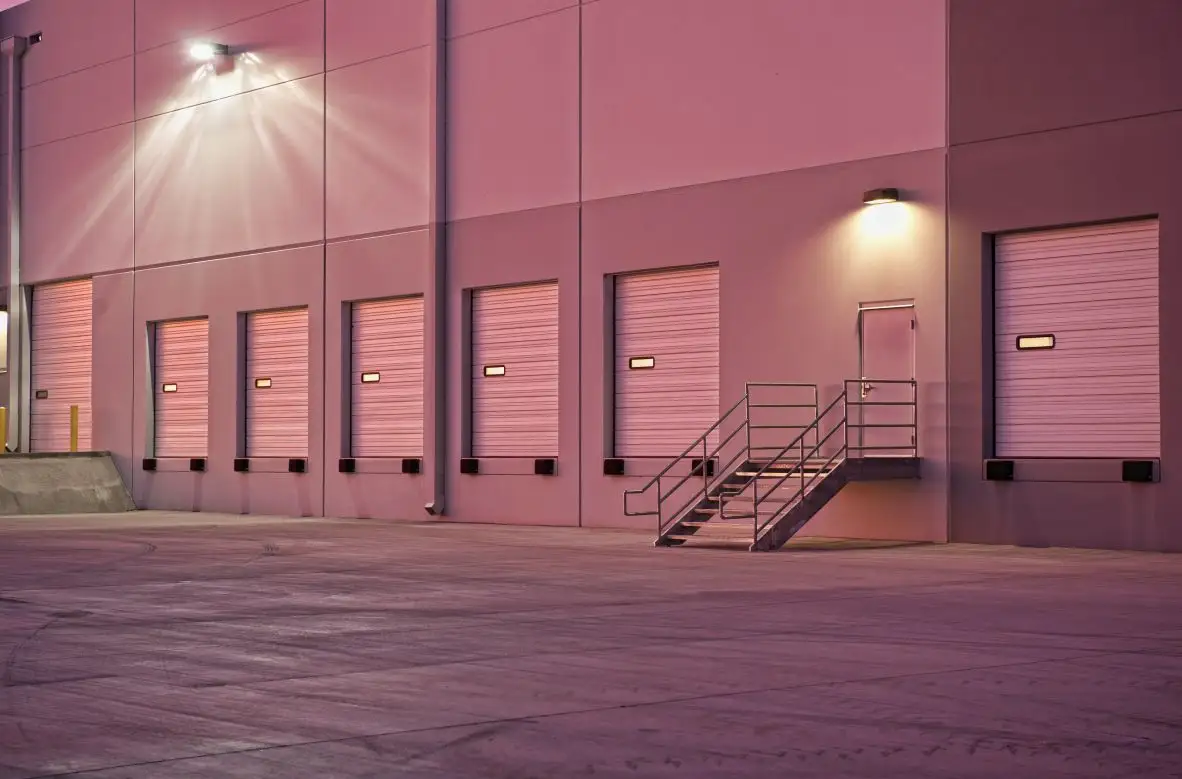
A functional industrial warehouse exterior with ample loading docks and clear signage.
In these cases, focusing on a competitive commercial real estate lease agreement with a lower base rate can ensure 100% occupancy. This strategy appeals to “efficiency experts”—businesses that operate on thin margins and prioritize cash flow stability above all else. For a 100,000-square-foot warehouse, a difference of $0.10 per square foot in rent translates to $120,000 in annual savings for the tenant. In a world of rising labor and fuel costs, that $120,000 can be the difference between a profitable year and a loss.
Understanding the Risks of Aggressive Price Cutting
However, we have to be careful. Drastically lowering rates can negatively impact your property’s valuation. Since cap rates are explained as the ratio between Net Operating Income (NOI) and the asset’s value, a drop in rent directly lowers what the building is worth. It can also signal to the market that the property is “distressed,” attracting lower-quality tenants who may struggle to meet lease obligations. A building filled with tenants who are only there because it was the cheapest option is a building at high risk of mass vacancy during an economic downturn.
Furthermore, once a building’s rent roll is set at a lower rate, it can take years or even decades to bring those rates back up to market levels, especially with long-term commercial leases. This “revenue erosion” can make it difficult to fund necessary capital improvements later, leading to a cycle of property degradation. If you can’t afford to fix the roof because the rent is too low, the building will eventually become un-leasable at any price. This is the “death spiral” of commodity commercial real estate.
Market Conditions and the Power of Dynamic Pricing
In markets with high vacancy (over 10%), tenants have the leverage. Here, landlords often use “concessions”—like three months of free rent—instead of lowering the permanent face rate. This protects the long-term valuation while giving the tenant the immediate “win” of a lower effective cost. Using dynamic pricing models—adjusting rates based on real-time demand rather than annual reviews—is a sophisticated way to stay competitive without leaving money on the table. This approach allows landlords to remain flexible during economic downturns while maintaining the asset’s integrity for future financing or sale.
Another critical aspect of the lower-rate strategy is the “Triple Net” (NNN) lease structure. In many industrial and retail scenarios, the tenant pays for taxes, insurance, and maintenance. If a landlord can keep these operating expenses low through efficient management, they can offer a lower total occupancy cost to the tenant without necessarily sacrificing their own bottom line. This requires a hands-on approach to property management and a commitment to preventative maintenance that avoids costly emergency repairs.
Calculating the Winner: ROI, Market Conditions, and Tenant Demographics
To decide which strategy wins, you have to look at who is renting. The demographic profile of your target tenant should dictate your capital expenditure budget. A tech startup has vastly different needs than a regional distribution center. A medical group requires specialized infrastructure that a law firm might find unnecessary. Understanding these nuances is the key to a successful commercial real estate strategy.
| Metric | Premium Amenities Strategy | Lower Lease Rate Strategy |
|---|---|---|
| Typical Rent Premium | 5% – 18% Higher | Market Average or Below |
| Lease-up Speed | Up to 50% Faster (if well-designed) | Variable based on price sensitivity |
| Asset Valuation | Higher (due to higher NOI) | Stable but capped |
| Maintenance Cost | Higher (ongoing upkeep) | Lower (basic infrastructure) |
| Target Tenant | Tech, Creative, Medical, Fortune 500 | Logistics, Back-office, Local small biz |
| Tenant Retention | High (due to environment) | Moderate (price-dependent) |
| Capital Requirement | High Upfront | Low Upfront |
Knowing what is a good cap rate for your specific asset class in the Inland Empire is vital. A medical office building requires high-end infrastructure, specialized plumbing, and high-capacity electrical systems. It will almost always “win” with a premium amenity strategy because the tenants require those features to operate. Conversely, a Class C suburban office might be better off maintaining a low-cost, high-occupancy model to serve local small businesses that are highly price-sensitive. These businesses often don’t need a gym or a rooftop lounge; they need a functional space with good parking and a reliable landlord.
Hybrid Strategies for Optimal Portfolio Performance
The smartest landlords often use a hybrid approach. They might offer “tiered amenities”—where basic access is included, but premium features like reserved parking or executive gym memberships carry an additional fee. This allows you to keep the base rent competitive while generating secondary revenue streams. This is common in high-end office towers where the “amenity floor” is a separate profit center.
Another hybrid tactic is “strategic incentives.” Instead of a permanent rent cut, offer “early possession,” allowing a tenant to move in 30 days early for free to set up their equipment. This is a “disguised concession” that protects your long-term leasing vs buying commercial real estate math. By focusing on the “Net Effective Rent” rather than just the “Face Rate,” landlords can create win-win scenarios that satisfy tenant budgets while preserving investor returns. For example, offering a higher Tenant Improvement (TI) allowance instead of lower rent allows the tenant to customize the space to their needs, which often leads to a longer lease term and higher renewal probability.
Furthermore, landlords can look at “soft amenities” that don’t require massive capital. This could include organized food truck visits, outdoor yoga classes, or a concierge service for tenants. These features add value and build a sense of community without the permanent overhead of a built-out fitness center or cafeteria. In the Riverside market, where community and local connections are highly valued, these soft amenities can be a powerful differentiator.
Premium Amenities or Lower Lease Rates? Which Strategy Wins?
The strategy that “wins” for long-term profitability is the one that aligns with the Flight to Quality. Even in a tepid economy, businesses are willing to pay for convenience, flexibility, and productivity. The modern workforce is more mobile and more discerning than ever before. If a commercial space doesn’t offer a compelling reason for people to be there, it will eventually struggle to maintain occupancy.
A modern retail strip with outdoor seating, EV charging stations, and high-end finishes.
Whether you are buying vs leasing commercial real estate, the goal is future-proofing. A building that offers EV charging, smart tech, and collaborative spaces will always be more resilient than a “cheap” building that hasn’t been painted since 1995. In the Southern California market, quality is the best hedge against vacancy. As environmental regulations tighten, buildings with green certifications and energy-efficient systems will also face lower risk of obsolescence and regulatory fines.
Ultimately, the “winner” is the landlord who understands their tenant’s business model as well as the tenant does. If you know that your target tenant is a growing tech firm, you invest in fiber and collaborative zones. If your target is a regional distributor, you invest in yard space and dock high doors. The strategy isn’t about amenities vs. price in a vacuum; it’s about delivering the highest value for the specific needs of the market. In the Inland Empire, where the economy is diversifying beyond just logistics into healthcare, tech, and professional services, the demand for high-quality, amenitized space is only going to grow.
Frequently Asked Questions about Commercial Leasing Strategies
Which amenities provide the highest rent premium in office buildings?
According to industry-wide research, roof and sky terraces lead the pack with a 5.2% rent premium. Other high-performers include fitness centers with showers (2.9%), courtyards (3.5%), and LEED certification (2.8%). These features are highly valued because they provide employees with spaces to decompress and socialize, which is a key component of modern workplace culture. In a post-pandemic world, outdoor access has moved from a luxury to a top-tier requirement for many corporate tenants.
How do lower lease rates affect the long-term valuation of a commercial property?
Lower lease rates directly reduce your Net Operating Income (NOI). Since commercial property value is typically calculated by dividing NOI by the market cap rate, lower rent equals a lower building value. This can make it harder to refinance or sell the property for a profit later. For example, a $10,000 reduction in annual NOI can result in a $200,000 loss in property value at a 5% cap rate. This is why many sophisticated investors prefer to offer concessions like free rent rather than lowering the base rate.
When should a landlord choose concessions over a permanent rent reduction?
Concessions (like free rent or tenant improvement allowances) are best used during temporary market oversupply or seasonal dips. They allow you to attract tenants immediately while keeping the “face rate” of the lease high, which preserves the building’s appraised value for investors and lenders. This is a critical strategy for maintaining the long-term health of a commercial portfolio and ensuring that the property remains attractive to future buyers or refinancing partners.
What is the impact of EV charging stations on commercial property value?
As Southern California moves toward a greener economy, EV charging stations have become a significant draw for both retail and office tenants. Properties that offer these stations often see higher dwell times in retail settings and higher satisfaction scores in office settings. They are increasingly viewed as a standard infrastructure requirement rather than a luxury amenity. Furthermore, many state and local incentives can help offset the cost of installation, making it a high-ROI upgrade.
How does high-speed fiber connectivity influence tenant retention?
In the modern digital economy, downtime is not an option. Buildings with redundant fiber-optic connections and high-speed capabilities are far more resilient to market fluctuations. Tenants in sectors like finance, tech, and healthcare view reliable connectivity as a non-negotiable utility, similar to electricity or water. A building that can guarantee 99.9% uptime will always have a competitive advantage over one that relies on older copper or single-provider connections.
How Stance CRE Can Help You
Stance CRE supports commercial real estate clients by providing clear guidance on how lease structures, addendums, and amendments align with their broader business and investment objectives. This approach begins with a careful review of financial goals, operational needs, risk tolerance, and long-term flexibility, ensuring that contract decisions support growth rather than create unintended constraints. Instead of promoting one-size-fits-all solutions, Stance CRE emphasizes education, transparency, and strategic alignment at every stage of the transaction.
With deep expertise in Riverside County and the surrounding commercial markets, the Stance CRE team brings local insight and practical experience to each client engagement. From initial site selection to lease negotiation and ongoing contract modifications, Stance CRE helps businesses navigate complex agreements with confidence and clarity. Whether securing a first location or optimizing an existing portfolio, the focus remains on protecting client interests while positioning them for sustainable success in a dynamic commercial environment.