


Addendum or Amendment? A Clear Guide for Commercial Real Estate Contracts
Why Understanding Contract Modifications Matters in Commercial Real Estate
In commercial real estate contracts, even small changes in language can carry significant legal and financial consequences. When deal terms evolve after initial negotiations, property owners and tenants are often faced with a critical question: should the change be handled through an addendum or an amendment? Although these terms are sometimes used interchangeably, they serve different purposes and are applied at different stages of a lease or contract lifecycle.
Understanding the distinction between an addendum and an amendment is essential for protecting your interests and maintaining a clear, enforceable agreement. Using the wrong document or applying it incorrectly can create confusion, weaken contractual protections, or lead to disputes down the line. This guide explains how addendums and amendments function in commercial real estate contracts, when each should be used, and why choosing the right approach matters for long-term clarity and risk management.
Quick Answer:
- Addendum = Adds new information to a contract without changing the original terms (like attaching a new appendix during the offer phase).
- Amendment = Changes, deletes, or replaces existing contract language (like editing the original text after the contract is fully executed).
- Key difference: Addendums supplement the initial agreement; amendments modify an existing, binding agreement.
- Both require: Signatures from all authorized parties to be legally binding and enforceable under California law.
When to use each:
| Use an Addendum When: | Use an Amendment When: |
|---|---|
| Adding new environmental contingencies | Changing the final purchase price after inspections |
| Including additional hazardous material disclosures | Extending the due diligence or closing date |
| Attaching detailed site plans or floor maps | Modifying monthly base rent or NNN allocations |
| Adding new clauses not in the original boilerplate | Correcting legal description errors in existing terms |
Real-estate transactions live and die by what is written—and signed—in the contract. Yet nearly every commercial deal requires adjustments after that first signature. That's where these two deceptively similar tools come in: the addendum and the amendment. Using the wrong one, or drafting either poorly, can lead to serious legal complications, especially when dealing with institutional lenders or sophisticated REITs. In the Inland Empire's booming industrial sector, where logistics hubs and distribution centers are under constant negotiation, the ability to pivot through contract modifications is a competitive advantage. The legal landscape in California is particularly rigorous regarding the "Statute of Frauds," which mandates that any modification to a real estate contract must be in writing and signed by the parties to be charged. This means that a handshake deal to extend a due diligence period on a Moreno Valley warehouse is essentially worthless without a properly executed amendment.
Research shows that nearly 100% of analyzed public procurement and large-scale commercial contracts included addendums for extending deadlines and increasing costs, while poorly drafted modifications can lead to serious non-conformity issues when obligations become ambiguous. For a business owner in Moreno Valley or an investor in Corona, these documents are the lifeblood of the transaction lifecycle. The financial implications of a single misplaced word in a commercial lease amendment can be staggering, potentially affecting the Net Operating Income (NOI) and, consequently, the overall valuation of the asset.
Addendum or Amendment? A Clear Guide for Commercial Real Estate Contracts
In the fast-paced world of Riverside commercial property, the initial contract is rarely the final word. As we move through the due diligence period or manage a long-term triple-net (NNN) lease, circumstances change. Maybe a Phase I Environmental Report suggests further testing is needed on a former industrial site, or perhaps a tenant in a Colton industrial park needs to expand their square footage mid-lease to accommodate a new logistics contract. These shifts require formal documentation to ensure that both the landlord and the tenant remain in compliance with their agreed-upon obligations. The complexity of these agreements often stems from the fact that commercial properties are not just physical structures; they are financial instruments with intricate cash flow models that can be disrupted by even minor contractual ambiguities.
The fundamental difference lies in how these documents interact with the "parent" agreement. An addendum is like a "bonus chapter" added to the end of a book; it provides extra information that wasn't there before, often at the time the contract is being created or before it is fully executed. An amendment is like an "editorial strike-through" in the middle of a chapter; it changes the words that are already on the page of a signed, binding agreement. In commercial practice, the distinction is vital because it dictates how the document is integrated into the master file and how it affects the priority of terms. For instance, if an amendment conflicts with the original lease, the amendment typically takes precedence, but if an addendum is added at the start, it must be carefully cross-referenced to ensure it doesn't create internal inconsistencies within the document.
Defining the Addendum: Adding Without Altering
An addendum is a supplementary document attached to the original contract. Its primary purpose is to provide clarity or introduce new provisions that were not addressed in the initial agreement. In commercial real estate, we often call these "riders" or "exhibits." They are frequently used during the offer stage to customize a standard AIR (American Industrial Real Estate Association) or CAR (California Association of Realtors) commercial form to the specific needs of a unique property. These standard forms are excellent starting points, but they are designed to be generic. The addendum is where the "meat" of the specific deal is often found, detailing everything from exclusive use clauses in a retail center to specific hazardous material handling protocols in an industrial facility.
Think of an addendum as a way to keep the original contract intact while "tacking on" necessary details. For example, if we are helping a client purchase a retail strip in Moreno Valley and we need to include a specific list of personal property (like specialized kitchen equipment in a restaurant space) that stays with the building, we would use an addendum. This ensures the main body of the purchase agreement remains clean while the specific details are handled in the attachment. Furthermore, addendums are often used to incorporate complex legal descriptions or survey maps that are too large to fit within the standard form's margins. By referencing these as "Exhibit A" or "Addendum 1," the parties ensure that the technical details are legally part of the agreement without cluttering the core business terms.
Defining the Amendment: Changing the Core Agreement
An amendment is the tool we use when we need to change, delete, or replace language that already exists in a signed contract. In the Inland Empire, where market conditions can shift during a 60-day escrow or a 10-year lease term, amendments are incredibly common. They represent a mutual agreement to deviate from the original path set by the contract. Unlike an addendum, which is often part of the initial package, an amendment is almost always a reactive document, created in response to new information or changing circumstances. It is the primary mechanism for "course correction" during the life of a commercial agreement.
Common scenarios for an amendment include:
- Price Adjustments: If an inspection reveals a significant structural issue on a Riverside office building, the buyer might negotiate a lower purchase price in exchange for taking the property "as-is." This requires an amendment to the Purchase and Sale Agreement (PSA).
- Timeline Shifts: Extending the due diligence period because a city planning department is delayed in issuing a zoning verification letter or a conditional use permit (CUP).
- Clause Modifications: Deleting a "no-sublease" clause in a commercial lease to allow a growing tech company the flexibility to bring in a partner firm or a subsidiary.
- Rent Restructuring: During economic downturns or periods of significant growth, landlords and tenants may agree to amend the rent schedule to ensure the long-term viability of the tenancy.
Practical Applications in Commercial Transactions
In real-world commercial transactions, addendums and amendments are used to address practical needs that arise before and after a contract is executed. Addendums are commonly applied during the initial negotiation phase to incorporate supplemental terms such as tenant improvement allowances, exclusive use provisions, or special operating conditions that are not fully addressed in the base agreement. Amendments, by contrast, are typically used once the contract is in effect to modify existing terms in response to changing business needs, market conditions, or property circumstances. Understanding how and when to apply each document allows parties to adapt agreements efficiently while preserving contractual integrity and minimizing the risk of misunderstandings or disputes.
Before moving forward with any modification, it is vital to consult a Due Diligence Checklist for commercial property. This ensures that the modification doesn't inadvertently conflict with other critical aspects of the deal, such as zoning restrictions, CC&Rs (Covenants, Conditions, and Restrictions), or the requirements of a CMBS (Commercial Mortgage-Backed Securities) lender. For instance, an amendment to lower rent might require the approval of the landlord's lender if it drops the Debt Service Coverage Ratio (DSCR) below a certain threshold. In the world of institutional commercial real estate, the landlord often doesn't have the unilateral right to amend a lease without the consent of their financial partners, making the amendment process a multi-party negotiation.
When to Use an Addendum or Amendment? A Clear Guide for Commercial Real Estate Contracts
Deciding between the two often comes down to timing and the existing text. In the Inland Empire market, where industrial vacancy rates have historically been low, speed is often of the essence, but precision cannot be sacrificed for haste. A poorly executed modification can lead to "estoppel" issues later, where a party is legally prevented from asserting a right because of a previous statement or action. This is why every modification must be treated with the same gravity as the original contract.
Use an Addendum when:
- You are submitting an initial offer and want to include specific contingencies (e.g., "Subject to SBA 504 loan approval").
- You need to provide environmental disclosures, such as a Natural Hazard Disclosure (NHD) report, that were not part of the standard form.
- You are adding a completely new exhibit, like a detailed floor plan for a build-to-suit medical office or a site map for a Commercial Property for Lease.
- You are defining the scope of Tenant Improvements (TI) before the lease is finalized, including specific materials, timelines, and contractor requirements.
- You are incorporating a "Right of First Refusal" (ROFR) or a "Right of First Offer" (ROFO) for adjacent space that wasn't in the boilerplate lease.
Use an Amendment when:
- The contract is already signed and fully executed, and you need to change the expiration date of the inspection period due to a delay in the Phase II environmental study or a structural engineering report.
- The parties agree to change the Common Area Maintenance (CAM) fee structure from a fixed rate to a variable "pass-through" model based on actual operating expenses.
- There is a typo in the original document that could cause legal issues, such as an incorrect suite number, a misspelled corporate name, or an error in the square footage calculation that affects the rent.
- A tenant is expanding into an adjacent suite and the total premises description, rent, and pro-rata share of operating expenses need to be updated.
- You are extending the lease term (a "Lease Extension Amendment") or changing the guarantor on the lease after a corporate restructuring.
Common Examples in Commercial Leases and Sales
In our work across Riverside and the Inland Empire, we see these documents used daily to facilitate complex business moves. Here are some real-world examples from our practice:
- Rent Escalations: In a long-term industrial lease in Ontario, an amendment might be used to adjust the annual rent increases from a flat 3% to a CPI-linked (Consumer Price Index) increase if the tenant agrees to a longer term in exchange for building upgrades. This requires a detailed calculation of the CPI index to be used, which is often attached as an addendum to the amendment.
- Tenant Improvements (TI): An addendum might be used at the start of a lease to detail exactly what "carpet and paint" the landlord will provide. If the scope of work changes during construction—perhaps the tenant decides they need additional plumbing for a lab space or specialized electrical for a server room—an amendment would be used to reflect the new costs, the revised TI allowance, and any changes to the rent commencement date caused by the construction delay.
- Environmental Issues: If a Phase II study finds soil contamination on a commercial lot in Jurupa Valley, an addendum might be drafted during the escrow period to outline the seller's responsibility for remediation and the specific "No Further Action" (NFA) letter required before the close of escrow. If the remediation takes longer than expected, a subsequent amendment would be needed to extend the closing date.
Whether you are Buyers or Sellers, these documents are your primary means of ensuring the final deal matches your expectations and protects your balance sheet. In the commercial sector, where assets are often held in single-purpose entities (SPEs), the clarity of these modifications is also vital for maintaining the corporate veil and ensuring that the entity's obligations are clearly defined.
Avoiding Pitfalls: Addendum or Amendment? A Clear Guide for Commercial Real Estate Contracts
Even seasoned institutional investors can make mistakes when the pace of a deal accelerates. One of the most common pitfalls is ambiguous wording. If an amendment says "the closing is extended by two weeks," does that mean 14 calendar days or 10 business days? In commercial real estate, those four days can mean the difference between keeping or losing a locked-in interest rate or missing a 1031 exchange deadline. We always recommend using specific dates (e.g., "The Closing Date is hereby extended to October 15, 2024") rather than relative timeframes.
Another mistake is missing signatures. If a commercial property is owned by an LLC with two managing members, both may need to sign the amendment for it to be valid, depending on the operating agreement. We often see amendments signed by a "Manager" who doesn't actually have the authority to bind the entity for transactions over a certain dollar amount. Verifying the "Authorized Signatory" is a critical step in the due diligence process for any contract modification. Failure to do so can lead to a situation where one party claims the amendment is invalid because the person who signed it lacked the authority to do so.
Who Can Execute Modifications?
In a commercial transaction, the parties themselves (the buyer/seller or landlord/tenant) are the ones who must execute the documents. However, they are rarely the ones drafting them. The roles are typically divided as follows:
- Authorized Signatories: For corporations or LLCs, the person signing must have the legal authority to bind the company. We often request a "Secretary's Certificate" or an "Operating Agreement" to verify this authority in large-scale Riverside commercial deals. In institutional deals, this might even require a formal board resolution.
- Brokers: While we as brokers often facilitate the negotiation and help prepare the standard forms, we do not have the authority to sign on behalf of our clients unless a specific Power of Attorney is in place. Our role is to ensure the business terms are accurately reflected and that the parties understand the implications of the modification.
- Legal Counsel: For high-value or complex transactions involving multi-tenant retail centers or industrial parks, we always recommend having an attorney review the language. A single misplaced comma in a "Percentage Rent" clause can cost a landlord tens of thousands of dollars over a five-year term. Attorneys also ensure that the modification complies with local and state laws, including specific California disclosures that may be required for commercial properties.
Streamlining Contract Management with Technology
The days of faxing signed pages back and forth and dealing with "illegible scrawls" are largely over. Modern commercial real estate relies on digital tools to manage the lifecycle of a contract. This is especially important when a deal has multiple amendments—keeping track of "Amendment No. 4" versus "Amendment No. 1" is much easier with a digital audit trail. In the Inland Empire, where many investors are based out of the area or even out of the country, digital execution is the standard. This technological shift has not only increased speed but also enhanced the security and reliability of commercial transactions.
Benefits of Digital Workflow Management
By using digital platforms, we can reduce the "human error" factor that often plagues complex commercial negotiations.
- Version Control: You always know you are looking at the most recent version of the contract. This prevents the nightmare scenario of a tenant signing "Version 3" while the landlord thinks they are on "Version 5." In a complex negotiation with multiple rounds of redlines, version control is the only way to maintain sanity.
- Audit Trails: You can see exactly who signed what and when. This is vital for proving compliance with "Time is of the Essence" clauses, which are common in commercial purchase agreements. If a buyer misses a deadline to remove a contingency, the digital audit trail provides the evidence needed to determine if the contract is still in force.
- Centralized Storage: All addendums and amendments are kept in one place, which is vital during a future sale or audit. When a buyer performs due diligence on your property, having a clean, chronological folder of all lease amendments increases their confidence in the asset and can even lead to a higher sale price by reducing the perceived risk.
- Automated Reminders: Many systems will alert you 180 days before a lease expiration or a rent increase date, allowing you to prepare the necessary amendments well in advance. This proactive approach is essential for maintaining high occupancy rates and maximizing the value of a commercial property.
- Security and Compliance: Digital platforms often include encryption and multi-factor authentication, ensuring that sensitive financial terms and corporate data are protected from unauthorized access. This is increasingly important as commercial real estate becomes a target for cyber-attacks and wire fraud.
Frequently Asked Questions about CRE Modifications
Does an addendum need to be signed by all original parties?
Yes. An addendum is an addition to the contract, and for it to be binding, all parties to the original agreement must agree to the new terms. If you are adding a new party to the deal (like an additional guarantor for a commercial lease), they must also sign the addendum to be bound by its terms. In California, the lack of a required signature can render the entire modification voidable. This is why we always perform a "signature audit" before finalizing any modification to ensure every required entity and individual has signed in the correct capacity.
What happens if an amendment conflicts with the original lease terms?
In most cases, the terms of the amendment will override the original contract. This is known as the "rule of later expression." However, to avoid disputes, a well-drafted amendment will explicitly state: "In the event of any conflict or inconsistency between the terms of this Amendment and the Original Lease, the terms of this Amendment shall control and govern." This simple sentence can prevent thousands of dollars in legal fees and months of litigation. Without this clause, a court might have to look at the "intent of the parties," which is a subjective and expensive process.
Is a "Side Letter" the same as an amendment?
In commercial real estate, a side letter is often used to clarify a specific point or grant a one-time concession (like a temporary parking permission or a one-month rent abatement) that the parties don't want to become a permanent part of the lease. However, side letters can be legally risky because they may not be binding on future owners of the property. For permanent changes to rent, term, or space, a formal amendment is always the safer choice. Lenders also tend to dislike side letters because they can hide liabilities that aren't apparent in the main lease file.
Can I use an amendment to change the name of the tenant?
If a tenant is simply changing their corporate name but remaining the same legal entity (e.g., changing from "ABC Corp" to "ABC Logistics, LLC"), an amendment is appropriate. However, if the tenant is selling their business to a new owner, you typically need an "Assignment and Assumption of Lease" agreement, which is a more complex document than a standard amendment. This ensures the original tenant is properly released (or remains liable) and the new tenant is fully vetted and bound by all existing lease terms. This process often involves a "Landlord's Consent to Assignment" as well.
What is a "Ratification" clause in an amendment?
A ratification clause is a statement where both parties confirm that, except for the changes made in the amendment, the rest of the original contract remains valid and in full effect. This is a "safety net" that prevents a party from later claiming that the amendment somehow invalidated the entire original agreement. It is a standard best practice in commercial real estate drafting to include this clause in every amendment, regardless of how minor the change may be.
How Stance CRE Can Help You
Stance CRE supports commercial real estate clients by providing clear guidance on how lease structures, addendums, and amendments align with their broader business and investment objectives. This approach begins with a careful review of financial goals, operational needs, risk tolerance, and long-term flexibility, ensuring that contract decisions support growth rather than create unintended constraints. Instead of promoting one-size-fits-all solutions, Stance CRE emphasizes education, transparency, and strategic alignment at every stage of the transaction.
With deep expertise in Riverside County and the surrounding commercial markets, the Stance CRE team brings local insight and practical experience to each client engagement. From initial site selection to lease negotiation and ongoing contract modifications, Stance CRE helps businesses navigate complex agreements with confidence and clarity. Whether securing a first location or optimizing an existing portfolio, the focus remains on protecting client interests while positioning them for sustainable success in a dynamic commercial environment.


How Local Riverside Policies Encourage Business Expansion and Development
Why Riverside is California's Next Major Business Hub
Caption: A vibrant sunrise illuminates modern commercial properties in Southern California, reflecting the region's dynamic business environment.
Once defined by its sprawling citrus groves, Riverside has meticulously cultivated a new identity as a thriving, diversified economic hub for manufacturing, technology, and healthcare. This is not an accidental evolution but the direct result of deliberate, forward-thinking strategies designed to create an ecosystem where businesses can flourish. For commercial real estate investors, developers, and business owners, understanding how local Riverside policies encourage business expansion and development is the key to unlocking the immense potential within this cornerstone of the Inland Empire.
Riverside's comprehensive approach combines direct financial incentives, radically streamlined permitting processes, and sustained investment in robust infrastructure, creating tangible benefits for office, industrial, retail, and medical properties. The city's success is quantifiable: in 2023 alone, it issued over 3,500 new business licenses and attracted more than $1 billion in private investment, signaling strong market confidence. This momentum is guided by the city's ambitious "Ready for Prosperity Roadmap," a foundational document that aligns economic development initiatives with community well-being to ensure sustainable growth and superior long-term performance for commercial assets across the region.
Riverside's Strategic Vision: The "Ready for Prosperity" Roadmap
At the heart of Riverside's economic ascent is the "Ready for Prosperity Roadmap," a comprehensive strategic plan designed to foster intentional growth. This isn't just a policy document; it's a blueprint for leveraging the city's unique assets—from its academic institutions to its logistical advantages—to build a durable, innovative economy. For the commercial real estate market, this roadmap translates directly into stable, long-term demand. You can explore the full roadmap here.
Core Goals of Riverside's Economic Development
The strategy is built upon six interconnected goals:
- Diverse and Resilient Economy: Attracting businesses that create living-wage jobs, which fuels demand for office, industrial, and specialized R&D facilities and creates a predictable leasing market.
- Inclusive Entrepreneurship Ecosystem: Fostering innovation through co-working spaces and capital access to cultivate the next generation of tenants for flexible office and light industrial spaces.
- Strong Workforce: Deepening partnerships with UCR and RCCD to ensure a continuous pipeline of skilled workers, making the city attractive for corporate relocations and expansions.
- Welcoming Investment Climate: Simplifying regulations and championing initiatives like the "One Stop Shop" to reduce risk and shorten timelines for commercial real estate projects.
- Exceptional Quality of Place: Investing in arts, culture, and vibrant mixed-use commercial districts to help businesses attract and retain top talent, enhancing the value of surrounding properties.
- Effective Marketing: Proactively promoting Riverside as a premier destination for business and commercial real estate investment to drive inbound capital and corporate interest.
Aligning City Planning with Business Needs
Riverside delivers on its promises with programs like "Streamline Riverside." This initiative consolidates development services into a "One Stop Shop," offering concurrent plan reviews and predictable 2-4 week plan check turnarounds. This efficiency is a significant competitive advantage, reducing carrying costs and accelerating speed-to-market for new construction and tenant improvements. The city's Build Riverside online portal further enhances transparency, allowing 24/7 permit tracking. These policies are particularly effective in encouraging complex projects, including the Adaptive Reuse of historic buildings.
Fostering Entrepreneurship and Startup Culture
Riverside is actively building its innovation economy from the ground up through key initiatives:
- ExCITE Riverside Incubator: This partnership has supported over 30 startups that have generated more than 180 high-paying local jobs.
- EPIC Small Business Development Center (SBDC): Specializing in high-tech ventures, EPIC SBDC has helped local companies secure $54 million in grants and attract over $30 million in private investment.
These resources are transforming Riverside into a recognized innovation hub, creating sustained demand for specialized commercial facilities like labs, R&D centers, and flexible office environments. Learn more about this transformation in The Rise of Riverside's Innovation District.
Direct Financial Support for Business Growth
Riverside backs its pro-business stance with a robust suite of direct financial incentives designed to reduce capital costs and fuel growth. This tangible support benefits the office, industrial, retail, and medical real estate markets by fostering a healthy and expanding tenant base.
Grants and Loans for Businesses
The city and its partners offer a multi-tiered support system for businesses at various stages:
- Small & Micro Business Grant: Provides up to $25,000 from ARPA funds to help small businesses stabilize operations or lease a larger commercial space.
- Small Business Thrive Program: Combines micro-grants of $1,500-$5,000 with essential business training and mentorship.
- ReSTART Program: Offers low-interest loans of $15,000-$30,000 at a fixed 3.75% rate for businesses ready to scale and expand their footprint.
- Proof of Concept Grants: Provides $25,000-$50,000 in critical early-stage funding for tech startups to validate their ideas, seeding future demand for lab and R\&D space.
Incentive Zones for Maximum ROI
Strategic economic zones allow investors and businesses to leverage powerful tax advantages:
- Opportunity Zones: Riverside's 11 designated Opportunity Zones offer significant capital gains tax deferrals and reductions for investors. This tool has helped attract over $1 billion in private investment, catalyzing major developments like the $419 million California Air Resources Board (CARB) headquarters. Learn about Investing in Riverside's Opportunity Zones.
- HUBZones & Foreign Trade Zones (FTZ): These federal designations provide a competitive edge. HUBZones give businesses preferential access to federal contracts, while the city's FTZ status allows manufacturing and logistics companies to defer, reduce, or eliminate customs duties on imported goods, strengthening the appeal of local industrial properties.
Utility and State-Level Incentives
Businesses in Riverside can also tap into additional incentives that lower long-term operating expenses:
- Economic Development Rate (EDR): This Riverside Public Utilities program provides a 12% discount on electric bills for five years for qualifying businesses, offering significant savings for energy-intensive users.
- Energy Efficiency Programs: State programs like CEDA and SGIP provide rebates and assistance for businesses investing in energy-efficient systems and sustainable technologies. As detailed by Riverside Public Utilities, these programs lower operating costs and improve the marketability of commercial assets.
Building the Foundation: Infrastructure, Workforce, and Partnerships
Beyond direct financial aid, Riverside's long-term strategy focuses on building a robust foundation for business success through world-class infrastructure, a skilled workforce, and strong community partnerships. These pillars directly shape the performance and desirability of the city's commercial real estate.
Infrastructure for a Connected Economy
Riverside's strategic location in the Inland Empire is reinforced by significant infrastructure investments, making it a prime hub for logistics and commerce.
- Transportation Network: The city offers access to five major freeways (I-10, I-15, I-215, SR-60, SR-91), extensive rail services from BNSF and Union Pacific, and proximity to 17 airports, including Ontario International Airport. This connectivity is central to the appeal of distribution, warehouse, and light manufacturing properties.
- March Inland Port: This key logistics hub facilitates efficient freight movement, a major advantage for industrial and distribution companies and the facilities they occupy.
- Modern Utilities and Broadband: Investments in broadband expansion and EV charging infrastructure ensure businesses are equipped for the future and help position newer office, industrial, and mixed-use assets as competitive, future-ready properties.
This connectivity is a major draw for businesses evaluating Commercial Real Estate in Southwest Riverside County.
Cultivating a Talented Workforce
A skilled workforce is the engine of economic growth and a key driver of demand for commercial space. Riverside actively develops and attracts talent through:
- Educational Partnerships: Strong collaborations with the University of California, Riverside (UCR) and the Riverside Community College District (RCCD) create a direct pipeline of skilled graduates for employers occupying local office, lab, and industrial facilities.
- Workforce Development: The city's Workforce Development Centers offer free services like recruitment assistance and training incentives to businesses, helping tenants scale without relocating out of the market.
- Talent Retention: Programs such as assistance for targeted professionals help retain skilled workers in the area, supporting long-term stability for corporate campuses, medical facilities, and other commercial properties. These dynamics are highlighted in The Impact of Inland Empire Colleges and Universities on Commercial Real Estate Growth.
The Power of Public-Private Partnerships
Riverside's success is built on a foundation of collaboration that benefits local businesses and the properties they occupy.
- Riverside Chambers of Commerce: A vital advocate for business interests, providing networking, resources, and a direct line to local government. These activities support healthy occupancy and business activity in key commercial districts. Learn more at the Riverside Chambers of Commerce.
- Business Improvement Districts (BIDs): These districts, funded by local businesses, work to improve the commercial environment through beautification, security, and marketing efforts, which can improve foot traffic, tenant performance, and the perceived value of retail and mixed-use centers.
- Incubators and Accelerators: Partnerships like the ExCITE Incubator bring together government, academia, and private industry to support the next generation of entrepreneurs, driving demand for flexible office, lab, and innovation-focused real estate.
These collaborations demonstrate How Riverside, California Supports Businesses at every level, reinforcing the market fundamentals behind local commercial assets.
Targeted Growth: Key Industries and Success
Targeted growth is about focusing resources and strategies on the industries where your business can make the biggest impact. By identifying key sectors with high demand, strong margins, or untapped potential, companies can tailor their offerings, marketing, and operations to meet specific needs and outperform competitors. Success in these targeted industries doesn’t happen by chance—it requires data-driven decisions, a deep understanding of customer pain points, and the ability to deliver solutions that consistently create value and build long-term relationships.
Manufacturing and Logistics Powerhouse
- Strategic Industrial Zoning: Four zones (BMP, I, AI, AIR) with clear development standards
- Market Performance: Industrial rents climbed 6.4% with 17 million square feet net absorption
- Job Creation: Manufacturing employs 94,500 workers, adding 60,000 jobs since 2020
Industrial Zone Classifications
| Classification | Max FAR | Min Lot Area | Building Height |
|---|---|---|---|
| BMP | 0.50 | 20,000 sq ft | 50 ft |
| I | 0.60 | 7,200 sq ft | 50 ft |
| AI | 0.40 | 20,000 sq ft | 50 ft |
| AIR | 0.50 | 20,000 sq ft | 50 ft |
Explore Industrial Property for Sale in Riverside, CA.
Technology and Innovation Hub
Innovation jobs grew 74% over five years. The $419 million CARB headquarters anchors the ecosystem. EPIC SBDC secured $54 million in grants for startups. See The Rise of Riverside's Innovation District.
Healthcare and Life Sciences
With 294,000 workers, healthcare drives specialized commercial space demand. The $2.5 billion March Healthcare Development will create 3,000+ jobs. Find Medical Office Space for Lease in Riverside and Healthcare Facilities.
Frequently Asked Questions about Business Development in Riverside
What specific financial incentives are available for tech startups?
Riverside offers several programs for tech entrepreneurs. The EPIC SBDC specializes in helping startups secure non-dilutive funding, such as federal SBIR/STTR grants. The city also provides proof of concept grants of up to $50,000 to help validate new technologies. Incubators like ExCITE offer workspace, mentorship, and investor connections to accelerate growth, which in turn supports demand for flexible office and lab environments.
How does Riverside's location in the Inland Empire benefit industrial businesses?
Riverside's location is a major strategic advantage. It provides excellent access to the Ports of Los Angeles and Long Beach via a network of major freeways (I-10, I-15, I-215, SR-60, SR-91) and rail services. The March Inland Port further improves its capabilities as a logistics and distribution hub. This multimodal connectivity reduces transportation costs and improves supply chain efficiency for industrial businesses, strengthening fundamentals for nearby warehouse and distribution facilities.
How does the city support the adaptive reuse of older buildings?
The city actively encourages the adaptive reuse of underutilized buildings to revitalize commercial districts. The "Streamline Riverside" program is particularly beneficial for these complex projects, as it brings all necessary departments to the table early in the process. The city may also offer flexibility on zoning standards for adaptive reuse projects, and buildings in historic districts may be eligible for federal tax credits, providing a powerful financial incentive for developers.
How Stance CRE Can Help You
Riverside County truly shines as a guide of business support in Southern California. Through its thoughtfully designed programs, resources, and partnerships, the region demonstrates how Riverside California supports businesses of all sizes and stages—from scrappy startups to established enterprises looking to expand.
What makes Riverside special isn't just the individual programs like the Small Business Thrive grants or the ExCITE Incubator, but how these pieces work together to create a complete ecosystem of support. Entrepreneurs can find precisely the help they need, whether that's seed funding, affordable workspace, expert mentorship, or connections to potential clients and partners.
At Stance Commercial Real Estate, we're not just observers of Riverside's business-friendly environment—we're active participants in it. Our team brings deep local market knowledge to every client interaction, helping businesses find the perfect commercial space to leverage all that Riverside has to offer.
We understand that finding the right property is a critical piece of your business success puzzle. Whether you're launching a startup or expanding an established operation, our commitment is to help you steer Riverside's commercial landscape with confidence and clarity.
The resources, programs, and opportunities available in Riverside County create fertile ground for business growth—and we're here to help you make the most of them. For more information about how we can support your business journey in Riverside, explore our Resources for Small Businesses or reach out to our team today.
The BRRRR Method: A Step-by-Step Guide to Real Estate Success
Understanding the BRRRR Investing Strategy for Commercial Real Estate Success
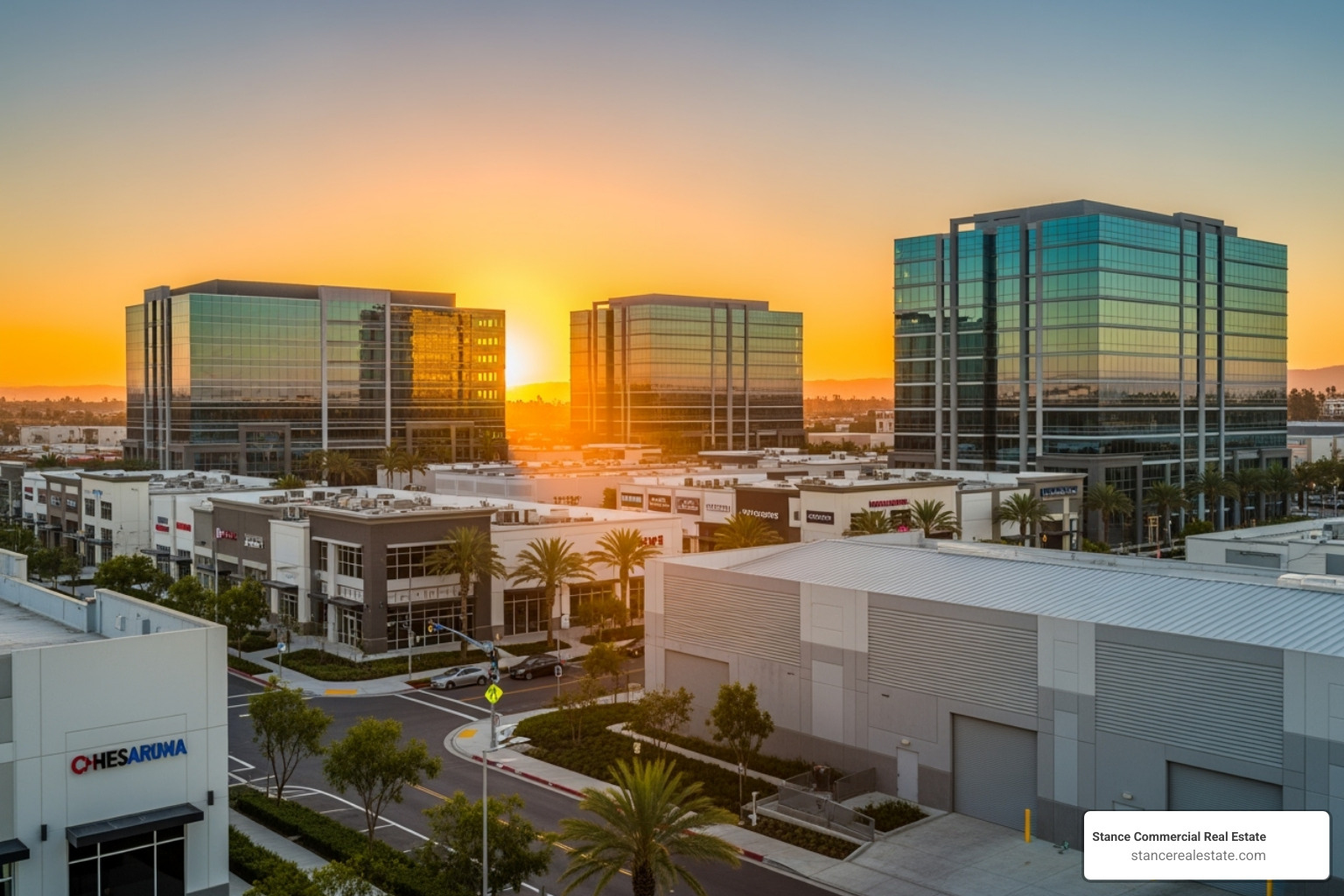
Modern commercial properties in the Inland Empire showcasing investment opportunities for the BRRRR strategy
The brrrr investing strategy is a proven method for rapidly building a commercial real estate portfolio. This five-step process allows investors to recycle their initial investment into multiple properties, creating a powerful wealth-building cycle by forcing appreciation and generating passive income.
Here's how the BRRRR method works:
- Buy - Acquire an undervalued commercial property below market value.
- Rehab - Renovate to increase property value and rental appeal.
- Rent - Secure quality tenants to generate positive cash flow.
- Refinance - Pull out equity based on the improved property value.
- Repeat - Use the extracted capital to purchase the next property.
This strategy enables you to build a portfolio with minimal personal capital, achieve higher returns than traditional buy-and-hold strategies, and scale your investments efficiently.
As Joe Stance, founder of Stance Commercial Real Estate, I've seen how the brrrr investing strategy thrives in our dynamic Inland Empire market. With over eighteen years of experience in Riverside, my team has guided countless investors through this process, leveraging the area's tremendous value-add potential.
Deconstructing the BRRRR Method: The Five Core Stages
The BRRRR investing strategy is a powerful wealth-building machine, but each stage requires careful planning and execution. Let's walk through each step to see how it works in the real world.
Step 1: Buy – Acquiring the Right Commercial Property
The foundation of a successful BRRRR investing strategy is finding the right deal. We're looking for undervalued commercial assets with untapped potential-the diamonds in the rough that other investors overlook. These are often distressed properties, such as buildings facing foreclosure or those owned by landlords who have deferred maintenance. Off-market deals, found through networking and relationship building, are also gold mines.
Before purchasing, a thorough market analysis is critical to calculate the After Repair Value (ARV)-what the property will be worth after your improvements. The 70% rule is a helpful guideline: you shouldn't pay more than 70% of the ARV minus renovation costs. For example, if a property's ARV is $800,000 and rehab costs are $80,000, your maximum offer should be around $480,000 ($800,000 x 0.70 - $80,000).
Due diligence is non-negotiable. Inspect the property from foundation to roof, review existing leases, and verify permits. For financing the initial purchase, many investors use short-term hard money loans or private lenders for their speed and flexibility. For more guidance, see our guide on How to Invest in Commercial Real Estate.
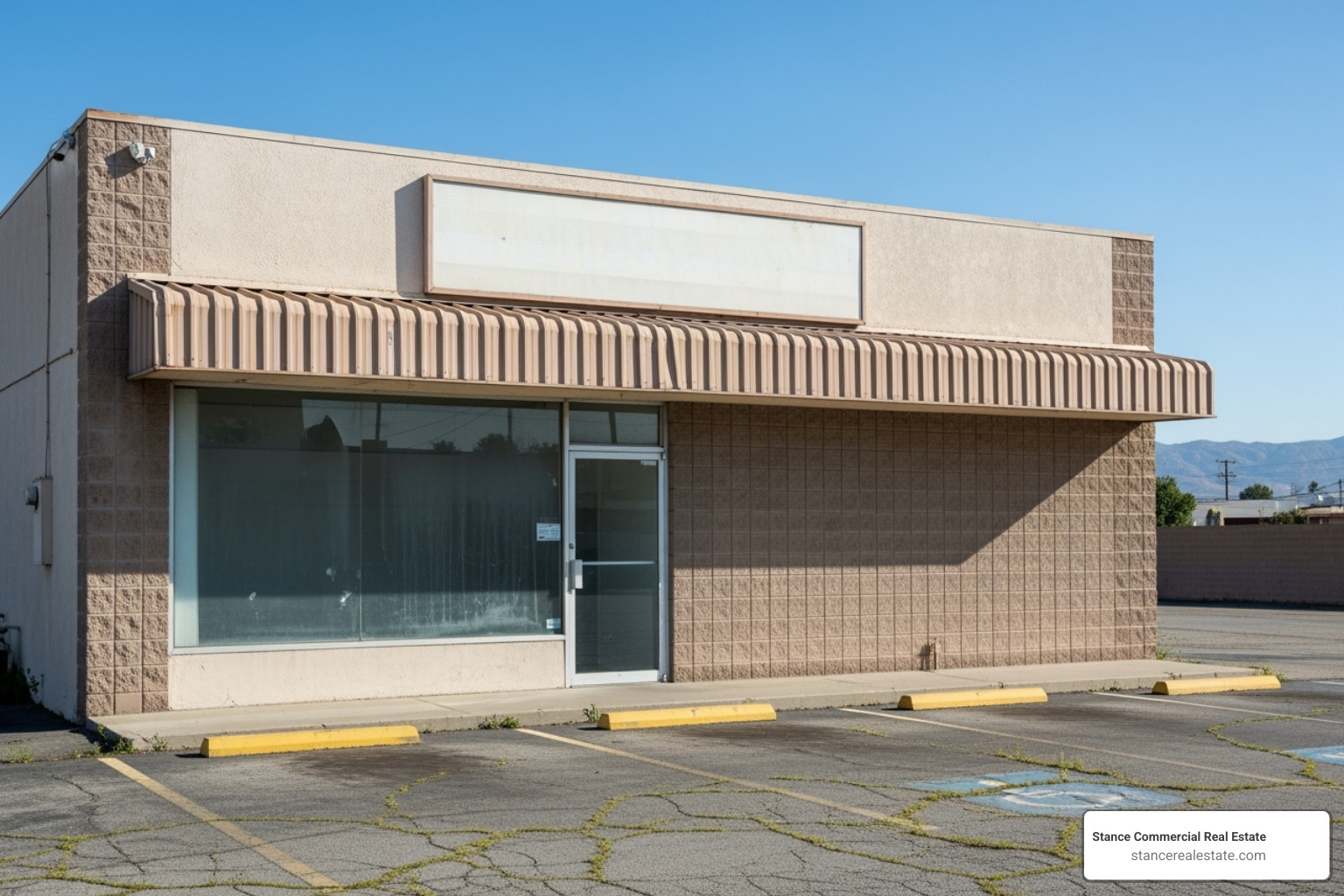
A vacant retail storefront in the Inland Empire, ripe for a BRRRR change.
Step 2: Rehab – Forcing Appreciation Through Renovation
The rehab phase is where you create forced appreciation, actively increasing your property's value. Focus on smart renovations that deliver the highest ROI on upgrades. For commercial properties, this often means facade updates, HVAC system upgrades, or reconfiguring floor plans to meet modern business needs. For industrial properties, increasing clear ceiling height or adding loading docks can significantly boost rental rates.
Effective project management is crucial. You'll need to coordinate contractors, manage timelines, and stay within budget, always including a 10-15% contingency for unexpected issues. Building relationships with reliable commercial contractors makes all the difference, as they can prevent costly delays and ensure quality work. You're renovating to appeal to commercial tenants and future buyers. For more on strategic improvements, explore our guide on Commercial Building Investment.
Step 3: Rent – Stabilizing the Asset and Generating Cash Flow
With renovations complete, it's time to find quality tenants to create stable, predictable income. This requires smart marketing and thorough screening. Commercial leasing has unique structures; you'll encounter net leases (often called NNN leases, where tenants pay most expenses) or gross leases (where you cover them). Understanding which structure fits your property and market is key.
Tenant screening for businesses involves reviewing financial statements and understanding their business model. Setting competitive rental rates is a balance-price too high and you'll sit vacant, too low and you leave money on the table. Your goal is to achieve positive cash flow and a healthy Debt service coverage ratio (DSCR). Lenders typically want to see a DSCR of at least 1.25, meaning your income is 25% higher than your debt payments. Learn more about building income streams in our article on Commercial Real Estate Passive Income Explained.
Step 4: Refinance – Recouping Your Capital for Reinvestment
This is where the magic happens. Your renovated, tenanted property is now worth significantly more, and it's time to open up that equity with a cash-out refinance. The process starts with a new property appraisal. Lenders will then offer a new loan based on a percentage of this higher value-typically 70-80% loan-to-value (LTV) for commercial properties.
Lenders will require proof of stable rental income and a good DSCR. Some also have a seasoning period, requiring you to own the property for six to twelve months. For example, if you bought a property for $400,000, spent $100,000 on rehab, and it now appraises for $750,000, a 75% LTV loan would be $562,500. After paying off your initial $500,000 costs, you'd get $62,500 back to reinvest. This recycling capital is the engine of the BRRRR strategy. Learn more about evaluating opportunities at What is a Good Cap Rate for Commercial Real Estate.
Step 5: Repeat – Scaling Your Commercial Real Estate Portfolio
Now you're ready to do it all over again. Portfolio growth through the BRRRR investing strategy creates a snowball effect, where each successful project funds the next. With each cycle, you gain experience, build relationships, and benefit from economies of scale. This disciplined approach is how you build long-term wealth and a commercial empire, one property at a time. For tools to track your portfolio, visit Commercial Real Estate Portfolio Analysis.
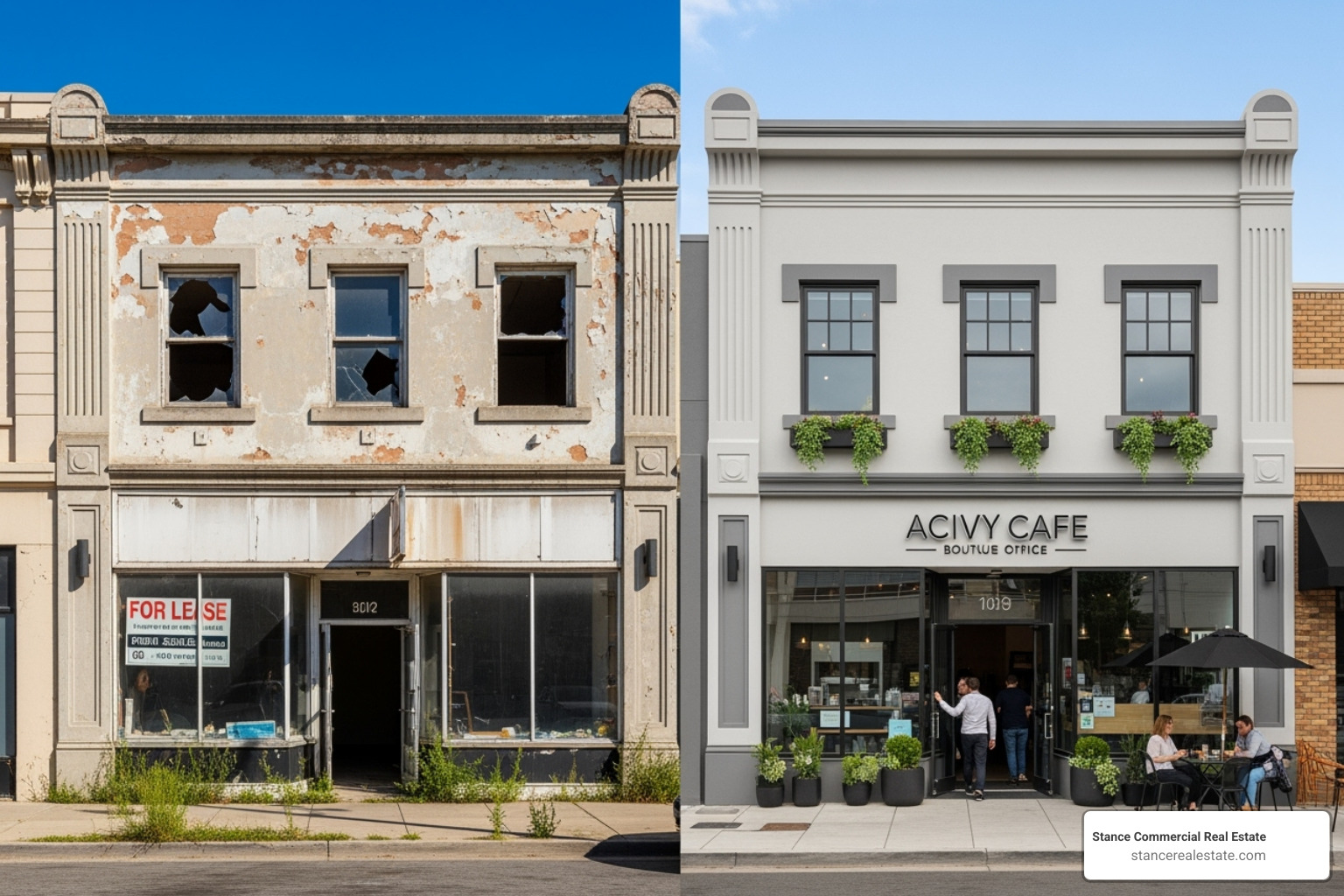
Before and after: A dilapidated commercial property transformed into a thriving, tenanted asset through the BRRRR strategy.
The BRRRR Investing Strategy: A Balanced Look at Benefits and Risks
Like any investment strategy, the BRRRR method has significant upsides and potential pitfalls. Success requires patience, dedication, and a realistic understanding of what you're getting into.
The Powerful Benefits of the BRRRR Investing Strategy
The allure of the brrrr investing strategy is its power to accelerate wealth creation. The primary benefits include rapid portfolio expansion by recycling the same capital, and a high return on investment, often leading to low-money-in deals. You're not waiting for the market to improve; you're creating value through forced appreciation with strategic renovations. Once stabilized, these properties generate consistent passive cash flow, building substantial long-term wealth as you repeat the process. For more on building these income streams, explore The Ultimate Guide to Generating Passive Income.
Navigating the Risks and Potential Pitfalls
It's crucial to be aware of the risks. The BRRRR method is not a guaranteed path to riches and requires careful management to avoid common pitfalls.
- Overleveraging: Acquiring properties quickly can be intoxicating, but taking on too much debt makes your portfolio vulnerable to market shifts or tenant issues.
- Market Risk: Economic downturns can impact property values and your ability to find tenants, potentially leading to appraisal gaps during the refinance stage.
- Renovation Issues: Cost overruns and construction delays are common. A $50,000 rehab budget can easily swell, and every month of delay is a month of carrying costs without income.
- Extended Vacancies: Finding the right commercial tenant can take time. Meanwhile, mortgage payments and operating costs continue.
- Refinancing Difficulties: Lending standards and interest rates can change, making it harder to qualify for a refinance or reducing the amount of cash you can extract.
Managing these risks requires thorough preparation, conservative budgeting, and a strong team of professionals. For investors seeking different risk profiles, consider exploring Low Risk Real Estate Investing Strategy options.
BRRRR vs. Other Commercial Real Estate Strategies
Understanding how the brrrr investing strategy stacks up against other popular investment approaches helps clarify when it's the right tool for the job. Each method suits different goals, timelines, and risk tolerances.
Here's a comparison of three common strategies:
| Criteria | BRRRR Investing Strategy | Traditional Buy-and-Hold | Commercial Flipping |
|---|---|---|---|
| Capital Required | Low (recycled) | Moderate to High | Moderate to High |
| Timeline | Medium-term (3-12 months/cycle) | Long-term (years) | Short-term (3-12 months) |
| Risk Level | Medium-High | Medium | High |
| Primary Goal | Portfolio Growth & Cash Flow | Passive Cash Flow & Appreciation | Capital Gain |
| Management Intensity | High (initially), then Moderate | Low to Moderate | High |
The BRRRR method's unique advantage is its focus on capital recycling, allowing for rapid portfolio growth funded by the assets themselves. It contrasts with flipping, which targets a single capital gain, and traditional buy-and-hold, where capital remains tied up in one property for long-term, slower growth. For a broader overview of your options, check out Different Real Estate Investment Strategies.
Essential Skills for a Successful BRRRR Investing Strategy
Executing the BRRRR method requires more than just capital; it demands a specific set of skills. Mastering these is key to navigating the complexities of each deal.
An investor reviews blueprints and financial documents on a commercial construction site.
- Market Knowledge: You need a deep understanding of local property values, rental rates, and economic trends to spot opportunities.
- Deal Analysis: Accurately calculating the After Repair Value (ARV) and applying metrics like the 70% rule is crucial for ensuring a deal is profitable from the start.
- Project Management: You must effectively coordinate contractors, manage budgets, and oversee timelines to keep the rehab phase on track and avoid costly overruns.
- Negotiation Skills: Strong negotiation is vital when dealing with sellers, lenders, contractors, and tenants to protect your bottom line at every stage.
- Financial Literacy: Understanding commercial financing, from loan-to-value ratios to debt service coverage, is essential for securing the right loans.
The brrrr investing strategy is not a solo endeavor. Success depends on building a reliable team of commercial contractors, lenders, and real estate agents who have deep local expertise. At Stance Commercial Real Estate, we've spent decades building these relationships in the Riverside market to help investors execute their vision with confidence. To learn more, see The Insiders Guide to Commercial Real Estate Services and Investments.
Frequently Asked Questions about the BRRRR Method
Here are answers to the most common questions we hear from investors considering the brrrr investing strategy for commercial real estate.
How do you finance the initial purchase and rehab of a BRRRR property?
Financing the 'Buy' and 'Rehab' stages typically involves short-term solutions like hard money loans, private money lenders, or a commercial line of credit. These options offer the speed and flexibility needed to acquire a property and fund renovations. They are designed to be temporary and are paid off during the 'Refinance' stage, when you secure a long-term, conventional commercial mortgage based on the property's higher After Repair Value (ARV).
What makes a good commercial property for the BRRRR method?
A good BRRRR candidate is an undervalued property with significant value-add potential in a solid location. In the Inland Empire, this could be a Class C office building that can be upgraded, a retail strip with high vacancy due to poor management, or an older warehouse needing modernization like higher ceilings or more loading docks. The key is finding a property where you can force appreciation through renovation and attract quality tenants who will pay higher rents.
Are there specific considerations for BRRRR in Canada versus the U.S.?
Yes. While the core brrrr investing strategy is the same, the execution differs. In Canada, cash-out refinancing can be more conservative, potentially limiting the capital you can extract. In the United States, lenders often have "seasoning" requirements, meaning you must hold the property for a period (typically 6-12 months) before refinancing. Tax laws and financing regulations also vary significantly. Partnering with local experts who understand these regional nuances is essential for success in either country.
How Stance CRE Can Help You
The brrrr investing strategy is a dynamic method that transforms investment dollars into a powerful engine for portfolio growth. Instead of tying up capital for years, you strategically renovate undervalued commercial properties and extract your investment through refinancing, using the same money to build wealth over and over again.
Success with BRRRR requires diligence, deep market expertise, and a strong professional team. This is where local knowledge becomes invaluable. The Inland Empire has unique characteristics, and understanding its commercial growth patterns, renovation costs, and key players can make or break a deal.
At Stance Commercial Real Estate, we have spent decades building this exact expertise in the Riverside and Inland Empire markets. We help investors analyze opportunities through the lens of the entire BRRRR cycle, from identifying undervalued assets to ensuring a profitable exit through refinancing. Our goal is to help you create long-term wealth through strategic reinvestment and value creation.
Ready to build your commercial real estate portfolio? See what we do.

How Riverside, California Supports Local Businesses
Riverside, California offers a thriving environment for businesses, supported by a robust ecosystem of resources, incentive programs, and strategic public-private partnerships. As a commercial real estate firm, we see firsthand how the city’s commitment to economic development creates exceptional opportunities for entrepreneurs and growing enterprises alike. As a small local business ourselves, we see firsthand how the city’s commitment to economic development creates exceptional opportunities for entrepreneurs and growing enterprises alike. With a business-friendly climate, access to a skilled workforce, and ongoing infrastructure investments, Riverside continues to attract innovative companies and long-term investment potential across diverse industries.
Quick Answer: How Riverside California Supports Businesses
- Economic Development Office provides business growth resources, site selection tools, and personalized support
- Small Business Thrive Program offers grants of $1,500-$5,000 with training and consulting services
- Innovation Centers like EPIC SBDC have secured over $54 million in grants and created 1,355+ new jobs
- Business Incubators including ExCITE provide mentorship and acceleration for startups
- Industrial Zones offer strategic locations with specific development standards for various industries
- Chambers of Commerce facilitate networking, events, and business promotion opportunities
Riverside County has developed a robust framework of business support that spans from startups to established enterprises. The region's commitment to economic vitality is evident in its diverse programs targeting specific business needs, whether you're seeking funding, affordable office space, or strategic connections.
I'm Joe Stance, co-founder of Stance Commercial Real Estate, and with eighteen years of hands-on experience in commercial real estate throughout the Inland Empire, I've witnessed how Riverside California supports businesses through its dynamic economic development initiatives and business-friendly environment. As a business owner myself, I understand the unique challenges and opportunities that come with growing a company in Riverside.
Riverside County Office of Economic Development
When entrepreneurs ask me about how Riverside California supports businesses, I always start by telling them about the Riverside County Office of Economic Development (RivCoED). This isn't just another government department – it's the heartbeat of our local business community.
RivCoED accepts a beautiful mission that resonates with both newcomers and longtime residents: "cultivating thriving communities and economic vitality, elevating quality of life, and promoting a culture of life-long learning."
Riverside proudly calls itself a world-class city of Arts and Innovation, and it's not just marketing talk. The city has positioned itself as Southern California's destination of choice – a place where talented professionals want to live and work, and where smart entrepreneurs choose to plant their business roots.
What makes RivCoED special is how comprehensive their approach is. They don't just focus on one aspect of business development; they manage several key divisions that work together:
Their Economic Development team provides direct business support services, maintains an international business office, and actively works to facilitate job growth across the county. The Community Facilities Districts division creates special districts that fund essential maintenance and services. Through County Service Areas, they ensure municipal services reach specific communities based on unique local needs. They even oversee the Riverside County Library System, which serves 1.4 million residents through 35 locations – because educated communities make for better business environments.
How the Office of Economic Development Supports Businesses
The partnership network between the Office of Economic Development and small business is impressive, connecting businesses with over 75 economic development entities throughout the county. Whether you're launching a startup or expanding an established company, there's specialized support available at every stage of your journey.
The office actively shapes a favorable investment climate by championing living wage jobs and helping diversify our local industries. This creates stability that benefits businesses of all sizes.
I especially appreciate their data-driven approach. Through tools like the Data Dashboard, local businesses gain access to economic trends and market intelligence that would otherwise be costly or difficult to obtain. This helps even small businesses make smarter, more informed decisions.
One thing that makes Riverside unique is how we integrate cultural institutions into our economic development strategy. The Edward-Dean Museum & Gardens isn't just a tourist attraction – it's part of how we improve quality of life, which directly impacts business attraction and retention. Happy employees make for successful businesses!
The county's demographics tell a compelling story about why so many businesses are thriving here:
- Population: 2,439,234
- Median Age: 36.6 (a perfect mix of experience and innovation)
- Median Household Income: $81,928
- Per Capita Income: $33,100
For businesses looking to tap into these resources, the Office of Economic Development website at rivcoed.org/economic-development is the perfect place to start your journey.
Resources and Tools for Businesses in Riverside County
When you're starting or growing a business in Riverside County, having the right tools at your fingertips can make all the difference. Our county has developed some truly helpful resources that take the headache out of common business challenges—helping you save both time and money as you build your dream.
Business Site Selection Tool: How Riverside California Supports Businesses with Location Solutions
Finding the perfect location for your business shouldn't feel like searching for a needle in a haystack. That's why Riverside County created RivCoSites, a user-friendly platform that takes the guesswork out of property hunting.
Whether you're looking for a wide-open plot of land, a modern industrial facility, a professional office space, or a prime retail location, RivCoSites helps you narrow down your options based on what actually matters to your business. Need to be near major transportation routes? Looking for a specific workforce demographic? Have particular zoning requirements? The tool helps you filter through options to find your perfect match in Riverside County.
Fictitious Business Name Search: Streamlining Business Setup in Riverside California
Getting your business officially established involves a fair bit of paperwork and verification. Riverside's Fictitious Business Name Search simplifies this process considerably, letting you quickly check if your desired business name is available. The same tool also helps with environmental filings, notary verifications, and various registrations—turning what could be a bureaucratic maze into a straightforward process.
Business Resource Guide: Comprehensive Support for Riverside Businesses
I always recommend the Business Resource Guide to clients looking to understand the full spectrum of support available in our county. This comprehensive handbook is regularly updated (the 2022 edition is the most current) and covers everything a business owner needs to know about:
Business incentives at every government level, from local perks to federal programs that can save you thousands. Training opportunities for your team, helping you build a skilled workforce without breaking the bank. Financial assistance programs that can provide crucial capital when you need it most. Compliance requirements that keep you on the right side of regulations. And local support organizations ready to partner with you on your journey.
As the Riverside County Workforce Development team points out, what makes this guide so valuable is how it brings together resources from multiple government departments—workforce development, economic development, purchasing, and more—creating a single reference that saves you from having to hunt down information across dozens of different websites and offices.
These tools showcase how Riverside California supports businesses by removing common obstacles and providing practical solutions that respect your time and resources as a business owner.
Incentives and Programs for Startups in Riverside County
When it comes to nurturing new businesses, Riverside County truly shines. The region has cultivated a reputation as a startup haven, offering entrepreneurs the financial boost and knowledge they need to turn great ideas into thriving businesses.
Riverside County Small Business Thrive Program
If you're just getting your business off the ground in Riverside, the Small Business Thrive Program could be your first stepping stone to success. Funded through the American Rescue Plan Act, this program offers a helping hand in the form of practical grants:
- $1,500 for basic startup needs
- $2,500 for growing businesses
- $5,000 for more established operations needing a boost
These aren't just handouts—they're investments in our local economy. As a business owner myself, I've seen how even modest funding can make the difference between surviving and thriving during those crucial early months.
To qualify, your business needs to call Riverside County home and either be a newcomer (registered after July 1, 2022) or a small operation with five or fewer full-time employees and annual receipts under $1 million. The program requires some training and consulting—which honestly might be just as valuable as the money itself!
What I love about this program is its flexibility. You can put these funds toward almost anything your business needs: startup costs, new equipment, working capital, rent, supplies, permits, or even paying down business debt. It's practical support that meets entrepreneurs where they are.
EPIC SBDC: Powering Innovation
For tech-focused entrepreneurs, the Entrepreneurial Proof of Concept and Innovation Center (EPIC) at UC Riverside is nothing short of remarkable. Their track record speaks volumes about how Riverside California supports businesses through innovation:
"Our success rate of 35% in raising federal SBIR and STTR grants is twice the national average of awards as a percent of proposals submitted."
The numbers tell an impressive story: $54 million in non-dilutive grants, $30 million in investment capital, $60 million in business revenue generated among clients, and over 1,355 new jobs created throughout the Inland Empire. That's not just economic development—that's economic change.
EPIC SBDC takes a holistic approach to nurturing tech businesses. They start with education through targeted workshops, then pair you with experienced mentors who've been in your shoes. Their validation process helps refine your concept before you invest too deeply, while their acceleration programs prepare you for serious growth. Perhaps most valuable is their assistance with capital access—they know exactly how to position your business for grants and investments.
What makes EPIC's approach special is the focus on non-dilutive funding through EPIC SBDC. Unlike traditional investments that require giving up equity, these grants allow founders to maintain control while accessing the capital they need to grow. For tech entrepreneurs in Riverside, this represents a uniquely supportive path to market that preserves both their vision and ownership.
Riverside County Business Incubator and Innovation Ecosystem
When you walk through Riverside today, you might not realize you're treading on ground that's been nurturing innovation for nearly 150 years. What started with California Navel Oranges taking root here has blossomed into a modern ecosystem where today's entrepreneurs find the perfect conditions to grow their big ideas.
The ExCITE Incubator
At the heart of this ecosystem sits the ExCITE Incubator, a place where dreams get the practical support they need to become reality. This isn't your typical business center - it's a dynamic partnership between local government and educational institutions that truly understands what startups need.
When you join ExCITE, you're not just renting a desk. You're gaining a support system that includes comfortable workspace, seasoned mentors who've "been there, done that," direct connections to university research that might otherwise be out of reach, face time with potential investors, and hands-on help developing your products.
I've watched numerous local businesses transform from scribbles on a napkin to thriving companies through the structured guidance ExCITE provides. The incubator bridges that crucial gap between "great idea" and "viable business" that trips up so many entrepreneurs.
How Riverside's Innovation Ecosystem Supports Businesses
How Riverside California supports businesses goes well beyond a single incubator. The county has built something special here - a complete innovation ecosystem where entrepreneurs can find support at any stage of their journey.
Rather than relying on a single innovation hub, Riverside has strategically developed multiple centers throughout the region. These centers have collectively helped local businesses secure hundreds of millions in funding over the past decade. That's real money flowing into real local companies.
The numbers tell a powerful story: innovation-related jobs in Riverside County have grown 74% over the last five years, according to research from UC Riverside's Center for Social Innovation. While other regions talk about tech growth, we're actually making it happen here.
Even more impressive, the Inland Empire (including Riverside) outpaced the entire nation in tech job growth, with a 3.5% increase in 2018 alone. This isn't happening by accident - it's the result of intentional support systems that help businesses thrive.
For early-stage companies, funding often makes the difference between success and closure. Riverside's ecosystem offers proof of concept grants between $25,000 and $50,000, with additional NSF I-Corps support of $50,000 available for qualifying ventures.
The results speak for themselves. ReJoule Inc. secured an impressive $10 million in grant funding for their clean energy demonstration. Edge Sound Research raised over $2.4 million in seed funding to pursue their innovations. VisiCELL Medical received nearly $1.9 million to develop their life-saving medical technology.
These aren't isolated success stories - they're examples of how Riverside California supports businesses through an ecosystem designed to nurture innovation at every stage of growth. From historical agricultural breakthroughs to today's cutting-edge technologies, Riverside continues to be fertile ground for big ideas and the people brave enough to pursue them.
Role of Chambers of Commerce in Supporting Businesses
How Riverside California Supports Businesses Through Chambers of Commerce
When local businesses thrive in Riverside, the whole community benefits. That's where the Chambers of Commerce step in—they're like friendly neighborhood connectors bringing businesses, government, and community together in ways that help everyone succeed.
Riverside Chambers of Commerce
The Riverside Chambers of Commerce isn't just another business organization. With their warm mission of "Empowering Community, Fueling Business Success," they perfectly demonstrate how Riverside California supports businesses while building stronger community bonds.
Walking through the doors of the Chamber feels like joining a family that's dedicated to your success. They offer practical help that local business owners can actually use:
Business owners can get listed in comprehensive directories that put their name in front of potential customers. Rather than struggling alone, entrepreneurs can make valuable connections at regular gatherings like the energetic "Business in Action" meetups or the popular morning networking events aptly named "Good Morning Riverside."
The Chamber doesn't just talk about supporting businesses—they actively advocate for them where it matters most: in the halls of local government. They make sure business voices are heard when important decisions are being made.
"Don't just stand on the sidelines wishing things were different... this is your chance to make a difference!" This invitation from the Chamber captures their hands-on approach. They're not about passive membership but active participation that creates real change.
Need to sharpen your business skills? Their educational workshops cover everything from marketing basics to advanced growth strategies. And when it comes to getting the word out about your business, their promotional channels help members reach new customers without breaking the marketing budget.
One of the nicest touches is their community calendars—a simple but effective way to keep everyone informed about local happenings, creating more opportunities for businesses to engage with residents.
Business Improvement Districts: A Model for How Riverside California Supports Businesses
Take a stroll through downtown Riverside and you'll notice the clean streets, beautiful planters, and vibrant atmosphere. That's not by accident—it's another example of how Riverside California supports businesses through its Downtown Business Improvement District (BID).
Established back in 1986, this one-square-mile district shows what can happen when local businesses pool their resources. The BID is funded through a simple but effective model: a levy equal to 100% of the business tax paid by businesses within its boundaries.
What does this investment return to local businesses? Quite a lot: improved parking that makes it easier for customers to shop; beautification projects that make the area more attractive; public events that draw crowds to the district; and even music in public spaces that creates a welcoming atmosphere. They also focus on practical matters like improved security and targeted business promotion.
The BID approach has been so successful that other Riverside neighborhoods like Arlington Village and the Auto Center have created their own districts, spreading these benefits throughout the city.
When you see businesses coming together like this in Riverside, it's clear why the city has earned its reputation as a place where entrepreneurs can put down roots and grow with community support.
Opportunities in Riverside County's Industrial Zones
How Riverside California Supports Businesses with Industrial Zones
When it comes to industrial development, Riverside County's location in the heart of the Inland Empire couldn't be more perfect. We've seen how Riverside California supports businesses through thoughtfully designed industrial zones that balance growth with community needs.
Industrial Zone Classifications
Driving through Riverside County, you'll notice distinct industrial areas, each with its own character and purpose. These zones aren't just random developments—they're carefully planned spaces that implement the county's vision for business growth while creating jobs and boosting the local tax base.
The county offers four main industrial zone types, each serving different business needs:
Business and Manufacturing Park Zone (BMP) spaces feel more polished and professional. These areas house lower-impact industrial operations and office complexes, with generous development allowances (maximum FAR of 1.50) and larger lot requirements (minimum 40,000 sq. ft.). If you're looking for a more corporate feel with industrial capabilities, BMP zones deliver exactly that.
General Industrial Zone (I) is where the real manufacturing magic happens. These areas support traditional manufacturing and warehousing operations with practical standards (maximum FAR of 0.60 and minimum lot area of 10,000 sq. ft.). The General Industrial zones form the backbone of Riverside's production economy.
Air Industrial Zone (AI) serves businesses with aviation connections. With building heights capped at 45 feet and specialized subzone standards, these areas accommodate businesses that need airport access while ensuring flight safety isn't compromised.
Airport Zone (AIR) surrounds airport facilities directly, supporting businesses that thrive on immediate airport proximity. These zones feature practical standards (maximum FAR of 0.60 and minimum lot area of 8,000 sq. ft.) that balance development with aviation safety.
Benefits of Riverside's Industrial Zones for Business Growth
The strategic advantages of setting up shop in Riverside's industrial zones are substantial. Business owners regularly tell us they appreciate the clarity and thoughtfulness behind these designated areas.
Riverside's industrial zones benefit from an unbeatable location near Interstate 10 and within reasonable distance to the busy ports of Los Angeles and Long Beach. This positioning slashes transportation costs and opens doors to broader markets.
The county has mastered the art of balanced development, with regulations that encourage industrial growth while protecting surrounding residential areas. This approach means fewer conflicts with neighbors and smoother operations over the long term.
Business planning becomes infinitely easier with Riverside's clear guidelines for development. When you know exactly what's permitted, you can confidently move forward with expansion or relocation plans without costly surprises.
Riverside doesn't sacrifice environmental quality for industrial growth. Requirements for environmental protection through landscaping, screening, and noise mitigation ensure that industrial development happens responsibly.
Perhaps most importantly, these zones provide growth potential for businesses looking ahead. With designated areas for industrial expansion, companies can plan their future with confidence.
The numbers tell a compelling story about the strength of Riverside's industrial market. As part of the broader Inland Empire region, industrial rents have climbed by 6.4%, with nearly 17 million square feet of net absorption in recent years. Looking ahead, projections suggest industrial rents will rise by over 30% in the near term—a strong indicator of the sector's continued vitality.
For businesses seeking industrial space with room to grow, Riverside County's thoughtfully designed zones offer the perfect blend of opportunity and structure.
How Riverside's Management of Key Industries Supports Business Growth
Riverside County has blossomed into an economic powerhouse with a wonderfully diverse mix of industries that create opportunities for businesses of all sizes. Rather than putting all its eggs in one basket, the county has nurtured several key sectors that work together to create a resilient local economy.
Walking through downtown Riverside, you can feel the energy of a region on the rise. The retail sector is booming, having created an impressive 70,000 new jobs since 2020. Major players like Target and Costco have found fertile ground here, with Target generating over $107 billion in revenue in 2023 while offering starting wages around $14 per hour in Riverside. Costco, another retail giant, recorded a whopping $237 billion in revenue during the same period.
Health and social services form another cornerstone of Riverside's thriving economy. With nearly 294,000 workers employed as of November 2024, this sector continues to expand, creating opportunities for healthcare professionals and support businesses alike. Kaiser Permanente stands out as a major employer, reaching $100.8 billion in revenue in 2023 and offering competitive salaries averaging around $102,000 annually.
The county's construction industry is building more than just structures—it's building careers for 115,800 employees. With a growing focus on green and energy-efficient solutions, companies like CEMEX USA (which reported $17.4 billion in revenue in 2023) offer solid career paths with average annual salaries of $78,233.
Manufacturing remains a bedrock of Riverside's economy, employing 94,500 workers and creating 60,000 new jobs since 2020. From global giants like Nike to innovative companies like Tesla, manufacturers have found Riverside's business-friendly environment and strategic location ideal for operations.
And let's not forget the leisure and hospitality sector, which employs 183,900 individuals and has contributed millions of jobs nationwide since 2020. This vibrant industry not only improves quality of life for residents but attracts visitors who inject fresh dollars into the local economy.
Managed IT Services Supporting Growth
What's fascinating about how Riverside California supports businesses is the way technology threads through all these industries, creating a modern, connected economy. Managed IT services have become the invisible backbone supporting growth across sectors.
In retail, cloud-based inventory systems and sophisticated point-of-sale technology help stores of all sizes compete effectively. Walk into most Riverside retailers and you'll find smart systems tracking inventory and analyzing customer preferences in real time.
The healthcare sector has acceptd telemedicine and secure digital patient management, allowing providers to deliver better care more efficiently. These technologies became especially crucial during recent healthcare challenges, and Riverside providers were well-positioned to adapt.
On construction sites throughout the county, digital project management tools keep teams connected and projects on schedule. Building information modeling (BIM) has revolutionized planning and execution, reducing costly mistakes and speeding completion times.
Manufacturing innovation shines particularly bright in Riverside. IoT solutions now enable real-time production monitoring, while sophisticated ERP software streamlines operations from supply chain to shipping. These technologies have helped local manufacturers remain competitive in a global marketplace.
Even in hospitality, technology makes a difference. CRM systems help track guest preferences, while 24/7 IT monitoring ensures services run smoothly for visitors to Riverside's many attractions.
This accept of technology highlights how Riverside California supports businesses by providing the infrastructure and ecosystem necessary for modern operations. Rather than resisting digital change, the county has leaned into it, creating an environment where businesses can leverage technology to grow and thrive in the 21st century economy.
Frequently Asked Questions about How Riverside Supports Businesses
What resources are available for startups in Riverside County?
Starting a business in Riverside County means you're never alone on your entrepreneurial journey. The county has created a remarkable support system that wraps around new businesses from day one.
Financial backing is often the first concern for startups, and that's where the Small Business Thrive Program shines, offering grants from $1,500 to $5,000 to help you get off the ground. These funds can make all the difference when you're just getting started.
Beyond money, physical space and mentorship are available through the ExCITE Incubator and EPIC SBDC. I've seen how these spaces transform ideas into viable businesses, with experienced mentors guiding entrepreneurs through the challenging early stages.
Training and education form another cornerstone of Riverside's startup support. The OCIE SBDC workshops cover everything from creating your first business plan to sophisticated marketing strategies. What's impressive is how these programs adapt to businesses at different stages of growth.
The networking opportunities through local Chambers of Commerce shouldn't be underestimated either. Some of the most successful businesses I've worked with in Riverside found their key partners, first major clients, or even investors at chamber events.
For tech-focused startups, programs like the NSF I-Corps provide specialized funding and guidance to help transform innovations into marketable products. This focus on technology commercialization shows how Riverside California supports businesses in forward-thinking industries.
How can businesses benefit from the Riverside County Small Business Thrive Program?
The Small Business Thrive Program is truly one of Riverside's gems for small business owners. It's designed with a holistic approach that recognizes money alone doesn't guarantee success.
The direct financial support through grants of $1,500, $2,500, or $5,000 gives businesses flexibility to address their most pressing needs. I've seen clients use these funds for everything from purchasing essential equipment to covering rent during challenging months or investing in critical software systems.
What makes this program special, though, is the required training component. Rather than just handing out checks, Riverside ensures business owners develop the skills they need to succeed long-term. The training covers fundamentals that many entrepreneurs might otherwise learn through costly trial and error.
The one-on-one consulting sessions are particularly valuable. These personalized meetings help identify blind spots in your business model and provide strategies custom to your specific situation. It's like having a business coach in your corner.
Financial literacy webinars through AmPac build a foundation for sound money management—a critical skill that many business owners wish they'd developed sooner. And even after the grant period ends, participants maintain access to OCIE SBDC resources, creating a continuous support system as your business evolves.
What role do Chambers of Commerce play in supporting businesses?
Riverside's Chambers of Commerce function as the heartbeat of the local business community. They're far more than networking groups—they're active partners in business growth.
As advocates for business interests, chambers regularly engage with local government to influence policies that affect the business environment. When challenges arise affecting multiple businesses, chambers often lead the charge in finding solutions.
The regular events and mixers they host create natural opportunities to meet potential clients, partners, and even mentors. I've watched countless business relationships begin at simple chamber coffee meetings that later blossomed into major partnerships.
Chambers also serve as knowledge hubs, offering workshops on relevant topics from digital marketing to tax preparation. These educational offerings help businesses stay current with trends and best practices without having to invest in expensive consultants.
For newer businesses, chambers provide valuable visibility and credibility through their directories, member spotlights, and community events. Being chamber-affiliated signals to potential customers that your business is established and connected.
Perhaps most importantly, chambers help businesses become integrated community members. This community connection is particularly valuable in Riverside, where relationships and local reputation significantly impact business success. They truly exemplify how Riverside California supports businesses through community building and connection.
When navigating the maze of available resources, your local chamber often serves as the perfect starting point, guiding you to the specific programs best suited to your business needs.
How Stance CRE Can Help You
Riverside County truly shines as a guide of business support in Southern California. Through its thoughtfully designed programs, resources, and partnerships, the region demonstrates how Riverside California supports businesses of all sizes and stages—from scrappy startups to established enterprises looking to expand.
What makes Riverside special isn't just the individual programs like the Small Business Thrive grants or the ExCITE Incubator, but how these pieces work together to create a complete ecosystem of support. Entrepreneurs can find precisely the help they need, whether that's seed funding, affordable workspace, expert mentorship, or connections to potential clients and partners.
At Stance Commercial Real Estate, we're not just observers of Riverside's business-friendly environment—we're active participants in it. Our team brings deep local market knowledge to every client interaction, helping businesses find the perfect commercial space to leverage all that Riverside has to offer.
We understand that finding the right property is a critical piece of your business success puzzle. Whether you're launching a startup or expanding an established operation, our commitment is to help you steer Riverside's commercial landscape with confidence and clarity.
The resources, programs, and opportunities available in Riverside County create fertile ground for business growth—and we're here to help you make the most of them. For more information about how we can support your business journey in Riverside, explore our Resources for Small Businesses or reach out to our team today.
Together, we can tap into the power of how Riverside California supports businesses to help your company thrive in this dynamic and welcoming community.

What you Need to Know about Commercial Real Estate: CPA (Certified Public Accountant)
So you’ve decided whether you want to lease or purchase your property, now what? There are a few professionals beyond your broker who you will want to consider for hire. One of those is your commercial real estate Certified Public Accountant (CPA). When you own a business, a CPA for real estate can assist with your taxes, financial advice, write-offs and more.
Why Hire a Commercial Real Estate CPA
There are numerous rules and regulations that come with commercial real estate. Hiring a CPA who specializes in the correct field is a must in order to navigate those ever-evolving regulations. Your CPA should be on top of what is happening within the commercial real estate industry to help you navigate unforeseen laws and allowances.
A commercial real estate CPA can also list what tax write-offs you may be eligible for. Various industries— law offices, hospitality, investors, retail etc.— may all have different write-offs.
An experienced CPA can also handle your company’s income taxes and other financials.
Hiring a CPA For Commercial Real Estate Taxes
Your commercial real estate CPA should have an understanding of the nuances within commercial real estate tax law.
Some of the services to consider are financial audits and financial advice for property investments. Ask your real estate CPA ahead of time what services they provide and how they can help you prepare your taxes. They should provide the structure and resources to make your state and local filings streamlined and without errors.
What To Look For
Look for a real estate CPA who has great reviews from clients within the commercial real estate agency. Seek out transparency when vetting potential partners and ask how they follow up with their reporting and communications.
Hiring a CPA for commercial real estate is a huge decision. You absolutely should ask any question that comes to mind and should look at your options before making a commitment. Your CPA will potentially be your go-to for all your financial planning, so knowing their experience, skill-set and the services they offer ahead of time is crucial.
--
Ready to invest in new opportunities? Call Joe Stance at (909) 772-1212 or contact our team today.
