

For years, workplace amenities were seen as a competitive advantage—sleek breakrooms, game spaces, and wellness perks designed to attract talent and boost morale. But in today’s business environment, the standard has shifted. Amenities alone no longer drive value unless they are intentionally designed to solve a real business problem. Organizations are increasingly scrutinizing every investment through the lens of performance, productivity, and measurable outcomes.
What separates impactful amenities from superficial ones is purpose. A space or feature must directly support how people work, collaborate, or recharge in ways that improve results—not just optics. Whether it’s reducing burnout, enhancing focus, or fostering meaningful collaboration, the most effective amenities are those aligned with organizational goals. Without that connection, even the most impressive features risk becoming underutilized expenses rather than strategic assets.
Amenities stop driving value when they don’t solve a real business problem because:
- Tenant Utility Over Aesthetics: Modern commercial tenants pay for what helps their business run efficiently — not what looks impressive in a marketing brochure but serves no functional purpose. A flashy lobby might impress a visitor for thirty seconds, but a lack of reliable high-speed data will frustrate an entire workforce for eight hours a day.
- The Cost of Underutilization: Unused amenities like golf simulators, cold plunges, or oversized, empty gyms become pure cost centers with zero return on investment (ROI), draining Net Operating Income (NOI). Every square foot of a commercial property must generate value, either through direct rent or by significantly increasing the leaseability of the surrounding space.
- Practicality Wins: Data shows 85% of tenants prioritize transit access and 75% prioritize diverse food options — these are practical needs that solve the daily logistical challenges of a workforce. In the Inland Empire, where commute times can be significant, amenities that reduce friction are the ones that command the highest premiums.
- Occupancy Premiums: Buildings with purpose-driven amenities post 16.2% higher occupancy and command significant rent premiums because they address specific operational pain points. This is the difference between a “nice-to-have” and a “must-have” for a growing company.
- The Amenity Arms Race Failure: The “amenity arms race” has left many landlords with expensive, underutilized spaces that increase maintenance costs without providing a competitive edge in leasing. This race to the top in terms of features has often ignored the bottom line of the tenant’s business model.
The bottom line for any commercial property owner or investor is simple: an amenity is only worth the capital expenditure if it directly helps your tenants attract top-tier employees, boost daily productivity, or solve a specific commute or operational challenge. In the Riverside and San Bernardino markets, where industrial and office sectors are the primary drivers of growth, the focus must remain on utility. If an amenity does not contribute to the tenant’s ability to recruit talent or move product, it is likely a wasted investment.
Over the past decade, the commercial real estate (CRE) sector has navigated what many call an “amenity arms race.” Following the 2008 financial crisis, office and retail landlords added perks to fill massive vacancies. Then came the global shift in work patterns — and suddenly, the commercial office was no longer the only place where work could happen. The bar for what it takes to justify a commercial lease got significantly higher. The competition is no longer just the building across the street; it is the flexibility of remote work and the comfort of a private workspace.
The result? Many landlords kept piling on amenities, hoping something would stick. We saw the rise of rooftop bars, salt baths, and elaborate gaming lounges. While some of these features worked in specific high-density urban cores like Los Angeles or San Francisco, many failed in suburban office parks and industrial hubs. Today, the market is correcting itself. Buildings that invested in functional amenities — such as ultra-fast fiber-optic connectivity, on-site healthy food options, secure 24/7 access, and high-quality end-of-trip facilities — are seeing strong absorption and tenant retention. Meanwhile, buildings that chased novelty are sitting with costly, vacant spaces that require expensive retrofitting to become useful again.
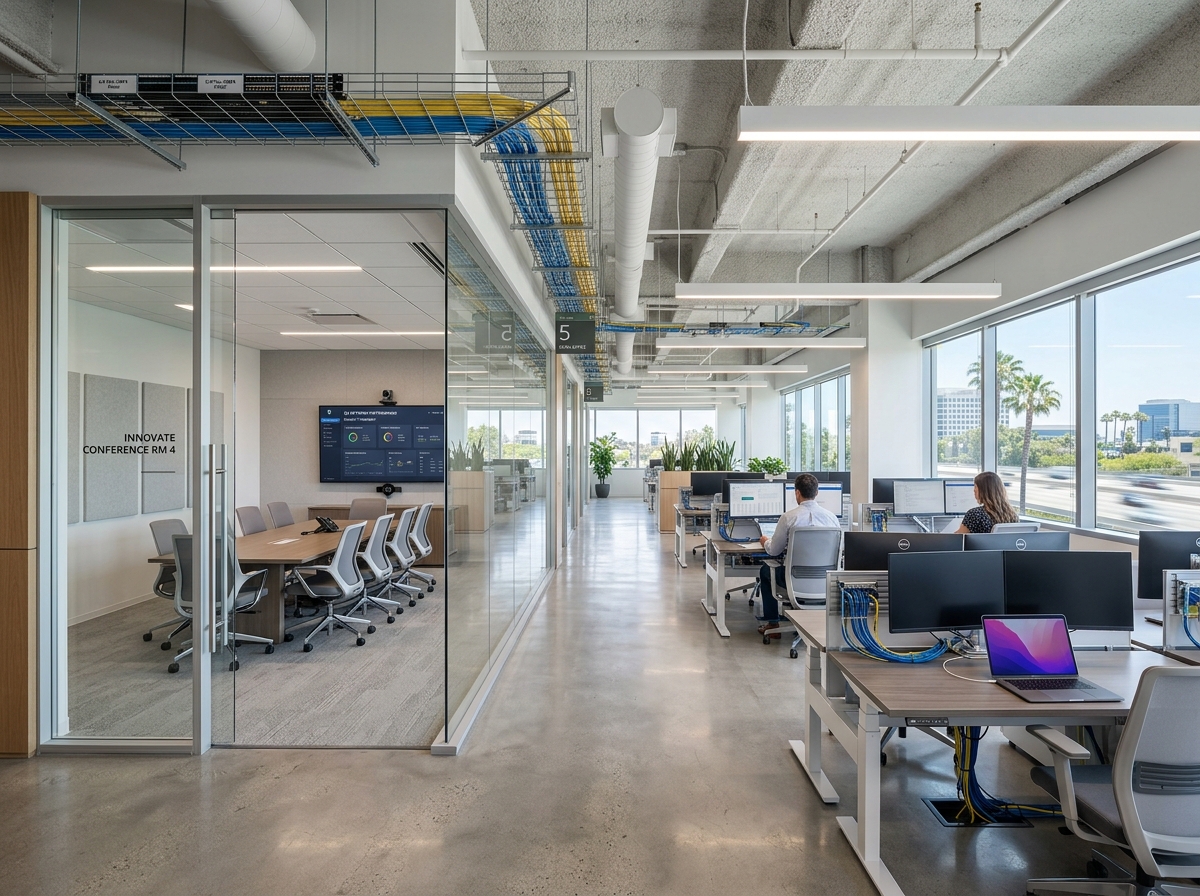
Utility-Driven Office Design: High-tech conference rooms with fiber-optic connectivity and ergonomic design are now essential for modern business operations.
In the current Southern California commercial market, we are seeing a fundamental shift in tenant behavior. The “wow factor” of a flashy lobby or a rooftop lounge is losing its luster if the building lacks the basic infrastructure to support a modern workforce. Post-pandemic demands have transformed amenities from “perks” into “business tools.” When a tenant looks at a property in Riverside or the wider Inland Empire, they aren’t just looking for a place to put desks or inventory; they are looking for a solution to their biggest headaches: employee retention, productivity, and the return-to-office (RTO) challenge.
If an amenity doesn’t help solve one of those three problems, it is effectively a “vanity amenity.” These flashy features might look good on a tour, but they don’t drive long-term Net Operating Income (NOI). On the other hand, functional convenience — things like high-speed fiber availability (which has an 84% prevalence in top-performing buildings) and controlled access (86% prevalence) — are what actually keep tenants from moving. This is why we see a massive “flight to quality.” Since the market shifted, there has been over 100 million square feet of positive absorption in the best, newest office buildings, while the rest of the market has seen negative absorption. In fact, 90% of office absorption in the years leading up to the pandemic was concentrated in Class-A buildings, which only make up about half of the total inventory.
Landlords who understand this are moving away from the “amenity arms race” and toward premium amenity strategies that prioritize utility over aesthetics. This applies not just to office spaces, but to industrial and retail properties as well. In the industrial sector, for example, an “amenity” might be extra trailer parking or enhanced power capacity — features that solve a direct business problem for a logistics company. In the retail sector, it might be high-visibility signage or ample EV charging stations that attract a specific customer demographic. The goal is always the same: align the property’s features with the tenant’s operational goals.
The RTO Challenge
The biggest business problem facing employers today is the competition with the flexibility of remote work. For many employees in the Inland Empire, the commute is a major deterrent. To win the RTO (Recovery Time Objective) battle, the commercial office must offer “irreplaceable experiences” that cannot be replicated elsewhere. This is where neighborhood retail and outdoor workspaces come into play. Employees miss the socialization and professional development that happens in person, but they require a frictionless environment to make the trip worthwhile.
Amenities that mitigate this friction — like on-site childcare, diverse food and beverage options, and high Walk Score locations — are the ones driving value. In suburban markets like Riverside, “commute ease” is the ultimate amenity. If a building offers ample on-site parking and proximity to transit or major highways, it solves a logistical nightmare for the employee. If that same building offers a high-quality café where teams can socialize, it solves a cultural problem for the employer. This is a strategic alignment of property features with business goals. We are seeing a rise in “third spaces” within commercial buildings—areas that are neither a desk nor a breakroom, but a collaborative environment that encourages the kind of spontaneous innovation that remote work often lacks.
Measuring Productivity Gains
Productivity is the lifeblood of any business. We’ve found that amenities that support wellness and focused work have a direct, measurable impact on a company’s bottom line. According to industry data, employees with high levels of wellbeing are 2.5 times more likely to say they can do their best work. This has led to a surge in wellness certifications like LEED, WELL, and Fitwel within the commercial sector. But it goes beyond plaques on the wall. True productivity-driving amenities include:
- Acoustic Privacy: Spaces designed for deep work, moving away from the noise of traditional open-plan layouts. This solves the business problem of cognitive load and employee burnout.
- Fiber Connectivity: 84% of top-tier buildings prioritize fiber because downtime is a massive business cost that no tenant can afford. In the digital age, a building without robust connectivity is functionally obsolete.
- Wellness Infrastructure: Fitness centers with showers and lockers (64% prevalence) that allow employees to integrate health into their workday without leaving the premises. This reduces time lost to off-site travel and improves overall employee morale.
Understanding these factors is key when you evaluate a commercial property for long-term ROI. If a building’s amenities don’t boost the “output” of the people inside it, those amenities are failing to drive value for the owner or the tenant. The focus must shift from what the building has to what the building does for the business.
The Flight to Quality: Data-Driven Evidence of Amenity ROI
The data is clear: commercial tenants are willing to pay a premium for quality, but only when that quality translates into tangible business results. There is a growing bifurcation between Class-A “trophy” assets and obsolete Class-B or C properties. In some Southern California markets, Class-A rents are now 84% higher than lower-tier properties, proving that “cheap” space is often the most expensive choice for a growing business due to lost productivity and talent turnover. When a company chooses a lower-tier building to save on rent, they often pay for it in the form of higher recruitment costs and lower employee engagement.
| Amenity Type | Business Problem Solved | Rent Premium / Impact |
|---|---|---|
| Roof/Sky Terraces | Socialization & Wellness | 5.2% Rent Premium |
| Courtyards/Outdoor Space | Employee Retention | 3.5% Rent Premium |
| Fitness Centers | Health & Wellness | 2.9% Rent Premium |
| Spec Suites | Speed to Market | 15-20% Higher Rents |
| Fiber/Tech Infrastructure | Productivity/Uptime | Essential for Retention |
| On-site Retail/Food | Convenience/RTO | 86% Prevalence in Top Leases |
Beyond rent premiums, amenitized properties boast a 16.2% higher occupancy rate than those without. For landlords, the ROI is also seen in “speed to lease.” Spec suites — move-in-ready offices with high-end finishes and integrated technology — lease up 11 months faster on average than raw shell space. While Tenant Improvement (TI) packages have risen to over $100/SF (and even $212/SF in some gateway markets), the cost of a vacant building is far higher. By providing a space that is already optimized for business, landlords solve the tenant’s problem of “time to occupancy.” This is particularly critical in the Inland Empire, where business cycles move quickly and companies cannot afford to wait for lengthy construction periods.
Critical Amenities in CBD vs. Suburban Locations
The value of an amenity often depends on the specific geography of the commercial asset. In a Central Business District (CBD), walkability and public transit are king. CBD buildings often have an average Walk Score of 93, and 80% of top-performing urban buildings are within two blocks of public transit. In these environments, the building must act as a hub that connects the worker to the city. The amenity here is the city itself, and the building’s job is to provide a seamless interface with that urban environment.
In suburban markets like the Inland Empire, the priorities shift toward accessibility and convenience. Here, on-site parking (80% prevalence) and highway proximity are the non-negotiables. However, both markets share a need for security and “end-of-trip” facilities. Features like bike storage, showers, and lockers are no longer just for “active” employees; they are part of a broader wellness and commute-mitigation strategy that makes the office a more attractive destination than any alternative. For industrial properties, this might translate to high-bay lighting, ESFR sprinkler systems, and ample truck court depths — amenities that solve the business problem of safety and throughput efficiency. In the logistics world, an amenity is anything that allows a truck to turn around faster or a pallet to be stored more securely.
Furthermore, the rise of ESG (Environmental, Social, and Governance) criteria has turned sustainability into a business-critical amenity. Tenants are increasingly looking for buildings with LEED or Energy Star certifications not just for the environmental benefits, but because these buildings typically have lower operating costs and provide a healthier environment for employees. This is a direct solution to the business problem of rising energy costs and employee absenteeism. A building that uses 30% less energy is a building that puts more money back into the tenant’s pocket, making it a more valuable asset in the long run.
The Amenity Trap: When Perks Become Costly Burdens

The Amenity Trap: An underutilized office gym with outdated equipment represents a sunk cost that fails to drive tenant value.
Not all amenities are created equal. In the rush to compete for tenants, many commercial landlords fall into the “amenity trap” — investing in vanity perks that sound great in a press release but sit empty 90% of the time. This is a critical error in asset management. Think about the “golf simulator” or the “cold plunge” suite. While these might provide a “wow” moment during a property tour, they often lead to high maintenance costs and low actual engagement. In fact, some studies show that “novelty” amenities can have an underutilization rate of over 60%. This is capital that could have been deployed into more critical infrastructure, such as HVAC upgrades or improved security systems.
When amenities are misaligned with the actual demographics of the tenants, they become “sunk costs.” A high-end gym in a building full of accounting firms that value quiet, focused space is a mismatch. These underused spaces drain the budget through perpetual operating expenses, insurance, and maintenance, eventually leading to revenue erosion. This is why understanding the specific needs of your target tenant is vital before committing capital to a renovation. A landlord must ask: “Does this feature help my tenant make more money or save more time?” If the answer is no, it is likely a vanity project.
It’s also important to consider total occupancy costs. If a landlord spends so much on flashy perks that they have to skimp on janitorial services, security, or HVAC maintenance, the tenant experience will suffer. Service consistency and operational management are the “invisible amenities” that actually drive retention. As noted in recent industry analysis, the amenity trap does not equal value. In the commercial world, a building that works perfectly is always more valuable than a building that looks pretty but functions poorly.
Frequently Asked Questions about Commercial Amenities
Which amenities provide the highest rent premium in office buildings?
Based on recent market data, roof and sky terraces command the highest premium at approximately 5.2%. This is followed by courtyards (3.5%), fitness centers (2.9%), and LEED/wellness certifications (2.8%). However, the “real” premium often comes from the speed of leasing; amenitized spaces can lease up to 11 months faster than standard shells, significantly reducing the cost of vacancy. In a high-interest-rate environment, the time-value of money makes speed-to-lease one of the most important metrics for any landlord.
How do amenities impact commercial property valuations?
Amenities act as “valuation levers.” By increasing occupancy rates and allowing for higher face rents, they boost the Net Operating Income (NOI). Because commercial property value is a multiple of NOI (based on cap rates), even a small increase in rent or a decrease in vacancy can add hundreds of thousands of dollars to an asset’s total value. Conversely, failing to provide essential infrastructure like high-speed fiber can reduce a property’s value by 5-10% in today’s tech-dependent market. Investors are increasingly looking at the “future-proofing” of a building when determining its cap rate.
What is the difference between a “vanity amenity” and “asset activation”?
A “vanity amenity” is a perk designed for “show” that often has low utilization and high maintenance (e.g., a golf simulator or a decorative water feature). These are often added without a clear understanding of the tenant’s business needs. “Asset activation” is the strategic repurposing of underutilized space into a functional utility that generates revenue or solves a specific tenant problem (e.g., converting a basement into rentable storage or a micro-logistics hub for e-commerce tenants). Asset activation is focused on the bottom line, while vanity amenities are focused on the brochure.
Do industrial properties need amenities?
Yes, but they are different from office amenities. In the industrial sector, amenities include enhanced power for automation, extra trailer parking, high-efficiency LED lighting, and modern breakrooms for warehouse staff. These features solve the business problems of operational efficiency and labor retention in the logistics industry. In the Inland Empire, where the labor market for warehouse workers is extremely competitive, a high-quality breakroom or an on-site fitness area can be a major differentiator for a tenant looking to reduce turnover.
How Stance CRE Can Help You
Stance CRE supports commercial real estate clients by providing clear guidance on how lease structures, addendums, and amendments align with their broader business and investment objectives. This approach begins with a careful review of financial goals, operational needs, risk tolerance, and long-term flexibility, ensuring that contract decisions support growth rather than create unintended constraints. Instead of promoting one-size-fits-all solutions, Stance CRE emphasizes education, transparency, and strategic alignment at every stage of the transaction.
With deep expertise in Riverside County and the surrounding commercial markets, the Stance CRE team brings local insight and practical experience to each client engagement. From initial site selection to lease negotiation and ongoing contract modifications, Stance CRE helps businesses navigate complex agreements with confidence and clarity. Whether securing a first location or optimizing an existing portfolio, the focus remains on protecting client interests while positioning them for sustainable success in a dynamic commercial environment.
At Stance CRE, we understand the importance of fostering strong relationships between communities and small businesses. We are not only working in Riverside; we live here and actively support the growth of the local economy. Our commitment to the community ensures that both property owners and business operators have the resources and insights necessary to thrive. Call us today at (909) 772-1212 and let us help you determine the best approach for supporting your business while contributing to a stronger, more connected community.