

The Importance of Real Estate Investment Strategies
Understanding different real estate investment strategies can enhance your investment portfolio by diversifying your assets, taking advantage of tax breaks, and building economic resilience.
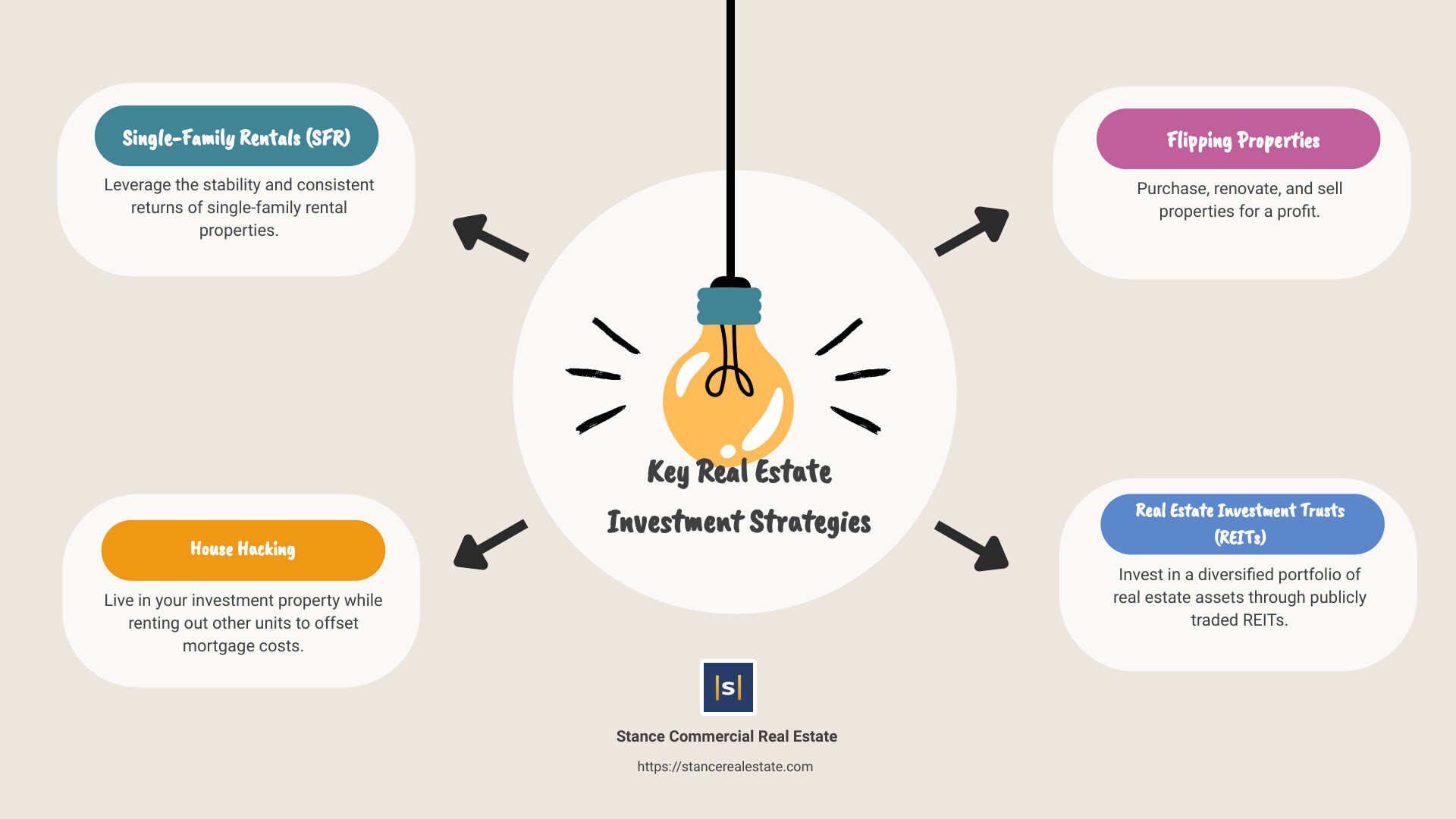
Key Strategies:
– Single-Family Rentals (SFR)
– House Hacking
– Flipping Properties
– Rental Income Properties
– Real Estate Investment Trusts (REITs)
Real estate is more than just an asset; it’s a powerful engine for building wealth. With a low correlation to stock market volatility and a range of tax incentives, these strategies offer both stability and lucrative returns over time. Owning geographically diverse rental properties can further mitigate risks associated with economic downturns.
I’m Joe Stance, founder of Stance Commercial Real Estate and a seasoned professional in real estate investment strategies. With over ten years in the industry, I have guided numerous clients through the complexities of real estate investments, ensuring they select the most suitable strategies for their needs.
Different Types of Real Estate Investments
Real estate investments come in many forms, each with unique benefits and risks. Understanding the different real estate investment strategies can help you make informed decisions. Let’s break down the main types: private equity, publicly traded equity, private debt, and publicly traded debt.
Private Equity
Private equity in real estate involves investing directly in properties or through private real estate funds. These investments are typically not listed on public exchanges. They offer the potential for high returns but come with higher risks and longer investment horizons.
Example: Emily, an entrepreneur, diversified her tech startup wealth by investing in a multifamily residential property. This direct investment provided her with rental income and potential property appreciation.
Publicly Traded Equity
Publicly traded equity includes investments in real estate investment trusts (REITs). REITs are companies that own, operate, or finance income-producing properties. They are traded on major stock exchanges, making them more liquid than private equity investments.
Fact: REITs often pay higher dividends than other publicly traded stocks, making them a stable, long-term investment option.
Private Debt
Private debt involves lending money to real estate developers or property owners in return for interest payments. This type of investment is not traded on public exchanges and can offer higher returns compared to publicly traded debt.
Case Study: Mark, a high net worth investor, used private debt to lend money to a developer. By leveraging depreciation and a 1031 exchange, he minimized his tax liabilities while earning a steady income from interest payments.
Publicly Traded Debt
Publicly traded debt includes bonds issued by real estate companies or mortgage-backed securities (MBS). These investments are traded on public markets and offer more liquidity than private debt. They typically provide regular interest payments and are considered less risky than private debt.
Statistic: According to industry sources, top crowdfunding platforms, which often involve publicly traded debt, boast annualized returns of between 2% and 20%.
Understanding these different real estate investment strategies can help you diversify your portfolio and optimize your returns. Each type has its own set of benefits and risks, so choose the one that aligns best with your financial goals and risk tolerance.
Next, we’ll explore simple ways to start investing in real estate, even if you’re a beginner.
5 Simple Ways to Invest in Real Estate
Investing in real estate doesn’t have to be complicated. Here are five straightforward strategies to get you started:
1. Rental Properties
Owning rental properties is a classic way to generate steady income. You buy a property, rent it out, and collect monthly rent.
Pros:
– Regular Income: You receive a monthly rent check.
– Equity Buildup: As you pay down the mortgage, you build equity.
– Tax Benefits: Many expenses, like maintenance and property management fees, are tax-deductible.
Cons:
– Management Hassles: Being a landlord requires time and effort. You might need to deal with repairs, tenant issues, and vacancies.
– Upfront Costs: You’ll need a significant down payment and cash reserves for maintenance.
2. Real Estate Investment Groups (REIGs)
REIGs are perfect for those who want to invest in rental properties without the hassle of managing them.
How It Works:
– A company buys or builds a set of rental properties.
– Investors can purchase units or shares in these properties.
– The company handles all management tasks, such as maintenance and tenant screening.
Pros:
– Hands-Off: The management company handles everything.
– Income and Diversification: You earn income and diversify your investments without much effort.
Cons:
– Fees: Management fees can eat into your profits.
– Vacancy Risks: If too many units are empty, your income may drop.
3. House Flipping
House flipping involves buying a property, renovating it, and selling it for a profit. This strategy requires a good understanding of real estate markets and renovation costs.
Pros:
– Quick Profits: You can make significant returns in a short period.
– Market Knowledge: Success requires deep knowledge of the local market and renovation skills.
Cons:
– High Risk: If you can’t sell the property quickly, holding costs (like mortgage payments) can add up.
– Capital Intensive: You need substantial upfront capital to buy and renovate properties.
4. Real Estate Investment Trusts (REITs)
REITs allow you to invest in real estate without owning physical property. You can buy shares of a REIT on a stock exchange, similar to buying stocks.
Pros:
– Liquidity: You can buy and sell REIT shares easily.
– Dividends: REITs often pay out regular dividends.
– Diversification: REITs invest in various types of properties, like shopping centers and office buildings.
Cons:
– Market Volatility: REIT prices can be affected by stock market fluctuations.
– Fees: Some REITs have management fees that can reduce returns.
5. Online Real Estate Platforms
Online platforms, also known as real estate crowdfunding, let you invest in large commercial or residential projects with a modest stake.
How It Works:
– Investors pool their money to fund real estate projects.
– You can invest in a single project or a portfolio of projects.
Pros:
– Diversification: Spread your investment across different properties and locations.
– Access to Large Projects: Invest in bigger deals that you couldn’t afford on your own.
Cons:
– Illiquidity: These investments often have lockup periods, meaning you can’t access your money for a set time.
– Management Fees: Fees can reduce your overall returns.
Each of these different real estate investment strategies has its own set of benefits and risks. Choose the one that aligns best with your financial goals and risk tolerance.
Next, we’ll dive into 11 Real Estate Investment Strategies for Beginners to help you get started with minimal risk.
11 Real Estate Investment Strategies for Beginners
1. Single-Family Rentals
Single-family rentals are a great way to start investing in real estate. You purchase a home and rent it out to a tenant. This strategy provides a steady income stream and potential property appreciation.
Pros:
– Steady Income: Monthly rent payments can provide reliable income.
– Appreciation: Property values may increase over time.
Cons:
– Vacancy Risk: Periods without tenants can affect income.
– Maintenance Costs: You are responsible for repairs and upkeep.
2. House Hacking
House hacking involves buying a property and living in one part while renting out the other. This can be a duplex, triplex, or even just renting out rooms in a single-family home.
Pros:
– Reduced Living Costs: Rent from tenants can cover your mortgage.
– Tax Benefits: You can deduct property expenses.
Cons:
– Privacy: Sharing your living space with tenants.
– Management: You may have to handle tenant issues personally.
3. Flipping Properties
Flipping properties means buying a home, renovating it, and selling it for a profit. This strategy requires good knowledge of the real estate market and renovation skills.
Pros:
– Quick Profits: Potential for high returns in a short period.
– Market Knowledge: Gain valuable insights into real estate trends.
Cons:
– High Risk: Market changes can affect profitability.
– Time-Consuming: Renovations and sales processes take time.
4. Live-In Flip
A live-in flip is similar to house flipping, but you live in the property while renovating it. This can save on living expenses while you improve the home.
Pros:
– Cost Savings: Save on rent or mortgage while renovating.
– Potential Profit: Sell the home for a higher price after improvements.
Cons:
– Disruption: Living in a construction zone can be challenging.
– Time Investment: Renovations can be time-consuming.
5. Wholesaling
Wholesaling involves finding properties at a discount and then selling the contract to another buyer for a fee. You don’t need to purchase the property yourself.
Pros:
– Low Capital Requirement: No need to buy the property.
– Quick Transactions: Deals can close quickly.
Cons:
– Market Knowledge: Requires a good understanding of property values.
– Networking: Success depends on finding buyers and sellers.
6. REITs (Real Estate Investment Trusts)
REITs allow you to invest in real estate without owning property. They are companies that own, operate, or finance income-generating real estate.
Pros:
– Diversification: Invest in a variety of properties.
– Liquidity: Easier to buy and sell than physical properties.
Cons:
– Market Risk: Share prices can fluctuate.
– Fees: Management fees can reduce returns.
7. REIGs (Real Estate Investment Groups)
REIGs pool money from investors to buy, manage, and sell properties. They offer a way to invest in real estate without hands-on management.
Pros:
– Passive Income: Professional management of properties.
– Diversification: Invest in multiple properties.
Cons:
– Fees: Management fees can impact returns.
– Illiquidity: Investments may have lock-up periods.
8. Tax Lien Investing
Tax lien investing involves buying tax lien certificates from municipalities. If the property owner doesn’t pay their taxes, you can earn interest or even acquire the property.
Pros:
– High Returns: Potential for high-interest earnings.
– Property Acquisition: Possibility of owning the property.
Cons:
– Complexity: Requires knowledge of tax laws and lien processes.
– Risk: Property owners may not pay their taxes.
9. BRRR (Buy, Rehab, Rent, Refinance, Repeat)
BRRR is a strategy where you buy a property, renovate it, rent it out, refinance it, and then use the funds to repeat the process.
Pros:
– Equity Growth: Increase property value through renovations.
– Cash Flow: Rental income covers mortgage payments.
Cons:
– Capital Intensive: Requires significant upfront investment.
– Management: Ongoing property management is needed.
10. Rental Debt Snowballing
Rental debt snowballing involves using rental income to pay off property mortgages quickly, then using the freed-up cash flow to buy more properties.
Pros:
– Debt Reduction: Pay off mortgages faster.
– Scalability: Grow your portfolio over time.
Cons:
– Initial Investment: Requires starting capital.
– Time Commitment: Managing multiple properties can be time-consuming.
11. BURL (Buy Utility, Rent Luxury)
BURL involves buying properties in less expensive markets (utility) and renting them out in high-demand areas (luxury).
Pros:
– Higher Returns: Rent in high-demand areas can be lucrative.
– Market Flexibility: Benefit from different market dynamics.
Cons:
– Market Risk: Economic changes can affect rental demand.
– Management: Requires effective property management.
Each of these different real estate investment strategies offers unique opportunities and challenges. Choose the one that best fits your goals and risk tolerance.
Next, we’ll explore Understanding the Four Main Commercial Real Estate Investment Strategies to help you navigate more advanced investment options.
Understanding the Four Main Commercial Real Estate Investment Strategies
When diving into commercial real estate, understanding the four main investment strategies—core, core-plus, value-add, and opportunistic—is crucial. These strategies offer different risk and return profiles, helping investors align their choices with their goals and risk tolerance.
Core Strategy
Summary: The core strategy is the classic “buy and hold” approach. Investors purchase high-quality buildings in prime locations that generate stable revenue.
Risk Profile: Low risk. Core properties are typically well-maintained, fully leased, and located in desirable areas, minimizing vacancy rates and ensuring steady income.
Typical IRR: Below 10%.
Example: Imagine buying a fully-leased office building in downtown Riverside. The building is in excellent condition and attracts high-quality tenants, providing reliable cash flow with minimal management effort.
Core-Plus Strategy
Summary: Core-plus involves acquiring high-quality assets that may require some improvements or are located in secondary locations. These properties have a slight element of risk but offer a higher return than core investments.
Risk Profile: Moderate risk. These properties might need minor upgrades or are in slightly less prime locations but still retain their value well.
Typical IRR: Between 10-12%.
Example: Purchasing an office building in a growing area of Riverside that needs a few cosmetic updates. With some investment in renovations, you can increase its appeal and rental income.
Value-Add Strategy
Summary: The value-add strategy focuses on properties that need significant improvements to enhance cash flow and value. This could include renovations, re-tenanting, or operational efficiencies.
Risk Profile: Higher risk. The success of this strategy depends heavily on the execution of the improvement plan.
Typical IRR: Between 11-16%.
Example: Buying an older apartment complex in Riverside with high vacancy rates. By renovating units, improving amenities, and rebranding, you can attract new tenants and raise rents, significantly increasing the property’s value.
Opportunistic Strategy
Summary: The opportunistic strategy involves high-risk, high-reward investments. This might include developing new properties, significant redevelopment, or acquiring distressed assets.
Risk Profile: Highest risk. These projects require substantial capital, expertise, and a keen understanding of market conditions.
Typical IRR: Greater than 16%.
Example: Developing a new mixed-use property in an emerging Riverside neighborhood. This project involves extensive planning and construction but has the potential for significant returns once completed and leased.
Each of these different real estate investment strategies offers unique opportunities. Whether you prefer the stability of core investments or the high potential returns of opportunistic projects, understanding these strategies will help you make informed decisions.
Next, we’ll answer some Frequently Asked Questions about Different Real Estate Investment Strategies to further clarify these concepts and help you choose the best path for your goals.
Frequently Asked Questions about Different Real Estate Investment Strategies
What is the 4-3-2-1 real estate strategy?
The 4-3-2-1 real estate strategy is a method to build financial stability and consistent income through property investments. Here’s how it works:
- 4 Properties: Start by acquiring four rental properties. These properties will generate rental income and help spread risk.
- 3 Properties: Sell one property and use the proceeds to pay off the mortgages on the remaining three properties.
- 2 Properties: Repeat the process by selling another property to pay down the debt on the remaining two.
- 1 Property: Finally, sell the third property to eliminate the mortgage on the last one, making it debt-free.
This strategy aims to create debt-free properties that generate consistent rental income, providing long-term financial stability.
What is the 10% rule in real estate investing?
The 10% rule is a simple guideline to evaluate the profitability of a rental property. It states that the annual rental income should be at least 10% of the property’s purchase price.
Example: If you buy a property for $200,000, it should generate at least $20,000 in annual rental income.
This rule helps investors quickly assess whether a property is likely to be profitable. Properties that meet or exceed this rule are generally considered good investments.
What are the most profitable types of real estate investments?
Commercial real estate often tops the list of the most profitable types of real estate investments. There are several reasons for this:
- Higher Income Potential: Commercial properties, such as office buildings, retail spaces, and industrial warehouses, typically generate higher rental income compared to residential properties.
- Longer Leases: Commercial leases often span several years, providing stable and predictable cash flow.
- Lower Vacancy Rates: Due to the longer lease terms, commercial properties tend to have lower vacancy rates, reducing the risk of income loss.
For example, owning a commercial building can provide rental income from multiple tenants, increasing overall profitability and spreading risk.
Each of these investment strategies—whether focusing on residential properties for stability or commercial properties for higher returns—offers unique benefits. By understanding these strategies and their potential, you can make informed decisions that align with your financial goals.
Conclusion
At Stance Commercial Real Estate, we understand that navigating real estate investment can be complex. Our mission is to simplify this process and help you make informed decisions that align with your financial goals.
Riverside: A Thriving Market
Riverside, CA, offers a vibrant and growing market for real estate investments. Its strategic location near major transportation routes and ports makes it ideal for industrial, retail, and office spaces. The city’s rich cultural scene and robust economic growth present numerous opportunities for investors looking to diversify their portfolios.
Local Market Expertise
Our team at Stance Commercial Real Estate is deeply embedded in the Riverside community. We know the streets, the buildings, and the history behind them. This local expertise allows us to offer insights that go beyond basic metrics. We can tell you which locations have the best foot traffic, the demographic shifts influencing the market, and how future developments might affect your investment.
Service Over Profit
At Stance, service excellence is at the heart of everything we do. We strive to provide a seamless experience from start to finish. Our team is dedicated to transparency, communication, and integrity. We handle the complexities of commercial transactions so that you can focus on what you do best—running your business.
From identifying the perfect property to negotiating contracts and managing post-sale logistics, we are with you every step of the way. Our goal is to ensure that every client is fully supported and satisfied with their real estate journey.
Partner with Us
Choosing Stance Commercial Real Estate means choosing a partner who values local insight and delivers exceptional service. Let us help you navigate Riverside’s dynamic commercial real estate landscape and achieve your investment goals.
Learn more about our services at Stance Commercial Real Estate.
By integrating our local expertise with your investment strategies, together we can build a robust portfolio that stands the test of time. Whether you’re looking to buy, sell, or lease, our team is equipped to guide you through every step of the process.
Let Stance Commercial Real Estate be your partner in achieving long-term success in Riverside’s flourishing commercial real estate market.