

Commercial Real Estate: A Comprehensive Guide
Navigating the World of CRE Real Estate
Commercial real estate (CRE) refers to properties used for business activities rather than residential living. This can include anything from storefronts and office spaces to massive industrial warehouses.
Main types of CRE properties:
- Office buildings
- Retail properties
- Industrial complexes
- Hotels
- Multifamily properties
Commercial real estate (CRE) is essential for businesses needing a workspace. It helps generate income through tenants who lease the space for their operations. Understanding CRE is crucial for investors and business owners exploring this market.
My name is Joe Stance, and I've spent over ten years in commercial real estate, assisting clients with buying, leasing, and managing various properties. My aim is to guide you through the complexities of the CRE market.
Now, let's dive deeper into what CRE real estate truly entails.
What is CRE Real Estate?
Commercial real estate (CRE) refers to properties used for business purposes. Unlike residential real estate, which is meant for living spaces, CRE properties are designed to generate income through business activities. This includes everything from leasing office buildings to running hotels. Let's break down the different types of CRE properties and how they differ from residential real estate.
Types of CRE Properties
Office Buildings
Office buildings are one of the most common types of CRE properties. They range from small professional buildings to large skyscrapers. These spaces are typically leased to businesses that need a place for their employees to work.
Retail Properties
Retail properties include shopping centers, strip malls, and standalone stores. These spaces are leased to businesses that sell goods or services directly to consumers. For instance, a strip mall might house a variety of stores, such as a grocery store, a pharmacy, and a clothing boutique.
Industrial Complexes
Industrial properties are used for manufacturing, production, and storage. These include factories, warehouses, and distribution centers. For example, Amazon's fulfillment centers are industrial properties where products are stored and shipped to customers.
Hotels
Hotels and resorts are another category of CRE properties. These establishments provide lodging, food, and other services to travelers. They can range from budget motels to luxurious resorts.
Multifamily Properties
Multifamily properties are residential buildings with multiple units, such as apartment complexes. While they serve as residences, they are considered commercial properties because they generate income for the owner through rent.
CRE vs. Residential Real Estate
The primary difference between CRE and residential real estate is their purpose. CRE properties are non-residential and are used for business activities, while residential properties are meant for people to live in.
Business Activities
CRE properties are designed to support various business activities. These activities include office work, retail sales, manufacturing, and hospitality services. The goal is to generate income through leasing or other business operations.
Residential Purposes
Residential properties, on the other hand, are meant for people to live in. This includes single-family homes, condos, and apartment complexes. Even though multifamily properties generate income, they are still considered residential because they serve as living spaces.
In summary, while both CRE and residential real estate can be profitable, they serve different purposes and cater to different markets. Understanding these differences is essential for anyone considering investing in or working within the CRE sector.
Investing in CRE Real Estate
Investing in CRE Real Estate can be a lucrative venture, but it requires a solid understanding of the market, strategies, and financing options available.
CRE Investment Strategies
There are four main strategies for investing in commercial real estate, each with its own risk and return profile:
- Core Real Estate
- Low Risk, Stable Returns: Core investments focus on high-quality, fully-leased properties in prime locations. These properties typically offer stable, long-term returns with minimal risk.
- Example: A fully-leased office building in a major city like New York or San Francisco.
- Core Plus
- Moderate Risk, Slight Renovations, Solid Returns: Core Plus properties are similar to Core but may require minor improvements or have slightly higher risk due to location or tenant quality.
- Example: A well-maintained shopping center in a growing suburban area.
- Value-Add
- Higher Risk, Substantial Improvements, Higher Returns: Value-Add investments involve properties that need significant renovations or repositioning. The goal is to increase the property's value and generate higher returns.
- Example: An older apartment complex that requires extensive upgrades to attract higher-paying tenants.
- Opportunistic
- High Risk, Significant Work Needed, Potentially High Returns: Opportunistic investments are the riskiest and involve properties that need major redevelopment or are in less desirable locations. The potential returns can be very high if the investment is successful.
- Example: Converting an old industrial warehouse into a trendy office space or mixed-use development.
Financing CRE Investments
Financing commercial real estate investments can be complex, involving various sources of capital:
- Debt and Equity
- Debt: Borrowing money from lenders, typically in the form of mortgages or loans. The investor pays interest and repays the principal over time.
- Equity: Raising capital by selling ownership stakes in the property. Investors share in the profits and losses.
- Traditional Banks
- Loans: Banks offer various loans, such as permanent loans, which are first mortgages with terms of at least five years. These loans are ideal for stable, long-term investments.
- REITs (Real Estate Investment Trusts)
- Indirect Investment: REITs allow investors to buy shares in a company that owns, operates, or finances income-producing real estate. This offers liquidity and diversification without the hassles of property management.
- Private Equity Firms
- Capital Raising: Private equity firms raise capital from outside investors and use it to acquire, develop, and manage properties. They aim to improve the properties and sell them for a profit.
Investing in CRE Real Estate requires careful planning and a clear strategy. By understanding the different investment strategies and financing options, you can align your investments with your financial goals and risk tolerance.
Becoming a CRE Professional
Key Roles in CRE
Commercial Real Estate (CRE) offers a variety of career paths, each with its own set of responsibilities and required skills. Here are some key roles:
- Real Estate Acquisitions: Professionals in this role identify and evaluate potential properties for investment. They conduct market research, analyze financials, and negotiate purchase terms.
- Development: Developers oversee the entire process of creating a new property or renovating an existing one. They work with architects, contractors, and local authorities to ensure the project meets all regulations and is completed on time and within budget.
- Lending: CRE lenders work for banks or private lending institutions. They assess the creditworthiness of borrowers, evaluate property values, and structure loan terms. Their goal is to minimize risk while providing capital for CRE projects.
- Brokerage: Brokers act as intermediaries between buyers and sellers or landlords and tenants. They help clients find the right properties, negotiate deals, and handle the paperwork. Successful brokers need excellent networking and negotiation skills.
- Appraisal: Appraisers provide an unbiased estimate of a property's value. They consider factors like location, condition, and market trends. Accurate appraisals are crucial for securing financing and making informed investment decisions.
Essential Skills for CRE Professionals
To succeed in CRE Real Estate, you'll need a mix of technical knowledge and soft skills:
- Self-Motivation: CRE professionals often work independently and need to stay driven to meet their goals. Whether it's closing a deal or managing a project, self-motivation is key.
- Problem-Solving: The CRE industry is complex and ever-changing. Professionals must be able to think on their feet and find solutions to unexpected challenges.
- Negotiation: Strong negotiation skills can make or break a deal. Whether you're a broker closing a sale or a developer securing funding, the ability to negotiate effectively is invaluable.
- Market Analysis: Understanding market trends and economic factors is essential. This skill helps in making informed decisions about property investments and developments.
- Financial Modeling: Financial modeling involves creating detailed projections of a property's performance. This skill is crucial for evaluating potential investments and securing financing.
Becoming a CRE Professional requires a blend of education, experience, and the right skill set. Whether you're drawn to acquisitions, development, lending, brokerage, or appraisal, mastering these skills will set you up for success in the dynamic world of commercial real estate.
CRE Real Estate Market Trends
2024 Outlook for CRE
The commercial real estate (CRE) market in 2024 is navigating through a complex landscape shaped by various economic and societal factors. One of the most significant trends is the ongoing impact of work-from-home arrangements. Since the COVID-19 pandemic, many companies have adopted hybrid work models, reducing the demand for traditional office spaces. This shift has led to a record-breaking 19.6% office vacancy rate at the end of 2023.
Despite these challenges, certain CRE sectors like multifamily, retail, and industrial properties remain strong. For instance, JPMorgan Chase's mid-year update in May 2024 highlighted the resilience of these sub-sectors, even in the face of rising interest rates. However, the office market continues to struggle with high vacancy rates and declining property values.
Challenges in CRE
The CRE market faces several problems that investors and professionals must steer. One major challenge is the tight credit environment. With interest rates at a 23-year high, refinancing existing debt has become increasingly difficult. The Conference Board economists predict that around $1 trillion in CRE debt will come due this year and next, creating significant stress on property owners.
Construction costs have also surged, with prices for materials like steel, lumber, and asphalt rising by 46% since pre-COVID times. This increase complicates new development projects and adds pressure on existing properties to maintain profitability.
Rental rates are another area of concern. While rental rates have increased by 31% over the past decade, further hikes may be hard to justify as renters already spend 30% to 35% of their income on housing. This issue is particularly pressing for sectors like retail and office spaces, where tenant turnover can be high.
Redevelopment projects offer a glimmer of hope. For example, The Counselors of Real Estate are advising on the redevelopment of Peoria’s McKinley and Harrison School sites, showcasing how strategic redevelopment can breathe new life into underused spaces.
Volatility and High CRE Debt
The CRE market is inherently volatile, and the current economic climate exacerbates this instability. The Federal Reserve Chair Jerome Powell has warned that CRE losses will primarily impact small- and medium-sized banks, which hold a significant portion of troubled loans. The practice of "extend and pretend," where lenders extend loan maturity dates rather than write off bad loans, adds another layer of uncertainty.
Maturing loans are a ticking time bomb. As these loans come due, property owners face the daunting task of refinancing at much higher interest rates. This situation is particularly dire for office properties, which have seen a more than 35% drop in value from their peak.
Construction input costs continue to rise, making new projects more expensive and less feasible. This increase in costs, coupled with tight credit conditions, creates a challenging environment for new developments and renovations.
Navigating these challenges requires a keen understanding of market trends, economic factors, and strategic investment approaches. As the CRE market continues to evolve, staying informed and adaptable will be key to success.
Frequently Asked Questions about CRE Real Estate
What does CRE mean in real estate?
CRE stands for Commercial Real Estate. It refers to properties used for business-related purposes. Unlike residential real estate, which is for living spaces, CRE is used to generate income. Examples include office buildings, retail stores, hotels, and industrial complexes.
What is CRE investing?
CRE investing involves purchasing commercial properties to earn rental income or achieve capital appreciation. Investors lease these properties to businesses. This can provide a steady income stream and potential growth in property value over time.
Types of CRE investments include:
- Office buildings: Leased to companies for workspace.
- Retail properties: Stores, strip malls, and shopping centers.
- Industrial complexes: Factories and warehouses.
- Hotels: Lodging for travelers.
- Multifamily properties: Apartment complexes rented out to multiple tenants.
Investors can also participate indirectly through REITs (Real Estate Investment Trusts). These are companies that own, operate, or finance income-producing real estate and are publicly traded.
How to get a CRE designation?
To earn a CRE designation, you must be invited by your peers and recognized for your expertise and problem-solving skills in real estate. The Counselors of Real Estate (CRE) organization awards this prestigious title.
Steps to earn a CRE designation:
- Gain experience: Work in various roles within the commercial real estate sector to build your expertise.
- Network: Engage with industry professionals and participate in real estate organizations.
- Peer recognition: Be acknowledged by your peers for your contributions and knowledge.
- Invitation: Receive an invitation to join the Counselors of Real Estate.
CRE professionals are trusted advisors who find solutions to complex real estate challenges. They offer expertise across more than 60 real estate disciplines and practice in 22 countries.
How Stance CRE Can Help You
At Stance Commercial Real Estate, we pride ourselves on our deep understanding of Riverside's vibrant market. Our local expertise allows us to offer insights that go beyond basic metrics, ensuring you make informed, strategic decisions in the complex world of cre real estate.
Riverside is not just a location for us; it's our community. We live and breathe Riverside culture, giving us unparalleled knowledge of the area's real estate dynamics. This local insight is invaluable when it comes to understanding which locations have the best foot traffic, how demographic shifts are influencing the market, and how future developments might affect your investment.
Service over profit is at the heart of everything we do. Our team is dedicated to providing a seamless experience from start to finish. We handle the complexities of commercial transactions so you can focus on what you do best—running your business. From identifying the perfect property to negotiating contracts and managing post-sale logistics, we are with you every step of the way.
Choosing Stance Commercial Real Estate means choosing a partner who values local insight and delivers exceptional service. We are more than just a real estate agency; we are your neighbors and your partners in navigating the complexities of the commercial real estate landscape.
Find how we can help you capitalize on the opportunities in Riverside’s dynamic market. Learn more about our services and start your investment journey with a team that knows Riverside best.
If you’re considering investing in downtown Riverside commercial real estate, let Stance Commercial Real Estate guide you through the process. Our knowledge and expertise are your assets in making informed, strategic decisions that drive growth and success.


The Commercial Real Estate Services Industry: What You Need to Know
Navigating the Commercial Real Estate Services Industry
When diving into the commercial real estate services industry, it’s crucial to understand its market landscape, diverse service offerings, and significant scope. This sector is vast, embracing everything from office space brokerage to multifamily rental management. Let's break it down:
- Definition: The commercial real estate services industry involves companies specializing in services like brokerage, property management, construction, and consulting.
- Market Size: The industry is projected to reach an estimated $1.3 trillion in 2024, despite a decline over the past five years.
- Types: Encompasses office spaces, industrial sites, multifamily rentals, and retail properties.
Understanding these elements can provide a clear picture of what to expect when engaging with this dynamic sector.
I’m Joe Stance. With over a decade in the commercial real estate industry and experience in the Inland Empire, I aim to guide business owners and investors through this market's complexities. Let's dive deeper into the essentials and current trends shaping the industry.
Key Segments of the Commercial Real Estate Services Industry
Understanding the key segments of the commercial real estate services industry is essential for anyone looking to invest or operate within it. Each segment has unique characteristics, benefits, and challenges. Let's explore these segments:
Office Space
Office spaces are designed for business use and vary greatly in size and function. They can be categorized into three classes:
- Class A: These are the top-tier buildings, known for their prime locations, modern amenities, and high-quality infrastructure. They are newer buildings with excellent aesthetics and are usually located in major business districts.
- Class B: These buildings are older but still in good condition. They are less expensive than Class A buildings and often targeted by investors for renovation and upgrades.
- Class C: These are the oldest buildings, typically over 20 years old, and may require significant maintenance. They are located in less desirable areas and are the least expensive.
Industrial Use
Industrial properties are used for manufacturing, production, and storage of goods. They include:
- Manufacturing: Facilities designed for the production of goods. These buildings often have large open spaces and specialized infrastructure to support heavy machinery.
- Production: Similar to manufacturing but may include facilities for processing raw materials.
- Heavy Goods: These properties are used for storing and distributing heavy products and are often located near major transportation routes to facilitate logistics.
Multifamily Rental
Multifamily rentals refer to residential properties with five or more units. These properties can serve dual purposes:
- Residential: Primarily used for housing tenants. These properties provide a stable revenue stream through rental income.
- Commercial Activity: Some multifamily properties may include commercial spaces, such as ground-floor retail or office spaces, which can generate additional income for the property owner.
Retail
Retail properties are designed for businesses that sell goods or services directly to consumers. This segment includes:
- Hotels and Resorts: These properties cater to travelers and tourists, offering lodging, dining, and entertainment services.
- Strip Malls: Small shopping centers with multiple retail outlets. They are often located in suburban areas and attract local shoppers.
- Restaurants: Standalone or within malls, these properties range from fast-food outlets to fine dining establishments.
- Healthcare Facilities: Buildings designed for medical services, such as clinics, hospitals, and specialized treatment centers.
Each of these segments offers unique opportunities and challenges. By understanding the specifics of each segment, investors and business owners can make informed decisions and maximize their returns.
Current Trends in the Commercial Real Estate Services Industry
The commercial real estate services industry is experiencing dynamic changes in 2024. Post-pandemic trends are reshaping how businesses operate and how spaces are used. Here’s a look at the key trends:
Office Spaces Rebounding
Office spaces are seeing an uptick in occupancy levels. By December 2023, major urban centers like Manhattan's office occupancy hit 52%, with over half of the workforce returning to their desks on weekdays. Yet, the preference for hybrid schedules remains strong, as many employees enjoy the flexibility of working both remotely and in the office.
Smaller office spaces are becoming more popular. Businesses now favor units around 5,000 square feet or smaller, a significant shift from larger offices. This trend is evident with major tenants like JPMorgan Chase, which reduced its commercial footprint by 400,000 square feet in 2023.
Retail Spaces Flourishing
Retail spaces, especially in prime locations, are experiencing a resurgence. Leasing activities are on the rise, with high-profile leases such as Dolce & Gabbana’s acquisition of a 23,338-square-foot space on Madison Avenue.
Consumer spending is robust, growing at a 4.0% annual rate, which supports the retail sector's vitality. Available retail space in major submarkets declined or remained steady in 9 out of 11 submarkets, highlighting a retail resurgence.
Restaurant Sector’s Recovery
The restaurant industry in major cities is bouncing back robustly. Leasing activity has surged, with vacancy rates dropping to 2.4% by late January 2023, nearly reaching pre-pandemic levels. This recovery is driven by the revitalization of city life and the return of residents, tourists, and office workers.
Optimism among restaurant operators reached 43% by August 2023, indicating growing confidence in the sector’s future. The end of the 2023 sales tax year also saw taxable sales for restaurants returning to pre-pandemic levels, further emphasizing the restaurant sector’s recovery.
Key Factors Influencing the Industry in 2024
Impact of Interest Rate Cuts
Interest rates play a crucial role in the commercial real estate services industry. The Federal Reserve has hinted at three potential interest rate cuts in 2024, with markets expecting these cuts as early as May. Lower interest rates typically make borrowing cheaper, which can spur dealmaking and refinancing activities.
For property owners, lower rates mean better loan terms. This can lead to more favorable refinancing options, allowing owners to manage their properties more efficiently or invest in new projects. However, there is uncertainty about whether the cost of capital might worsen through 2024. This unpredictability adds a layer of complexity to financial planning and investment decisions.
Overall Economic Conditions
The broader economic landscape significantly impacts commercial real estate. Economic growth, or the lack thereof, can influence everything from property values to rental demand. For instance, concerns about a potential recession loom large. TD Securities estimates a 65% likelihood of a recession in 2024, although they expect it to be mild.
Expense mitigation remains a top priority for real estate professionals, especially with revenues potentially hitting their lowest levels since 2018. Additionally, CBRE predicts a slowdown in the U.S. economy, which could tighten bank lending practices. This tightening could make it harder for businesses to secure financing for new projects or property acquisitions.
Global Factors
Global events and conditions also play a significant role in shaping the commercial real estate services industry. Geopolitical uncertainties, such as the conflicts in Ukraine and the Middle East, can create market instability. These conflicts can lead to supply chain disruptions, affecting construction and development projects.
Persistent inflation and an unpredictable energy market add further complexity. High operational costs and fluctuating energy prices can strain budgets and influence investment decisions. Moreover, a slower-than-expected economic recovery in Mainland China can have ripple effects on global markets, including real estate.
Climate risk is another growing concern. The urgency around sustainability is pushing the industry towards adopting energy-efficient solutions and complying with stricter ESG regulations. While this shift presents challenges, it also offers opportunities for innovation and leadership in sustainable practices.
Challenges and Opportunities in the Commercial Real Estate Services Industry
The commercial real estate services industry faces a host of challenges and opportunities. From rising operational costs to ESG compliance and technology modernization, understanding these factors can help stakeholders steer the complex landscape.
Rising Operational Costs
Operational costs in commercial real estate have been climbing steadily. Construction materials are more expensive due to supply chain disruptions and inflation. For instance, the price of lumber spiked dramatically during the COVID-19 pandemic, affecting project budgets.
Insurance premiums are another rising expense. As natural disasters become more frequent and severe, insurers are increasing premiums to cover potential losses. This adds a significant burden on property owners who already face high operational costs.
Inflation exacerbates these issues. The cost of goods and services rises, making everything from maintenance to new construction more expensive. This inflationary pressure can squeeze profit margins, making it critical for property managers to seek cost-effective solutions.
ESG Compliance
Environmental, Social, and Governance (ESG) compliance is no longer optional. Investors and tenants alike are demanding sustainable and responsible business practices. According to the U.S. Department of Energy, commercial buildings account for 40% of CO2 emissions and 88% of potable water consumption in the U.S.
Sustainability initiatives can lead to long-term cost savings, higher rents, and lower financing costs. For example, green-certified buildings often consume 29 to 50% less energy than non-green buildings. They also depreciate at a slower rate and attract more tenants willing to pay a premium for eco-friendly features.
Regulatory standards are tightening. Governments are implementing stricter rules to reduce carbon footprints and manage waste more effectively. In California, failure to adhere to new green initiatives can result in hefty penalties. Compliance with these regulations can be costly, but it also presents an opportunity for forward-thinking companies to lead the way in sustainable practices.
Technology and Infrastructure Modernization
The need for technology upgrades is pressing. Many commercial real estate firms still rely on outdated legacy systems, which can be inefficient and costly to maintain. Modern technology solutions can improve efficiency, data analysis, and overall operations.
Efficiency improvements are a significant benefit of modernization. Advanced software can streamline property management tasks, from tenant communications to maintenance scheduling. This not only reduces operational costs but also improves tenant satisfaction.
However, the transition to modern technology represents a substantial investment. Upgrading systems and training staff can be expensive and time-consuming. Despite these challenges, the investment is essential for staying competitive. Firms that successfully modernize their infrastructure can expect to see significant returns in the form of improved operational efficiency and better data-driven decision-making.
Frequently Asked Questions about the Commercial Real Estate Services Industry
How concentrated is the commercial real estate industry?
The commercial real estate services industry is highly fragmented. Most companies operate in small segments, focusing on specific niches like brokerage, property management, or appraisal. No single company dominates the market, with even the largest players holding less than 2% of the total market revenue. This low concentration means that competition is generally localized, and many smaller firms can thrive by specializing in particular services or regions.
Vacancy rates, property values, and credit activity significantly influence market dynamics. For example, during economic downturns, higher vacancy rates can reduce demand for new office spaces and retail centers. Conversely, lower vacancy rates can drive up property values and stimulate new construction projects.
How big is the CRE market in the US?
The commercial real estate market in the US is massive, with an estimated market size of $1.3 trillion in 2024. This market size is expected to grow over the next five years despite recent declines at a CAGR of 1.0% over the past five years.
The total value of the US CRE market is estimated to be around $20.7 trillion, with some estimates ranging between $18 to $22 trillion. This valuation underscores the significant role that commercial real estate plays in the broader economy, impacting everything from employment to investment strategies.
How is the commercial real estate market in NYC?
New York City is a critical hub for commercial real estate, and its market dynamics are closely watched. Occupancy levels in NYC have been rebounding, especially in prime locations like Fifth Avenue and SoHo. These areas are experiencing bidding wars for desirable corners, indicating strong demand despite the challenges posed by the COVID-19 pandemic.
The retail sector in NYC is flourishing, with landlords investing in more innovative and appealing environments to attract tenants. Retail construction starts were down significantly in 2023, making new space scarce. This has led to increased competition for existing spaces, driving up lease rates.
The restaurant sector is also showing signs of recovery. Leasing activity is picking up, and vacancy rates are falling as new and existing restaurants look to capitalize on the return of consumer spending. Optimism is high, with many operators expecting a full recovery as foot traffic increases and dining out becomes more common again.
How Stance CRE Can Help You
At Stance Commercial Real Estate, we believe that navigating the commercial real estate services industry requires more than just market knowledge; it demands a commitment to service over profit and a deep understanding of local dynamics.
Local Market Expertise
Riverside is a vibrant and economically diverse area with a growing demand for commercial spaces. Our team at Stance CRE has deep roots in this community, giving us unparalleled insights into local market trends, zoning laws, and economic factors that impact property values. This local expertise allows us to provide accurate appraisals and effective marketing strategies custom to Riverside's unique market.
Service Over Profit
We prioritize our clients' needs over our profit margins. Our goal is to ensure you get the best possible outcome for your property. Whether it's through meticulous property preparation, strategic pricing, or targeted marketing, we go the extra mile to make sure your property stands out.
We believe in building long-term relationships with our clients. This means providing ongoing support and advice, even after the sale is complete. Our success is measured by your satisfaction and the value we bring to your investment decisions.
Riverside: A Strategic Investment
Investing in Riverside's commercial real estate is more than just a financial decision; it's a strategic move towards sustainable growth. The city's proximity to major ports improves its appeal as a hub for industrial activities, while its rich cultural scene and growing population make it ideal for retail and office spaces. Over time, property values in Riverside have shown a consistent upward trend, driven by these intrinsic qualities coupled with substantial infrastructural developments.
By choosing to invest in Riverside, you are positioning your enterprise in a location with robust growth potential and high returns on investment. This demand drives up rental yields, making it a lucrative market for those looking to lease properties.
Partner with Us
At Stance, our deep understanding of the Riverside market sets us apart. We are not just observers but active participants and advocates of this community’s growth. Our expertise is not merely in transacting properties but in forming strategic partnerships that improve the value we deliver to our clients.
We offer custom advice that aligns with your business’s long-term goals and current market trends. Our team is skilled in navigating the complexities of the commercial real estate market, from legal and zoning challenges to securing the most favorable financing options. With Stance, you gain more than a service provider; you gain a partner who is committed to your success.
For more information on how we can assist you in your commercial real estate endeavors, visit our services page.
By understanding these key aspects, potential investors and business owners can make more informed decisions about entering the Riverside market, ensuring they choose the right properties that align with their business goals and financial strategies. With the guidance and expertise of Stance Commercial Real Estate, you can steer this dynamic market with confidence and secure a prosperous future for your business.


A Comprehensive Guide to How Interest Rate Cuts Impact Commercial Real Estate
Overview of the Impact of Recent Interest Rate Cut on Commercial Real Estate
How the recent interest rate cut could impact commercial real estate is a crucial topic for investors, developers, and businesses navigating today's financial environment. Here are the key impacts:
- Lower Borrowing Costs: Financing new projects and refinancing existing debt becomes more affordable.
- Refinancing Opportunities: Stakeholders can lock in reduced rates, improving long-term profitability.
- Increased Market Activity: Lower costs may spur new projects and investments.
- Sector-Specific Effects: Varied impacts across retail, office, industrial, and multifamily properties.
As commercial real estate stakeholders, understanding how the recent interest rate cut could impact commercial real estate is vital to making informed investment choices. Lower rates can improve cash flow, foster market growth, and open new avenues for profitability. However, it can also increase competition and influence property valuation dynamics.
My name is Joe Stance. With seventeen years of experience in Riverside's commercial real estate industry, I’ve guided numerous clients through ebbs and flows, understanding how the recent interest rate cut could impact commercial real estate investments.
Understanding Interest Rate Cuts
Interest rate cuts are crucial financial events that can significantly impact various sectors, including commercial real estate. Let's break it down:
Definition
An interest rate cut refers to the reduction of the federal funds rate, the interest rate at which banks lend to each other overnight. This rate is set by the Federal Reserve, the central bank of the United States, and serves as a benchmark for many other interest rates, including those for loans and mortgages.
The Role of the Federal Reserve
The Federal Reserve, often referred to as "the Fed," uses interest rate adjustments as a tool to manage the economy. By lowering rates, the Fed aims to stimulate economic activity by making borrowing cheaper, encouraging spending and investment.
Economic Impact
Interest rate cuts can have several effects on the economy:
- Lower Borrowing Costs: As borrowing becomes cheaper, businesses and consumers are more likely to take out loans for expansion, purchasing, or investing.
- Increased Spending: With lower interest payments, consumers and businesses have more disposable income to spend, boosting economic growth.
- Investment Incentives: Lower rates can make investments in stocks and real estate more attractive compared to savings accounts and bonds, which offer lower returns in a low-rate environment.
Key Takeaways
Interest rate cuts are a powerful tool used by the Federal Reserve to influence economic activity. By lowering rates, the Fed can stimulate borrowing, spending, and investment, which in turn can have significant implications for the commercial real estate market.
How the Recent Interest Rate Cut Could Impact Commercial Real Estate
Lower Borrowing Costs
One of the most immediate impacts of an interest rate cut is the reduction in borrowing costs. This is great news for commercial real estate stakeholders. Lower borrowing costs mean:
- Reduced Debt Service: With lower interest rates, the cost of servicing existing debt decreases. This can significantly improve cash flow for property owners and developers.
- Increased Profitability: Lower interest expenses can lead to higher net operating income (NOI), boosting the overall profitability of investment properties.
For example, a developer with a $10 million loan at a 5% interest rate would pay $500,000 annually in interest. If the rate drops to 4%, the annual interest payment falls to $400,000, saving $100,000 each year.
Refinancing Opportunities
The recent rate cut opens up attractive refinancing opportunities:
- Refinancing Existing Debt: Property owners can refinance their existing loans at lower interest rates. This can reduce monthly payments and free up capital for other investments.
- Financing New Projects: Lower rates make it cheaper to finance new developments. This can accelerate project timelines and make previously marginal projects viable.
- Flexible Financing Structures: With more favorable terms, borrowers might explore new financing structures that offer greater flexibility and lower risks.
A case study from Reuters highlights that approximately $2.75 trillion in commercial mortgage loans will mature between 2023 and 2027. Refinancing at lower rates could be a lifeline for many property owners.
Investment Opportunities
Lower interest rates can also create a fertile environment for investment:
- Increased Market Activity: Cheaper borrowing costs can stimulate market activity, with more investors looking to acquire properties.
- Project Launches: Developers might be more inclined to launch new projects, taking advantage of reduced capital costs.
- Acquisition Financing: Investors can secure more attractive financing options for new acquisitions, making it easier to expand their portfolios.
However, remain cautious. As borrowing becomes more accessible, competition for prime assets could intensify, potentially driving up prices. This dynamic was observed in the NAIOP Research Foundation Study, which noted that commercial real estate development contributed significantly to the economy, supporting numerous jobs and generating substantial wages.
In summary, the recent interest rate cut offers a blend of opportunities and challenges. Lower borrowing costs, refinancing options, and new investment opportunities can significantly impact the commercial real estate landscape.
Sector-Specific Impacts
The recent interest rate cut impacts various sectors of commercial real estate differently. Let’s break down how retail, office, industrial, and multifamily sectors are affected.
Retail Sector
Consumer Spending and Tenant Demand
Retail properties are closely tied to consumer spending. Lower interest rates often lead to increased consumer spending as borrowing costs for consumers drop, making credit more affordable. This can boost sales for retail tenants, potentially increasing demand for retail spaces.
However, as noted in a study by MSCI Real Assets, while the Commercial Property Price Index for retail remained flat, there was a 27% drop in investment sales volume. This suggests that while consumer spending may rise, the retail sector still faces challenges in attracting investment.
Office Sector
Remote Work Trends and Leasing Activity
The office sector is navigating significant changes due to the rise of remote work. Even with lower interest rates, the demand for office space is influenced by how companies adjust their work models. Many businesses are still considering whether to downsize, relocate, or redesign their office spaces.
A report by CBRE highlighted that one-fifth of all U.S. offices stood vacant in the first quarter of this year. This high vacancy rate reflects the ongoing uncertainty in the office market, despite the potential benefits of lower borrowing costs.
Industrial Sector
E-Commerce Growth and Logistics Demand
The industrial sector has been a standout performer, driven by the growth of e-commerce. Lower interest rates can further boost this sector by reducing the cost of financing for new logistics and warehouse facilities.
According to a J.P. Morgan report, industrial real estate continues to perform well. The demand for logistics space remains strong, and lower borrowing costs can help developers meet this demand by financing new projects more affordably.
Multifamily Sector
Rental Demand and Housing Affordability
Multifamily properties benefit from lower interest rates as they make financing new developments and refinancing existing properties more affordable. This can lead to an increase in the supply of rental housing, which is crucial for addressing housing affordability issues.
However, as noted by Principal Asset Management, the overall economic environment also plays a role. If rate cuts are coupled with rising unemployment, the positive impact on multifamily investments could be offset by broader economic concerns.
In conclusion, while the interest rate cut presents opportunities across various sectors, each sector faces unique challenges and dynamics. Understanding these nuances is key to making informed investment decisions in the commercial real estate market.
Market Dynamics and Economic Indicators
Understanding market dynamics and economic indicators is crucial for commercial real estate investors. Let's explore the 10-year treasury yield, inflation, and unemployment, and how they interact with interest rate changes.
10-Year Treasury Yield
The 10-year treasury yield is a benchmark for long-term interest rates. It influences borrowing costs and investment strategies in commercial real estate.
- Benchmark for Borrowing Costs: When the Federal Reserve cuts interest rates, it often leads to a decrease in the 10-year treasury yield. This can lower borrowing costs for long-term loans, making real estate investments more attractive.
- Investment Strategies: Lower treasury yields mean investors might seek higher returns in riskier assets, including commercial real estate. This can lead to increased market activity as investors look for better returns than what bonds offer.
- Market Stability: A stable or falling 10-year treasury yield can signal economic stability, which is beneficial for long-term investments.
Inflation and Unemployment
Inflation and unemployment are key indicators of economic health and can significantly impact commercial real estate.
- Inflation: Moderate inflation can be positive for real estate as it often leads to higher property values and rental income. However, high inflation can increase construction costs and reduce purchasing power, potentially dampening investment returns.
- Unemployment: Low unemployment indicates a strong economy, which can boost demand for commercial real estate. Conversely, high unemployment can lead to lower demand for office and retail spaces as businesses cut back.
Economic Health and Risk Factors
Monitoring these indicators helps investors assess the economic environment and make informed decisions.
- Economic Health: A healthy economy, characterized by low inflation and unemployment, supports robust real estate markets. Investors can expect stable or increasing property values and rental income.
- Risk Factors: Economic uncertainties, such as unexpected inflation spikes or rising unemployment, can pose risks. Investors need to balance potential rewards with these risks, ensuring they are prepared for market fluctuations.
By keeping an eye on the 10-year treasury yield, inflation, and unemployment, commercial real estate investors can better steer the market and make strategic decisions.
Frequently Asked Questions about How the Recent Interest Rate Cut Could Impact Commercial Real Estate
How do interest rates affect commercial real estate?
Interest rates have a direct impact on commercial real estate. When interest rates are low, borrowing costs decrease, making it cheaper to finance new projects or refinance existing debt. This can lead to:
- Increased Competition: Lower borrowing costs can attract more investors to the market, increasing competition for prime properties. This heightened competition can drive up property prices.
- Negotiation Power: With cheaper financing, buyers might have more leverage in negotiations, potentially securing better terms or lower prices.
- Pricing: As more investors enter the market, increased demand can push property prices higher. However, sellers may also feel pressure to adjust prices to stay competitive.
What happens to real estate when interest rates go down?
When interest rates go down, several key changes can occur in the real estate market:
- Homebuyer Demand: Lower interest rates can make mortgages more affordable, increasing demand for residential properties. Although this primarily affects the residential market, it can have a spillover effect on commercial real estate, especially in mixed-use developments.
- Inventory: Increased demand can lead to lower inventory levels as properties get snapped up quickly. This can create a seller's market, where prices rise due to limited supply.
- Home Prices: With higher demand and lower inventory, home prices typically increase. This trend can be mirrored in the commercial sector, where lower borrowing costs make investments more attractive, driving up property values.
Is commercial real estate affected by recession?
Yes, commercial real estate is significantly affected by economic downturns. Here are some ways a recession can impact the sector:
- Property Types: Different types of commercial properties are affected in various ways. For example, retail spaces might struggle if consumer spending drops, while industrial properties might fare better if e-commerce continues to grow.
- Foreclosure Risk: Economic downturns can lead to higher vacancy rates and reduced rental income, increasing the risk of foreclosure for property owners who can't meet their debt obligations.
- Profit Margins: Reduced demand and higher vacancy rates can compress profit margins. Property owners might have to lower rents or offer concessions to attract tenants, impacting overall profitability.
Understanding these dynamics can help investors make informed decisions and steer the challenges and opportunities presented by interest rate changes and economic fluctuations.
How Stance CRE Can Help You
In summary, the recent interest rate cut has the potential to significantly impact the commercial real estate market. Lower borrowing costs can make financing new projects and refinancing existing debt more affordable. This can improve cash flow and profitability for investors and developers. However, increased competition for prime properties and economic uncertainties remain challenges that stakeholders must steer.
Strategic Positioning
To strategically position yourself in this evolving landscape, it's crucial to:
- Evaluate Financing Options: Take advantage of lower interest rates by refinancing existing loans or securing new financing for upcoming projects.
- Adjust Investment Strategies: Reassess your property acquisition and development plans to align with the current market conditions.
- Monitor Economic Indicators: Keep an eye on the 10-year treasury yield and other economic indicators to anticipate future rate movements and adjust your strategies accordingly.
- Balance Risk and Reward: With increased competition, ensure thorough due diligence in investment decisions to balance potential rewards with inherent risks.
Stance Commercial Real Estate
At Stance Commercial Real Estate, we leverage our local market expertise to help you steer these changes effectively. Founded by Joe and Heidi Stance, our company emphasizes service over profit, making us a trusted partner in Riverside's commercial real estate sector. Our deep understanding of the Riverside market allows us to provide insights that go beyond basic metrics, ensuring you make informed, strategic decisions that drive growth and success.
Explore our services to see how we can help you capitalize on the opportunities in Riverside’s dynamic market. With our guidance and expertise, you can steer through this evolving financial landscape with confidence and secure a prosperous future for your business.
Investing in Riverside’s commercial real estate is not just a financial decision; it’s a strategic move towards sustainable growth. Let us guide you through the process and help you make the most of the current interest rate environment.

The Insider's Guide to Commercial Real Estate Services and Investments
The Basics of Commercial Real Estate
Navigating commercial real estate might seem overwhelming, but it doesn't have to be. Whether it's your first time diving into this market or you're a seasoned investor, understanding the essentials can streamline your journey.
Benefits of commercial real estate:
- Income Generation: Rental income and capital appreciation.
- Types: Offices, industrial spaces, retail units, and special-purpose buildings.
- Purpose: Space for businesses and income-generating activities.
Commercial real estate (CRE) encompasses properties used primarily for business purposes, not living spaces. From busy shopping malls to modern office buildings, CRE is integral to any city's economic framework.
I’m Joe Stance, with over a decade in commercial real estate, I've steered countless businesses and investors through successful transactions. Let's dive deeper into what makes CRE a robust investment choice and a vital part of community infrastructure.
Understanding Commercial Real Estate
Commercial real estate (CRE) refers to properties used for business activities. These properties generate income through rent or capital appreciation. Unlike residential real estate, CRE is not intended for living spaces but for commercial uses. Let's break down the main types of CRE and the key players involved.
 Types of Commercial Real Estate
Commercial real estate can be categorized into several types, each serving different business purposes:
- Office Buildings: These include skyscrapers, small office buildings, and business parks. Office spaces are typically used by businesses for administrative functions. Class A buildings are the most prestigious, featuring high-quality infrastructure and prime locations. Class B and C buildings are less expensive and might need upgrades.
- Industrial Spaces: These properties are used for manufacturing, storage, and distribution. Examples include warehouses and factories. The rise of e-commerce has increased demand for industrial spaces, especially warehouses.
- Retail Units: Retail properties include shopping malls, strip malls, and standalone stores. These spaces are leased by businesses selling goods directly to consumers. Retail spaces are often evaluated based on foot traffic and location.
- Special Purpose: This category includes properties designed for specific uses, such as hotels, healthcare facilities, and schools. These properties often require specialized management due to their unique requirements.
Key Players in Commercial Real Estate
Several key players drive the commercial real estate market. Each has a distinct role in the development, investment, and management of CRE properties:
- Developers: These are the professionals who create new commercial properties. They handle everything from land acquisition to construction. Developers take on significant risk but can earn substantial rewards if a project is successful.
- Investors: Investors provide the capital needed to purchase and develop CRE properties. They can be individuals, companies, or real estate investment trusts (REITs). Investors earn returns through rental income and property appreciation.
- Brokers: Brokers facilitate transactions between buyers and sellers or landlords and tenants. They provide market insights, negotiate deals, and help clients find suitable properties. Brokers earn commissions based on the value of the transactions they handle.
- Property Managers: Property managers oversee the day-to-day operations of commercial properties. Their responsibilities include maintenance, tenant relations, and financial reporting. Effective property management ensures that properties remain profitable and well-maintained.
By understanding the types of CRE and the roles of key players, you can better steer the complex world of commercial real estate. Whether you're looking to invest, lease, or manage a property, knowing these fundamentals is crucial.
The Current State of U.S. Commercial Real Estate
The U.S. commercial real estate (CRE) market is in a state of flux. Several factors, including market trends, economic impacts, and evolving work habits, are reshaping the landscape. Let's dive into the key elements affecting CRE today.
Market Trends and Predictions
Interest Rates and Debt Maturity
Interest rates are a significant factor in CRE. The Federal Reserve has kept the benchmark interest rate at a 23-year high to curb inflation. This high-rate environment impacts the cost of borrowing, making it more expensive for investors to finance new projects or refinance existing debt.
About $1 trillion in CRE debt is maturing soon, creating potential turbulence. Property owners face the challenge of refinancing at higher rates, which can strain their finances.
Hybrid Work
The shift to hybrid work has reduced demand for office spaces. Many companies are downsizing or moving to more affordable locations. Moody’s Analytics predicts that the value of office properties will drop by 26% by the end of next year. This trend is especially pronounced in major metro areas, where office vacancies continue to rise.
Economic Impact and Risks
Pandemic Effects
The pandemic has had a lasting impact on CRE. While residential real estate markets have fared well due to low interest rates, commercial properties have faced more challenges. The NAIOP Research Foundation study highlights that the commercial real estate development contributed $26 billion to the state economy, supporting 162,515 jobs. However, the pandemic has accelerated changes in how businesses use space.
Bank Exposure and Investment Risks
Banks, especially small and medium-sized ones, are exposed to CRE debt. Federal Reserve Chair Jerome Powell has warned that CRE losses will mostly harm these banks, which hold higher concentrations of troubled loans. The strategy of "extend and pretend"—extending loan maturity dates rather than writing off loans—has become common among small- and mid-size banks.
Market Turbulence
The CRE market is expected to face more turbulence in the coming years. The Conference Board economists predict that the worst is still ahead, referring to the stress on CRE as a "first-in-a-generation, if not a lifetime, event." Valuations across all CRE types are likely to slump by 10% peak-to-trough during the next 18 months.
Investment Risks
Investing in CRE comes with its risks. Market volatility, economic downturns, and tenant defaults are significant concerns. Diversification and thorough market analysis are essential strategies to mitigate these risks.
Despite the challenges, not all analysts have a gloomy outlook for CRE. JPMorgan's mid-year report suggests that the outlook for the second half of 2024 is largely positive, with multifamily, industrial, and retail sectors performing well.
Understanding these trends and risks is crucial for anyone involved in commercial real estate. As the market continues to evolve, staying informed and adaptable will be key to navigating the complexities of CRE investments and services.
Investing in Commercial Real Estate
Investing in commercial real estate (CRE) can be a lucrative venture if approached with a well-thought-out strategy. Let's dive into the essentials of evaluating properties and managing risks to maximize your returns.
Evaluating Commercial Properties
1. Highest and Best Value
When evaluating a commercial property, it’s crucial to determine its highest and best value. This means identifying the most profitable use of the property. For example, a building in a prime location might fetch higher returns if converted from an office space to a mixed-use development.
2. Income Potential
Analyze the income potential by looking at rental rates, occupancy levels, and lease terms. A property with long-term, stable tenants will offer more predictable income. For instance, a retail building with national chain tenants may provide steady cash flow compared to a property with short-term leases.
3. Location Analysis
Location is a key factor in property evaluation. Properties in high-demand areas, such as tech hubs or areas with strong economic growth, often yield better returns. For example, the rise of e-commerce has boosted the demand for industrial properties like warehouses near urban centers.
Risk Management in CRE Investments
1. Market Analysis
Conduct thorough market analysis to understand economic trends, demographic shifts, and local market conditions. For instance, knowing that a new infrastructure project is planned in an area can signal future property value appreciation.
2. Diversification
Diversification is essential to spread risk. Invest in different property types and locations. For example, combining investments in multifamily housing, industrial spaces, and retail units across various regions can help balance your portfolio.
3. Financial Planning
Develop a solid financial plan that includes budgeting for maintenance, property management, and potential vacancies. This helps ensure you can handle unexpected expenses without jeopardizing your investment.
Investment Strategies
1. Property Evaluation
Before purchasing, evaluate the property’s potential for income and appreciation. Look at factors like the building’s condition, tenant quality, and lease terms. Properties in good condition with long-term tenants are often safer bets.
2. Highest and Best Value
Identify the property’s most profitable use. Sometimes, the current use isn’t the most lucrative. For example, converting an old office building into apartments in a growing residential area can increase its value.
3. Income Potential
Assess the property’s ability to generate income. Check current rental rates and compare them to market rates. Properties with below-market rents offer opportunities for rent increases and higher returns.
4. Location Analysis
Location significantly impacts property value and rental income. Properties in prime locations with high foot traffic or near major transportation hubs are usually more valuable.
Risk Management
1. Market Analysis
Understanding the market is key to managing risks. Analyze economic indicators, local market conditions, and future development plans. For instance, a property in an area slated for infrastructure improvements may see an increase in value.
2. Diversification
Spread your investments across various property types and locations to minimize risk. For example, owning both retail and industrial properties can protect you if one sector underperforms.
3. Financial Planning
Create a robust financial plan that includes budgeting for unexpected expenses like repairs or vacancies. This ensures you have the funds to manage your properties effectively.
Investing in commercial real estate requires careful evaluation and strategic planning. By focusing on the highest and best value, income potential, and location, and by managing risks through market analysis, diversification, and financial planning, you can maximize your returns and build a successful CRE portfolio.
Commercial Real Estate Services
Navigating commercial real estate can be complex, but having the right services can make all the difference. Here, we'll break down the key services that help you buy, sell, lease, and manage commercial properties effectively.
Brokerage Services
Brokerage services are the backbone of commercial real estate transactions. Brokers assist with:
- Buying and Selling: Whether you're looking to purchase a new commercial property or sell an existing one, brokers guide you through the process. They help you find the right property, negotiate prices, and handle all the paperwork.
- Leasing: Brokers also specialize in leasing, helping landlords find tenants and tenants find the right spaces. They negotiate lease terms to ensure both parties are satisfied.
- Market Analysis: A critical part of brokerage services is market analysis. Brokers provide insights into market trends, property values, and potential investment returns. This helps you make informed decisions.
Property Management
Property management involves overseeing the day-to-day operations of a commercial property. This includes:
- Maintenance: Ensuring the property is well-maintained is crucial. Property managers handle regular upkeep, repairs, and emergency maintenance.
- Tenant Relations: Good tenant relations are essential for retaining tenants and reducing vacancy rates. Property managers handle tenant complaints, lease renewals, and any issues that arise.
- Financial Reporting: Keeping track of finances is another key responsibility. Property managers provide detailed financial reports, including rent collections, expenses, and budgeting.
Tenant Representation
Tenant representation services focus on helping tenants find and secure the best commercial spaces. This involves:
- Lease Negotiation: Tenant reps negotiate lease terms to get the best deal possible. They ensure the lease aligns with the tenant's needs and budget.
- Space Planning: Finding the right space is more than just square footage. Tenant reps help plan the layout to ensure it meets the tenant's operational requirements.
- Relocation Services: If a tenant needs to move, tenant reps manage the relocation process. This includes finding new space, negotiating the lease, and coordinating the move.
Commercial real estate services encompass a wide range of activities that make buying, selling, leasing, and managing properties more efficient and effective. Whether you need brokerage services, property management, or tenant representation, having the right support can significantly impact your success in the commercial real estate market.
Frequently Asked Questions about Commercial Real Estate
What is commercial real estate?
Commercial real estate (CRE) refers to properties used for business purposes. These properties are typically leased to tenants to conduct income-generating activities. Examples include office buildings, industrial spaces, retail units, and special-purpose properties like hotels and hospitals.
How do you evaluate a commercial property?
Evaluating a commercial property involves several key factors:
- Income Potential: One of the primary metrics is the property's ability to generate income. This is often measured by the capitalization rate (cap rate), which is the ratio of the property's net operating income to its purchase price. For example, a retail building with a cap rate of 6.90% and a price of $3,000,000 indicates a strong income potential.
- Location: The property's location significantly impacts its value and attractiveness to tenants. Consider factors like proximity to transport links, local amenities, and the demographic profile of the area. For instance, a property in a developing area with new transport links might offer significant appreciation potential.
- Market Trends: Stay informed about local market conditions, including zoning laws, infrastructure developments, and neighborhood dynamics. Market research can help identify promising opportunities and avoid costly mistakes. For example, an aging population might increase demand for senior living housing.
What are the risks in commercial real estate investment?
Investing in commercial real estate comes with its own set of risks:
- Market Volatility: CRE markets can be volatile, influenced by broader economic trends such as GDP growth, employment rates, and interest rates. For example, industrial properties may thrive with the rise of e-commerce, while retail spaces might struggle during economic downturns.
- Economic Downturns: Economic recessions can lead to decreased demand for commercial spaces, affecting rental income and property values. The recent pandemic has shown how sudden economic shifts can impact the CRE market.
- Tenant Defaults: The risk of tenants defaulting on their lease agreements can affect your income stream. Diversification can help mitigate this risk by spreading investments across different property types and geographical locations.
Understanding these risks and evaluating properties thoroughly can help you make informed decisions and achieve success in the commercial real estate market.
How Stance CRE Can Help You
Commercial real estate is a dynamic and multifaceted sector that offers numerous opportunities for investors and businesses alike. Understanding the various types of properties, key players, market trends, and risks involved is crucial for making informed decisions.
Key Takeaways
- Types of Commercial Real Estate: From office spaces to industrial units and retail properties, each type serves different business needs and offers unique investment opportunities.
- Market Trends: Staying updated on market trends, such as interest rates and economic impacts, can help you steer through market turbulence and make strategic investments.
- Investment Strategies: Evaluating properties for their highest and best value, understanding income potential, and managing risks through diversification and financial planning are essential for successful investments.
- Commercial Real Estate Services: Utilizing brokerage services, property management, and tenant representation can streamline your transactions and improve your property investments.
Stance Commercial Real Estate
At Stance Commercial Real Estate, we specialize in helping you steer the complexities of the commercial real estate market. Our team of experts is dedicated to providing you with the best services, from brokerage and property management to tenant representation. We leverage advanced technology and local market knowledge to ensure you make confident and informed decisions.
Owning and investing in commercial real estate can be highly rewarding with the right strategy and support. Let us be your trusted partner in achieving your real estate goals.
For more information on how we can assist you, visit our services page.
Your Roadmap to Investing in Commercial Real Estate
Why Investing in Commercial Real Estate is a Smart Move
How to invest in commercial real estate may seem daunting, but with the right approach, it can be highly profitable. Here’s a quick snapshot to get you started:
- Understand the Market: Know the difference between commercial and residential real estate.
- Analyze Comparables: Compare similar properties to gauge market value.
- Set Success Metrics: Learn key formulas and metrics to track performance.
Investing in commercial real estate involves unique challenges and rewards compared to residential properties. For instance, commercial real estate often requires a higher upfront investment but promises higher income potential due to longer lease terms and income tied to usable square footage.
I’m Joe Stance. With seventeen years in commercial real estate, I have helped many steer their first steps into this exciting investment territory. Let me guide you on how to invest in commercial real estate effectively.
Ready to dive deeper? Let’s explore each essential step in detail.
Understanding Commercial Real Estate
Ready to dive into the next steps? Let’s explore how to invest in commercial real estate effectively.
Benefits of Investing in Commercial Real Estate
Investing in commercial real estate offers several advantages that can make it a lucrative venture. Let's explore some of the key benefits.
Higher Income Potential
One of the most compelling reasons to invest in commercial real estate is the potential for higher income. Commercial properties generally offer a return on investment (ROI) of 6-12%, compared to just 1-4% for single-family residential properties. The higher rental yields are a significant draw for investors looking to maximize their income.
Additionally, commercial properties often face lower vacancy risks. For example, a vacancy in a 25-unit office building has a smaller impact on your income than a vacancy in a duplex. Longer lease terms also contribute to income stability by reducing tenant turnover.
Cash Flow Advantages
Commercial real estate investments provide a consistent stream of income, thanks to longer lease periods. This stability is further improved by triple net leases, where tenants cover real estate taxes, property insurance, and maintenance costs. This setup not only boosts your cash flow but also reduces your operational expenses.
Moreover, commercial properties often have more units, allowing you to achieve economies of scale. This means you can multiply your income streams more quickly compared to residential properties.
Less Competition and Longer Leases
The commercial real estate market is less saturated than the residential market. The perceived difficulty of commercial investing keeps many potential investors at bay, resulting in less competition. This can provide you with more opportunities to find profitable deals.
Commercial leases are generally longer than residential leases, often spanning multiple years. These longer lease agreements offer you impressive returns and significant monthly cash flow.
Business Relationships
Investing in commercial real estate allows you to build business-to-business relationships. These relationships are often more professional and neighborly compared to residential tenant interactions. You may even have the opportunity to network with business owners renting in your building, which can be beneficial for expanding your community ties and professional network.
Limited Operational Hours
One of the lesser-known perks of commercial real estate is that you typically share working hours with your tenants. This means you won't have to deal with around-the-clock maintenance requests, unlike residential properties. This allows for a better separation between property ownership and personal life.
These benefits make commercial real estate a compelling investment option. From higher income potential to less competition and longer leases, the advantages are numerous. Ready to dive in? Let's explore how to invest in commercial real estate effectively.
How to Invest in Commercial Real Estate
Step 1: Understand the Differences
Before diving into commercial real estate, it's crucial to grasp how it differs from residential real estate. Commercial properties are valued based on usable square footage and longer leases, which can result in higher income potential.
Tenant type and location play a pivotal role. For instance, a corporate office will thrive in an urban area, unlike a residential neighborhood.
Step 2: Analyze Comparables
To determine the market value of a property, you'll need to analyze comparables or "comps." These are prices paid for recently sold properties similar in location, size, and style.
- Square Footage: Ensure the property you're evaluating falls within 10% of the square footage of your comps for accuracy.
- Market Trends: Look at recent sales and future developments in the area to gauge potential appreciation or depreciation.
Step 3: Use the Right Success Metrics
Commercial real estate investing involves various calculations. Here are three key metrics:
- Net Operating Income (NOI): This is all revenue minus operating expenses like insurance, property management fees, and property tax.
- Cap Rate: This ratio of NOI to property value helps estimate future profits.
- Cash on Cash: This measures the return on out-of-pocket cash invested relative to the portion that was financed.
These metrics offer a snapshot of an investment’s performance and future profitability.
Step 4: Reserve Cost Contingencies
Always set aside rainy day funds for unexpected expenses. This can cover early vacancies, renovations, or other upfront costs. A typical contingency budget ranges from 5% to 15% of your total budget.
- Capital Reserves: These are funds set aside for unexpected expenses and are built into the operating budget. This ensures you have the cash flow to handle unforeseen issues.
Step 5: Avoid Common Mistakes
Mitigating risk is key to successful commercial real estate investing. Here are common pitfalls to avoid:
- Improper Valuations: Each commercial property is unique. Ensure you accurately account for all variances in your valuation.
- Financial Ignorance: Understand the financial intricacies, such as loan-to-value (LTV) ratios and debt service coverage ratios (DSCR).
- Neglecting Due Diligence: Take the time to thoroughly research a property before buying. It’s better to lose a deal than to buy into a bad one.
By following these steps and avoiding common mistakes, you'll be well on your way to making informed and profitable commercial real estate investments.
Commercial Real Estate Investment Strategies
Investing in commercial real estate can be a rewarding journey if you choose the right strategy. Here are three main strategies to consider: Real Estate Investment Trusts (REITs), Rental Properties, and Development Projects.
Real Estate Investment Trusts (REITs)
REITs are a great option for those who want to invest in real estate without the hassle of managing properties. These trusts pool money from multiple investors to buy and operate income-producing real estate.
Advantages of REITs:
- Hands-off Investing: You don’t have to worry about property management.
- Diversification: REITs often own a variety of property types, from office buildings to shopping centers.
- Liquidity: Many REITs are publicly traded, making it easy to buy and sell shares.
Example: Imagine you want to invest in a shopping mall but don't have millions to buy one. By purchasing shares in a REIT, you can own a piece of that mall and earn a portion of the rental income.
Rental Properties
Owning rental properties is a more hands-on approach but can offer consistent rental income. This strategy involves buying properties and leasing them out to tenants.
Key Points:
- Rental Income: Provides a steady cash flow.
- Property Management: You can manage the property yourself or hire a property management firm.
- Tenant Relations: Building good relationships with tenants can lead to longer leases and fewer vacancies.
Example: Consider buying a small apartment building. You collect rent from tenants each month, which can cover your mortgage and other expenses, leaving you with a profit.
Development Projects
Development projects involve building new commercial properties or significantly renovating existing ones. This strategy can be risky but offers high potential returns.
Steps Involved:
- New Builds: Constructing new properties from scratch.
- Commercial Development: Changing raw land or outdated properties into modern commercial spaces.
- Market Demand: Researching the market to ensure there is demand for the new development.
Example: Suppose you purchase an old warehouse in a growing urban area. By converting it into modern office spaces, you can attract tech startups and increase the property's value significantly.
Each of these strategies has its own set of risks and rewards. By understanding your goals and risk tolerance, you can choose the strategy that best aligns with your investment objectives.
Frequently Asked Questions about Investing in Commercial Real Estate
How Much Do I Need to Invest in Commercial Real Estate?
Investing in commercial real estate often requires a significant amount of capital upfront. However, the exact amount can vary widely based on the type and location of the property.
- Initial Costs: You need to consider the down payment, which typically ranges from 20% to 30% of the property's value. Additionally, budget for closing costs, appraisal fees, and inspection costs.
- Financing Options: Various financing options can help you manage these costs. Loans such as Small Business Administration (SBA) 7(a) loans, Certified Development Company (CDC) / SBA 504 loans, and conventional loans are popular choices. Each has unique terms and eligibility requirements, so choose the one that best fits your needs.
How to Invest in Commercial Real Estate with Little Money?
You don't need to have a fortune to start investing in commercial real estate. Here are a few strategies to consider:
- Partnerships: Teaming up with other investors can help you pool resources and share the financial burden. This approach allows you to invest in larger properties that might be out of reach individually.
- Crowdfunding: Platforms like Fundrise or RealtyMogul allow you to invest smaller amounts alongside other investors. This method provides access to commercial properties without the need for a large initial investment.
- REITs: Real Estate Investment Trusts (REITs) let you invest in commercial properties through the purchase of shares, similar to buying stocks. This is a hands-off way to diversify your portfolio with minimal investment.
What Are the Risks of Investing in Commercial Real Estate?
Commercial real estate investing comes with its own set of risks. Here are some key risks to consider:
- Market Volatility: Economic downturns can affect property values and rental income. It's crucial to have a plan for handling market fluctuations.
- Tenant Risk: The success of your investment often depends on your tenants. High vacancy rates or unreliable tenants can lead to financial instability.
- Property Management: Managing commercial properties can be complex and time-consuming. Hiring a professional property management team can mitigate some of this risk, but it also adds to your costs.
Understanding these risks and preparing for them can help you make more informed investment decisions.
How Stance CRE Can Help You
Investing in commercial real estate can be a rewarding journey, but it comes with its own set of complexities and risks. This is where partnering with a knowledgeable and experienced team, like ours at Stance Commercial Real Estate, can make all the difference.
Stance Commercial Real Estate: Your Partner in Riverside
At Stance Commercial Real Estate, we are more than just a real estate agency. We are your partners in navigating the complexities of the commercial real estate landscape. Our deep understanding of the Riverside market sets us apart. We don't just work here; we live here, giving us unique insights into the community's dynamics.
Local Market Expertise
Our local expertise is not just about knowing the streets and buildings. It's about understanding the history, culture, and future developments that can impact your investment. We can provide you with insights that go beyond basic metrics, such as which locations have the best foot traffic and how demographic shifts might influence the market.
Service Over Profit
We pride ourselves on our commitment to service excellence. Our goal is to provide a seamless experience from start to finish. We handle the complexities of commercial transactions so that you can focus on what you do best—running your business. From identifying the perfect property to negotiating contracts and managing post-sale logistics, we are with you every step of the way.
Our dedication to transparency, communication, and integrity ensures that you are not just investing in a property but also in a community that suits your business needs.
Ready to Invest?
If you're considering investing in commercial real estate in Riverside, let us guide you through the process. Our knowledge and expertise are your assets in making informed, strategic decisions that drive growth and success.
Find how we can help you capitalize on the opportunities in Riverside’s dynamic market. Visit our commercial real estate services page to learn more and to start your investment journey with a team that knows Riverside best.
Investing in Riverside’s commercial real estate is not just a financial decision; it’s a strategic move towards sustainable growth. With the guidance and expertise of Stance Commercial Real Estate, you can steer this dynamic market with confidence and secure a prosperous future for your business.

The Art of Selling Commercial Real Estate
Why Selling Commercial Real Estate is Essential and Complex
How to sell commercial real estate can be a daunting task. Let's break it down step-by-step to make it easier:
- Conduct a detailed property evaluation.
- Prepare a comprehensive market analysis.
- Determine the optimal "Go to Market" value.
- Prepare the property for sale.
- Create an effective marketing & sales plan.
Successfully selling commercial real estate is crucial for maximizing investments and achieving profitable returns. However, the complexity involved—from property evaluations to negotiations—requires strategic planning and meticulous execution.
I'm Joe Stance, a commercial real estate expert with seventeen years of experience in the Inland Empire. I have overseen millions of square feet in transactions and founded Stance Commercial Real Estate to prioritize client needs over commissions.
Understanding the Commercial Real Estate Market
Selling commercial real estate isn't just about listing a property and waiting for buyers. It's about understanding the market trends, economic factors, and local conditions that influence property values and buyer interest. Let's break it down.
Market Trends
Understanding current market trends is key to selling commercial real estate. Market trends tell us which property types are in demand and which are oversaturated. For example, the rise of e-commerce has driven demand for industrial properties like warehouses, while traditional retail spaces may be struggling.
Case Study: In recent years, office spaces in tech hubs have seen increased demand due to the booming tech industry. On the other hand, retail spaces in smaller towns might face challenges due to the shift towards online shopping.
Economic Factors
Economic factors play a huge role in the commercial real estate market. Key indicators such as GDP growth, employment rates, and interest rates can significantly impact property values and rental demand.
Example: During economic downturns, businesses may downsize, leading to increased vacancies in office buildings. Conversely, during economic booms, the demand for commercial spaces can skyrocket, driving up prices.
Local Market Conditions
Local market conditions are just as important as national trends. Factors like zoning laws, infrastructure developments, and neighborhood dynamics can make or break a sale.
Tip: Always research the local market. For instance, if you are selling an office building in a city planning a new subway line, highlight this future development to potential buyers.
Understanding the commercial real estate market is the foundation of a successful sale. Knowing the market trends, economic factors, and local conditions will help you price your property correctly and attract serious buyers.
Preparing Your Commercial Property for Sale
Before you put your commercial property on the market, preparation is crucial. This involves getting an accurate appraisal, assessing the property’s condition, and making necessary improvements. Let’s break it down.
Get an Appraisal
An appraisal is your starting point. It provides an accurate market value for your property, helping you set a realistic asking price. An experienced appraiser will evaluate the property using three main approaches:
- Comparative Sales: Looks at similar properties recently sold.
- Capitalized Income: Evaluates the income the property generates.
- Replacement Cost: Considers what it would cost to replace the property.
Example: If you have an office building generating $100,000 in annual net income and similar properties in the area have sold for $1 million, your appraiser might use these figures to determine a fair market value.
Prepare the Property
Once you have an appraisal, it’s time to get your property in top shape. Here are the key steps:
Deferred Maintenance
Deferred maintenance can be a deal-breaker. Fixing issues like plumbing leaks, electrical problems, or structural damage can make your property more attractive to buyers.
Tip: Address deferred maintenance issues promptly. Any commercial real estate buyer will spot these problems, and that could cost you the deal.
Capital Improvements
Consider making capital improvements to increase your property’s value. This does not mean a full rehab but think about upgrades that can improve energy efficiency or add curb appeal.
Example: Adding modern lighting or improving landscaping can make a significant difference.
Staging
Just like residential properties, staging can help sell commercial real estate. While this is not always possible if your building is fully occupied, dressing up vacant spaces can make them more appealing.
Tip: Think about investing in some in-demand amenities or even improving the property’s exterior. A well-staged property can attract more attention and sell faster.
Accurate Market Value
Understanding your property’s market value is essential. Combine your appraisal with local market research to set a competitive price.
Example: If you are selling a self-storage facility in an area with high demand and low vacancy, you can leverage that in your asking price.
Experienced Appraiser
Hiring an experienced appraiser can make all the difference. They bring expertise and a deep understanding of the market, ensuring you get an accurate valuation.
An experienced appraiser will be able to provide you with an accurate market value of your commercial property.
Pricing Your Commercial Property
Calculating Your Internal Rate of Return
Pricing your commercial property correctly is crucial for attracting buyers and maximizing your return on investment (ROI). One key metric to consider is the Internal Rate of Return (IRR). This helps you understand the profitability of your investment over time.
Fair Market Value
To set a competitive price, you first need to determine the fair market value of your property. This involves a detailed analysis of the local market, including recent sales of similar properties (sales comps). For example, if similar properties in your area are selling for $200 per square foot, that’s a good benchmark for your own pricing.
IRR is a metric used to evaluate the profitability of your investment. It considers all cash flows from the property, including rental income and eventual sale proceeds, discounted back to their present value. A higher IRR indicates a more profitable investment.
Example:
Imagine you bought a property for $1 million. Over five years, you collect $500,000 in rental income and sell the property for $1.5 million. Your IRR would factor in these cash flows and the initial investment to give you a percentage that represents your annual return.
Sales Comps and Market Research
Sales comps are recent sales of similar properties in your area. They provide a baseline for setting your price. For instance, if three nearby office buildings sold for an average of $2 million, your property should be priced similarly, adjusted for any unique features or conditions.
Market research is also essential. Understanding current trends, such as whether demand is rising or falling, can help you price your property more effectively. For example, if the market is cooling, you may need to be more flexible with your pricing.
Investment Analysis
To make an informed pricing decision, conduct a thorough investment analysis. This includes calculating your IRR, assessing your net operating income (NOI), and understanding your cap rate.
Net Operating Income (NOI):
NOI is your property’s income after operating expenses but before taxes and financing costs. A positive NOI is a good indicator of profitability.
Cap Rate:
The cap rate is the ratio of NOI to the property’s value. For example, if your property generates $100,000 in annual NOI and is valued at $1 million, the cap rate is 10%. A higher cap rate generally means a better return, but it can also indicate higher risk.
Profitability
Your goal is to ensure the property is profitable. By using metrics like IRR, NOI, and cap rate, you can get a clear picture of your property’s financial performance. For instance, a property with a high IRR and positive NOI is likely to attract more buyers.
By carefully calculating your IRR and doing thorough market research, you can set a competitive price that reflects the true value of your commercial property.
How to Sell Commercial Real Estate
Work with a Commercial Real Estate Broker
Working with a commercial real estate broker can save you a lot of time and effort. Brokers have extensive networks and deep market knowledge, which can help you get the best price for your property.
Advantages of Using a Broker:
- Network: Brokers have a vast network of potential buyers. They can connect you with serious investors quickly.
- Negotiation Skills: Experienced brokers are skilled negotiators. They can help you get the best possible deal.
- Time Savings: Brokers handle the marketing, showings, and paperwork, freeing up your time for other important tasks.
- Market Knowledge: Brokers are up-to-date on market trends and can provide valuable insights into pricing and strategy.
While brokers do charge a commission, their expertise and connections often make this a worthwhile investment.
List Your Property for Sale
Creating a compelling listing is crucial for attracting buyers. Here’s how to do it:
Use Listing Platforms:
- LoopNet: One of the most popular platforms for commercial real estate listings.
- Showcase: Great for showcasing high-quality images and detailed property descriptions.
- Ten-X Commercial: An online marketplace for buying and selling commercial real estate.
- CREXi: Offers a comprehensive platform for marketing and managing commercial real estate transactions.
- Commercial Exchange: Another platform to get your property in front of serious buyers.
Essential Listing Information:
- Zoning: Make sure to include the zoning information.
- Square Footage: Clearly state the total square footage.
- Price: List your asking price.
- Photographs: Include high-quality images of your property.
A well-crafted listing can make your property stand out and attract more potential buyers.
Find Buyers Off Market
Sometimes, the best buyers aren't looking at public listings. Here’s how to find them:
Leverage Off-Market Data:
- Reonomy: This platform provides comprehensive off-market data, including public records and ownership details.
- Public Records: Use public records to identify potential buyers who have purchased similar properties recently.
Tap into Your Network:
- Business Events: Attend local business events and real estate meetups to network with potential buyers.
- Owner-Occupiers: Reach out to businesses that might want to own their space instead of leasing.
By using off-market data and leveraging your network, you can find serious buyers who are ready to make a deal.
Marketing Your Commercial Property
Marketing your commercial property effectively is key to attracting the right buyers. Here’s how to do it:
Use Commercial Property MLS
A Multiple Listings Service (MLS) is a powerful tool for getting your property in front of potential buyers. Platforms like LoopNet, CoStar, and Xceligent are popular for commercial listings. These platforms allow you to reach a wide audience and provide detailed information about your property.
Benefits of Using MLS:
- Wide Exposure: Your property gets seen by thousands of potential buyers.
- Detailed Listings: Include important details like dimensions, amenities, and photos.
- Professional Network: Brokers and agents often use MLS to find properties for their clients.
Tap into Your Network
Your commercial real estate network can be one of your best assets when selling a property. Here’s how to leverage it:
Attend Business Events
Local business events and real estate meetups are great places to network. You can meet potential buyers and learn about their needs. This face-to-face interaction can be more effective than online communication.
Reach Out to Owner-Occupiers
Owner-occupiers are businesses that might want to own their space instead of leasing. These buyers are often more motivated and willing to pay a premium. Reach out to local businesses and let them know your property is available.
Create a Comprehensive Marketing Plan
A well-thought-out marketing plan is essential. Here’s what to include:
- Professional Photography: High-quality photos make your property stand out. Consider hiring a professional photographer.
- Online Listings: Use platforms like LoopNet, CoStar, and Xceligent to list your property. Include detailed descriptions and high-quality images.
- Social Media: Share your property on social media platforms like LinkedIn and Instagram. Use videos to give virtual tours and engage potential buyers.
- Local Signage: Don’t underestimate the power of a well-placed sign. Make sure it’s visible and provides essential information.
Use Professional Photography
Professional photography can make a huge difference. High-quality photos attract more interest and can lead to faster sales. Here are some tips:
- Highlight Key Features: Show off the best parts of your property, like modern amenities or unique architectural details.
- Include Floor Plans: Visual aids like floor plans help buyers understand the layout.
Leverage Online Listings
Online listings are crucial for reaching a broad audience. Here’s how to make the most of them:
- Detailed Descriptions: Provide comprehensive information about the property, including dimensions, amenities, and zoning details.
- Engaging Content: Use videos and virtual tours to make your listing more attractive.
Use Social Media
Social media can be a powerful marketing tool. Platforms like LinkedIn and Instagram allow you to reach a broad audience quickly. Share engaging content, such as:
- Property Videos: Short, professional videos showcasing the property.
- Client Testimonials: Positive reviews from previous clients can build trust and attract buyers.
Install Local Signage
Local signage can attract attention from passersby who might be interested in your property. Make sure your signs are:
- Visible: Place them in high-traffic areas.
- Informative: Include key details like contact information and a brief description of the property.
By combining these strategies, you can effectively market your commercial property and attract the right buyers.
Negotiating the Sale
Negotiating the sale of your commercial property is a critical step that can significantly impact your final return. Here are some key strategies to master this art:
Understand Market Research
Before entering negotiations, arm yourself with detailed market research. Knowing the local market conditions, recent sales comps, and current trends will give you a strong foundation. Nathan Bragg emphasizes that thorough property evaluation and market analysis can make negotiations smoother, as "the facts of the market speak for themselves."
Develop Clear Negotiation Strategies
Price and terms are usually the main points of negotiation. Be clear about your seller's bottom line and what's essential to them. Keep this information confidential between you and your agent. Focus on presenting data-backed reasons for your asking price, using market comps and property evaluations.
Flexibility is Key
Flexibility can be a powerful tool in negotiations. While you should have a clear idea of your must-haves, being open to compromise on less critical points can help close the deal faster. For instance, if timing is flexible for you but crucial for the buyer, accommodating their schedule might secure a better price.
Must-Haves vs. Wants
Identify your must-haves versus wants before negotiations begin. Must-haves are non-negotiable elements like the minimum sale price or specific contract terms. Wants are areas where you can be more flexible, such as closing dates or minor repairs.
Consult Legal Experts
For contractual issues, always consult with legal experts. Attorneys are crucial for reviewing and finalizing contracts to ensure all legal aspects are covered.
Use Case Studies and Data
Presenting case studies and data can bolster your negotiation position. Show potential buyers how similar properties have performed and justify your asking price with solid evidence. This approach appeals particularly to business or investment buyers who rely on data for decision-making.
By mastering these negotiation strategies, you can steer the complexities of selling commercial real estate and secure the best possible outcome.
Closing the Sale
Closing the sale of a commercial property involves several critical steps. Let's break down the key areas: paperwork requirements, financing considerations, and tax implications.
Paperwork Requirements
The paperwork is one of the most crucial aspects of closing a commercial real estate sale. Ensure all documents are completed accurately and in the correct order.
Sales Agreement
The sales agreement outlines the terms and conditions of the sale. Both parties must review and sign this document to proceed.
Deed
The deed transfers ownership from the seller to the buyer. This legal document must be signed and notarized.
Title Commitment
A title commitment guarantees that the title company will issue a title insurance policy after closing. This document ensures there are no legal issues with the property's title.
Additional Documents
Depending on the state or local government requirements, additional documents may include:
- Disclosure forms
- Loan payoff statements
- Inspection reports
Make sure to consult with a real estate attorney to ensure all paperwork is in order.
Financing Considerations
Financing can significantly impact the closing process. Various factors need to be considered to ensure a smooth transaction.
Buyer Financing
Buyers often need to secure a loan to purchase commercial property. This can delay the closing process, especially if the loan takes time to finalize. Ensure the buyer is pre-approved to minimize delays.
Seller Financing
In some cases, the seller may offer financing to the buyer. This involves the seller acting as the lender, which can speed up the closing process but requires thorough legal documentation.
Loan Process
Both buyer and seller should understand the loan process timelines. This includes:
- Loan application and approval
- Appraisal and inspection
- Underwriting and final approval
Tax Implications
Tax implications are another critical aspect of closing a commercial real estate sale. Federal and state taxes can affect both the buyer and the seller.
Federal and State Taxes
Selling commercial property often results in capital gains tax. The rate depends on how long you've owned the property and your income level.
IRS Reporting
Both parties must report the sale to the IRS. This includes filling out the appropriate forms, such as Form 1099-S.
1031 Exchange
A 1031 exchange allows you to defer paying capital gains taxes by reinvesting the proceeds into another property. This process requires careful planning and adherence to strict timelines:
- Identify a new property within 45 days
- Close on the new property within 180 days
Consult a tax professional to steer the complexities of a 1031 exchange.
By understanding these key elements, you can ensure a smooth closing process for your commercial real estate sale.
Frequently Asked Questions about Selling Commercial Real Estate
How do investors make money in commercial real estate?
Investors have several avenues to make money in commercial real estate:
- Rental Income: The most straightforward method is through rental income. Commercial properties, such as office spaces, retail stores, and industrial units, often have longer lease terms, providing stable and predictable cash flow.
- Property Appreciation: Over time, the value of commercial properties can increase, allowing investors to sell at a profit. Factors like location, market conditions, and capital improvements can significantly impact appreciation.
- Value-Add Opportunities: Investors can increase a property's value through renovations, better property management, or by increasing occupancy rates. For example, upgrading outdated office spaces or adding amenities can attract higher-paying tenants.
- Tax Benefits: Commercial real estate investors can take advantage of various tax benefits, including depreciation, interest deductions, and 1031 exchanges, which allow deferring capital gains taxes by reinvesting in another property.
What are the common mistakes to avoid when selling commercial property?
Selling commercial real estate can be lucrative, but it's easy to make mistakes that can cost you time and money. Here are some common pitfalls to avoid:
- Incorrect Pricing: Overpricing or underpricing your property can be detrimental. Overpricing can result in the property sitting on the market too long, while underpricing can lead to lost revenue. Use sales comps and market research to determine a fair market value.
- Poor Paperwork Management: Incomplete or incorrect paperwork can lead to legal issues and delays. Ensure all documents, including title reports, environmental surveys, and financial statements, are accurate and up-to-date.
- Going Rogue: Attempting to sell without professional help can be risky. Commercial real estate transactions are complex, and having an experienced broker can provide valuable insights and negotiation skills.
- Ignoring Market Conditions: Selling in a down market without proper evaluation can lead to lower offers. Be patient and wait for favorable market conditions if possible.
- Lack of Property Preparation: Failing to address deferred maintenance or make necessary improvements can turn off potential buyers. Ensure the property is in good condition and presentable.
By avoiding these mistakes, you can streamline the selling process and achieve a better outcome for your commercial property.
How Stance CRE Can Help You
At Stance CRE, we understand that selling commercial real estate is more than just a transaction—it's a strategic move that requires local expertise and a commitment to service over profit. Our team has deep roots in the Riverside community, and we leverage our local knowledge to help you steer the complexities of the commercial real estate market.
Local Expertise
In the fast-moving market of Southern California, having a local expert on your side can make all the difference. Our team knows the ins and outs of Riverside and the surrounding areas. We stay updated on market trends, zoning laws, and economic factors that impact property values. This allows us to provide you with accurate appraisals and effective marketing strategies custom to the local market.
Service Over Profit
At Stance Commercial Real Estate, we prioritize your needs over our profit margins. Our goal is to ensure you get the best possible outcome for your property. Whether it's through meticulous property preparation, strategic pricing, or targeted marketing, we go the extra mile to make sure your property stands out.
We believe in building long-term relationships with our clients. This means providing ongoing support and advice, even after the sale is complete. Our success is measured by your satisfaction and the value we bring to your investment decisions.
For more information on how we can assist you in your commercial real estate endeavors, visit our services page.
By choosing Stance Commercial Real Estate, you are partnering with a team that is committed to your success. Let's work together to master the art of selling commercial real estate.

Mastering Commercial Real Estate Lease Agreements: What You Need to Know
A commercial real estate lease agreement is a crucial document for any business looking to rent commercial space. It details the terms under which property is leased and sets the foundation for the tenant-landlord relationship.
Quick Overview:
- Definition: A binding contract between a landlord and tenant for business property rental.
- Key Elements: Includes lease term, rent, responsibilities, and other conditions.
- Types: Gross Lease, Triple Net Lease, Modified Gross Lease.
Understanding the ins-and-outs of a commercial real estate lease agreement is vital for any business owner. Whether you are starting a new venture or expanding an existing one, the terms detailed in this agreement can make or break your success. We'll break down everything you need to know to master your next commercial lease agreement.
I'm Joe Stance, with seventeen years of experience in the commercial real estate world. My mission is to guide business owners like you through the complexities of commercial leases to ensure you get the best deal possible.
Understanding Commercial Real Estate Lease Agreements
Types of Commercial Real Estate Leases
Commercial real estate lease agreements can be complex, but they generally fall into a few main categories: gross leases, net leases, triple net leases, percentage leases, and shell leases.
Gross Lease: In a gross lease, the tenant pays a fixed monthly rent, and the landlord covers most of the property expenses, such as taxes, insurance, and maintenance. This is straightforward but can come with higher rent to offset the landlord's costs.
Net Lease: This type of lease requires the tenant to pay rent plus one or more additional expenses. There are three types of net leases:
- Single Net Lease (N): The tenant pays rent and property taxes. The landlord covers other costs like insurance and maintenance.
- Double Net Lease (NN): The tenant pays rent, property taxes, and insurance premiums. The landlord handles maintenance costs.
- Triple Net Lease (NNN): The tenant is responsible for rent, property taxes, insurance, and maintenance costs. This often results in lower base rent but higher overall costs for the tenant.
Percentage Lease: Common in retail, a percentage lease requires the tenant to pay a base rent plus a percentage of their gross sales. This aligns the landlord's revenue with the tenant's success.
Shell Lease: In a shell lease, the landlord provides the property in a "shell" condition, and the tenant is responsible for completing the interior build-out. This offers flexibility but requires a significant upfront investment from the tenant.
Key Components of a Commercial Lease Agreement
Understanding the key elements of a commercial lease agreement can help you steer the process more effectively.
Lease Term: This specifies the duration of the lease. Commercial leases typically range from three to five years, but can be customized to suit the needs of both parties.
Rent: The base rent amount is a crucial component. It’s essential to understand how this amount is calculated and whether it includes any additional expenses.
Security Deposit: This is a sum paid upfront by the tenant to cover any potential damages or unpaid rent. The amount and conditions for its return should be clearly outlined.
Maintenance Responsibilities: Define who is responsible for maintaining the property. This can include everything from structural repairs to everyday cleaning and utilities.
Permitted Use: This clause specifies what type of business activities can be conducted on the premises. It ensures that the tenant’s operations comply with zoning laws and landlord preferences.
Renewal Options: Renewal clauses outline the terms under which the lease can be extended after the initial term expires. This can include rent adjustments and other conditions.
By understanding these components, you can better negotiate and tailor a lease agreement that meets your business needs.
How to Negotiate a Favorable Lease Agreement
Negotiating a commercial real estate lease agreement can be daunting, but with the right approach, you can secure terms that benefit your business. Here are some key tips and strategies to help you get the best deal:
Negotiation Tips
Start Early: Begin negotiations well before your current lease expires. This gives you leverage and time to explore other options.
Understand Your Needs: Clearly define what your business requires in terms of space, location, lease duration, and budget. This helps prioritize what's most important while negotiating.
Research Market Conditions: Be informed about current real estate market trends in your desired area. Knowing average lease costs, vacancy rates, and occupancy terms can give you leverage in negotiations.
Flexibility
Flexible Terms: Negotiate for flexibility, such as the ability to sublease or terminate the lease early. Understand any penalties involved.
Exit Strategy: Know your exit strategy. What happens if you need to leave early? What liabilities continue after you leave? These are critical questions to answer before signing.
Lease Terms
Lease Duration: Most commercial leases range from 3 to 10 years. Make sure the term aligns with your business plan.
Rent Adjustments: Clarify if and how rent will increase over time. This can be through fixed increments or based on market rates.
Renewal Clauses: Look for options to renew the lease. This can give you flexibility if your business grows.
Common Clauses to Watch Out For
Escalation Clause: This clause allows the landlord to increase rent over time, often tied to inflation or market rates. Make sure the terms are clear and fair.
Sublease Clause: This clause determines whether you can sublease the space to another tenant. Ensure it’s included if you may need to vacate before the lease ends.
Termination Clause: Understand the conditions under which you or the landlord can terminate the lease early. This can include penalties or notice periods.
Maintenance Clause: Clearly outline who is responsible for maintenance and repairs. This can prevent disputes over unexpected costs.
Tips for Tenants
Business Description: Provide a clear description of your business in the lease agreement. This ensures that the tenant’s operations comply with zoning laws and landlord preferences.
On-Site Employees: Specify the number of employees who will be on-site. This can impact parking and facility requirements.
Business Hours: Define your business hours. This can affect building access and utility costs.
Current Space Overview: Include a detailed overview of the current space. This can help in negotiating tenant improvements or allowances.
By following these tips and understanding key clauses, you can negotiate a lease that supports your business's success.
Frequently Asked Questions about Commercial Real Estate Lease Agreements
What is the Best Commercial Lease for a Tenant?
When it comes to choosing the best commercial lease, it often depends on the specific needs and financial situation of the tenant. Here are some common types of leases and their benefits:
- Gross Lease: In a gross lease, the tenant pays a single, all-inclusive rent amount. The landlord covers property taxes, insurance, and maintenance costs. This is beneficial for tenants who prefer predictable expenses and want to avoid the hassle of managing additional costs.
- Triple Net Lease (NNN): With a triple net lease, tenants pay rent plus property taxes, insurance, and maintenance costs. This lease type can be advantageous for tenants looking for lower base rent and who are comfortable managing additional expenses.
- Modified Gross Lease: This lease is a middle ground where the tenant and landlord agree on how to split expenses. The flexibility of a modified gross lease can be ideal for tenants who want some control over their costs but don't want to manage all property expenses.
How to Write an Offer Letter to Lease a Commercial Property?
Writing an effective offer letter can set the tone for a successful lease negotiation. Here are the key components to include:
- Statement of Interest: Clearly express your intention to lease the property. Mention why the location and property are suitable for your business.
- Company Description: Provide a brief overview of your business, including your industry, years in operation, and any relevant achievements. This helps the landlord understand your business's stability and potential.
- Contact Details: Include your full name, business name, address, phone number, and email. Make it easy for the landlord to get in touch with you.
- Proposed Lease Terms: Outline your desired lease duration, preferred move-in date, and any specific requirements you have for the property. This could include modifications, parking needs, or special accommodations.
What is the Difference Between Lease and Rent?
Understanding the difference between a lease and rent can help you make informed decisions:
- Lease Duration: A lease typically involves a longer-term commitment, often ranging from one to five years or more. It provides stability for both the tenant and landlord, with terms that are legally binding for the duration of the lease.
- Rent Duration: Renting usually involves a shorter-term agreement, such as month-to-month. It offers more flexibility but can also mean higher costs and less stability.
- Maintenance Responsibilities: In a lease, responsibilities for maintenance and repairs are often clearly outlined. For example, in a triple net lease, the tenant may be responsible for most maintenance. In a gross lease, the landlord usually handles these tasks. Renting arrangements might not specify such detailed responsibilities, leaving more ambiguity.
By understanding these distinctions, you can choose the arrangement that best suits your business needs and financial situation.
How Stance CRE Can Help You
Navigating the complexities of a commercial real estate lease agreement can be daunting, but with the right knowledge and guidance, it becomes manageable. We've covered essential elements, types of leases, key components, negotiation tips, and legal requirements to help you make informed decisions.
At Stance Commercial Real Estate, we pride ourselves on our deep-rooted expertise in Riverside's commercial real estate market. Our team understands the unique dynamics of the local market, allowing us to provide custom advice and support to our clients.
Whether you're a landlord looking to lease your property or a tenant seeking the perfect business space, we're here to help. Our local market expertise ensures that we can guide you through every step of the process, from initial discussions to the final signing of the lease agreement.
Feel free to contact us today to explore how we can assist you in mastering your commercial real estate ventures in Riverside. Our commitment is to support your success and help you achieve your business goals within this vibrant community.
We hope this guide has provided valuable insights into commercial lease agreements and empowered you to make the best choices for your business. The right lease can significantly impact your business's success, so take the time to understand your options and negotiate terms that work for you.

Mastering Commercial Real Estate Investment: Strategies for Success
Maximizing Your Success with Commercial Real Estate Investment Strategies
Commercial real estate investment strategies are your ticket to navigating a dynamic, lucrative market. When diving into commercial real estate, the right approach can make all the difference. Here are the top strategies you should consider:
1. Core Investments: Low risk, stable returns, high-quality properties.
2. Core Plus Investments: Moderate risk, slight renovations, solid returns.
3. Value-Add Investments: Higher risk, substantial improvements, higher returns.
4. Opportunistic Investments: High risk, significant work needed, potentially high returns.
Understanding and selecting the right strategy is crucial for aligning with your financial goals and risk tolerance.
I'm Joe Stance, and I have spent 17 years mastering the landscape of commercial real estate investment strategies. With experience in leasing and selling millions of square feet of property, I have helped countless clients optimize their real estate portfolios.
Ready to dive deeper? Read on to explore the intricacies of each strategy and how to apply them for maximum success.
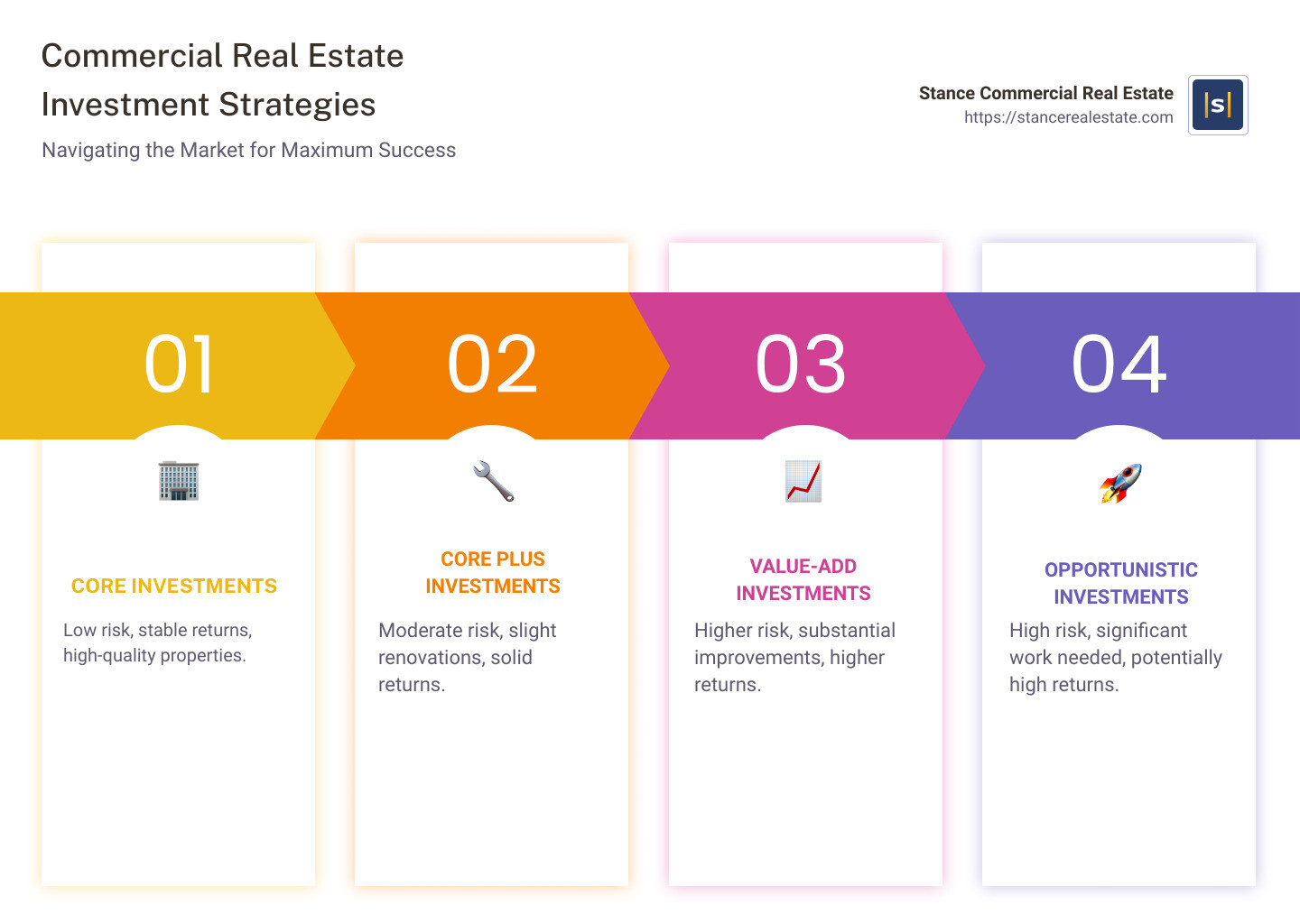
Types of Real Estate Investment
When it comes to investing in real estate, there are several avenues you can explore. Each type of investment offers unique opportunities and challenges.
Here is a breakdown of the most popular types of real estate investment:
Commercial Real Estate
Commercial real estate involves properties used for business purposes. This includes:
- Office buildings: High-rises, midrises, and single-tenant offices.
- Industrial properties: Warehouses, manufacturing facilities, and distribution centers.
- Retail spaces: Shopping centers, strip malls, and standalone stores.
- Multifamily units: Apartment complexes and other residential buildings with five or more units.
Commercial real estate is popular because it often offers longer leases and higher rental returns compared to residential properties. However, it requires significant capital and is more complex to manage.
Raw Land
Raw land investment involves purchasing undeveloped land. Investors can:
- Develop the land: Build residential or commercial properties.
- Hold for appreciation: Wait for the land value to increase and sell at a profit.
This type of investment requires a keen understanding of zoning laws, market trends, and development potential. It is high-risk but can yield substantial returns.
Real Estate Investment Trusts (REITs)
REITs are companies that own, operate, or finance income-producing real estate. They allow investors to:
- Buy shares: Similar to stocks, providing a way to invest in large-scale properties without directly owning them.
- Earn dividends: REITs are required to distribute at least 90% of taxable income to shareholders.
REITs offer liquidity and diversification, making them attractive for those who want to invest in real estate without the hassles of property management.
Crowdfunding
Real estate crowdfunding platforms allow multiple investors to pool their money to invest in properties that would be out of reach individually. This method:
- Democratizes investment: Allows non-institutional investors access to high-value properties.
- Offers diversification: Invest in various properties with smaller amounts of capital.
However, crowdfunding can be riskier and often involves lockup periods where your investment is illiquid.
Residential Real Estate
Residential real estate involves properties like single-family homes, condos, and townhouses. Investors can:
- Rent out properties: Generate monthly rental income.
- Flip houses: Buy, renovate, and sell for a profit.
Residential real estate is generally more accessible to individual investors and can be less risky compared to commercial properties. However, it requires active management, especially if you are handling tenant issues and maintenance.
Each type of real estate investment has its own risk and return profile. Choosing the right one depends on your financial goals, risk tolerance, and investment horizon.
Understanding Commercial Real Estate Investment Strategies
When it comes to commercial real estate investment strategies, there are four main approaches: Core, Core Plus, Value-Add, and Opportunistic. Each strategy has its own risk and return profile, catering to different investor needs and objectives.
Core Investment Strategy
Core investing is the safest form of commercial real estate investment. It involves acquiring high-quality, well-located properties, often referred to as Class A buildings. These assets are typically found in prime locations and feature low vacancy rates. The primary goal here is to generate stable revenue.
- Risk Profile: Low
- Returns: Typically below 10%
- Characteristics: Prime locations, high-quality buildings, low vacancies
Example: Think of a Class A office building in downtown New York City. These properties maintain their value well and attract high-quality tenants who sign long-term leases. This makes them resilient even in unfavorable market conditions.
Core Plus Investment Strategy
Core Plus investing is similar to Core but with a bit more risk and potential for higher returns. This strategy involves acquiring mostly stable buildings that might need some minor renovations or have tenant vacancies.
- Risk Profile: Low to moderate
- Returns: Typically between 10-14%
- Characteristics: Stable assets with potential for revenue-boosting improvements
Example: Imagine a slightly older office building in a good location that needs some updates or has a few vacant units. By renovating these units or improving common areas, the property can attract higher-paying tenants and increase overall returns.
Value-Add Investment Strategy
Value-Add investing is for those willing to take on more risk for potentially higher rewards. This strategy focuses on properties that need significant improvements or repositioning.
- Risk Profile: Moderate
- Returns: Typically between 15-19%
- Characteristics: Distressed properties needing capital investment
Example: A distressed shopping mall that requires extensive renovations to attract new tenants. Over a period of 5-7 years, investors can stabilize the asset and sell it for a substantial profit. This strategy is popular because it offers a cost-effective entry into major markets.
Opportunistic Investment Strategy
Opportunistic investing is the highest risk but offers the greatest potential returns. This strategy involves properties that need substantial investment to become profitable.
- Risk Profile: High
- Returns: Potentially exceeding 20%
- Characteristics: Extensive renovations or new developments
Example: Picture a dilapidated warehouse that can be converted into a modern office space. Such investments often go through periods of little to no income and are considered high liability. However, the potential for returns over 20% makes them attractive to certain investors.
Understanding these strategies helps investors align their financial goals with the right risk-return balance.
Key Factors for Successful Commercial Real Estate Investing
Diversification
Diversification is a cornerstone of successful commercial real estate investing. By spreading investments across different property types and geographical locations, you can reduce risk and increase potential returns. Think of it like not putting all your eggs in one basket.
Property Types: Consider investing in multifamily, industrial, retail, and office properties. Each type reacts differently to economic cycles. For example, industrial properties like warehouses have thrived with the rise of e-commerce, while retail spaces may face challenges during economic downturns.
Geographies: Spread your investments across various regions to mitigate local market risks. A downturn in one area might be balanced by growth in another. For instance, investing in both urban and suburban locations can provide stability.
Risk Reduction: By diversifying, you can protect your portfolio from significant losses. If one property type or location underperforms, others might perform well, balancing your overall returns.
Market Research
Market research is essential for making informed investment decisions. Understanding economic trends, demographic shifts, and local market conditions can help you identify promising opportunities and avoid costly mistakes.
Economic Trends: Keep an eye on broader economic indicators like GDP growth, employment rates, and interest rates. These factors can impact property values and rental demand.
Demographic Shifts: Analyze population trends. For example, an aging population might increase demand for senior living housing, while a growing tech industry could boost demand for office spaces in tech hubs.
Local Market Conditions: Investigate local factors such as zoning laws, infrastructure developments, and neighborhood dynamics. A property in a developing area with new transport links might offer significant appreciation potential.
Technology Utilization
Leveraging technology can streamline your investment process and provide a competitive edge. Real estate investment software, data-driven analysis, and deal management tools can enhance decision-making and efficiency.
Real Estate Investment Software: Tools like property management software can help track expenses, manage leases, and monitor property performance.
Data-Driven Analysis: Use analytics to evaluate market trends, property values, and rental rates. This can help you identify undervalued properties and forecast future performance.
Deal Management Software: Platforms that facilitate deal tracking and document management can save time and reduce errors, making the investment process smoother.
Networking
Building a strong network is invaluable in commercial real estate investing. Connections with industry professionals can provide insights, opportunities, and partnerships that might not be available otherwise.
Industry Connections: Attend industry events, join real estate investment groups, and connect with brokers, property managers, and other investors. These relationships can offer insider knowledge and potential deals.
Partnerships: Collaborating with other investors can pool resources and share risks. Joint ventures can be particularly useful for large projects that might be too costly or complex to undertake alone.
Adaptation
The real estate market is dynamic, and successful investors must adapt to changing conditions. Staying informed about market changes, regulatory updates, and economic cycles is crucial.
Market Changes: Keep abreast of shifts in supply and demand, technological advancements, and consumer preferences. For example, the rise of remote work has increased demand for flexible office spaces.
Regulatory Updates: Stay updated on zoning laws, tax regulations, and environmental policies. Compliance is essential to avoid legal issues and fines.
Economic Cycles: Understand how different stages of the economic cycle affect property values and rental demand. During a recession, for instance, demand for luxury office spaces might decline, while affordable housing could see increased demand.
By focusing on these key factors—diversification, market research, technology utilization, networking, and adaptation—you can navigate the complexities of commercial real estate investing and set yourself up for long-term success.
How to Choose the Right Commercial Real Estate Investment Strategy
Choosing the right commercial real estate investment strategy means understanding your risk tolerance, investment goals, time horizon, and the type of property you want to invest in.
Assessing Risk Tolerance
Your risk tolerance is a key factor in deciding which investment strategy to use. Here is a quick breakdown:
- Core Strategy: Low risk, stable revenue, and prime locations. Ideal for investors who want steady income with minimal risk. Returns are usually below 10%.
- Core Plus Strategy: Low to moderate risk. Involves improving mostly stable buildings to boost revenue. Returns range from 10-14%.
- Value-Add Strategy: Moderate risk. Focuses on properties needing capital investment and improvements. Returns typically between 15-19%.
- Opportunistic Strategy: High risk, involving substantial investment to turn properties profitable. Potential returns can exceed 20%.
Defining Investment Goals
What do you want to achieve with your investment? Your goals will help determine the best strategy.
- Income Generation: If you want regular income, core or core plus strategies might be best. These focus on stable properties with reliable tenants.
- Capital Appreciation: Looking for growth in property value? Value-add and opportunistic strategies focus on improving and selling properties for a profit.
- Portfolio Diversification: Mixing different types of properties and strategies can reduce risk and increase opportunities for returns.
Determining Time Horizon
Your investment timeline will also influence your strategy choice.
- Short-Term: Opportunistic strategies can offer high returns quickly but come with high risk.
- Medium-Term: Value-add strategies often require 5-7 years to improve and sell properties.
- Long-Term: Core and core plus strategies are more stable and can provide consistent income over many years.
Selecting Property Type
The type of property you invest in will depend on your risk tolerance, goals, and time horizon.
- Multifamily: Often seen as a safer bet due to constant demand for housing.
- Industrial: High demand due to e-commerce growth. Suitable for investors looking at long-term stable returns.
- Retail: Can be risky due to the "Amazon effect," but e-commerce-resistant options like grocery stores can be profitable.
- Office: Trends in remote work are changing this market. Look for properties with modern amenities and sustainability features.
By aligning your risk tolerance, investment goals, time horizon, and property type, you can choose the right commercial real estate investment strategy to meet your needs.
Frequently Asked Questions about Commercial Real Estate Investment Strategies
What are the CRE investment strategies?
Commercial real estate (CRE) investment strategies can be categorized into four main types: core, core-plus, value-added, and opportunistic.
- Core: This strategy focuses on low-risk investments in high-quality, fully leased properties in prime locations. These buildings, often class A, generate stable revenue with minimal need for active management or capital improvements.
- Core-Plus: Slightly riskier than core investments, core-plus strategies involve properties that are mostly stable but may require some renovations or filling tenant vacancies. These investments typically offer returns of 10-14%.
- Value-Added: This strategy targets properties that need significant improvements or repositioning. Investors take on moderate risk, aiming for returns of 15-19% by enhancing the property’s value through renovations or improved management.
- Opportunistic: The highest-risk strategy, opportunistic investments involve properties that need substantial redevelopment or are in distress. These projects can yield returns exceeding 20% but require significant capital and come with higher uncertainty.
What is a good ROI for commercial real estate investment?
A good return on investment (ROI) for commercial real estate varies based on the strategy, property type, and market conditions. Generally, investors aim for an ROI of 8-10%.
- Core investments might yield modest returns of 4-6%, reflecting their low-risk nature.
- Core-Plus strategies offer returns around 10-14%.
- Value-Added investments target 15-19%.
- Opportunistic deals can exceed 20% returns, but with higher risk.
Factors like location, property type, and market dynamics significantly influence ROI.
How do investors make money in commercial real estate?
Investors make money in commercial real estate through property appreciation and tenant rents.
- Property Appreciation: As market conditions improve, the value of the property increases. This can result from favorable economic trends, strategic property enhancements, or rising demand in the area. For instance, buying a property in a growing market like Riverside, CA, and selling it later at a higher price can generate significant returns.
- Tenant Rents: Consistent rental income is a primary revenue stream. High occupancy rates and long-term leases with reliable tenants ensure steady cash flow. Effective lease optimization, such as passing on certain costs to tenants or negotiating rent escalations, can also enhance rental income.
By understanding and leveraging these strategies, investors can maximize their returns and build a robust commercial real estate portfolio.
Conclusion
In summary, mastering commercial real estate investment requires a blend of strategic planning, market knowledge, and a tailored approach to risk and reward. From core investments offering stability to opportunistic strategies promising high returns, understanding the nuances of each commercial real estate investment strategy can significantly impact your success.
At Stance Commercial Real Estate, we pride ourselves on our deep local expertise and commitment to service excellence. Our team is not just familiar with Riverside; we live and work here, giving us unparalleled insight into the market. This local knowledge allows us to offer you the best advice and support, ensuring that your investments align with your goals and thrive in this vibrant community.
Riverside, CA, offers a unique blend of historical charm and modern opportunity, making it a prime location for commercial real estate investment. Whether you are looking to buy, sell, or lease, our hands-on approach ensures that you are not just investing in property but also in a community that suits your business needs.
Let us guide you through the complexities of commercial real estate investment. Our goal at Stance Commercial Real Estate is to provide a seamless experience from start to finish, handling the details so you can focus on what you do best—running your business.
Discover how we can help you capitalize on the opportunities in Riverside’s dynamic market. Learn more about our services and start your investment journey with a team that knows Riverside best.
By choosing Stance Commercial Real Estate, you are selecting a partner dedicated to your success with unmatched local insight. Let us help you navigate the exciting landscape of commercial real estate in Riverside.

Navigating the Complexities of Commercial Building Ownership
Why Understanding Commercial Buildings is Important
Owning a commercial building can be a lucrative investment. However, navigating through its complexities is no small feat. If you're looking for a quick answer on what a commercial building entails, here it is:
A commercial building is a property used for business activities, such as offices, retail stores, warehouses, and multifamily apartments.
Now, let's dive in deeper.
Choosing the right commercial building is critical for your business growth and financial health. Location, building condition, and zoning laws are just a few of the essential elements to consider. Whether you're leasing or buying, understanding these aspects can help you make a well-informed decision and maximize your investment returns. Riverside's dynamic market, for example, offers unique opportunities and challenges that can significantly impact your business.
I'm Joe Stance, founder of Stance Commercial Real Estate. With over ten years in the commercial real estate industry, I've guided countless businesses through the complexities of buying, leasing, and managing commercial properties. My experience ensures that you get the best advice and services tailored to your needs.
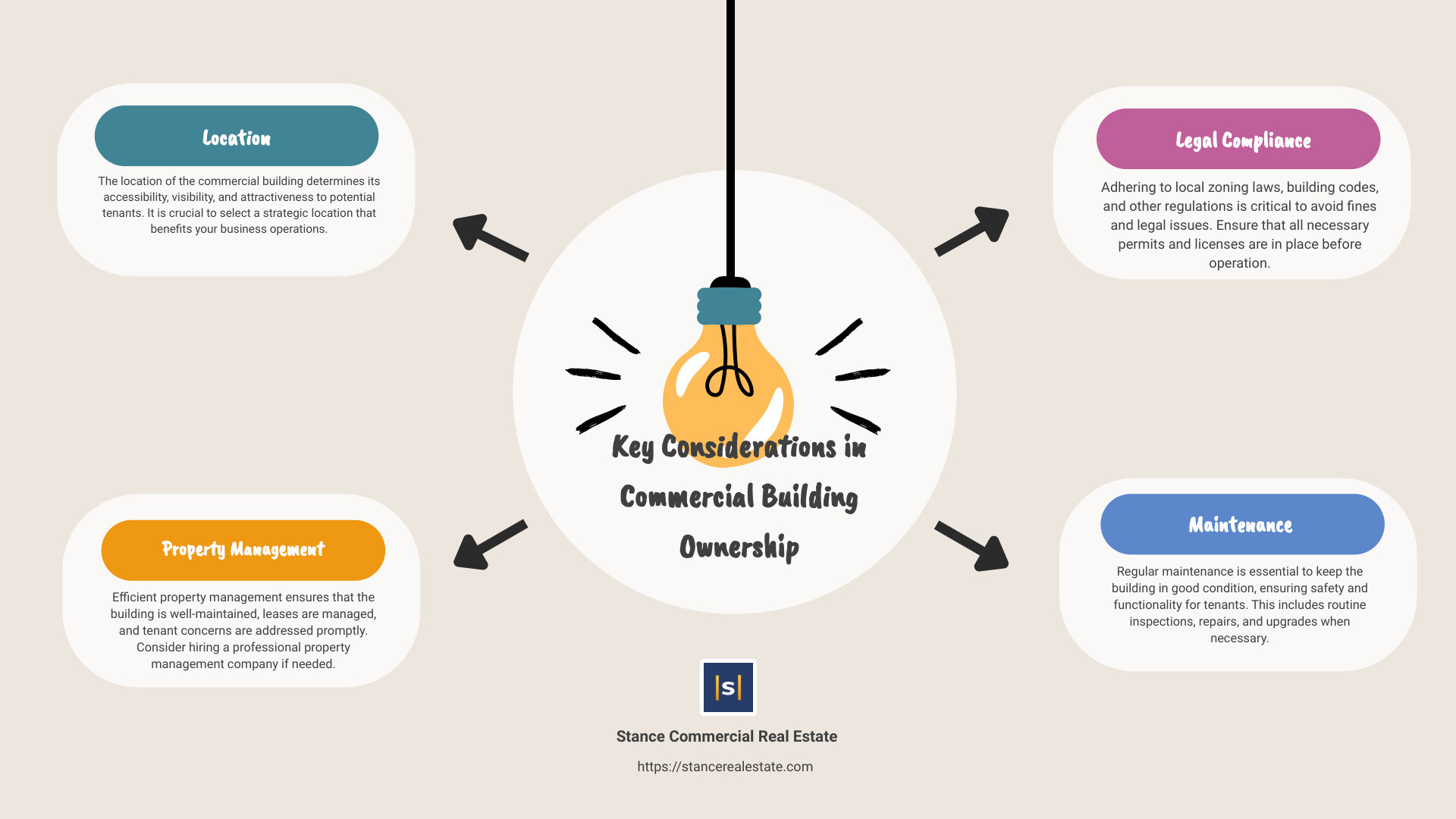
Understanding Commercial Building Types
When it comes to commercial buildings, understanding the different types is crucial. Each type has unique features, benefits, and challenges. Here, we'll break down the main categories: Office, Retail, Industrial, Multi-Family, and Mixed-Use.
Office Buildings
Office buildings are designed for business use. They range from small, single-tenant offices to large skyscrapers.
- Class A: These are the top-tier buildings. They are new, in prime locations, and have high-quality finishes. They attract high-quality tenants and command the highest rents.
- Class B: These buildings are a step down from Class A. They are older or in less desirable locations but still offer good quality and lower rents.
- Class C: These are the oldest buildings, often in need of major renovations. They are usually in less attractive areas and have higher vacancy rates.
Retail Spaces
Retail spaces are where businesses sell goods or services to consumers. They come in various forms:
- Standalone Stores: These are individual buildings occupied by a single tenant.
- Strip Malls: These are clusters of stores with shared parking.
- Shopping Centers: Larger complexes that may include big-box stores, restaurants, and entertainment facilities.
Retail properties are designed to maximize foot traffic and visibility. For example, retail spaces in Riverside, CA, are known for their vibrant commercial activity.
Industrial Properties
Industrial properties are used for manufacturing, storage, and distribution. They include:
- Warehouses: Large spaces for storage and distribution.
- Manufacturing Plants: Facilities where products are made.
- Flex Spaces: Buildings that can be used for multiple purposes, such as office and industrial.
These properties are often located near major transport routes to enhance logistical efficiency. For instance, 1975 Rt 309 in South Whitehall, PA, is a prime industrial property with excellent transport access.
Multi-Family Buildings
Multi-family buildings are residential properties with five or more units. They include:
- Apartment Complexes: Large buildings with multiple rental units.
- Condos: Similar to apartments but typically owned individually rather than rented.
Multi-family properties offer stable revenue streams, especially in growing areas. For example, 960-966 Hamilton St in Allentown, PA, is a notable multi-family property.
Mixed-Use Complexes
Mixed-use complexes blend residential, commercial, and sometimes industrial spaces in one location. These properties cater to a trend towards integrated living and working spaces. They are popular in urban areas where space is at a premium.
Mixed-use developments offer several advantages, such as diversified income streams and higher occupancy rates. They are ideal for investors looking for a blend of residential and commercial opportunities.
By understanding these different types of commercial buildings, you can better navigate the complexities of commercial real estate and make informed investment decisions.

Next, we'll dive into the key considerations in commercial building ownership to help you further understand what it takes to succeed in this field.
Key Considerations in Commercial Building Ownership
Owning a commercial building can be a lucrative investment, but it comes with its own set of challenges. Here's a breakdown of key considerations to keep in mind:
Location
Location is crucial in commercial real estate. A prime location can attract high-quality tenants and command higher rents. For example, properties like 2428 Walbert Avenue in South Whitehall boast exceptional visibility to over 20,000 vehicles per day (VPD), making them highly desirable.
Consider the following when evaluating a location:
- Traffic Flow: High visibility can lead to higher foot traffic.
- Accessibility: Easy access to highways and public transportation can be a huge plus.
- Demographics: Ensure the location suits the target market for your tenants.
Property Management
Good property management is essential for maintaining the value of your investment. Poor management can lead to high vacancy rates and deteriorating property conditions.
Key aspects of property management include:
- Tenant Relations: Building a good rapport with tenants can result in longer leases and fewer vacancies.
- Maintenance: Regular upkeep prevents small issues from becoming costly repairs.
- Financial Management: Keeping accurate financial records is crucial for tax purposes and understanding your return on investment (ROI).
Legal Compliance
Navigating the legal landscape is a must for any commercial property owner. Failure to comply with local, state, and federal regulations can result in hefty fines and legal issues.
Important areas to consider:
- Zoning Laws: Ensure the property is zoned for its intended use.
- Building Codes: Regular inspections can help you stay compliant with safety regulations.
- Lease Agreements: Draft clear and enforceable lease agreements to protect your interests.
Maintenance
Regular maintenance is key to preserving the value of your property. A well-maintained building attracts and retains tenants, reducing vacancy rates and increasing ROI.
Areas to focus on:
- Routine Inspections: Regularly check for issues like plumbing leaks, electrical problems, and structural damage.
- Upgrades: Consider upgrades that can improve energy efficiency and reduce long-term costs.
- Emergency Repairs: Have a plan in place for handling urgent repairs to minimize disruption for tenants.
By paying close attention to these key considerations, you can navigate the complexities of owning a commercial building and set yourself up for long-term success.
Next, let's explore the financial aspects of owning a commercial building to understand the investment potential and financing options available.
Financial Aspects of Owning a Commercial Building
When it comes to owning a commercial building, understanding the financial aspects is crucial. Let's break down some key topics: investment potential, cap rates, off-market deals, and financing options.
Investment Potential
Commercial buildings can be a lucrative investment. They often appreciate over time, offering both rental income and capital gains. For example, if you buy a property for $2.5 million and sell it two years later for $2.8 million, you would have a capital gain of $300,000.
Rental Income: Owning a commercial property allows you to earn rental income. If you're not using all the space, you can lease it to other businesses. This provides a steady cash flow, which can help offset mortgage payments and other expenses.
Tax Breaks: You can also benefit from tax deductions for mortgage interest and annual depreciation. These deductions can significantly reduce your taxable income, making the investment even more attractive.
Cap Rates
Cap rate, or capitalization rate, is a key metric in commercial real estate. It helps you understand the potential return on your investment.
Formula: Cap Rate = Net Operating Income (NOI) / Purchase Price
For example, if a building generates $100,000 in annual net income and costs $1 million, the cap rate is 10%. A higher cap rate generally indicates a higher return, but also higher risk.
Off-Market Deals
Off-market deals are properties not listed publicly. They can offer unique opportunities for savvy investors. These deals often come with less competition and can be negotiated more flexibly.
Finding Off-Market Deals: Networking is key. Building relationships with brokers, property managers, and other investors can help you find these hidden gems.
Financing Options
Financing a commercial building can be complex, but there are several options available:
- Traditional Loans: Banks offer commercial real estate loans, but they often require a down payment of 20-35%.
- SBA Loans: Small Business Administration (SBA) loans are a great option for owner-users. They usually require only a 10% down payment.
- Private Lenders: These lenders offer more flexible terms but at higher interest rates.
- REITs: Real Estate Investment Trusts (REITs) allow you to invest in commercial properties without owning them directly. This is a good option for those looking for less hands-on involvement.
Down Payments: Be prepared for a significant upfront cost. Down payments typically range from 15-30% of the purchase price. For example, a $1 million property might require $150,000 to $300,000 upfront.
Liabilities: Owning a commercial property comes with responsibilities. You’ll need liability insurance to protect against lawsuits and property damage.
By understanding these financial aspects, you can make informed decisions and maximize the return on your investment in a commercial building.
Next, we'll dive into the challenges and solutions in commercial real estate to help you navigate tenant management, market fluctuations, and more.
Challenges and Solutions in Commercial Real Estate
Owning a commercial building can be rewarding, but it comes with its own set of challenges. Here’s how to navigate some common issues:
Tenant Management
Managing tenants can be tricky. Tenant turnover is higher in commercial properties compared to residential ones. Each business has unique needs, which can lead to costly refurbishments.
Solution: Qualify tenants by examining their credit and financial history. This minimizes the risk of lease breaches. A commercial real estate expert can help assess a tenant’s past financials and leasing history. This ensures you attract reputable and creditworthy tenants.
Building Upgrades
Each tenant may require different modifications to the space, leading to high renovation costs.
Solution: Negotiate tenant improvements upfront. Discuss who will handle the renovations and the costs involved. Ensure you understand the terms, like whether you need to repay the improvement allowance if you end the lease early.
Market Fluctuations
Market conditions can change rapidly, affecting property values and rental income. The 2008 recession and the COVID-19 pandemic are prime examples of how external factors can impact the commercial real estate market.
Solution: Diversify your investment portfolio. Combining both commercial and residential investments can provide more stability. Stay informed about market trends and be prepared to adapt your strategy as needed.
Environmental Regulations
Environmental regulations are becoming stricter. Commercial buildings are responsible for a significant portion of energy usage and CO2 emissions.
Solution: Invest in sustainable building practices. This can lead to long-term cost savings and higher profitability. Green-certified buildings can attract tenants looking for environmentally conscious spaces, and you may benefit from lower-cost financing and tax benefits.
By understanding these challenges and implementing the right solutions, you can navigate the complexities of owning a commercial building more effectively. Next, we’ll answer some frequently asked questions about commercial buildings.
Frequently Asked Questions about Commercial Buildings
What is the meaning of commercial building?
A commercial building is any structure used for business activities. This includes office buildings, retail spaces, warehouses, and more. These buildings are designed to generate income, either through renting out space to businesses or by being used directly for business operations.
What is a general commercial building?
A general commercial building is a versatile structure that can accommodate various types of businesses. Examples include office buildings, shopping centers, and mixed-use properties that combine retail, office, and sometimes residential spaces. These buildings often feature flexible layouts to suit different tenant needs.
How does commercial real estate investment compare to residential?
Investing in commercial real estate can offer higher returns and consistent cash flow compared to residential properties. However, it also comes with more complexities and risks.
Here are some key differences:
- Income Potential: Commercial properties often generate higher rental income. For instance, a multi-family residential property can provide steady income from multiple tenants.
- Financing: Commercial loans typically require larger down payments (15%-30%) and more stringent approval processes than residential loans.
- Management: Managing a commercial property can be more demanding. You'll need to handle multiple tenants, comply with stricter regulations, and maintain larger facilities.
- Risk: Commercial real estate can be affected by economic downturns, leading to higher vacancy rates. However, it can also offer better protection against inflation.
Overall, commercial real estate can be a lucrative investment, but it requires careful planning and management.
Conclusion
Owning a commercial building is not just about having a piece of property; it's about creating a long-term strategy for success.
Long-term Strategy
When it comes to commercial real estate, long-term planning is key. This means:
- Focusing on Location: A prime location can increase property value and attract quality tenants. For example, properties in areas with high visibility and traffic, like those along Hamilton Street in Allentown, PA, tend to do well.
- Regular Maintenance: Keeping your property in good condition not only maintains its value but also keeps tenants happy and reduces turnover.
- Adapting to Market Trends: Stay informed about market changes. For instance, retail properties have shown resilience, with only a 1.39% decline compared to the overall 8.39% fall in commercial real estate from Q4 2022 to Q3 2023.
- Financial Planning: Understand your financing options and plan for potential economic downturns. Having a solid financial strategy can help you weather market fluctuations.
Stance Commercial Real Estate
At Stance Commercial Real Estate, we understand the complexities of owning a commercial building. Our team is equipped with extensive industry experience and in-depth local market knowledge. We work hard to simplify the process at every step, ensuring you make confident decisions.
We use advanced technology to stay organized and efficient, making your experience as smooth as possible. Our goal is to help you succeed in your commercial real estate endeavors.
For more information on how we can assist you, visit our services page.
Owning a commercial building is a significant investment, but with the right strategy and support, it can be highly rewarding. Let us help you navigate the complexities and achieve your real estate goals.

Navigating the Commercial Landscape of Southwest Riverside County
If you're looking at navigating the commercial real estate market in Southwest Riverside County, you're stepping into a dynamic arena. Amidst this constantly evolving landscape, businesses and investors find both opportunities and challenges. With a local economic climate boosted by diverse industries and strategic positioning near major transportation routes, this area is attracting heightened interest from commercial real estate segments.
Southwest Riverside County has seen robust growth, characterized by a broad spectrum of property types including retail spaces, office buildings, industrial sites, and vacant land poised for development. Key trends indicating this growth include rising demands for industrial spaces due to increased e-commerce activity and a noticeable uptick in office spaces as businesses expand or relocate from densely populated urban centers to more suburban locales.
The commercial real estate market here is not only abundant with opportunities but also complexities related to zoning, permits, and evolving market conditions. For local business owners and investors, understanding these facets is crucial to making informed decisions that align with both current needs and future growth.
Understanding Zoning and Permits in Southwest Riverside County
When diving into commercial real estate in Southwest Riverside County, grasp the fundamentals of zoning, permits, and the legal framework that governs these processes. This knowledge is key to navigating the complexities of real estate investment and development in this region.
Zoning: What You Need to Know
Zoning laws in Southwest Riverside County are designed to segment the region into districts, each designated for specific uses such as residential, commercial, or industrial. These laws influence what type of buildings can be constructed and the activities that can occur in these zones. For instance, a property zoned for industrial use cannot be used for a retail business without re-zoning or obtaining a variance.
The main types of zones you'll encounter include:
- Commercial (C): For shops, offices, and other commercial ventures.
- Industrial (I): For manufacturing, warehouses, and distribution centers.
- Residential (R): Primarily for homes and apartments.
Understanding the zoning of a property is crucial because it affects the valuation and potential uses of the property.
Permits: Navigating the Approval Process
Obtaining the right permits is another critical step in the development process. Permits ensure that your project complies with local building codes, safety laws, and environmental regulations. Here’s a simplified overview of the permitting process:
1. Pre-application: Before submitting your application, it's advisable to meet with a planner at the local planning department. They can provide guidance on the necessary steps and the likelihood of project approval.
2. Application Submission: Submit detailed plans and documents that outline your project. This typically includes site plans, architectural designs, and environmental impact assessments.
3. Review Process: Your application will undergo several reviews, including zoning, environmental, and building safety checks.
4. Public Hearing: For larger projects, a public hearing might be required to consider the views of community members.
5. Approval or Denial: If your application meets all requirements, it will be approved. Otherwise, you may need to make modifications or appeal the decision.
Legalities: Ensuring Compliance
Legal considerations in commercial real estate involve more than just adhering to zoning and permit regulations. It's about understanding lease agreements, property rights, and potential disputes. Here are some legal aspects to consider:
- Lease Agreements: Whether you're a landlord or a tenant, a well-drafted lease agreement is essential to outline the rights and responsibilities of each party.
- Property Rights: These include rights related to the ownership, development, and use of the property.
- Dispute Resolution: In case of disputes over property use, lease terms, or compliance with zoning laws, legal intervention may be required to resolve these issues.
Navigating the zoning and permit processes in Southwest Riverside County requires a thorough understanding of local laws and regulations. For investors and business owners, it’s advisable to consult with legal and real estate professionals to ensure that all aspects of your commercial real estate ventures are compliant and strategically sound. This foundational knowledge not only aids in making informed decisions but also streamlines the development process, leading to successful real estate projects in this dynamic region.
Key Areas for Commercial Real Estate Investment in Southwest Riverside County
Southwest Riverside County is a thriving hub for commercial real estate investment, with Temecula, Perris, and Palm Springs standing out as key areas. Each city offers unique opportunities and challenges that attract a diverse range of investors and businesses.
Temecula
Temecula is renowned for its picturesque vineyards and burgeoning wine industry, but its commercial real estate market extends far beyond. With a robust local economy, Temecula presents lucrative opportunities in retail, hospitality, and office spaces. The city's strategic location near major highways enhances its attractiveness for distribution and logistics companies. Investors are particularly drawn to the potential for developing or enhancing properties to cater to the tourism and service industries, capitalizing on the steady influx of visitors to the area.
Perris
Moving to Perris, this area is rapidly growing with a focus on industrial and manufacturing sectors. The development of large-scale industrial parks and proximity to transportation corridors like Interstate 215 make it a prime location for warehousing and distribution centers. The city's commitment to expanding its infrastructure supports long-term growth and sustainability, making it an appealing option for businesses looking to scale operations in a strategically located environment.
Palm Springs
Lastly, Palm Springs offers a unique blend of retail, hospitality, and residential developments. Known for its midcentury modern architecture and as a resort destination, Palm Springs continues to attract a high volume of tourists year-round. This makes it a hotspot for investing in boutique hotels, luxury resorts, and entertainment venues. The city's vibrant arts scene and cultural festivals provide additional commercial avenues to explore, particularly in the arts, entertainment, and recreation sectors.
Each of these areas within Southwest Riverside County showcases distinct characteristics that make them attractive for specific types of commercial real estate investments. Whether it's the industrial potential of Perris, the tourist-driven market of Palm Springs, or the mixed-use developments in Temecula, investors can find diverse opportunities tailored to their strategic goals.
Navigating the zoning and permit processes in Southwest Riverside County requires a thorough understanding of local laws and regulations. For investors and business owners, it’s advisable to consult with legal and real estate professionals to ensure that all aspects of your commercial real estate ventures are compliant and strategically sound. This foundational knowledge not only aids in making informed decisions but also streamlines the development process, leading to successful real estate projects in this dynamic region.
Types of Commercial Properties Available in Southwest Riverside County
Southwest Riverside County offers a diverse range of commercial real estate options to suit various business needs and investment strategies. Here, you can find everything from retail spaces and office buildings to industrial facilities and vacant land ready for development. Let's explore the types of properties available in this vibrant region.
Retail Spaces
Retail properties in Southwest Riverside County cater to a wide array of businesses, from small boutiques to large shopping centers. High traffic areas such as main streets in Temecula or near the Promenade Mall are particularly attractive for retail operations looking to capitalize on the area's growing population and tourism. Retail spaces here are designed to provide maximum visibility and accessibility to customers, enhancing the shopping experience and increasing foot traffic for businesses.
Office Buildings
The demand for office space in Southwest Riverside County has been steadily increasing, driven by the growth of local businesses and the influx of companies seeking more cost-effective alternatives to the pricier markets of nearby metropolitan areas. Office properties range from small, single-tenant buildings to large, multi-story office complexes with advanced amenities. These spaces often offer flexible floor plans, allowing businesses to create a customized work environment that fosters productivity and collaboration.
Industrial Facilities
Industrial real estate in Southwest Riverside County is robust, with a variety of properties available, including warehouses, manufacturing facilities, and distribution centers. The proximity to major transportation routes like Interstate 215 makes the region an ideal location for companies that require efficient logistics and distribution capabilities. Industrial properties here are equipped with features such as high ceilings, large loading docks, and ample parking, making them suitable for a range of industrial activities.
Land
For those interested in building from the ground up, there is ample undeveloped land available in Southwest Riverside County. This offers a unique opportunity for custom developments, whether for commercial, industrial, or mixed-use projects. Investing in land allows for a high degree of customization, ensuring that the final development precisely meets the specific needs of a business or investment objective.
Each type of property in Southwest Riverside County presents unique opportunities and considerations. Whether you are looking to open a retail store, expand your office, operate an industrial facility, or develop land, the region offers a wealth of options to support your endeavors. With its strategic location, growing economy, and diverse real estate options, Southwest Riverside County continues to be a smart choice for commercial real estate investors and business owners alike.
Commercial Real Estate Southwest Riverside County: Opportunities and Challenges
Southwest Riverside County is a burgeoning hub for commercial real estate investment. This region, encompassing vibrant cities like Temecula, Perris, and Palm Springs, offers a dynamic blend of growth, infrastructure development, and evolving regulations. Let's explore these aspects to better understand the landscape.
Growth
The economic landscape of Southwest Riverside County is marked by robust growth. This region has seen a significant influx of both businesses and residents, driven by its affordability compared to neighboring areas like Los Angeles and San Diego. The Inland Empire, including Riverside, has a thriving industrial and retail sector, which continues to expand as businesses seek more space and lower costs. This growth is not only attracting new investors but also creating new opportunities in commercial sectors.
Infrastructure
Infrastructure development is a key driver of commercial real estate opportunities. Southwest Riverside County is experiencing substantial enhancements in transportation and utilities, which facilitate easier access and operational efficiency for businesses. Major highways and improved public transit options make it simpler for employees to commute and for goods to be transported, enhancing the appeal of the region for commercial operations.
Regulations
Navigating the regulatory environment is crucial for success in commercial real estate. Southwest Riverside County has business-friendly policies that encourage development, but investors must stay informed about local zoning laws and building codes. For instance, specific areas are designated for different types of commercial activities, and understanding these zoning restrictions is essential for selecting the right property and planning development projects.
Investors and developers must also consider environmental regulations, which can affect building projects, especially in areas close to natural habitats or agricultural land. Staying compliant with these rules not only ensures legal operations but also promotes sustainable development practices.
Each of these factors — growth, infrastructure, and regulations — plays a significant role in shaping the commercial real estate landscape in Southwest Riverside County. By understanding these dynamics, investors can better position themselves to capitalize on the opportunities and navigate the challenges that come with commercial real estate investments in this region.
Moving forward, it's important to keep a close eye on how these elements evolve to adapt strategies accordingly and maximize the potential of your real estate ventures in this promising area.
Navigating Legal Considerations for Commercial Real Estate in Southwest Riverside County
When stepping into commercial real estate in Southwest Riverside County, understanding the legal landscape is crucial. This section covers essential topics like zoning changes, permits, and legal challenges that you may face.
Zoning Changes
Zoning laws dictate how a property can be used, and they vary widely across different areas within Southwest Riverside County. For instance, a parcel zoned for industrial use cannot be developed for residential use without a change in zoning, which involves approval from local authorities. Keeping up-to-date with zoning changes is vital because these can significantly impact your investment. For example, a shift from industrial to mixed-use zoning can increase a property's value due to its newfound versatility.
Permits
Securing the correct permits is another critical step in commercial real estate development. Whether it's building new structures or modifying existing ones, each activity requires specific permits from the local government. Delays in obtaining these permits can lead to stalled projects and increased costs. It's advisable to engage with experts who understand the local permitting process to streamline your developments. For instance, projects like the development of the Class A industrial buildings in Perris must comply with strict building codes and safety standards, requiring multiple permits before construction can commence.
Legal Challenges
Legal challenges in commercial real estate often arise from contract disputes, zoning issues, or compliance with local regulations. An example is when a property does not meet environmental standards and requires remediation work, which can be costly and time-consuming. Additionally, disputes with tenants over lease terms or with contractors over construction issues are not uncommon. Having a robust legal strategy and expert legal counsel can help mitigate these risks.
By staying informed about zoning laws, understanding the permitting process, and preparing for potential legal disputes, you can navigate the complexities of commercial real estate in Southwest Riverside County more effectively. This proactive approach will enable you to address issues swiftly and maintain the momentum of your real estate projects, ensuring that each venture not only complies with all legal requirements but also moves forward without unnecessary hindrances.
Let's explore some of the most frequently asked questions about commercial real estate in this region to further clarify your understanding and prepare you for successful investments.
Frequently Asked Questions about Commercial Real Estate in Southwest Riverside County
Navigating the realm of commercial real estate in Southwest Riverside County can be complex. Here, we address some common questions that help demystify aspects of commercial property investments in this area.
Can I live in a commercial property in California?
In California, living in a commercial property is generally not permitted unless the property is zoned for mixed-use or includes specific residential units. These zoning regulations ensure that each area is used according to planned guidelines, which can include commercial, residential, or a combination of both. If you're considering a property for both living and business purposes, look for mixed-use properties or consult with local zoning authorities to explore possible re-zoning or use exceptions.
What are the best areas for commercial real estate in Southwest Riverside County?
Southwest Riverside County offers several key areas that are prime for commercial real estate investments:
- Temecula: Known for its vibrant wine country and growing retail and hospitality sectors, Temecula is a hotspot for tourists and local commerce.
- Perris: With its strategic location near major transportation routes like Interstate 215, Perris is ideal for industrial and distribution centers.
- Palm Springs: A perennial favorite for its tourism and hospitality industries, offering opportunities in retail, entertainment, and leisure properties.
These areas not only provide diverse opportunities but are also supported by local economic development efforts that enhance their attractiveness to investors and businesses.
How do zoning laws affect commercial real estate in Southwest Riverside County?
Zoning laws play a crucial role in shaping the development and use of properties in Southwest Riverside County. These laws determine what types of buildings and businesses can operate in certain areas. For instance, industrial zoning permits activities related to manufacturing and warehousing, while office zoning is for business and professional uses.
Understanding the zoning laws is essential for investors to ensure that the intended use of a property is allowable under local regulations. Misjudging zoning can lead to costly legal challenges or restrictions in property use, which is why it’s important to conduct thorough due diligence or work with knowledgeable local experts like those at Stance Commercial Real Estate.
Remember that each commercial real estate endeavor in Southwest Riverside County is unique. With the right knowledge and resources, you can navigate these waters successfully, unlocking the potential of each property investment.
Conclusion
In the intricate world of commercial real estate in Southwest Riverside County, navigating the landscape requires not just knowledge but a deep understanding of local dynamics. This is where Stance Commercial Real Estate stands out. Our roots in the community, combined with our extensive experience, equip us to offer unparalleled insights and services tailored specifically to this region.
Local Expertise: At Stance Commercial Real Estate, we are more than just brokers; we are part of the fabric of Riverside. This intimate local knowledge allows us to provide unique insights that are crucial for making informed investment decisions. Whether you are looking to invest in retail spaces, offices, or industrial properties, our team ensures that you have the latest and most relevant information at your disposal. Our expertise is especially critical in navigating the complexities of zoning laws and the changing commercial landscape.
Future Outlook: Looking ahead, the prospects for commercial real estate in Southwest Riverside County are promising. With the area's continuous growth and development, opportunities for investors and businesses are expanding. Infrastructure improvements and a thriving local economy make this region a hotspot for commercial investments. At Stance Commercial Real Estate, we are excited about the future and are committed to helping our clients thrive in this dynamic environment.
We invite you to explore how investing in Riverside's opportunity zones can benefit your portfolio. Let us guide you through the complexities of commercial real estate with the assurance that comes from having a dedicated local expert by your side. Learn more about our investment services and how we can help you succeed.
Each commercial real estate journey in Southwest Riverside County holds unique promise. With Stance Commercial Real Estate, you gain a partner who is not just in the business, but a part of the community. Together, let's unlock the potential of your next property investment, ensuring it not only meets but exceeds your expectations.